Advertisement
Advertisement

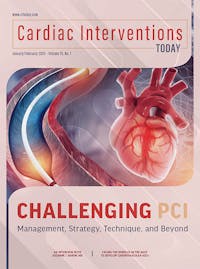
The field of percutaneous coronary intervention (PCI) is always evolving, with the constant introduction of novel technologies and techniques entering the space. Thus, it is our great challenge as interventional cardiologists to continue to develop with the field; shed old tools, techniques, and practice patterns; and pick up new ones to better serve our patients. In this edition of Cardiac Interventions Today, we will explore evolving technologies and innovative techniques in some of the most challenging scenarios and discuss ways we as operators can continue to grow in clinical practice.
Our issue begins with an exploration into how artificial intelligence can enhance lesion assessment, integrate functional assessments, and optimize clinical decision-making in coronary interventions, with an article by Ahmed Elamin, MBBS; Hany Eissa, MBBCh; Mohammed O A. Abubakr, MBBS; Ryan Moran, MBBS; Gabor G. Toth, MD; and Sadeek S. Kanoun Schnur, MBBCh.
We move on to a discussion of a commonly faced challenge: managing elderly patients with complex coronary disease. Eric Rothstein, MD, and Hannah Chaudry, MD, highlight a patient-centered approach to managing, counseling, and treating geriatric patients with complex coronary disease, ensuring optimal individualized outcomes for this population.
In further coverage of challenging PCI, we discuss an algorithmic, target-driven approach to in-stent restenosis management. Audrey Ready, DO; Jesse Kane, MD; and Kevin J. Croce, MD, provide practical insights into managing this unique patient subset.
A thorough understanding of challenging PCI should include a review of the strategies that can facilitate the delivery of equipment and stents across complex coronary lesions. Dantwan Smith, MD; Thomas Koshy, MD; and Salman S. Allana, MD, provide their expertise on “getting the stent to deliver.”
When it comes to chronic total occlusions (CTOs), there has been significant evolution over the past decade with regard to technique, dedicated algorithms, and approaches. However, Anna Subramaniam, MD, and Jasleen Tiwana, MD, share with us how these techniques can also be applied in non-CTO lesions.
We close our coverage of challenging PCI with personal insights from Jarrod D. Frizzell, MD, on his experiences in dealing with the learning curve and aiming for lifelong improvement when developing a complex PCI skill set in clinical practice.
Elsewhere in this issue, our Today’s Practice article by Ginger Biesbrock, DSc, explores hurdles in the race to develop cardiovascular ASCs. With a focus on careful planning, technology investment, and patient safety, cardiovascular ambulatory surgery centers can revolutionize how cardiovascular care is delivered.
Closing this issue is a conversation with Suzanne J. Baron, MD, on health care economics, the importance of integrating patient-reported outcomes into clinical practice and research, steps to improving the representation of females in clinical trials, and more.
We as interventional cardiologists are challenged with a dynamic and changing world of complex patients and coronary anatomy, as well as novel tools with varying efficacy. However, we are also gifted with the ever-expanding opportunity to provide better care to our patients. It is our hope that this issue provides practical treatment strategies that can be used in your catheterization lab today and insights into where your practice can be headed in the future. We are grateful to you the reader for your time as we continue to grow as a community together.
Jesse A. Kane, MD, FACC, SCAI
Guest Chief Medical Editor
Advertisement
Advertisement