Advertisement
Advertisement
January/February 2025
CTO Techniques in Non-CTO Cases
Improving guide support and wiring difficult lesions.
Chronic total occlusion (CTO) techniques have evolved significantly over the past decade, with dedicated algorithms and approaches leading to improved success rates. Although these techniques are often used in the context of CTO percutaneous coronary intervention (PCI), they provide a valuable skill set that translates to non-CTO lesions as well (Figure 1). This article reviews techniques for improving guide support and wiring difficult lesions, providing operators with an expanded tool set for complex coronary interventions.
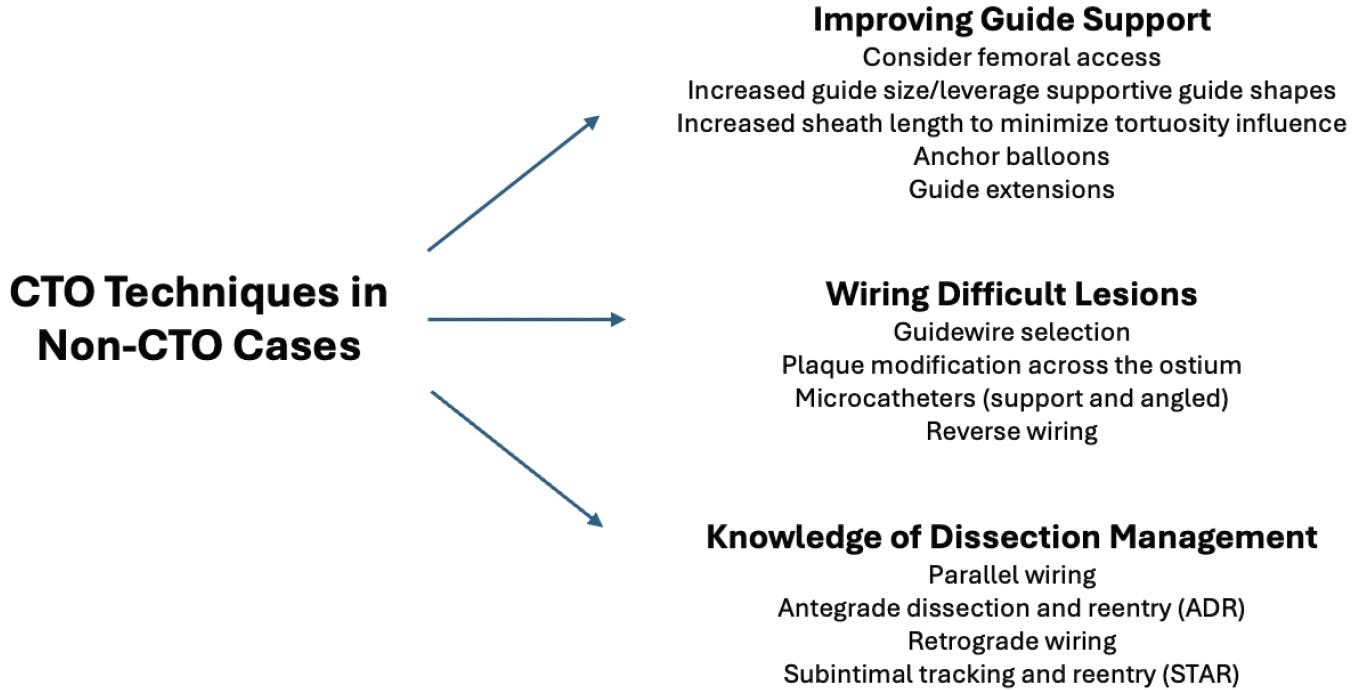
Figure 1. CTO techniques in non-CTO cases.
INCREASING GUIDE SUPPORT
Access and Sheath Selection
Dual access is often considered a staple of CTO PCI, but it highlights the key importance of both radial and femoral access and large-bore sheaths in complex cases. Radial access can be sufficient for many coronary interventions. However, tortuosity through the subclavian artery and smaller-caliber radial arteries introduces challenges to adequate guide support. Longer sheaths can be employed to decrease the effects of tortuosity and improve support, and transitioning to a femoral approach can allow for larger guides and decreased tortuosity. Long, 8-F sheaths via a femoral approach often provide excellent support for complex interventions. The use of meticulous ultrasound-guided femoral access and micropuncture technique can minimize the risk of vascular complications and therefore should be skills that all operators are familiar with.1
Guide Catheter Selection
The foundation of successful crossing lies in optimal guide catheter support.2 Both passive and active guide support can be required for particularly challenging lesions that may be difficult to wire and cross with gear after wiring. Passive support refers to the inherent properties of the guide, including the guide size, shape, and length. For most PCIs, 6-F guides remain the standard, but lesions that are difficult to wire and cross often benefit from 7- or 8-F guides when anatomically feasible. Use of more supportive shapes, such as an Amplatz left for the right coronary artery and an extra backup guide for the left main coronary artery, can be considered. Depending on the root anatomy, wider aortic roots require guides with extra length between the primary and secondary curve to adequately seat a guide. Active guide support refers to intermittent deep seating of guides by managing the torque and forward advancement of a guide within the ostia. These techniques require vigilance for signs of guide catheter dampening and, therefore, ischemia, with active engagement and disengagement often employed.
Alternative Techniques to Improve Guide Support
Two additional tools for improving guide support include balloon anchoring and guide extensions. Balloon anchoring requires inflation of a balloon in a side branch to anchor the guide in place. The balloon is sized 1:1, and gentle traction can be applied to the shaft of the balloon to maintain guide engagement while wiring or advancing gear within the main branch. Notably, ballooning may end up traumatizing the side branch, and therefore this technique is best used in coronaries where the side branch may have already been stented or is diseased and will require stenting regardless of trauma. It could also prove useful in a small, inconsequential side branch.
Guide extensions provide an additional avenue for improving guide support. These extensions are advanced deep into the coronary to extend passive support from the guide. Coaxial advancement of guide extensions is necessary to prevent proximal vessel trauma. There are three predominant techniques for advancing guide extensions. The first technique involves gentle forward advancement, generally over a wire with other gear in place (microcatheter or balloon). This technique is best used when there is minimal proximal vessel tortuosity and disease. In the setting of proximal tortuosity and disease, inflated balloons can be used to maintain coaxial alignment while advancing the guide extension. The “inchworm” technique involves inflating a balloon just distal to the tip of the guide extension and advancing the guide extension while deflating the balloon. The anchoring technique involves inflation of a balloon sized 1:1 with the distal vessel with inflation used to anchor it in place. The guide extension is then advanced with additional traction on the balloon as required to maintain coaxial engagement. Notably, deep engagement of guide extensions can result in ischemia and therefore requires evaluation of hemodynamics with cuff pressures and vigilance for ST changes and ischemic symptoms. Intermittent advancement and retraction of the guide extension may be necessary to balance ischemia and support.
DIFFICULT-TO-WIRE LESIONS
Guidewire Selection
The selection and understanding of guidewires are critical to successful wiring of challenging lesions. When initial attempts with a workhorse wire prove unsuccessful, wire escalation can be considered. A common wire escalation may be to a low-tip-load, polymer-jacketed guidewire, with or without a tapered tip (Table 1).3 Polymer-jacketed wires decrease resistance for guidewire advancement and are designed to track along the path of least resistance. They are less likely to exit the vessel architecture and cause perforation when compared with nonpolymer-jacketed wires.4 However, they may exit at the distal end of a coronary, and therefore distal wire perforations are still possible. Nonpolymer-jacketed wires with higher tip loads can offer penetration power and can be used when there is a clear understanding of the vessel course, but these wires may exit the vessel architecture, and following these wires with devices such as microcatheters should be undertaken after confirming the distal wire position within the vessel architecture. A recent analysis of the PROGRESS-CTO registry has shown that nonpolymer-jacketed wires are associated with lower rates of technical success and higher rates of perforation.4 Wire selection is largely based on individual operator preference, but we typically use low- to intermediate-tip-load, nontapered, polymer-jacketed wires such as the Sion Black (Asahi Intecc), Gladius Mongo (Asahi Intecc), and Pilot 200 (Abbott) for antegrade wire escalation.
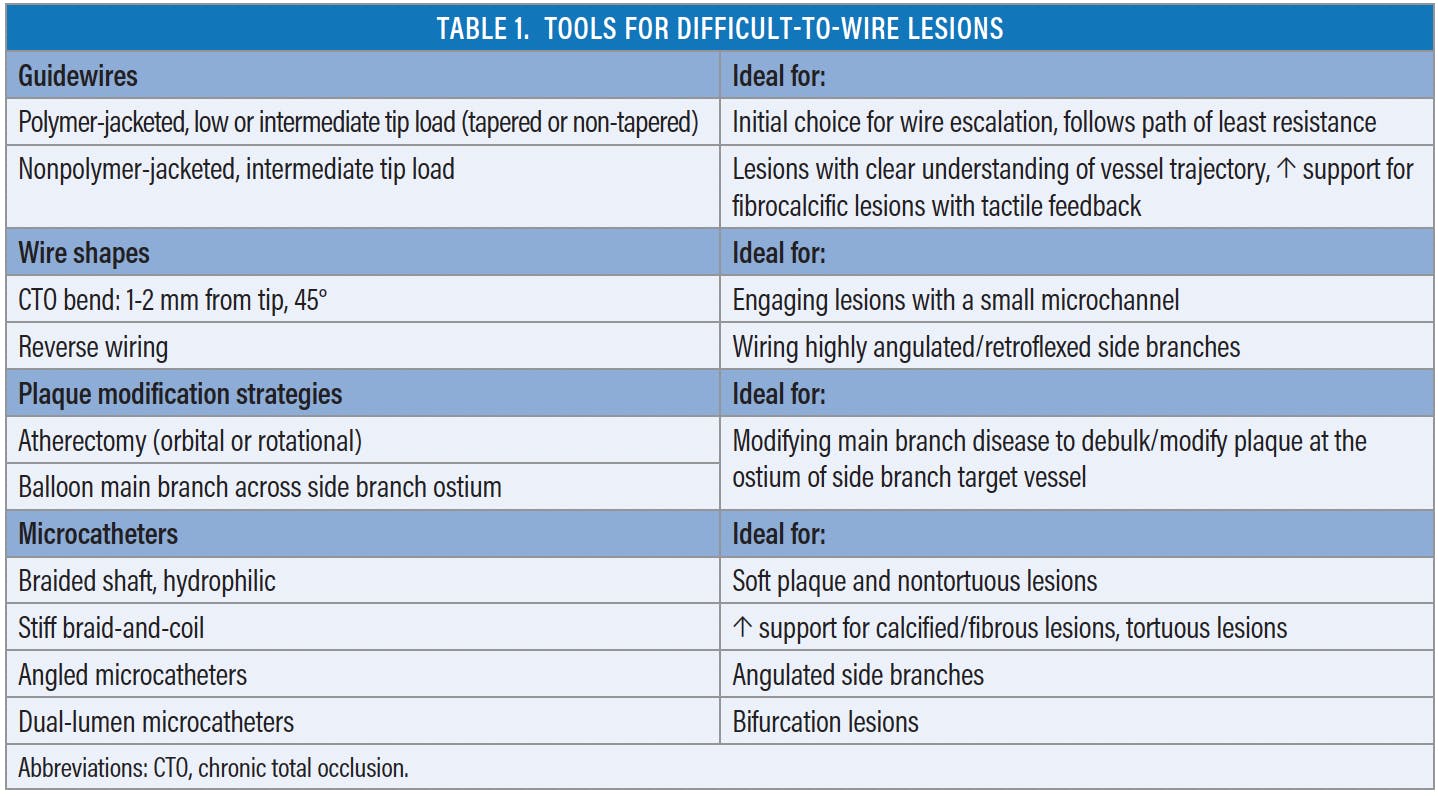
Wire shape can also facilitate successful crossing in challenging lesions.5 Instead of a standard bend, a “CTO bend” can be useful to traverse small-channel crossing. The first bend is 1 to 2 mm from the tip with an angle of 45°, which facilitates progression into the lesion. A second bend 3 to 5 mm from the tip at 15° to 20° may enhance steerability and provide greater reach toward a side branch. Lastly, specialized techniques such as the reverse wiring technique may also be beneficial for wiring a highly angulated side branch, as has been previously described in detail.6
Plaque Modification
Strategies to modify plaque across the proximal portion of a lesion can be employed if wiring into the vessel proves challenging. This is best done when the desired vessel of entry is a side branch. If the main branch has significant calcific disease, the use of atherectomy (rotational or orbital) may be helpful to debulk the area surrounding the ostium of the side branch, with subsequent attempts to wire the branch. Similarly, shifting plaque by ballooning the main branch across the ostium could be employed. This may change the angle of entry required to wire the side branch enough such that subsequent wiring attempts may be successful. This should be approached with caution as there is a risk of vessel closure; therefore, it should be employed after other wiring strategies have failed.
Microcatheters
Microcatheters can also assist the wiring process, both to support and direct the wire and to facilitate wire exchange for escalation or de-escalation.7 A microcatheter is advanced over a wire in close proximity to the lesion and provides support as the operator attempts to cross. The closer the tip of the microcatheter to the tip of the guidewire, the higher the penetration power of the guidewire. If the wire requires reshaping or exchange, the microcatheter can be left in place to maintain position within the vessel. Microcatheter selection can be guided by lesion characteristics. In many cases, braided-shaft, hydrophilic microcatheters such as the FineCross (Terumo Interventional Systems) and Caravel (Asahi Intecc) are appropriate in difficult-to-wire lesions. Stiffer lesions that are difficult to cross may benefit from a stiffer braid-and-coil–designed microcatheter, including the Corsair Pro (Asahi Intecc) and Turnpike Spiral (Teleflex), which can allow for force transmission through torque and greater trackability through tortuosity. Lesions that cannot be wired due to angulation may benefit from angled microcatheters such as a SuperCross (Teleflex), which comes with 45°, 90°, or 120° angled tips. An angled microcatheter often needs to be paired with a soft, low-tip-load wire to maintain the distal bend of the microcatheter, given that stiffer wires may straighten the bend. If an angled microcatheter is used, it can be delivered slightly distal to the lesion over a wire, followed by wire and microcatheter retraction until the microcatheter is angled toward the side branch followed by gentle advancement of the coronary wire. Finally, when wiring bifurcation lesions, dual-lumen microcatheters such as the Sasuke (Asahi Intecc) and Twin-Pass Torque (Teleflex) can be used to gain access to a side or main branch depending on which is wired first.
Once the lesion has been crossed, the operator must understand the wire’s location before advancing the microcatheter. If the wire has inadvertently exited the vessel, following with a microcatheter can cause perforation. If the operator is uncertain of the wire position, angiography can be employed to confirm distal wire position. After the microcatheter has been advanced into the distal vessel, the wire should be exchanged and de-escalated to a workhorse wire to avoid distal wire perforation.
DIFFICULT-TO-WIRE LESIONS: CORONARY DISSECTION
Attempting to wire a difficult-to-cross lesion can result in coronary dissection. There are algorithmic solutions to managing a coronary dissection without a wire across the lesion.8 The first step involves assessing the patient to determine if ongoing attempts are necessary to open the vessel. Specifically, in a situation where the patient is hemodynamically stable, without ischemic electrocardiographic changes and a relatively small territory supplied by the vessel, it may be more prudent to stop wiring attempts and allow the vessel to heal. The patient could subsequently be referred to an alternative operator or center with expertise in CTO PCI. If the patient requires ongoing attempts to open the vessel, familiarity with CTO techniques will be particularly useful. Additional wiring attempts can be made, but ideally with a nonpolymer-jacketed wire given greater tactile feedback of nonjacketed wires. Parallel wiring or intravascular ultrasound–guided wiring can be initially attempted. These may be more fruitful if gear has not already been advanced over a wire in the subintimal space (eg, a microcatheter or balloon). If these wiring attempts are unsuccessful, ADR (antegrade dissection and reentry) may be tried. Device-based reentry systems, such the Stingray LP (Boston Scientific Corporation), may be used to attempt targeted reentry, keeping in mind that visualization of the dissected distal vessel may be limited, and therefore ADR may be particularly challenging in this setting, requiring the use of the “stick and swap” technique. A dedicated discussion of ADR is beyond the scope of this article but has been previously well described.9 If ADR is unsuccessful, retrograde wiring and retrograde dissection-based reentry can be pursued. An example of using the retrograde approach to rescue a dissected, acutely occluded vessel has been described by Wilgenhof et al.10 If the antegrade wire position is not believed to be critical, then the same access site can be used to evaluate for retrograde options, with secondary access obtained only in the setting of successful retrograde wiring from the initial primary access. Otherwise, up-front secondary access can facilitate visualization of the retrograde options. If retrograde wiring is unachievable, then STAR (subintimal tracking and reentry) can serve as a bailout option. STAR is performed with a low-tip-load, polymer-jacketed wire like the Gladius Mongo or Fielder XT (Asahi Intecc) to allow a small knuckle to travel within the subintimal space. The wire is shaped into a U-shaped or umbrella bend and advanced through a microcatheter positioned within the subintimal space. When the wire exits the microcatheter, it should take on the U-shaped bend (knuckle), advance through the subintimal space, and shrink and “jump forward” fluoroscopically when it has reentered the distal true lumen. If the knuckle unfurls after initially exiting the microcatheter as a U-bend, this indicates exit out of the distal end of a branch and should not be followed with additional gear. If coronary revascularization is not achieved through percutaneous methods and the patient clinically warrants further attempts at revascularization, emergent coronary artery bypass grafting (CABG) can be considered. Lastly, depending on the stability of the patient, with full assessment of their candidacy and risks/benefits of emergent CABG, a final option of employing mechanical circulatory support to support the patient while they sustain a myocardial infarction may be reasonable.
CONCLUSION
The systematic application of CTO techniques to difficult non-CTO lesions can significantly improve procedural success while maintaining safety. Appropriate guide selection, use of microcatheters and wire escalation, and familiarity with bailout strategies are essential to success in such lesions. A structured approach incorporating these advanced techniques can be part of every operator’s skill set.
1. Seto AH, Abu-Fadel MS, Sparling JM, et al. Real-time ultrasound guidance facilitates femoral arterial access and reduces vascular complications: FAUST (Femoral Arterial Access with Ultrasound Trial). JACC Cardiovasc Interv. 2010;3:751-758. doi: 10.1016/j.jcin.2010.04.015
2. Elrayes MM, Xenogiannis I, Nikolakopoulos I, et al. An algorithmic approach to balloon-uncrossable coronary lesions. Cathet Cardiovasc Interv. 2021;97:E817-E825. doi: 10.1002/ccd.29215
3. Masoomi R, Moscardelli S, Hirai T, Azzalini L. Antegrade techniques for chronic total occlusion percutaneous coronary intervention. Prog Cardiovasc Dis. Published online July 18, 2024. doi: 10.1016/j.pcad.2024.07.001
4. Alexandrou M, Rempakos A, Mutlu D, et al. Comparative analysis of polymer versus non-polymer jacketed wires in chronic total occlusion percutaneous coronary intervention. Am J Cardiol. 2024;215:10-18. doi: 10.1016/j.amjcard.2024.01.003
5. Novelli L, Sanz-Sanchez J, Gasparini G. Wire escalation and de-escalation techniques in antegrade and retrograde approaches to chronic total occlusion percutaneous coronary interventions. Interv Cardiol. 2024;19. doi: 10.15420/icr.2024.14
6. Filho EM. Reverse wire technique for angulated side branches. Cardiac Interv Today. 2021;15:58-61. https://citoday.com/articles/2021-sept-oct/reverse-wire-technique-for-angulated-side-branches
7. Goel PK, Sahu AK, Kasturi S, et al. Guiding principles for the clinical use and selection of microcatheters in complex coronary interventions. Front Cardiovasc Med. 2022;9:724608. doi: 10.3389/fcvm.2022.724608
8. Doll JA, Hira RS, Kearney KE, et al. Management of percutaneous coronary intervention complications: algorithms from the 2018 and 2019 Seattle Percutaneous Coronary Intervention Complications Conference. Circ Cardiovasc Interv. 2020;13:e008962. doi: 10.1161/CIRCINTERVENTIONS.120.008962
9. Tiwana J, Kane JA, Azzalini L. A step-by-step approach to antegrade dissection and reentry tips on devices, techniques, and troubleshooting. Cardiac Interv Today. 2023;17:36-38. https://citoday.com/articles/2023-july-aug/a-step-by-step-approach-to-antegrade-dissection-and-reentry
10. Wilgenhof A, Zivelonghi C, Budassi S, et al. Chronic total occlusion techniques in non-chronic total occlusion cases, the wealth of a large toolbox. Acta Cardiol. 2021;76:576-580. doi: 10.1080/00015385.2020.1751957
Advertisement
Advertisement