Advertisement
Advertisement
January/February 2025
Developing a Complex PCI Skill Set in Clinical Practice
Creating your own learning curve and lifelong improvement.
Hermann Ebbinghaus was the first to study mental processes through experimentation in the burgeoning field soon known as psychology. The graphs depicted in his groundbreaking work on memory became widely known as “the learning curve.”1 Nowadays, the phrase immediately conjures the image of a steep slope of knowledge rising up, followed by a “plateau of mastery” (Figure 1A).
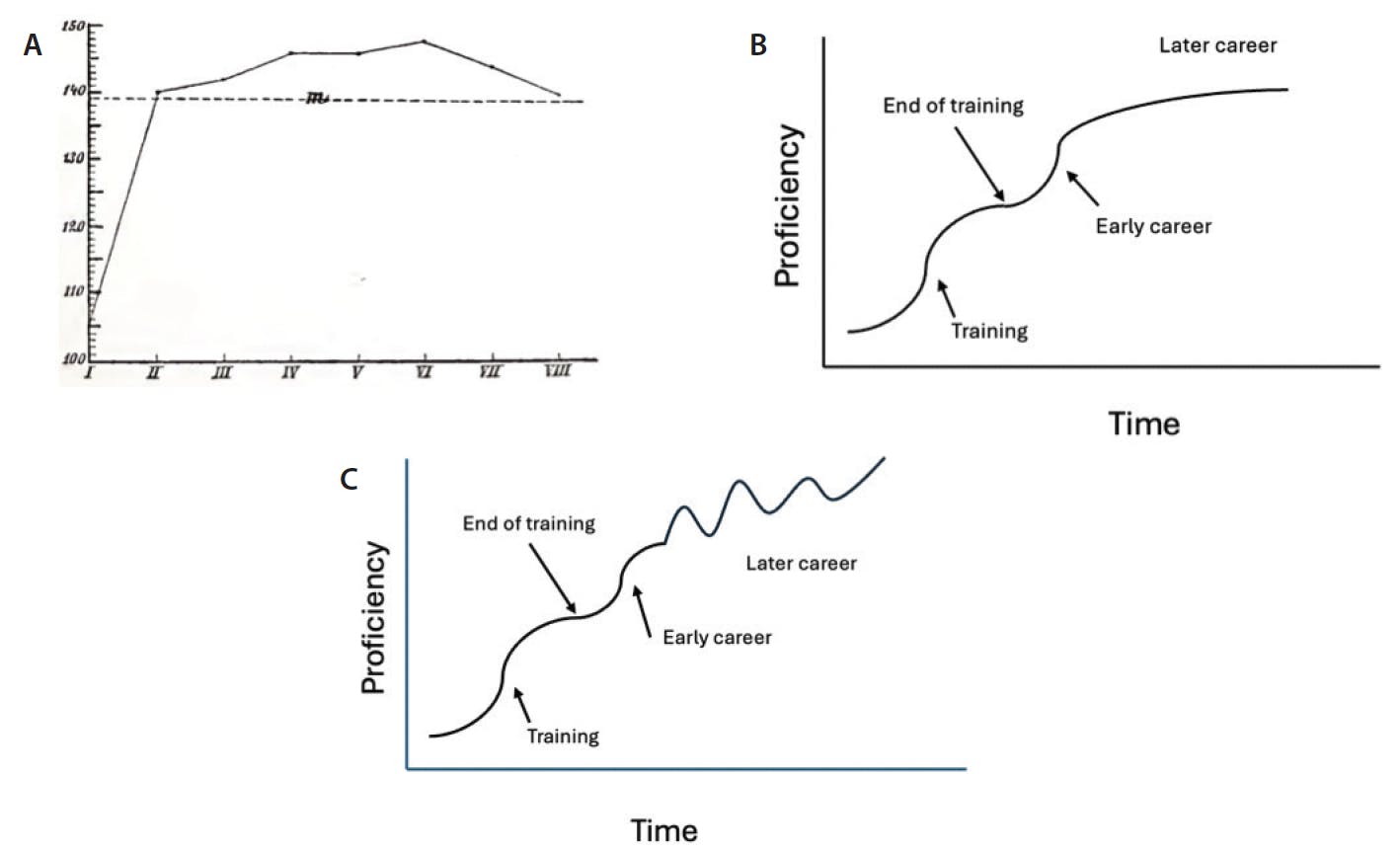
Figure 1. One of many figures from Ebbinghaus, this shows the average time taken for subjects to memorize eight blocks of 13 random syllables (y axis) against number of attempts (x axis) (A). The learning curve of going from training into practice (B). A curve of continued growth and improvement (C). Panel A adapted from Ebbinghaus H. Memory: a contribution to experimental psychology. Teachers College, Columbia University; 1913.
With a long training phase followed by starting practice, the curve for interventional cardiologists (ICs) is shaped differently (Figure 1B). In the first phase, there is the familiar “steep learning curve” as one rapidly gains and integrates new knowledge and technical skills during training for percutaneous coronary intervention (PCI) and other procedures. However, as a new attending physician, one quickly encounters another slope. Finally unburdened by the drudgeries of medical training and entering into a career as an attending physician, there is another world of administrative and clinical burdens. The complexities of dealing with insurance prior authorizations, billing, administrative decisions, schedule management, and other issues are undertaught in training and can be frustrating and stressful. Additionally, there is the challenge of doing procedures on your own, which can be both exhilarating and frightening. If you get into trouble, you are responsible for not only causing the problem but also bailing yourself out (or not) and dealing with the consequences. These consequences can be clinical, as in sequelae from complications or change in strategy, or psychological. Psychological considerations include coping with your role in both healing and harming (if an adverse outcome) and discussion management of the feelings of patients and families. There is likely no one else to credit for success or failure—only you.
A near-universal piece of advice to graduating fellows is targeted toward controlling these latter issues: Keep your head down, work hard, and defer higher-risk or complex cases to senior partners. You will have enough challenges beginning your career, so avoid adding complex cases to the mix, such as bifurcation, unprotected left main (ULM), or chronic total occlusion (CTO). If you choose to do those cases, scrub with an older colleague with a “larger N” and gain from those experiences. Eventually, of course, you should be doing those cases on your own as a mature interventionalist. But does that actually reflect how we learn as interventionalists? How do we get better after formal training?
BUILDING YOUR LEARNING CURVE
Just Do Cases
As a procedural specialty, mastery in interventional cardiology requires the seamless integration of both mental and technical proficiency. As Gilbert Ryle delineated, there are key differences in theoretical and practical knowledge, or “knowledge that” versus “knowledge how.”2 Knowing the physics behind how force transfers from leg to pedal to crankset to chain to wheel is a fundamentally different category than knowing how to ride a bicycle.
Answering correctly on a board exam is quite different from the technical challenge of actually doing the procedure, the “craft” of PCI. Perhaps equipment delivery was challenging in a case. Why not change guides earlier? Would a more supportive wire help, such as a “buddy wire”? What about a guide extension? How about using a balloon to anchor or “inchworm” the guide extension down? There are many techniques to facilitate PCI, with extensive publications detailing algorithms for use (eg, Brilakis,3 who also has an extensive and thorough YouTube channel with illustrations and guides4). While graduating ICs should be able to list off such methods without hesitation, actually appreciating the nuances of how they work and the specific situations in which one or more are most useful is only found with practical knowledge. This can be extended to nearly every aspect of IC procedures.
Actively Review All Your Cases
It is not simply a matter of “the more you do, the better you get.” If one is not conscientious about what they are doing and actively seeking improvement, then one is less likely to actually get better. Although we all fixate on the “misses,” either complications or failures, it is equally important to review the “hits” as well. This is not only because there are often things to learn but also because, frankly, it can be helpful for mental health to remind yourself that you can do good things too, even if imperfect. There is almost always some room for improvement. If you were struggling, what ended up working? Why did it take you so long to try that?
The conjunction of “just do cases” and “review all your cases” can help elucidate your shortcomings, both in knowledge and experience. Reading or watching a video about the anchor balloon technique and then going straight to that technique the next time you use a guide extension is building that “knowledge how.” If you are not comfortable with bifurcation PCI, then when you jail side branches, wire them for practice. “Purposeful practice,” focused on achieving well-defined goals, is far more effective than just accumulation of volume or repetition.5
This experience of discomfort is where the usual advice of case selection for early career ICs falls short. If you do not do the challenging cases, you will not be comfortable when they arise. Practice when you can so you can do it when you must. Part of the learning curve is getting comfortable as your knowledge and experience increases. What it fails to account for is that continuing to grow involves being comfortable with discomfort and leaning into that discomfort to improve. After all, this is how you learned procedures during training; now, you have to do it on your own. There is clearly a dose-response curve for many interventional cardiology procedures, demonstrating a relationship between volume and outcomes. ULM PCI is an example: In the United States the mean operator performs only two per year, and 86% perform less than four per year.6 Only the top 1% of PCI operators in the United States perform ≥ 15 ULM PCI per year, a threshold clearly associated with improved outcomes.7 How are you supposed to get better unless you actually do the cases?
Seeking Help: Peers and Coaching
Forming a peer community to be able to share your triumphs and tragedies is important. Personally, I can divide the entirety of my professional life into before and after the summer of 2022, when happenstance brought together a core group of like-minded young interventionalists at a conference in Seattle. They are now among my best friends and most trusted sounding boards for cases, as well as sharing each other’s lives and laughs. Over time, that circle has widened as friends of friends are brought into the fold. When I get stumped during a case, I now have an extensive list of people to call for help from all over the country. While group text chains can be excellent ways to communicate, we also meet biweekly in virtual meetings to share cases, good and bad, past and upcoming. These connections build resilience and can foster skill development as you are able to progress as a group, instead of individually.
Conferences and breakout sessions can be excellent routes to establishing these connections. Many of us are not natural extroverts, but the importance of overcoming the initial hesitation in introducing yourself, establishing rapport, and exchanging contact information—and following up!—cannot be overstated. It is too easy for us to fall into natural silos of our own institution or training program. However, cross-pollination among styles, cultures, and approaches is key to continued growth and improvement. You do not have to know everyone, you just need to meet someone to get started.
Social media can be used to learn, build community, and give and receive active feedback. Whether on X (formerly Twitter), Threads, TikTok, or even the cardiology-specific Murmur, there are oceans of knowledge—and opinions. However, one should beware of the tendency to post “wins” or have a strong bias toward positive outcomes.8 Personal relationships can certainly form on social media but may not replace or supplant the authenticity of deep personal relationships.
Although seeking out the advice of friends and trusted mentors is important, coaching is underutilized. As a key part of getting better, every month I receive coaching from an experienced leader in complex PCI, who is also well-versed in dealing with hospital leadership and managing personal and professional struggles. We review cases and talk through difficulties to seek solutions. Often these are technical, dealing with identifying the key problem to overcome effectively and efficiently (eg, a CTO PCI). Sometimes we get personal, like dealing with the mental burden of doing higher-risk procedures and the psychological and physical toll such can take on the operator. Coaching may not replace mentorship from those who have helped during training and beyond, but it can be a crucial additive for improvement. Many leaders in IC are affable and approachable, and you have little to lose by going forward and asking questions during and after talks in conferences and meetings. Frankly, structured coaching is lacking within professional societies, but programs such as the Society for Cardiovascular Angiography & Interventions Mentor Connect have potential.
MY CURVE
Due to the combination of personality and the patients seen in my first job out of training, the traditional advice of taking it easy and not seeking out challenging cases did not appeal to me. During fellowship, I purposefully sought out the most challenging coronary cases. I did not like the idea of saying “no” just because the lesion looked hard. These patients were just as symptomatic as those with “type A” lesions, and yet many were treated differently. The shortcomings appeared to be not of the patient but of the treating provider. When I looked around at other providers, the ones that did more challenging cases over time were certainly the exception rather than the rule. Did this not belie the advice of avoiding complex cases initially and then doing more as your skill set improved? What of the skill set gained during fellowship? Fellowships should be geared toward providing the most experience of cutting-edge techniques in a supervised environment. Are those skills “use it or lose it”? What about the patients with significant symptoms and complex coronary disease?
My approach starting out was just as I outlined above: Just do cases, actively review, seek help (Figure 2). I tracked all my cases assiduously. I did not shy away from cases based on anatomy. The indication for revascularization exists prior to the procedure (ie, treat the patient, not the angiogram).9 I started my career in a rural tertiary care hospital. When interviewing, I was forthright in my interest in challenging cases, including CTOs, despite those not being done there. Having trained in the same network, I knew there was an opportunity because those patients were often transferred to the larger hospital, although many refused to travel such a long distance.
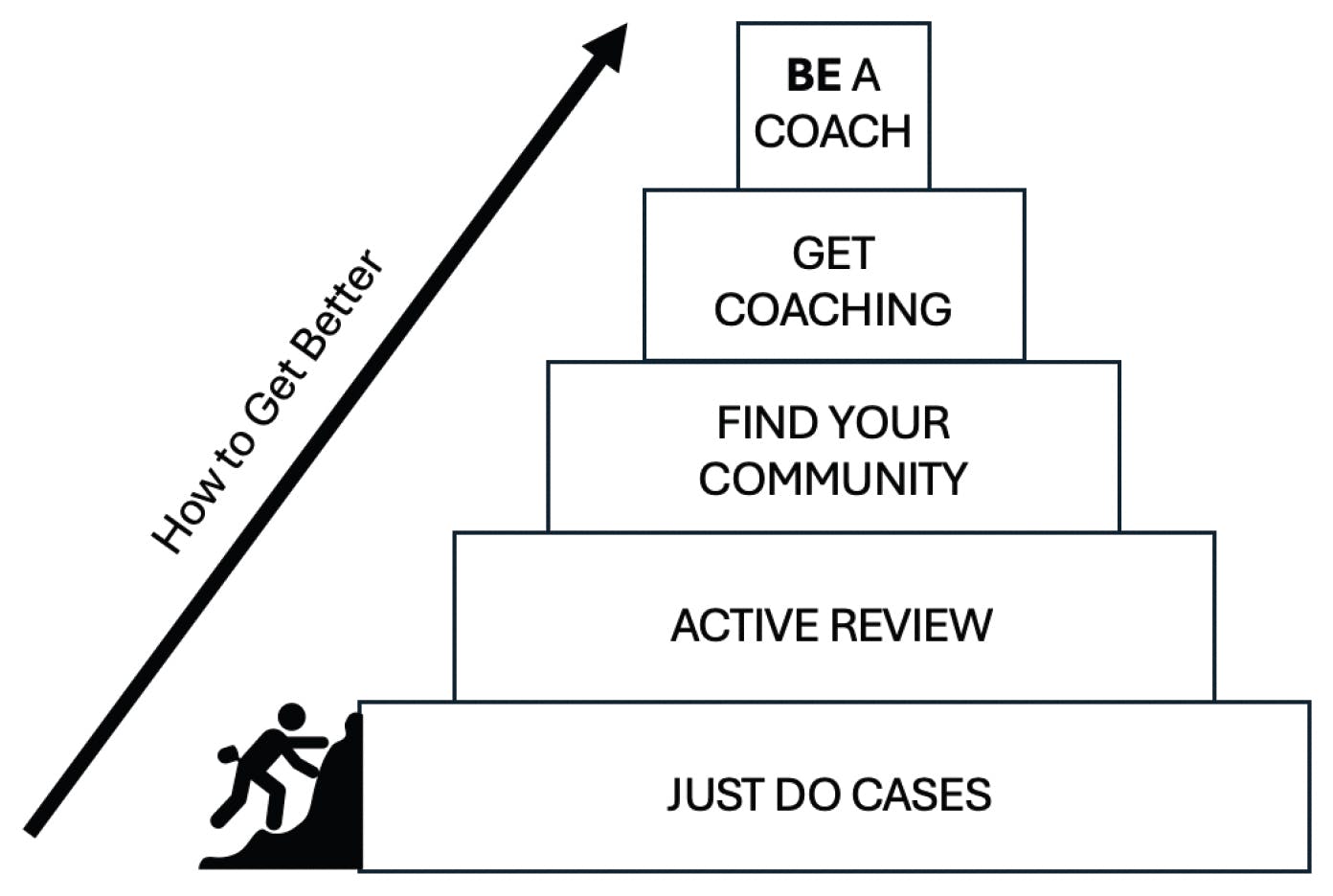
Figure 2. Building your curve.
If something looked particularly challenging, I did not feel obligated to rush in ad hoc during the index procedure. I invited other, more senior colleagues into my cases, but because they themselves had not done many of these procedures, they were not comfortable in an advisory role. Instead, I relied on the advice of my former attendings in fellowship, and I frequently talked through cases and approaches at length in advance, including walking through potential pitfalls and their solutions. Over time, I also developed relationships with others in the broader interventional cardiology community, and those discussions helped me improve tremendously.
CONCLUSION
I am still working on being the best IC I can be. I am far better now than I was several years ago when I started, by any metric. Furthermore, I am much better now than I was even a year ago. I am actively resisting plateauing. Fellowship should be a starting point, not an ending one. Rather than a plateau of mastery, what is described herein is a process of continual improvement, even if sometimes in fits and starts. Trying new things means you probably will not be good initially. My curve (Figure 1C) does not have a plateau but requires active involvement, sustained refinement, and dedication to the craft. As my high school chemistry teacher exhorted, “If you rest on your laurels, you’re wearing them in the wrong place,” so get off them and get going. Focusing on improvement has led to an increasing proportion of complex PCI taking up my practice. As I have gotten better, more complex and higher-risk cases have been referred to me. Doing those cases conscientiously has obviously led to greater mental and technical proficiency. As a consequence, my current practice bears little resemblance to the case mix during fellowship. Although I did not do a separate dedicated year of complex, high-risk, indicated procedures (CHIP fellowship), > 75% of my PCI now involves some combination of LM, CTO, and/or atherectomy. It is not the volume that I do but what I am able to do, using my training as a foundation on which to build.
Importantly, taking these steps can be done well within a typical work week, focusing on work while at work and not taking time away from your loved ones or other pursuits. Just as I try to be the best interventionalist I can be, I also try to be the best husband and father. I may not be at my best every day, but that does not prevent me from trying my best each day.
1. Ebbinghaus H. Memory: a contribution to experimental psychology. Teachers College, Columbia University; 1913.
2. Ryle G. The concept of mind. Hutchinson’s University Library; 1949.
3. Brilakis E. Manual of percutaneous coronary interventions: a step-by-step approach. Academic Press; 2020.
4. @Manosbrilakis. YouTube page. Accessed December 18, 2024. https://www.youtube.com/@manosbrilakis
5. Ericsson A, Pool R. Peak: secrets from the new science of expertise. HarperCollins; 2016.
6. Brindis RG, Dehmer GJ. The volume-outcome relationship revisited: does it matter for high-risk PCI? JACC Cardiovasc Interv. 2016;9:2094-2096. doi: 10.1016/j.jcin.2016.08.033
7. Xu B, Redfors B, Yang Y, et al. Impact of operator experience and volume on outcomes after left main coronary artery percutaneous coronary intervention. JACC Cardiovasc Interv. 2016;9:2086-2093. doi: 10.1016/j.jcin.2016.08.011
8. Gualano SK, Trumpower B, Wanamaker BL, et al. Procedural outcomes on Twitter: too good to be true? EuroIntervention. 2021;17:e1019-e1021. doi: 10.4244/EIJ-D-21-00498
9. Grantham JA. Treat the patient, not the angiogram. Circulation. 2017;135:1382-1384. doi: 10.1161/CIRCULATIONAHA.116.022150
Advertisement
Advertisement