Advertisement
Advertisement
January/February 2025
Getting the Stent to Deliver: Strategies for PCI in Calcified and Tortuous Vessels
Equipment delivery in complex coronary artery interventions.
By Dantwan Smith, MD, MBA, MS; Thomas Koshy, MD; and Salman S. Allana, MD
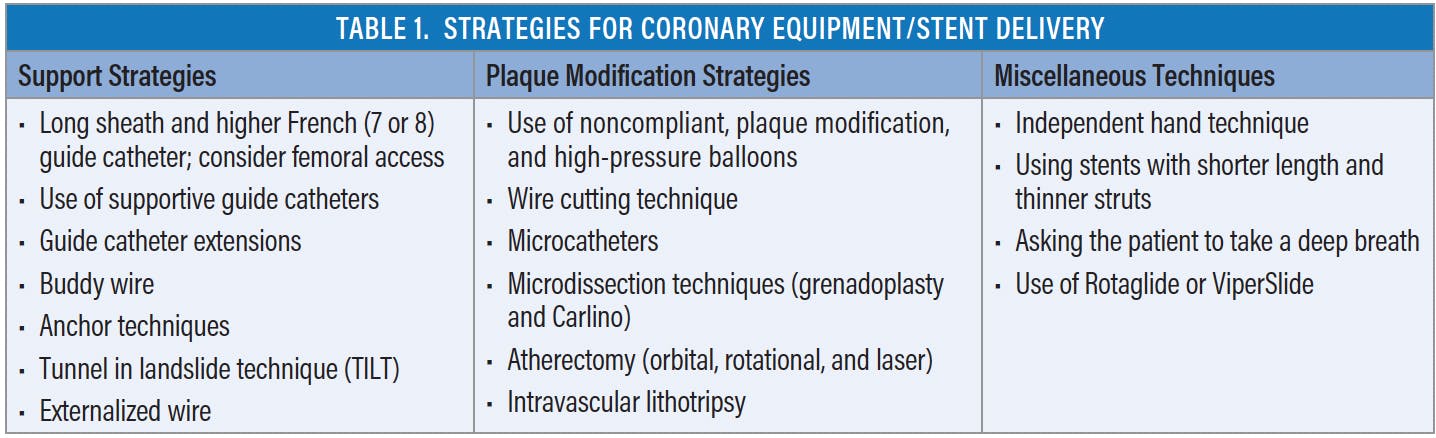
The clinical and anatomic complexity of patients with coronary artery disease (CAD) continues to increase in the United States.1 Percutaneous coronary intervention (PCI) of complex CAD has many different technical challenges due to the associated anatomic factors, which include vessel tortuosity and calcification, chronic total occlusions (CTOs), bifurcation lesions, aorto-ostial lesions, and in-stent occlusions. These factors can make the coronary equipment delivery challenging and can lead to procedural failure or complications. This article reviews the strategies that can facilitate the delivery of equipment and stents across complex coronary lesions (Table 1).
STRATEGIES TO INCREASE SUPPORT
Sheath and Guide Catheter Characteristics
It is extremely important that the selected guide catheter provides a high degree of support. Due to lower complication rates, feasibility, and patient comfort, radial arterial access has become favored over femoral arterial access for most coronary interventions. In most patients, radial access can allow passage of 7- or 7.5-F (sheathless) guide catheters and provide adequate support. A 7- or 8-F supportive guide catheter via femoral arterial access in combination with a long, 45-cm sheath likely provides the best passive support and should be considered for very complex interventions. The use of a larger-sized guide catheter also has its caveats, including higher risk of guide-induced coronary artery dissection and use of higher contrast volume.
Guide Catheter Extension
The development of guide catheter extensions (GCEs) has been instrumental in device delivery for complex CAD.2 GCEs are available in 5- to 8-F sizes and allow equipment delivery while providing strong active support when advanced deep into the target vessel. GCEs are also advantageous in reducing the risk of proximal stent deformation by reducing the need for deep guide catheter advancement while maintaining vessel engagement. From an imaging standpoint, GCEs can also allow for selective angiography when using optical coherence tomography.
Buddy Wire
Use of an additional coronary guidewire (buddy wire), especially in combination with extra support guidewires, can provide strong support for equipment delivery. This technique is especially useful in tortuous lesions because it allows for straightening of the vessels and better support for equipment delivery. The stiff guidewires are generally not very steerable and thus are best delivered after wiring the lesion with a workhorse guidewire and then switching this with a stiff guidewire using a microcatheter. However, the use of stiff guidewires may sometimes be counterproductive in heavily calcified vessels because they can hinder equipment delivery in some cases, likely by creating wire bias.
The most commonly used extra support guidewires include Grand Slam (Asahi Intecc USA, Inc.); Iron Man, BHW, and Extra S’port (all Abbott); and Mailman (Boston Scientific Corporation). These guidewires have strong supportive bodies and soft tips. The Wiggle guidewire (Abbott) is a unique supportive guidewire that has three deflections, starting at 6 cm from the tip, and goes over the next 6 cm giving three waves, each with an amplitude of 3 mm. These deflections center the wire in the vessel and reduce side-wall bias, allowing equipment delivery through calcification, tortuosity, and previously placed stents. The Wiggle guidewire should never be used for primary wiring of the vessel. If the Wiggle guidewire is not available, bends can be placed manually over the distal segment of a workhorse guidewire to mimic the construction of the Wiggle guidewire.
Anchor Techniques
Inflating a balloon in a segment of an artery can anchor the guide catheter and allow advancement of coronary equipment. Table 2 outlines the different anchor techniques for management of complex coronary lesions.
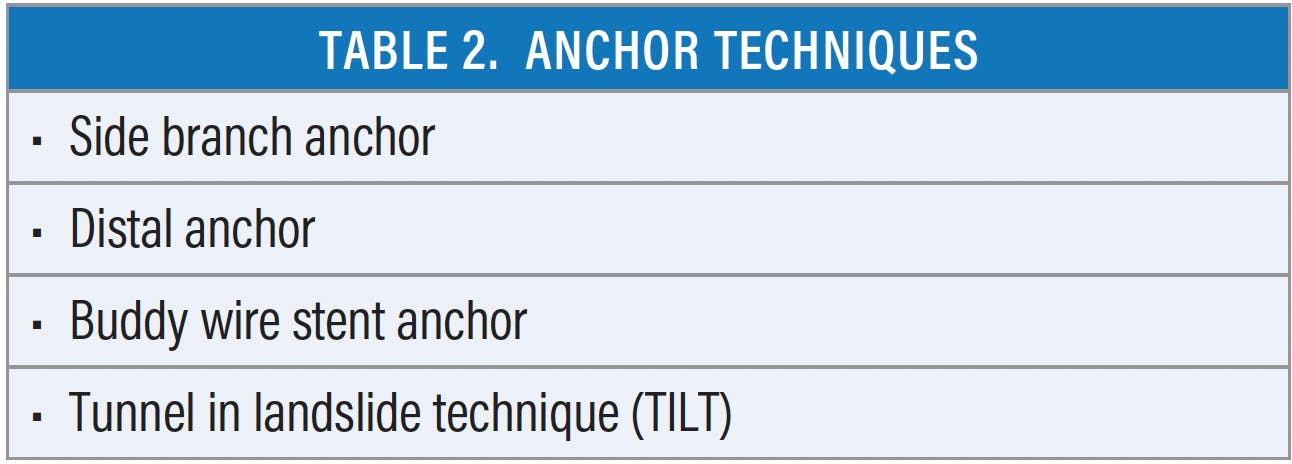
In a side branch anchor technique, a workhorse guidewire is advanced into a side branch of the target vessel, such as a conus or right ventricular marginal branch when treating the right coronary artery. A 1:1-sized balloon is inflated in the side branch at low pressure. This balloon remains in place while equipment such as balloons, microcatheters, or stents are advanced into the target vessel. In a distal anchor technique, a 1:1-sized balloon is inflated at a location distal to the target lesion and can allow passage of a larger balloon or stent across the target lesion. In the latter technique, it is important to remove the balloon prior to stent deployment to avoid jailing the balloon.
In the buddy wire stent anchor technique, a proximal segment of the vessel is stented, trapping a buddy wire that then increases good guide catheter support. Occasionally, myocardial ischemia and side branch dissection can occur with the use of anchor techniques.
Another anchor technique is the tunnel in landslide technique (TILT), also called “power guide extension.”3 This technique requires the passage of two guidewires across the lesion. On one guidewire, a GCE is advanced as close to the target lesion as possible. On the other guidewire, a 2.5- to 3.5-mm semicompliant balloon is advanced and inflated (outside the GCE), pinning the GCE against the vessel wall and allowing for the passage of equipment through the GCE. The TILT can be performed using either two guide catheters (ping-pong technique) or a single guide catheter. However, the latter requires the use of an 8-F guide catheter along with a 5-F GCE. The TILT can also be a very effective technique in delivering a covered stent during coronary perforation across a complex coronary lesion while simultaneously maintaining balloon tamponade.4
Externalized Wire
In CTO PCIs, after successful retrograde lesion crossing, wire externalization can be performed using dedicated externalized wires such as the R350 (Teleflex) and RG3 (Asahi Intecc Co Ltd.). This externalized system provides an extremely strong support for coronary equipment delivery.
PLAQUE MODIFICATION STRATEGIES
Most complex lesions, especially highly calcified lesions, do not allow stent and other coronary equipment delivery until the lesions are adequately modified. Plaque modification is therefore extremely important for stent delivery and expansion. With advances in technology, there are different tools that can be utilized for plaque modification.
Balloons
The most commonly used step in plaque modification is the use of balloons. In balloon-uncrossable lesions, low-profile balloons like the 1-mm Sapphire Pro balloon (Abbott, manufactured by OrbusNeich) can be used. This is followed by serial dilatations by sequential use of larger-profile balloons until there is complete lesion expansion using a 1:1-sized, noncompliant balloon at nominal or high pressure. Occasionally, the use of two balloons side by side or prolonged balloon expansion for 30 to 60 seconds can help with lesion expansion. The OPN balloon (SIS Medical AG) can deliver very high (40 atm) pressure and facilitate lesion expansion. Plaque modification balloons, such as the Wolverine cutting balloon (Boston Scientific Corporation), AngioSculpt balloon (Philips), Scoreflex (Abbott, manufactured by OrbusNeich), and Chocolate balloon (Medtronic), can facilitate lesion expansion through the application of concentrated pressure at the lesion site; however, they have a larger crossing profile and thus are less deliverable than compliant balloons. In a wire cutting technique, two coronary guidewires are advanced across the lesion and inflated. A balloon is advanced as deep into the lesion as possible and inflated. The second wire is withdrawn, “cutting” and modifying the lesion.
Microcatheters
Certain microcatheters such as Tornus (Asahi Intecc USA, Inc.) and Turnpike Spiral and Gold (Teleflex) can “screw into the lesion” and modify it. However, their use has become less common over the years as other techniques are likely to be more effective.
Microdissection Techniques
Grenadoplasty (ie, the balloon-assisted microdissection technique) uses a small, 1- to 1.5-mm balloon that is advanced as deep into the lesion as possible. The balloon is then inflated at high pressure until it ruptures. This can create microdissections and subsequently allow for easier passage of larger-profile balloons for adequate lesion preparation. The Carlino technique is another technique frequently used in CTOs where 0.5 to 1 mL of 100% contrast is injected into the microcatheter buried into the lesion. This can create microdissections that can enable subsequent balloon crossing. This technique can also be used to facilitate external cap crush in balloon-uncrossable lesions. These techniques carry a small risk of extensive vessel dissection and coronary perforation. Also, when performing grenadoplasty, the balloon should be prepared meticulously to ensure that there is no air in the balloon to reduce the risk of air embolism.
Atherectomy
Currently available atherectomy modalities include orbital (Diamondback, Abbott), rotational (Rotapro, Boston Scientific Corporation), and laser (ELCA, Philips). Atherectomy is typically used in heavily calcified lesions. Rotational and orbital atherectomy each have their own specialized coronary guidewires (Rotawire Drive floppy or Rotawire Drive extra support [Boston Scientific Corporation] for rotational atherectomy and Viper Advance or Viper Advance flex tip [Abbott] for orbital atherectomy). Wiring the lesion primarily with these specialized wires can be challenging, and thus most operators choose to wire the target vessel with a workhorse wire and exchange via a microcatheter. If the target lesion is microcatheter-uncrossable, the microcatheter can be advanced as deep as possible into the target lesion, the original wire removed, and an attempt made to wire the lesion using one of these specialized wires.
Alternatively, this can also be attempted using a dual-lumen microcatheter with the advantage of not losing the original wire position. Rotational atherectomy uses a burr that comes in various sizes. The ideal burr size is 50% (and not more than two-thirds) of the diameter of the target vessel. Unlike rotational atherectomy, orbital atherectomy has a single-sized crown for coronary arteries that can be utilized for antegrade and retrograde ablation of plaque. Both devices have a risk of vessel dissection and no reflow. Laser atherectomy is another tool used for plaque modification and is most useful in managing lesions that are balloon uncrossable, in stent, and thrombotic.
Intravascular Lithotripsy
Shockwave intravascular lithotripsy (Shockwave Medical, Inc.) uses acoustic shockwaves in a balloon-based delivery system to modify severely calcified lesions. Its use has become widespread due to its ease of use, efficacy, and safety profile. The balloon has a large profile and can be difficult to deliver at times.
MISCELLANEOUS STENT ADVANCEMENT TECHNIQUES
Other techniques that can be utilized specific to coronary stent delivery are as follows:
- The independent hand technique can be very useful for balloon or stent delivery across a complex coronary lesion. In this technique, while the right hand fixes the wire and advances the stent, the left hand pushes the guide catheter, providing support for equipment delivery.
- Using shorter-length stents and stent platforms with thinner struts can sometimes allow successful stent delivery.
- Asking the patient to take a deep breath can facilitate stent delivery, possibly by straightening the coronary arteries or changing the seating of the guide catheter.
- Using Rotaglide (Boston Scientific Corporation) or ViperSlide (Abbott) during stent advancement might reduce friction and facilitate delivery.
TORTUOUS VESSELS
Vessel tortuosity can make it difficult to navigate equipment across a coronary lesion and also increases the risk of complications with perforation and dissection. Buddy wires with stiffer wires can be used to assist with delivery, as mentioned previously. Angulated vessels can be difficult to wire, and specialized angulated microcatheters may be needed for lesion crossing with a guidewire.
CONCLUSION
There are many different techniques and strategies to deliver equipment in complex CAD. Adequate assessment of the lesion characteristics with angiography and imaging, adequate guide support strategies, and lesion preparation are essential for coronary equipment and stent delivery.
1. Riley RF, Henry T, Mahmud E, et al. SCAI position statement on optimal percutaneous coronary interventional therapy for complex coronary artery disease. Catheter Cardiovasc Interv. 2020;96:346-362. doi: 10.1002/ccd.28994
2. Garbo R, Iannacone M, Werner GS, et al. Utility of guiding catheter extensions for recanalization of chronic total occlusions: A EuroCTO club expert panel report. JACC Cardiovasc Interven 2023;16:1833-1844. doi: 10.1016/j.jcin.2023.05.019
3. Santigago R, Moroni F, Del Rio V, et al. The guide extension tunnel in landslide technique (TILT) for equipment delivery in severely tortuous or uncrossable lesions during percutaneous coronary intervention. EuroIntervention. 2021;17:e923-e924. doi: 10.4244/EIJ-D-21-00454
4. Allana SS, Kostantinis S, Simsek B, et al. Tunnel in landslide technique to “block and deliver”: a novel method to deliver covered stent for coronary perforation. JACC Cardiovasc Interv. 2023;16:730-733. doi: 10.1016/j.jcin.2023.01.368
Advertisement
Advertisement