Advertisement
Advertisement


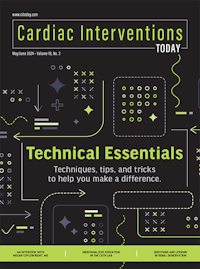
This edition of Cardiac Interventions Today is the latest in our efforts to highlight topical and essential information, tips and tricks, and thoughtful insights regarding your practice and how to ensure better outcomes.
We start our focus coverage with Agam Bansal, MD, and Amar Krishnaswamy, MD, who share how “same-side” femoral access for the secondary arterial access sheath can provide numerous benefits during TAVR.
The recent FDA approval of the Evoque tricuspid valve (Edwards Lifesciences) has provided us with a new tool for treating tricuspid regurgitation. Aakriti Gupta, MD; Moody Makar, MD; and Raj Makkar, MD, provide a step-by-step guide to the procedural technique, data, and future challenges in this exciting new arena.
Despite its advantages, radial access presents specific challenges that must be recognized, and knowledge of techniques to overcome these limitations is critical to modern patient care. Gregory A. Sgueglia, MD, shares a synthesized collection of strategies and insights for improving the safety and effectiveness of transradial percutaneous coronary intervention.
Next, Robert F. Riley, MD, and Nadia Sutton, MD, educate us on calcium modification, sharing their top pearls for success with coronary intravascular lithotripsy and coronary atherectomy, respectively.
The final offering in our cover focus is a collection of experts who share their tips and methodology for optimizing PCI specialty balloon use. Pier Pasquale Leone, MD, and Antonio Colombo, MD, highlight drug-coated balloons; Matteo Maurina, MD, and Valeria Paradies, MD, focus on super-high–pressure balloons; and Ottavia Cozzi, MD; Antonio Mangieri, MD; Gabriele Gasparini, MD; and Damiano Regazzoli, MD, conclude with cutting and scoring balloons.
Elsewhere in this issue, we have a subfocus featuring renal denervation (RDN). Herbert D. Aronow, MD; Michael Kunz, MD; Lucas Lauder, MD; and Felix Mahfoud, MD, begin this section with thoughts about the RDN learning curve. Their lessons learned from clinical trials and real-world experience to date, as well as their thoughts on the future of RDN, are essential reading.
Ajay J. Kirtane, MD, follows with reflections on key questions for ongoing and future RDN trials, the role of RDN devices in the blood pressure control landscape, patient access concerns, and ideal goals for future trials.
Our Today’s Practice column by Denise Busman, MSN, RN, and Katie Willerick, MA, focuses on individualized education in the cath lab. They provide a strategy to improve outcomes and workforce stability through interdisciplinary training.
Closing this issue is a conversation with Megan Coylewright, MD, who reflects on her shared decision-making philosophy and what it looks like in practice, her hopes for future research, keys to a well-run structural program, and DEI efforts in interventional cardiology.
This annual issue of Cardiac Interventions Today is intended to provide a focus on aspects of practice that might not be disseminated readily through the specialty. Our goal has been to collect and provide information that can be readily used in your practice for better outcomes. We hope you have found this useful and look forward to continuing to serve as a resource for you.
Azeem Latib, MD
Chief Medical Editor
Andrea Scotti, MD
Guest Chief Medical Editor
Advertisement
Advertisement