Advertisement
Advertisement
May/June 2024
Tips and Tricks for Ipsilateral Transfemoral TAVR
“Same-side” femoral access for the secondary arterial access sheath has numerous benefits, including the ability to rapidly and straightforwardly treat peripheral complications during TAVR.
By Agam Bansal, MD, and Amar Krishnaswamy, MD
Vascular complications after transcatheter aortic valve replacement (TAVR) are a significant complication associated with significantly increased morbidity and mortality.1 A Society of Thoracic Surgeons/American College of Cardiology Transcatheter Valve Therapy registry study found that 9.3% of patients experienced a vascular complication, and these were associated with worse short- and long-term clinical outcomes, including all-cause mortality.2 Although these complications have decreased with small delivery sheath sizes3 and increasing operator experience, they remain a concern due to their impact on patient outcomes.
Conventionally, the contralateral femoral artery has been the first choice for “secondary” arterial sheath access to provide aortography at the time of valve placement, as well as completion angiography once the “primary” arterial TAVR access sheath site has been closed. In recent years, some operators have favored the radial approach for secondary access, and this has been shown to be associated with a reduction in vascular complications.4-6 In the setting of a vascular complication, this secondary arterial site is most commonly used to perform peripheral “bailout” intervention for arterial dissection and/or perforation with balloon angioplasty and/or stent placement. However, the ability to reach the iliofemoral system from the wrist may be limited due to the length of even contemporary peripheral intervention sheaths and devices. Furthermore, with either of these approaches, complete arterial occlusion due to suture or collagen plug-based closure devices or vascular trauma and dissection remains a possibility.
We began to use the ipsilateral common femoral artery (CFA) or superficial femoral artery (SFA) inferior to the TAVR site as our secondary access point in 2017 (Table 1 and Figure 1).7 The transition from contralateral to ipsilateral femoral access reflects an evolution in our procedural strategy.7,8 There are numerous potential benefits to this approach:
- Patient comfort with single-side arterial (and venous) access7,8
- Immediate endovascular access to the TAVR delivery sheath site without the need for crossover at the aortoiliac bifurcation, especially in the setting of catastrophic bleeding7
- No risk of complete occlusion of the TAVR delivery site as the inferior sheath will always end proximal to the TAVR sheath site7
- Improved resource utilization without the need for specialized guide catheters and peripheral sheaths (ie, intervention directly via the inferior sheath)7,8
- Procedural efficiency with simultaneous achievement of hemostasis at the inferior arterial sheath and ipsilateral venous temporary pacemaker sheath sites7
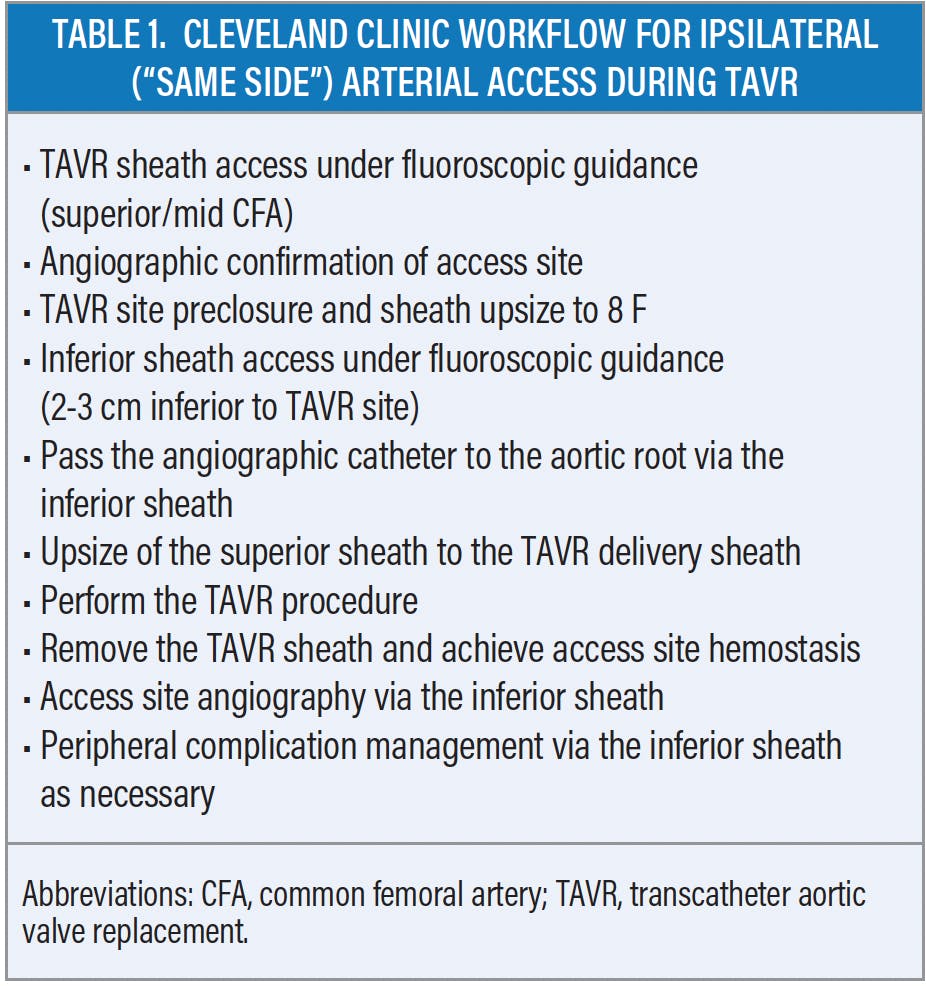
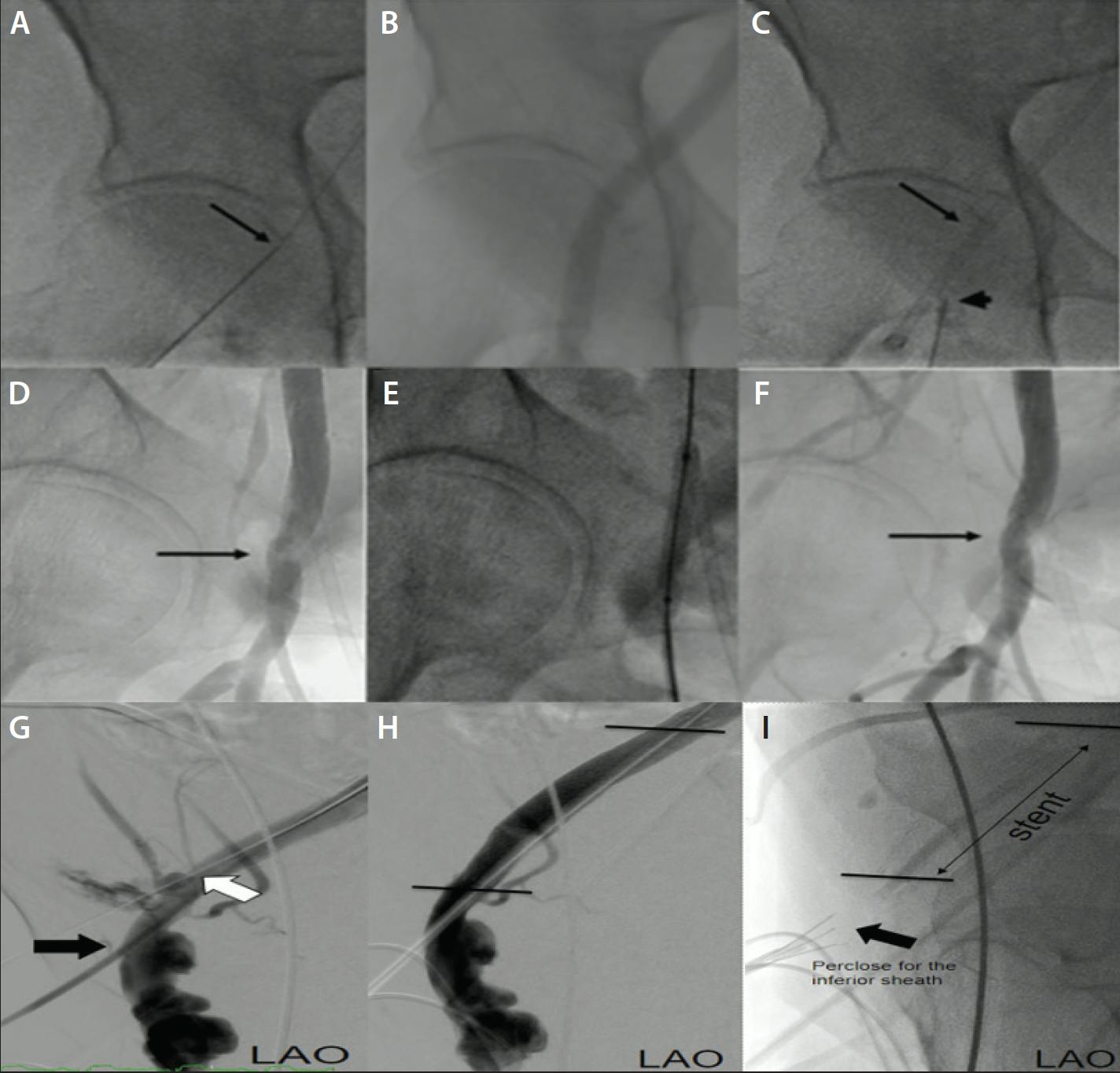
Figure 1. Unilateral arterial access and peripheral complication management during TAVR. Proximal right femoral artery (RFA) access site for TAVR delivery sheath (arrow) (A). RFA angiogram (B). Proximal RFA sheath (arrow) and inferior ipsilateral RFA access site (arrowhead) (C). Completion angiogram via inferior sheath shows delivery sheath site stenosis (arrow) (D). Angioplasty via inferior sheath (E). Resolution of RFA delivery site stenosis (arrow) (F). CFA perforation (white arrow) (G) treated with covered stent placement and balloon postdilation (both via the inferior sheath, black arrow) (H) and preclosure of the inferior access site (I).
In rigorously assessing this approach, we found that peripheral vascular complications were similar between patients undergoing TAVR with bilateral access and those with unilateral access (10.8% vs 8.6%; P = .543), demonstrating no increased risk of using the same side.7 In another study by Yan et al,8 single-artery access TAVR achieved similar device success compared with dual-artery access and did not increase the x-ray time or dose. Importantly, no major vascular complication was observed in both groups, and the incidence of minor main vascular and access complications in the single-artery access group was comparable to those of the dual-artery access procedure.
TECHNICAL DETAILS
Preprocedural planning with multidetector CT is an essential tool for unilateral access TAVR to establish the planned site of TAVR sheath placement, as well as the inferior sheath in relation to the femoral head.9,10 We then typically obtain femoral access under fluoroscopic guidance using a micropuncture kit with a modified Seldinger technique. The sequence starts with TAVR sheath site arterial access in the mid- or superior aspect of the CFA, with sheath injection to confirm satisfactory arteriotomy location. This arteriotomy is then dilated with a 5-F sheath and then (in our routine) preclosed with a single Perclose ProGlide device (Abbott) and upsized to an 8-F sheath. Ipsilateral inferior arterial access is obtained using the micropuncture system, again under fluoroscopic guidance, to ensure an access at a point at least 2 to 3 cm below the 8-F sheath to facilitate “space” for bailout intervention (especially stent placement) without extension out the inferior arterial site.
Depending on CFA length, this sheath can be placed in the CFA or SFA. An angled pigtail or straight flush catheter is advanced to the aortic root via the 5-F sheath followed by upsizing of the 8-F superior sheath to the TAVR delivery sheath. It is imperative that the aortic root angiographic catheter is placed first because wiring of the iliofemoral system from the inferior sheath after the TAVR sheath is placed may be impassable.
At the conclusion of the case, hemostasis is achieved at the TAVR delivery sheath site, and an angiogram of the iliofemoral system is obtained via the distal sheath. As the sheath is already proximal to the TAVR access site, this angiogram is obtained via the sheath and does not require a catheter (as it would in situations of contralateral femoral or radial sheath placement). In cases of vascular dissection or perforation requiring intervention, repairs are then performed via the inferior sheath. A balloon is advanced to the proximal external iliac artery and inflated to 1 to 2 atm (to “wing” the balloon).11 This is then withdrawn until it meets the end of the sheath, and the entire system is withdrawn so that the balloon overlaps the area of interest. The sheath is then withdrawn another 1 to 2 cm and full balloon inflation can be performed. Once completed, the sheath is readvanced over the balloon and another angiogram can be obtained for assessment. As most cases are treated using angioplasty alone, it is rarely necessary to upsize the inferior sheath from the 5-F sheath that is placed. If a stent is necessary, upsizing may be required (usually to 6 F) and also placed via this sheath.
At our institution, we prefer to “preclose” the access site using a single Perclose ProGlide device (with placement of an 8-F Angio-Seal device [Terumo Interventional Systems] after TAVR sheath removal if hemostasis is inadequate, as in approximately 50% of cases). Published results by our group12 and others13 have demonstrated that using a single Perclose device results in a statistically significant improvement in overall procedural success, defined as intraprocedural hemostatic control and lack of contrast extravasation, arterial dissection, occlusion, or stenosis > 50% in the final crossover angiogram, as well as unimpaired limb perfusion without claudication throughout the index hospitalization. Additionally, there was a significant improvement in arterial dissection rates, stenosis > 50%, and Valve Academic Research Consortium major vascular complications when using a single device.
CONCLUSION
In our experience, “same-side” femoral access for the secondary arterial access sheath has provided numerous benefits, most importantly the ability to rapidly and straightforwardly treat peripheral complications during TAVR. Especially in cases of significant vascular perforation, time is of the essence to achieve balloon hemostasis, and ipsilateral access provides substantial benefit in this regard. Furthermore, in cases of “borderline” vascular trauma/stenosis after TAVR sheath site closure, the ipsilateral access may reduce the activation energy required for angioplasty “touch up” of the sheath site.
1. Généreux P, Webb JG, Svensson LG, et al; PARTNER Trial Investigators. Vascular complications after transcatheter aortic valve replacement: insights from the PARTNER (Placement of AoRTic TraNscathetER Valve) trial. J Am Coll Cardiol. 2012;60:1043-1052. doi: 10.1016/j.jacc.2012.07.003
2. Sherwood MW, Xiang K, Matsouaka R, et al. Incidence, temporal trends, and associated outcomes of vascular and bleeding complications in patients undergoing transfemoral transcatheter aortic valve replacement: insights from the Society of Thoracic Surgeons/American College of Cardiology Transcatheter Valve Therapies Registry. Circ Cardiovasc Interv. 2020;13:e008227. doi: 10.1161/CIRCINTERVENTIONS.119.008227
3. Barbanti M, Binder RK, Freeman M, et al. Impact of low-profile sheaths on vascular complications during transfemoral transcatheter aortic valve replacement. EuroIntervention. 2013;9:929-935. doi: 10.4244/EIJV9I8A156
4. Jhand A, Apala DR, Dhawan R, et al. Meta-analysis comparing transradial versus transfemoral secondary access in transcatheter aortic valve implantation. Am J Cardiol. 2020;131:74-81. doi: 10.1016/j.amjcard.2020.06.032
5. Das TM, Shin J, Czarny MJ, et al. Radial versus femoral secondary access for transcatheter aortic valve replacement: a systematic review and meta-analysis. Catheter Cardiovasc Interv. 2022;99:1225-1233. doi: 10.1002/ccd.30009
6. Fernandez-Lopez L, Chevalier B, Lefèvre T, et al. Implementation of the transradial approach as an alternative vascular access for transcatheter aortic valve replacement guidance: experience from a high-volume center. Catheter Cardiovasc Interv. 2019;93:1367-1373. doi: 10.1002/ccd.28024
7. Khubber S, Bazarbashi N, Mohananey D, et al. Unilateral access is safe and facilitates peripheral bailout during transfemoral-approach transcatheter aortic valve replacement. JACC Cardiovasc Interv. 2019;12:2210-2220. doi: 10.1016/j.jcin.2019.06.050
8. Yan Y, Yao J, Yuan F, et al. Single femoral artery access is safe and feasible during transcatheter aortic valve replacement: a propensity score matched analysis. Front Cardiovasc Med. 2023;10:1228258. doi: 10.3389/fcvm.2023.1228258
9. Blanke P, Weir-McCall JR, Achenbach S, et al. Computed tomography imaging in the context of transcatheter aortic valve implantation (TAVI)/transcatheter aortic valve replacement (TAVR): an expert consensus document of the Society of Cardiovascular Computed Tomography. JACC Cardiovasc Imaging. 2019;12:1-24. doi: 10.1016/j.jcmg.2018.12.003
10. Otto CM, Kumbhani DJ, Alexander KP, et al. 2017 ACC expert consensus decision pathway for transcatheter aortic valve replacement in the management of adults with aortic stenosis: a report of the American College of Cardiology Task Force on Clinical Expert Consensus Documents. J Am Coll Cardiol. 2017;69:1313-1346. doi: 10.1016/j.jacc.2016.12.006
11. Klein AJ, Feldman DN, Aronow HD, et al; Peripheral Vascular Disease Committee for the Society for Cardiovascular Angiography and Interventions. SCAI expert consensus statement for aorto-iliac arterial intervention appropriate use. Catheter Cardiovasc Interv. 2014;84:520-528. doi: 10.1002/ccd.25505
12. Bazarbashi N, Ahuja K, Gad MM, et al. The utilization of single versus double Perclose devices for transfemoral aortic valve replacement access site closure: insights from Cleveland Clinic Aortic Valve Center. Catheter Cardiovasc Interv. 2020;96:442-447. doi: 10.1002/ccd.28585
13. Hollowed J, Akhondi A, Rabbani A, et al. Single versus double Perclose techniques for vascular closure during transfemoral transcatheter aortic valve replacement. Catheter Cardiovasc Interv. 2022;99:2125-2130. doi: 10.1002/ccd.30176
Advertisement
Advertisement