Advertisement
Advertisement
May/June 2026
CT-Guided PCI: Toward Precision in Case Triage and Procedural Planning
Tips and tricks for integrating CT as a practical tool for planning and therapeutic guidance in contemporary percutaneous coronary intervention.
Coronary CTA has historically been viewed as the “gatekeeper” of the cardiac catheterization laboratory, largely because of its excellent negative predictive value and ability to rule out obstructive coronary artery disease. However, there has been a convergence of factors over the last few years that have changed how we think about CT for percutaneous coronary intervention (PCI). Improvement in visualization software, supportive evidence (eg, ongoing randomized trials, prospective studies), integration of artificial intelligence (AI), advances in CT-based physiology, and a better understanding of plaque characterization have made it clear that CT is now a practical platform for PCI planning, rather than a solely diagnostic tool.
Recognizing this evolution,1-5 the Society for Cardiovascular Angiography and Interventions and Society of Cardiovascular Computed Tomography copublished a multidisciplinary expert consensus document on CT-guided PCI in the societies’ journals in 2025.6 The document summarized the evidence, practical workflows, current limitations, and future opportunities in this rapidly evolving field. At the same time, pivotal studies such as the P4 trial (NCT05253677) have completed enrollment, and several additional trials and registries are underway. Pending the results of these studies, CT-guided PCI has the potential to improve procedural efficiency, optimize resource utilization, and improve clinical outcomes. Randomized and prospective data already suggest benefits in select populations, such as patients undergoing chronic total occlusion (CTO) PCI and those with prior coronary artery bypass grafting (CABG).7,8
In this overview, we discuss five key concepts in CT-guided PCI: understanding how it’s defined, preprocedural planning, program implementation, barriers to adoption, and future directions.
DEFINING CT-GUIDED PCI
Many patients undergoing PCI already have a prior CT demonstrating obstructive coronary disease that prompted referral for invasive angiography. However, a CT scan with a diagnostic report alone does not constitute CT-guided PCI.
CT-guided PCI requires the interventional cardiologist to directly interact with the CT data set, either independently or in collaboration with cardiac imagers, to develop a structured preprocedural plan. The emphasis goes beyond simply confirming the presence of disease; it also encompasses understanding lesion morphology, vessel size, calcium distribution, disease pattern, landing zones, and procedural complexity before entering the cardiac catheterization laboratory.
This concept is similar to the routine use of CT in structural heart interventions like transcatheter aortic valve replacement, where preprocedural CT planning has become standard practice. CT-guided PCI essentially extends that same philosophy of preprocedural planning into coronary intervention.
CORE COMPONENTS OF CT-GUIDED PCI PLANNING
There are multiple approaches to CT-guided PCI planning depending on available software and local expertise, but a practical workflow can often be developed using standard postprocessing tools already available in most cardiac imaging programs (Figure 1). At a minimum, the workflow should allow review of the following:
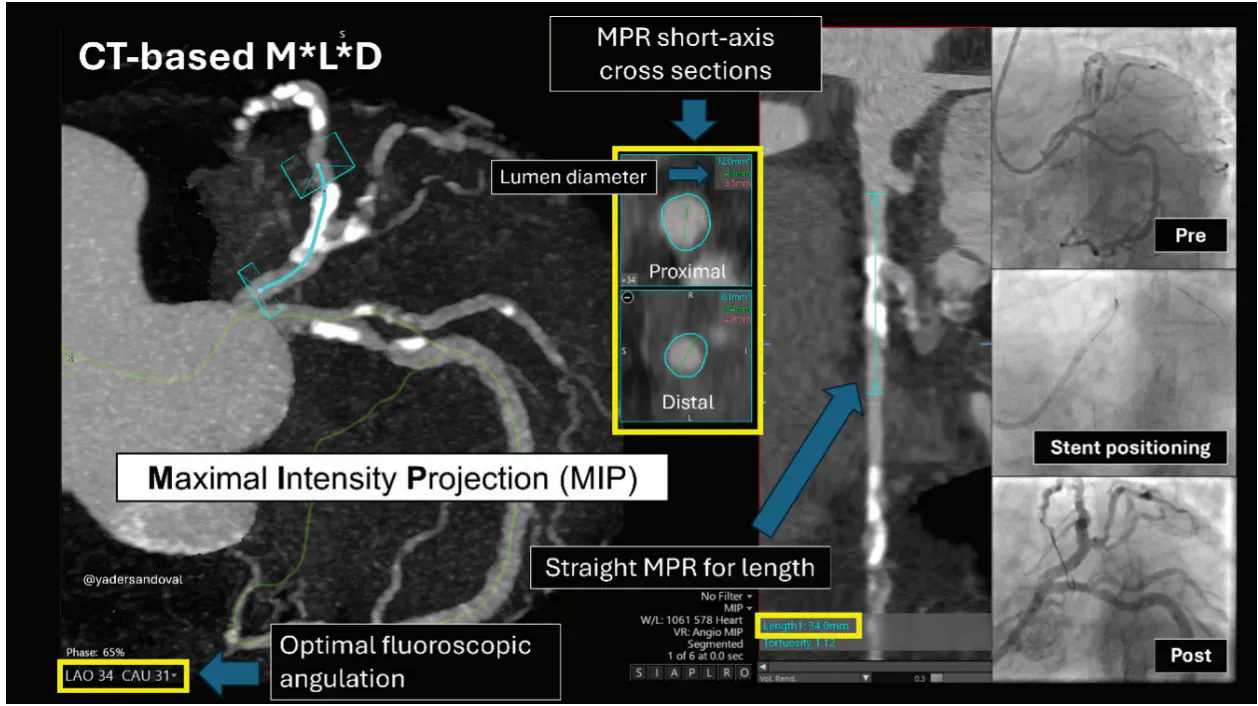
Figure 1. CT-based MLD approach using a standard post-processing software demonstrating the maximal intensity projection with projected stent length and position, as well as optimal fluoroscopic angles, along with straight MPR and short-axis vessel cross-section displaying stent length and landing zones including vessel size. CAU, caudal; LAO, left anterior oblique; MLD, minimal lumen diameter.
- Axial images for coronary anatomy and vessel origin
- Maximum intensity projection for vessel course, fluoroscopic planning, and disease complexity overview
- Multiplanar reformation (MPR) to assess extent of disease and inform stent length
- Short-axis cross-sections from MPRs for plaque composition and calcium assessment, as well as determination of landing zones and vessel size
While cardiac imagers have already comprehensively evaluated similar information for diagnostic purposes, often including in-depth assessment of raw data and multiple data sets, interventional cardiologists do not need to redo these efforts but can simply focus on the vessel(s) of interest from a PCI planning perspective.
Similar to the use of intravascular imaging for PCI guidance, the key questions can be focused on: (1) what is the disease morphology and, based on this, how should the lesion be prepared prior to stent implantation?; (2) how long (stent length) should the stent(s) be?; and (3) how big (stent size) should the stent be? Based on CT data, one can also inform whether high-risk lesion subsets are present, such as those involving calcific disease, ostial lesions, bifurcations, left main, or CTOs.
From a disease morphology perspective, the central question relates to the presence of severe calcific disease. This particular aspect of CT is of particular interest; not long ago, presence of severe calcific disease was perceived as a limitation of CT often associated with “nondiagnostic” studies or even a barrier to proceeding with CT acquisition in patients with high calcium scores. In contrast, knowledge about the presence and severity of coronary calcification is increasingly recognized as a strength for CT and an important clinical feature for case triage and procedural preparedness.
Although calcium blooming occurs with most scanners used in routine clinical practice, correlation studies with intravascular imaging indicate that CT assessment of calcium arc and calcium length are accurate and can inform decisions about lesion preparation. Further, with the adoption of photon-counting CT scanners, blooming and concerns about assessment of calcium and prior stents should decrease.
AI-enhanced visualization platforms have accelerated adoption of CT-guided PCI by simplifying workflow and improving accessibility through cloud-based interfaces.1,4-5 These tools facilitate interpretation of plaque, vessel dimensions, and physiology, making CT-guided PCI increasingly practical in routine care. Modern AI-enhanced platforms and integrated tools (such as PCI Navigator [Heartflow, Inc.], a CT-guided PCI platform recently introduced into clinical practice) now integrate coronary anatomy, plaque and calcium characterization, physiology, myocardial mass at risk, fluoroscopic projections, and stent planning (eg, lesion preparation strategy, landing zones, vessel sizing) into a single workflow (Figure 2).
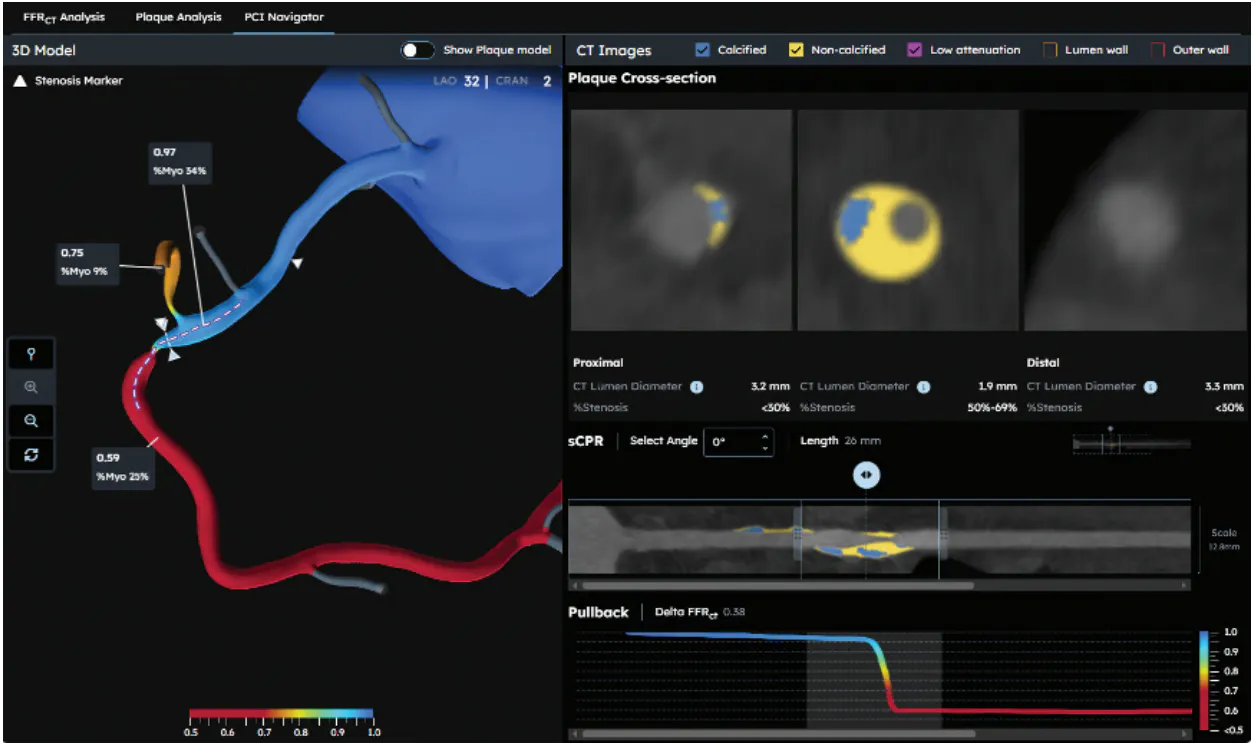
Figure 2. PCI Navigator platform for CT-guided PCI planning.
STARTING A CT-GUIDED PCI PROGRAM
A CT-guided PCI program is fundamentally an extension of an established coronary CT program. Successful implementation requires close collaboration between interventional cardiologists, cardiac imagers, radiologists, and administrative stakeholders. Alignment is important regarding acquisition protocols, access to visualization tools, reporting standards, billing considerations, and workflow integration.
The most essential component is access to visualization software that allows meaningful preprocedural planning. Additional technologies such as coregistration systems that synchronize CT images with live fluoroscopy may further enhance workflow but are not mandatory for implementation.
Although randomized trials and prospective studies are ongoing, the primary clinical value of CT-guided PCI currently relates to improved procedural preparedness and case triage. Preprocedural CT review may help determine:
- Whether a case should be performed in an ambulatory center versus hospital setting
- Whether advanced PCI expertise is needed
- Whether a planned rather than ad hoc PCI strategy is preferable
- What lesion preparation devices and adjunctive equipment may be required
CT can also support more informed shared decision-making discussions with patients by allowing individualized conversations about lesion complexity, procedural expectations, risks, and anticipated benefits.
MAIN BARRIERS TO CT-GUIDED PCI ADOPTION
The largest barriers to CT-guided PCI adoption remain access, training, and workflow integration. However, the biggest challenge for many interventional cardiologists is access to visualization tools and comfort interpreting CT data sets. Traditional postprocessing software can be difficult to access because of licensing limitations, and most operators did not receive formal CT training during fellowship.
This highlights the importance of educational initiatives and close collaboration with cardiac imagers. Operators interested in CT-guided PCI do not necessarily need advanced CT certification, but they do need familiarity with the strengths, limitations, and practical interpretation of CT data from a PCI planning perspective.
Another important limitation is that many purpose-built CT-guided PCI platforms currently focus primarily on native, nonstented vessels. As a result, patients with in-stent restenosis, previous CABG, or complex CTO anatomy may still require more traditional postprocessing approaches and experienced image interpretation.
Finally, CT-guided PCI requires a proactive commitment to preprocedural planning. Even with modern software, operators must dedicate time to reviewing data sets and developing a structured procedural strategy before entering the cath lab.
NEXT STEPS
This field is rapidly evolving, and high-level evidence is needed to better understand the added value of CT-guided PCI. The pivotal P4 trial has completed enrollment, and results are expected later this year. P4 will answer whether CT-guided PCI is noninferior to intravascular ultrasound (IVUS)–guided PCI with respect to 1-year major adverse cardiovascular events.
The CT-PLAN PCI trial is testing whether CT-guided PCI improves procedural efficiency compared to routine PCI. The OPTIMAL trial (NCT07286578) will determine whether leveraging non-invasive CT-based calcium assessment can enhance procedural efficiency and stent results while maintaining clinical safety comparable to IVUS-guided PCI. Finally, several upcoming registries will provide additional data.
Advances in scanner technology, software integration, AI-enhanced analysis, and education are expected to continue accelerating adoption. Photon-counting CT scanners may substantially improve evaluation of coronary calcium and prior stents while reducing blooming artifact.
In summary, CT is no longer simply a diagnostic “gatekeeper” of the cath lab. Increasingly, it is becoming a practical tool for procedural planning and therapeutic guidance in contemporary PCI.
1. Carvalho PEP, Cavalcante JL, Lesser J, et al. Coronary computed tomography angiography for percutaneous coronary intervention: initial United States experience with FFRCT based virtual PCI. Catheter Cardiovasc Interv. 2025;106:1574-1583. doi: 10.1002/ccd.31720
2. Carvalho PEP, Cavalcante JL, Lesser J, et al. Coronary CTA-guided bifurcation PCI: role of FFRCT virtual PCI and myocardial mass for preprocedural planning. JACC Case Rep. 2025;30:102814. doi: 10.1016/j.jaccas.2024.102814
3. Chan Z, Carvalho PEP, Cavalcante JL, et al. Left main coronary CT-guided percutaneous coronary intervention: role of virtual planning and wireless physiology. JACC Cardiovasc Interv. 2024;17:2952-2954. doi: 10.1016/j.jcin.2024.09.034
4. Carvalho PEP, Jalli S, Ser OS, et al. Artificial intelligence-guided quantitative coronary CT angiography (AI-QCT) automated detection and occlusion length estimation of chronic total occlusions. J Cardiovasc Comput Tomogr. 2025;19:677-683. doi: 10.1016/j.jcct.2025.10.010
5. Sandoval Y, Carvalho P, Cheng V, et al. Artificial intelligence enhanced analysis of coronary CT angiography to facilitate chronic total occlusion percutaneous coronary intervention. Catheter Cardiovasc Interv. 2026;107:395-406. doi: 10.1002/ccd.70312
6. Sandoval Y, Leipsic JA, Collet C, et al. Coronary computed tomography angiography to guide percutaneous coronary intervention: expert opinion from a SCAI/SCCT roundtable. J Soc Cardiovasc Angiogr Interv. 2025;4:103664. doi: 10.1016/j.jscai.2025.103664
7. Jones DA, Beirne AM, Kelham M, et al. Computed tomography cardiac angiography before invasive coronary angiography in patients with previous bypass surgery: The BYPASS-CTCA trial. Circulation. 2023;148:1371-1380. doi: 10.1161/CIRCULATIONAHA.123.064465
8. Hong SJ, Kim BK, Cho I, et al. Effect of coronary CTA on chronic total occlusion percutaneous coronary intervention: a randomized trial. JACC Cardiovasc Imaging. 2021;14:1993-2004. doi: 10.1016/j.jcmg.2021.04.013
Advertisement
Advertisement