Advertisement
Advertisement
May/June 2024
An Interview With Megan Coylewright, MD, MPH, FACC, FSCAI
Dr. Coylewright reflects on her shared decision-making philosophy and what it looks like in practice, hopes for future research in LAAO and aortic stenosis, keys to a well-run structural program, and DEI efforts in interventional cardiology.

Shared decision-making is a central aspect of your care philosophy. Why and how did this become a priority for you, and how do you incorporate it on a daily basis?
For many physicians, a significant drive to choosing medicine was an interest in listening to and caring for people. Amid the science, the technology, and the business of medicine, this intention may become less central. For me, listening to the patient voice is a matter of justice, of working to right inequity and address power imbalances that harm us all. Honoring the patient voice also includes assessing when interventions will be futile or unable to accomplish patient goals and holding patients and families in care during the process.
At the same time, I found myself distracted from this focus by the incredible science and alluring tech that is the field of interventional cardiology. Focusing my own research on shared decision-making helped me bridge between the intimate care of people and the staggeringly complex and impressive cardiac devices I am trained to use to help others.
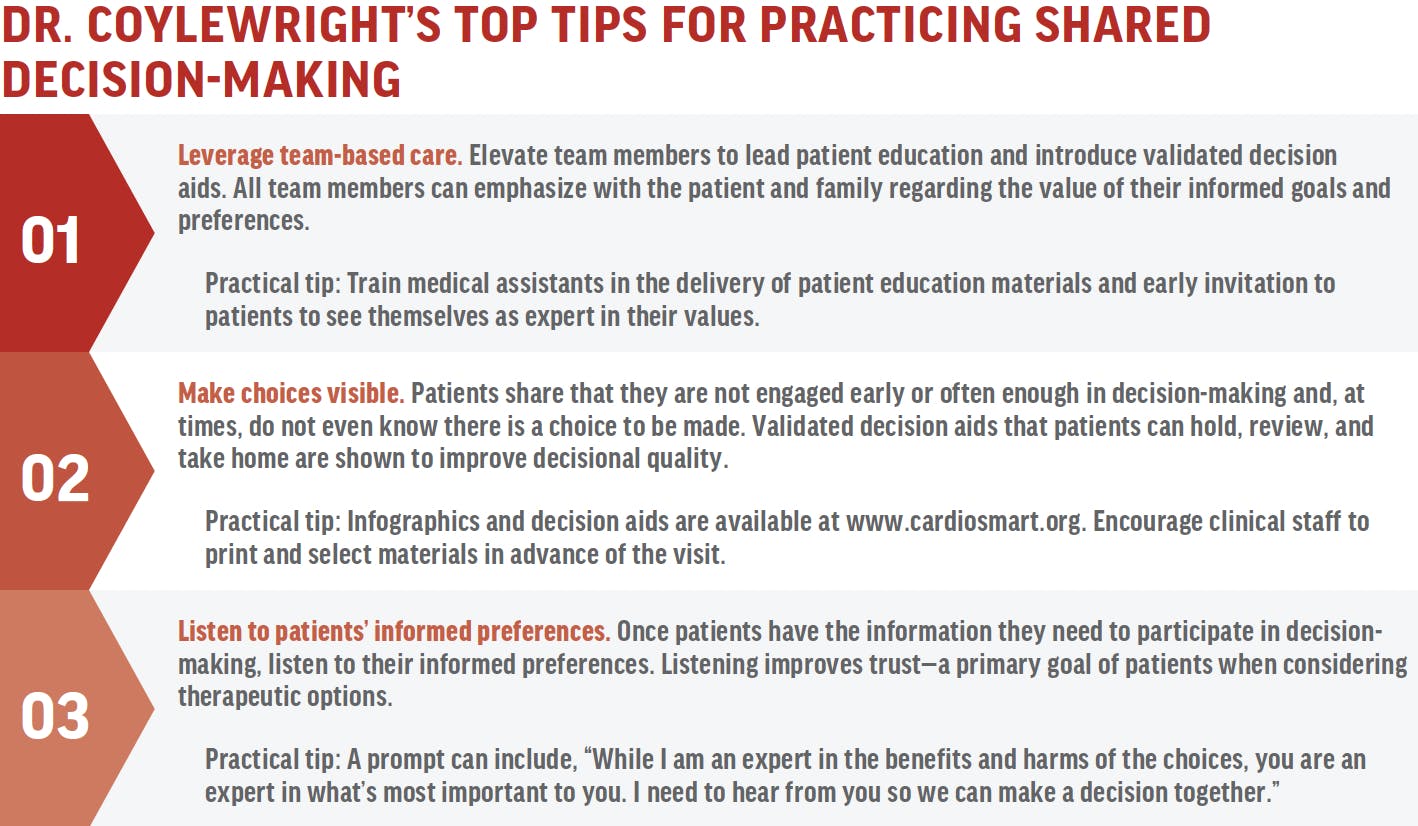
Thus, every day when I meet with patients and their families to discuss the options for treating their illness, I bring to bear the best practices and skill sets we have learned from shared decision-making research and, ultimately, what we have learned from patients. Patients want more engagement in decision-making than they receive, they are more knowledgeable and informed when we use validated decision aids, and their decisions are more likely to match their goals and values when we are intentional in this process.
Shared decision-making is at play in your work in patients with aortic stenosis (AS). In terms of patient goals and preferences, what commonalities do you recognize among those seeking treatment for AS? How do you balance respecting patient values with your expertise?
It is true that patient preferences may be distinct from physician preferences in decisions for which there are multiple options. This is in part due to the marked social distance between patients and their physicians, with differences in race, gender, age, education, roles and responsibilities for their families and communities, and, perhaps most critically, differences in power in that clinical encounter. Acknowledging this power differential is the first step to communicating the permission patients need to participate in coproduction of their own health care.
In severe AS, patients report that their primary goals are to feel trust in their physician and the medical system and to have complete information about the choices available to them. Again, patients with AS report they are not engaged—or invited—enough in decision-making.
This is partly due to common miscommunications. For example, when patients ask their physicians, “What would you do if I were your mother?”, they are not asking the physician to take over decision-making. Instead, they are imploring physicians, “Know me—as you know your own mother.” In short clinical encounters, reaching this level of knowing requires previsit preparation, leveraging a multidisciplinary team trained in varying components of shared decision-making and deploying validated decision aids. With these strategies, the visits can become higher quality and, paradoxically to many physicians, more efficient and less time intensive, with the patient more likely to make a decision at the end of the encounter.
What should be the top priorities for AS research of the next decade?
The research needs for AS over the next decade extend beyond transcatheter aortic valve replacement. Patients with severe AS also commonly have signs of cardiac damage, from the valve and as well as from comorbidities that often accompany it, such as hypertension, diabetes, and coronary disease. Our research is primed to consider the entire patient journey—from early detection including education and engagement, to selection of a treatment option that best matches patient goals and preferences, to ongoing medical management of congestive heart failure, to planning for the next valve, if indicated. The lifetime management of AS has come of age, with patient goals at the center.
Along with directing the structural heart program at Erlanger, you also founded the Dartmouth transcatheter mitral/tricuspid valve repair and left atrial appendage (LAA) closure programs. Can you share some keys to a well-run structural program?
At the core of well-run structural programs are high-functioning teams. Many structural programs are still composed of a team of experts but not an expert team (ie, the aspirational “heart team”). A necessary component is people who are focused on collective efficacy rather than individual gains or personal reputation.
This is a seismic shift in the cultures of interventional cardiology and cardiac surgery, which were founded by primarily men revered as the sole expert, the “go-to guy,” a savior, a hero—even referred to as a “cowboy.” This was a clear reference to the traditionally masculine characteristics of procedural- and surgical-based physicians. The cultures of these fields were renowned for restraint from expressing emotions other than anger, limited communication, a preference for working alone, and valuing risk taking and technical prowess over patient-centered, longer-term outcomes.
Thus, the heart team of today, which centers respectful and ongoing communication, collaborative decision-making, cooperation and sharing in procedures, and centering of patient perspectives and quality-of-life measures, is truly as revolutionary and disruptive as the transcatheter valves themselves. Importantly, these same team-based features are proven to reduce burnout and help keep physicians healthy within our demanding fields.
In recent years, you’ve particularly focused on LAA occlusion (LAAO). When looking at the current LAAO clinical trial landscape, where do you see the biggest gaps? What does your ideal future LAAO trial look like?
The field of stroke prevention in the setting of atrial fibrillation focused on LAAO seeks to address a critical need expressed from patients: their desire to avoid a lifetime of anticoagulant drugs that increase the risk of bleeding and reduce quality of life.
Current trials are moving fast to generate evidence for the benefit of LAAO in broader patient groups beyond currently approved indications, which are limited to either patients who are at high risk for bleeding (a requirement for transcatheter LAAO) or those undergoing surgery for other purposes (surgical LAAO). Some of the trials examine the role of LAAO in addition to long-term anticoagulation, although a key patient preference is for strategies that enable stroke prevention without a requirement for anticoagulation. Future trials and device innovations will lead to effective stroke prevention strategies that limit invasiveness, reduce stroke, and reduce bleeding by making anticoagulation no longer necessary.
Throughout your career, you’ve placed an emphasis on ensuring diversity, equity, and inclusion (DEI) in interventional cardiology—in terms of patient care, clinical trials, and the field itself. In which areas of interventional cardiology are we on the right path in terms of promoting DEI?
Innovation in interventional cardiology often begins with our clinical trials. For example, the conception and introduction of the heart team as a health care intervention began in coronary and valvular heart disease trials. Similarly, a focus on improving representation of women and racial/ethnic minorities in our field has begun primarily within our research efforts. And in this arena, an early leader and innovator is the FDA Center for Devices and Radiological Health (CDRH) team. CDRH produced a draft guidance on the need for and requirements of an initiative to improve DEI among patients in our clinical trials.1
And, what are the most needed areas of improvement for DEI in interventional cardiology?
This FDA draft guidance will become law in the coming months and will require Diversity Action Plans from industry and thus from site principal investigators, driving new strategies and efforts to recruit and retain women and racial/ethnic minorities in our clinical investigations. It is a hope that these efforts lead to the identification of best practices in DEI in all that we do. This includes improved representation of women and racial/ethnic minorities in our workforce and in interventional trials, on both the local and global leadership level. Current representation falls short in nearly all competitive specialties, including vascular surgery and invasive gastroenterology, draining our field of top talent.
Among other roles at Erlanger, you’ve also served as the Vice Chief for Faculty Development. What are your goals when in a leadership position, and how does it tie into your DEI efforts?
I continue to focus on diverse representation in our field based on well-proven benefits, including that diversity drives innovation, improves health care value, and increases the quality of care we deliver to all patients. In leadership positions, I strive to elevate others and ensure people have knowledge and access to opportunities. This includes supporting my partners in developing novel procedural skill sets, expanding who participates in clinical trials, and opening new leadership roles. I believe there is an abundance of resources and opportunities and that embracing the concept of scarcity drives us away from our true superpowers, which include collaboration and partnership.
What is one piece of advice you wish you had received before you entered the field?
Women entering interventional cardiology know they remain in a significant minority: 4% of practicing interventional cardiologists are women, and 2% of structural interventionalists are women. But they may not realize that there are some nearly universally shared experiences in the cath lab and operating room, including double standards for physician behavior that represent systemic problems, not an individual one. This is described widely in the literature, and understanding this as a phenomenon larger than individual women physicians can help prevent the well-documented “leaky pipeline” of women leaving the field due to their experience with sexism and double standards for behavior.2
1. US Food and Drug Administration. Diversity plans to improve enrollment of participants from underrepresented racial and ethnic populations in clinical trials guidance for industry: draft guidance. April 2022. Accessed May 9, 2024. https://www.fda.gov/media/157635/download
2. Dossett LA, Vitous CA, Lindquist K, et al. Women surgeons’ experiences of interprofessional workplace conflict. JAMA Netw Open. 2020;3:e2019843. doi: 10.1001/jamanetworkopen.2020.19843
Advertisement
Advertisement
Interested in reading more interviews?
To read more interviews with thought leaders in the interventional cardiology field, check out our Profiles & Perspectives hub.
Read More