Advertisement
Advertisement
The ability to deliver effective antiproliferative drug to the coronary vessel wall via drug-coated balloon (DCB) angioplasty without any remaining permanent foreign body is appealing in multiple scenarios within the percutaneous coronary intervention (PCI) panorama, and an appropriate strategy should regularly be implemented to maximize efficacy.1
WHEN CAN DCB BE USED?
The evidence for DCB PCI is well established for in-stent restenosis (ISR) and de novo small vessel disease (often defined as ≤ 2.75 mm).2 A promising level of observational data has been accruing for long lesions irrespective of vessel size, with the aim to avoid full-metal jacket, particularly for the left anterior descending artery. Data from randomized controlled trials are also underway (NCT04893291, NCT04859985).3,4
Additional indications emerging from the need to simplify treatment of increasingly complex and diffuse disease and from deeper acknowledgment of the relevance of vessel remodeling are bifurcation lesions and chronic total occlusions (CTOs). Appealing clinical indications for DCB are (1) high bleeding risk, given the possibility for a short dual antiplatelet therapy course; (2) diabetes mellitus, often associated with diffuse disease and given the increased risk of ISR; and (3) acute coronary syndrome, where proper vessel size might not be obvious (Figure 1).
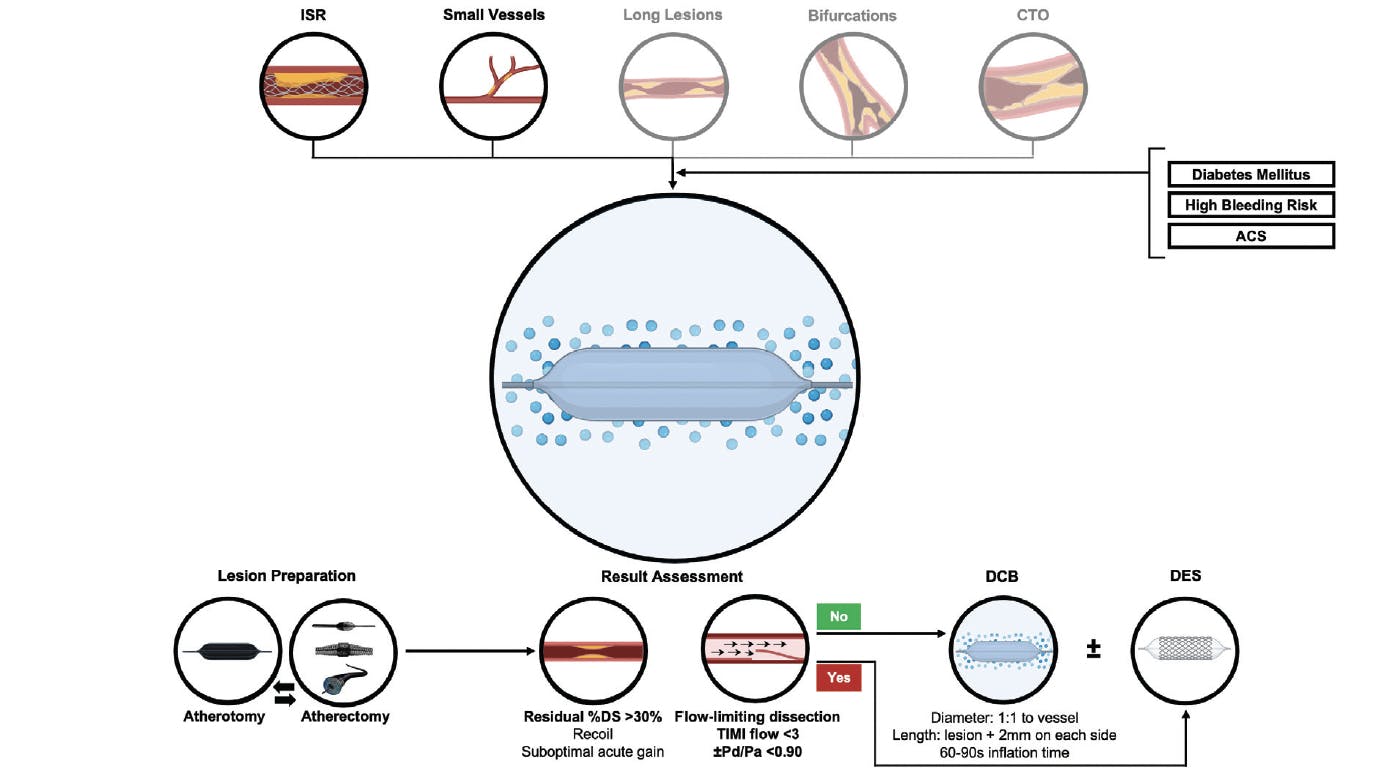
Figure 1. At the top, current and emerging (in opaque) indications for DCB PCI are highlighted. Clinical factors supporting the use of this approach are reported within the boxes on the right. At the bottom, a systematic approach to DCB PCI including lesion preparation, result assessment, and DCB angioplasty and/or stenting is suggested. Additional factors evaluated during result assessment include symptoms, electrocardiographic ischemic alterations, persistent contrast hang-up, and progressive luminal narrowing. ACS, acute coronary syndrome; DS, diameter stenosis; TIMI, thrombolysis in myocardial infarction.
HOW SHOULD DCB BE USED?
From a procedural point of view, our hypothesis is that DCB angioplasty prevents restenosis without the need to implant a drug-eluting stent (DES), if an adequate and stable lumen is obtained after lesion preparation. We hereby provide details on lesion preparation, result assessment, DCB angioplasty and, if planned or required, stenting.
Lesion Preparation
Optimal lesion preparation is key. This is particularly true in a DCB approach because the entire angioplasty is performed upon lesion preparation and the DCB serves the sole purpose of 360° delivery of an antiproliferative drug to the vessel wall. The goal is to achieve atherosclerotic plaque and intimal dissection without propagation onto media and adventitia.
We opt to routinely predilate crossable lesions via prolonged noncompliant (NC) balloon inflations with a 1:1 balloon-to-artery diameter ratio by angiography. The aim is full balloon expansion in two orthogonal fluoroscopic views.5 If recoil ensues, we support crossover to angioplasty with repeated, prolonged inflations at nominal pressure with specialty balloons such as scoring and cutting balloons. Conversely, if insufficient balloon expansion is observed due to heavy calcification, NC and specialty balloon inflation should be considered even at high pressure.6 A scoring or cutting balloon with a 1:1 balloon-to-artery diameter ratio on angiography can be first inflated repeatedly to nominal pressure, favoring prolonged inflation to promote scoring/cutting plane shift. If high-pressure inflation is considered for nondilatable segments, one should consider NC, scoring, or cutting balloon undersizing by 0.5 mm on angiography or 1 mm on intravascular imaging (media-to-media).
Scoring or cutting balloon angioplasty should be preferred in the case of ISR. When adopted, NC balloons can be slightly upsized with respect to the previously implanted stent’s diameter, especially if underexpansion is the underlying mechanism of stent failure.7 Gradual inflation of a super NC balloon (at up to 35 atm) or intravascular lithotripsy should follow in resistant cases. Atherectomy should be considered in device-uncrossable lesions and when proof of sufficiently severe calcification is available from angiography or intravascular imaging. It remains to be established whether early crossover to specialty balloons or atherectomy yields fewer and more benign dissections than high-pressure NC balloon inflation.
Result Assessment
Systematic evaluation of an adequate result includes assessment for significant recoil or inadequate acute lumen gain (ie, > 30% residual diameter stenosis). In addition, stability of the result is supported by absence of chest pain, ischemic changes on electrocardiography, persistent contrast hang-up, progressive luminal narrowing, flow-limiting dissection, and thrombolysis in myocardial infarction flow < 3. In this situation, stent implantation may not be necessary (Figure 2).
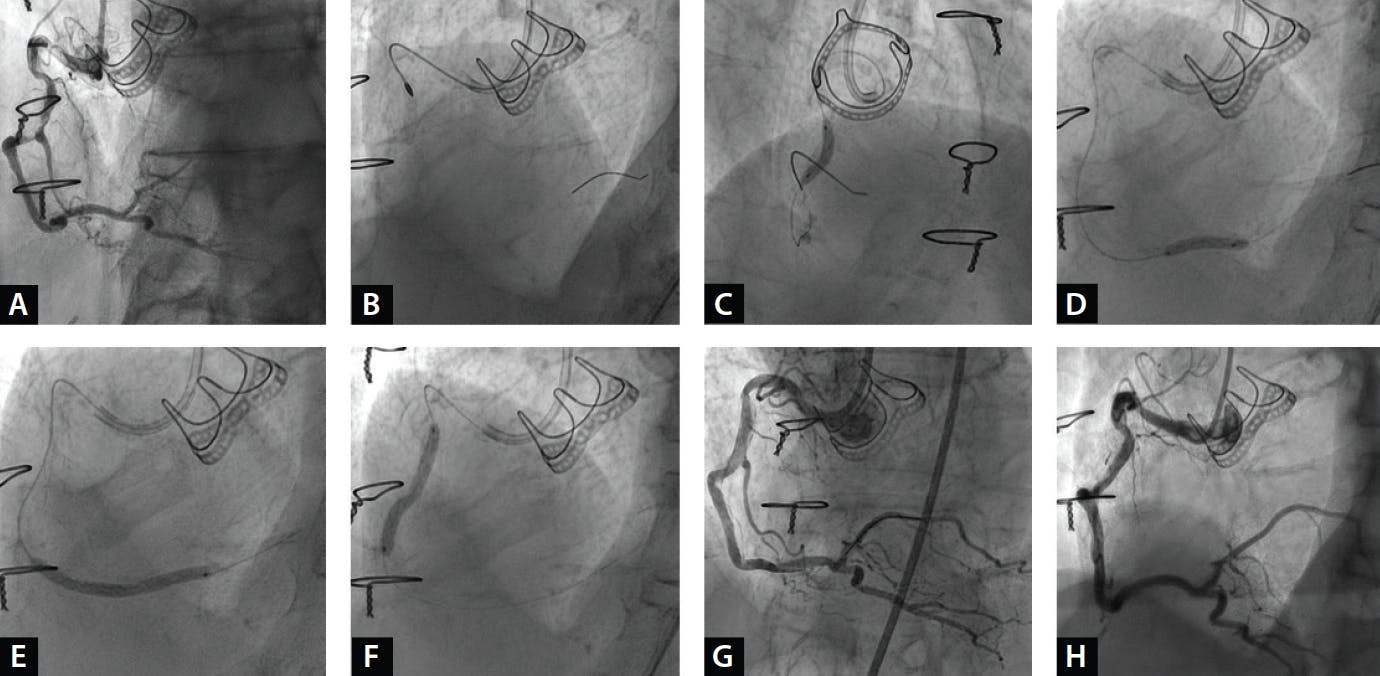
Figure 2. DCB angioplasty in a tortuous right coronary artery. Calcific lesions at the midproximal and distal segments of a tortuous diffusely diseased right coronary artery (A). Lesion preparation included rotational atherectomy with a 1.5-mm burr at the midproximal segment (B) and high-pressure, 3.5-mm NC balloon angioplasty along the vessel (C, D). Angioplasty with two sirolimus-coated 3.5- X 30-mm DCBs followed (E, F). Final angiography showed an adequate and stable result, with non–flow-limiting dissections at both segments (G). Spontaneous dissection healing and preserved lumen gain were evident at 1-month follow-up angiography (H).
When in doubt, we suggest using a pressure wire to evaluate the residual gradient across the dissected segment and recognize a threatening dissection (Pd/Pa [distal coronary/aortic pressure ratio] < 0.90) (Figure 1).8
Of note, wire withdrawal may help assess tortuous vessels by allowing the vessel to return to its proper shape. Rather than using intravascular imaging to guide assessment of dissection, we suggest using it to assess (1) plaque and calcium burden in complex lesions, (2) lumen gain in specific scenarios (such as ISR), and (3) vessel size in diffuse disease. Intravascular ultrasound is routinely preferred to avoid the rheolytic insult related to the high flow and volume injections needed for optical coherence tomography.
DCB Angioplasty
DCB angioplasty with a 1:1 balloon-to-artery diameter ratio and a length ≥ 2 mm longer than the predilated segment at either end should be planned. Uneventful delivery of the last used (and often bulkiest) balloon can be used as proxy of sufficient support for DCB delivery. DCB delivery to the target lesion is time sensitive and should be performed in a pristine manner. Once positioned, it should be inflated to nominal pressure for 60 to 90 seconds to ensure adequate drug delivery (Figure 1). There is no evidence to support repeated inflation to optimize drug delivery or whether lesion modification with specialty balloons such as scoring or cutting balloon might improve diffusion of antiproliferative agents. Result assessment should follow similarly to that occurring after lesion preparation. Although no signs of inadequate or unstable result should be expected after the low-pressure DCB inflation, PCI may proceed with additional lesion preparation and DCB angioplasty or stent implantation according to case specifics.
Stenting
Stenting should be considered in the presence of inadequate or unstable result, with the goal of covering the entire dissection if present (ie, bailout stenting). It has been reported that 5% to 15% of patients with de novo disease require bailout stenting.4,8 On the other hand, an up-front, hybrid strategy of stenting in the proximal segment and DCB angioplasty distally can be considered when treating a long lesion.
Specific Scenarios
The following scenarios may require specific nuances:
Bifurcation. DCBs allow simplification of the procedure, as most of the angioplasty can often be performed sequentially. A DCB can be integrated for side branch angioplasty in a provisional stenting strategy,9 which is of particular interest when treating the ostial left circumflex in distal left main bifurcation lesions. Additionally, a DCB-only strategy can be considered after adequate lesion preparation. Scoring or cutting balloon angioplasty should be preferred for ostial side branch lesions. Although sequential DCB delivery and inflation are then usually adequate (generally with the side branch first), kissing DCB inflation could be planned to avoid carina shift in specific cases.
CTO. For CTOs, an up-front hybrid strategy including stenting the occluded segment and DCB angioplasty of the distal (often diffuse) disease and negatively remodeled vessel can be pursued.
Thrombotic lesion. Operators may consider thrombus aspiration before DCB implementation in the presence of a thrombotic lesion. Nonetheless, we discourage following this approach in lesions with high residual thrombotic burden.
CONCLUSION
Altogether, in the current panorama of PCI, a systematic approach with considerate implementation of DCB angioplasty will not jeopardize patient safety, and it might further optimize the efficacy of PCI.
1. Colombo A, Leone PP. Redefining the way to perform percutaneous coronary intervention: a view in search of evidence. Eur Heart J. 2023;44:4321-4323. doi: 10.1093/eurheartj/ehad215
2. Jeger RV, Eccleshall S, Wan Ahmad WA, et al. Drug-coated balloons for coronary artery disease: third report of the International DCB Consensus Group. JACC Cardiovasc Interv. 2020;13:1391-1402. doi: 10.1016/j.jcin.2020.02.043
3. Colombo A, Leone PP, Ploumen EH, von Birgelen C. Drug-coated balloons as a first choice for patients with de novo lesions: pros and cons. EuroIntervention. 2024;20:e120-e122. doi: 10.4244/EIJ-E-23-00034
4. Leone PP, Oliva A, Regazzoli D, et al. Immediate and follow-up outcomes of drug-coated balloon angioplasty in de novo long lesions on large coronary arteries. EuroIntervention. 2023;19:e923-e925. doi: 10.4244/EIJ-D-23-00502
5. Cuculi F, Bossard M, Zasada W, et al. Performing percutaneous coronary interventions with predilatation using non-compliant balloons at high-pressure versus conventional semi-compliant balloons: insights from two randomised studies using optical coherence tomography. Open Heart. 2020;7:e001204. doi: 10.1136/openhrt-2019-001204
6. Mangieri A, Nerla R, Castriota F, et al. Cutting balloon to optimize predilation for stent implantation: the COPS randomized trial. Catheter Cardiovasc Interv. 2023;101:798-805. doi: 10.1002/ccd.30603
7. Kufner S, Joner M, Schneider S, et al. Neointimal modification with scoring balloon and efficacy of drug-coated balloon therapy in patients with restenosis in drug-eluting coronary stents: a randomized controlled trial. JACC Cardiovasc Interv. 2017;10:1332-1340. doi: 10.1016/j.jcin.2017.04.024
8. Leone PP, Mangieri A, Regazzoli D, et al. Drug-coated balloon angioplasty guided by postpercutaneous coronary intervention pressure gradient: the REDUCE-STENT retrospective registry. JACC Cardiovasc Interv. 2023;16:363-365. doi: 10.1016/j.jcin.2022.09.054
9. Neumann FJ, Sousa-Uva M, Ahlsson A, et al. 2018 ESC/EACTS Guidelines on myocardial revascularization. Eur Heart J. 2019;40:87-165. Published correction appears in Eur Heart J. 2019;40:3096. doi: 10.1093/eurheartj/ehy394
Advertisement
Advertisement