Advertisement
Advertisement
May/June 2024
Cutting and Scoring Balloons
By Ottavia Cozzi, MD; Antonio Mangieri, MD; Gabriele Gasparini, MD; and Damiano Regazzoli, MD
Cutting and scoring balloons have protrusive elements on the surface for modifying atherosclerotic plaque. These protruding elements (microsurgical blades for cutting balloons or nitinol or silicone wires for scoring balloons) anchor to the vessel surface, allowing uniform pressure to be distributed on a smaller surface compared to standard balloons. Commercially available cutting and scoring balloons differ regarding composition, number and shape of the protruding elements, the balloon crossing profile and compliance, and the design and coating of the distal body.
TIP 1: KNOW YOUR DEVICES
Modified balloon performance depends on different characteristics, including crossability, deliverability, compliance, and radial force.
The crossing profile is a function of the greatest diameter, usually at the level of the balloon. The protruding elements of cutting and scoring balloons create friction and reduce lesion crossability. The Wolverine cutting balloon (Boston Scientific Corporation) has a lower profile than the previous version (Flexotome, Boston Scientific Corporation). This was achieved by thinning the pad of the blade and adding a lubricious coating on the distal segment.
Deliverability depends on the balloon lesion entry profile (usually a tapered tip), pushability, and trackability. These characteristics result from a complex interaction between the design of the balloon (optimal crimping and reduced balloon thickness increase trackability), scoring elements, stiffening wire (shape and length past the rapid-exchange port), shape of the inflation lumen (a straight inflation lumen gives greater pushability), and stiffness of the metallic hypotube.
Balloon compliance, which refers to balloon diameter expansion as a function of pressure, varies among different cutting and scoring balloons, and as such, the operator should be aware of specific device compliance charts. Modified balloons are generally mounted on a relatively compliant balloon, which increases its diameter according to the pressure of inflation.
The protruding element shapes translate into different frictional properties. The triangle-shaped stainless steel microblades with cutting balloons have a better penetration depth compared to nitinol or silicone wires.1 Besides lacking sharpness, the scoring wire of some scoring balloons are fixed just at the end of the balloon. This reduces their anchoring properties and may hamper precise focal transmission of pressure to the vessel if the wire turns around during the inflation.
TIP 2: DETERMINE YOUR STRATEGY
Balloon predilatation is often performed before cutting balloons to facilitate device delivery and potentially perform intravascular imaging in the tightest lesions. Adequate support should be granted when using either cutting and scoring balloons, and this comprises access route selection, use of a supportive guiding catheter (Amplatz left for the right coronary artery, extra-backup for the left), and a low threshold for techniques and devices to increase support, such as a buddy wire, a guiding catheter extension, or an anchoring technique.
Two different strategies have been described for cutting balloons (Figure 1) and are, arguably, applicable also for scoring balloons. The first is nominal pressure inflation of a cutting balloon sized in a 1:1 ratio to the vessel; the balloon apposes to the vessel and uses the cutting action of the blades on the wall, rather than relying on high balloon pressure for plaque modification. The second is high-pressure inflation with an undersized cutting balloon (0.5 mm less than the media-to-media diameter). This combines the action of the scoring element and microblades and the high inflation pressure exerted on a delimited surface for achieving plaque modification.2 Undersizing is suggested to mitigate potential complications of balloon diameter increase at high pressure as a result of balloon semicompliance.
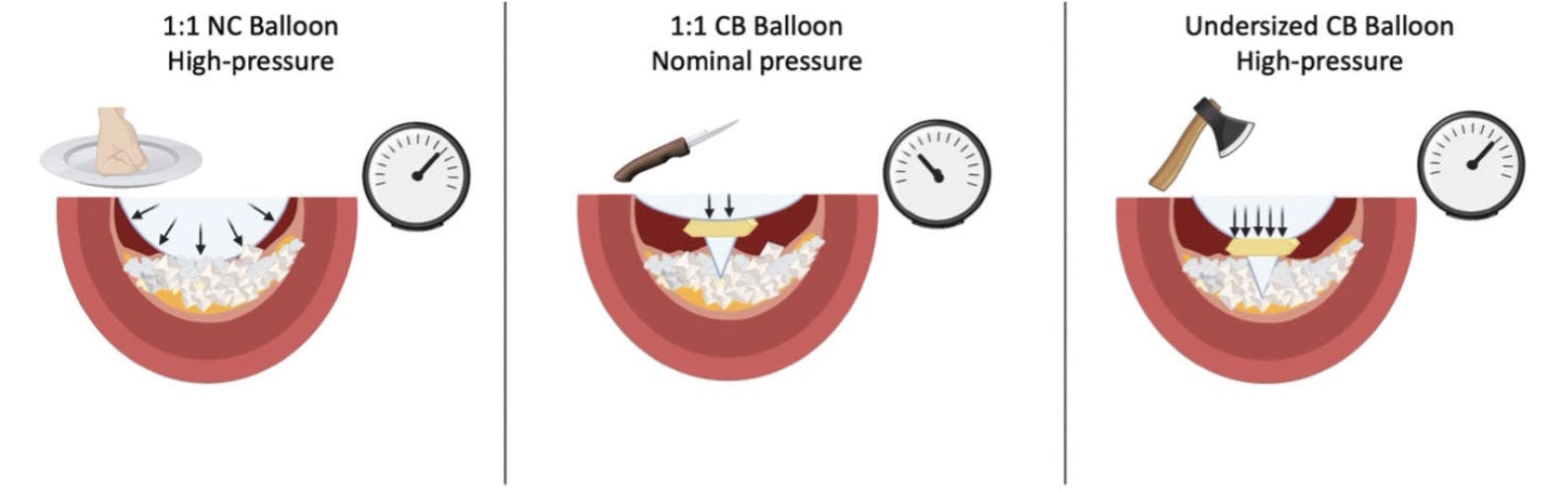
Figure 1. Effects of NC and cutting balloon (CB) inflated at nominal or high pressure on calcified plaque.
There is an absence of data from manufacturers regarding cutting balloon inflation at high atmospheres. According to manufacturer’s instructions for use, an inflation pressure with cutting balloon should not exceed 12 atm. Although a certain degree of balloon distortion must be considered, in our view the microblades may limit expansion and compliance of the balloon at high pressure. No exceeding risk of complications (ie, flow-limiting dissections, perforations) was reported with this strategy in previous studies.3,4 A potential drawback may be deformation of the rapid-exchange port, which could result in wire retraction when the balloon is pulled back, making a second wire advisable.
Our suggestion is a step-by-step inflation approach comprising prolonged inflations at progressively higher atmospheres followed by fluoroscopic or intravascular imaging evaluation to check full balloon expansion or proper lesion preparation. This approach exploits “plaque fatigue” while avoiding exceedingly aggressive dilatations.
Previous evidence suggests the effectiveness of lesion preparation with modified balloons before angioplasty using DCB. Drug transfer and tissue retention may be enhanced by the microinjury to the vessel wall achieved with cutting or scoring balloons. In this setting, gently dilatation of a modified balloon at nominal pressure can result in effective acute lumen gain, while allowing controlled plaque modification and microinjuries to increase drug tissue penetration.5,6
TIP 3: KNOW WHERE TO USE THE BALLOONS
Fibrotic and Ostial Lesions
Substantial plaque modification in noncalcified fibrotic lesions is generally not achieved with conventional balloon angioplasty. Elastic recoil and balloon slippage are frequent. Microincisions created by cutting and scoring balloons minimize elastic recoil, thus allowing more even expansion of the vessel. Lesions located at the ostium of epicardial vessels have high concentrations of elastic fibers and calcium, leading to elastic recoil and reduced vessel distensibility. As such, cutting and scoring balloons may be particularly advantageous here.
ISR
Cutting and scoring balloons should be sized 1:1 or upsized to 0.25 mm compared to the previously implanted stent size for ISR. Potential advantages include: (1) cutting balloon microblades can incise restenotic plaques up to the metallic stent cage and extrude the neointimal hyperplasia throughout the stent struts; (2) the hyperplastic tissue is rubbery and has a slippery surface; while conventional balloons tend to move forward or backward during inflation (Figure 2A), balloon anchoring is increased with scoring elements, thus reducing the risk of dissections at the stent margin; and (3) the incisions may favor intravascular diffusion of antiproliferative agents delivered by DCBs.5
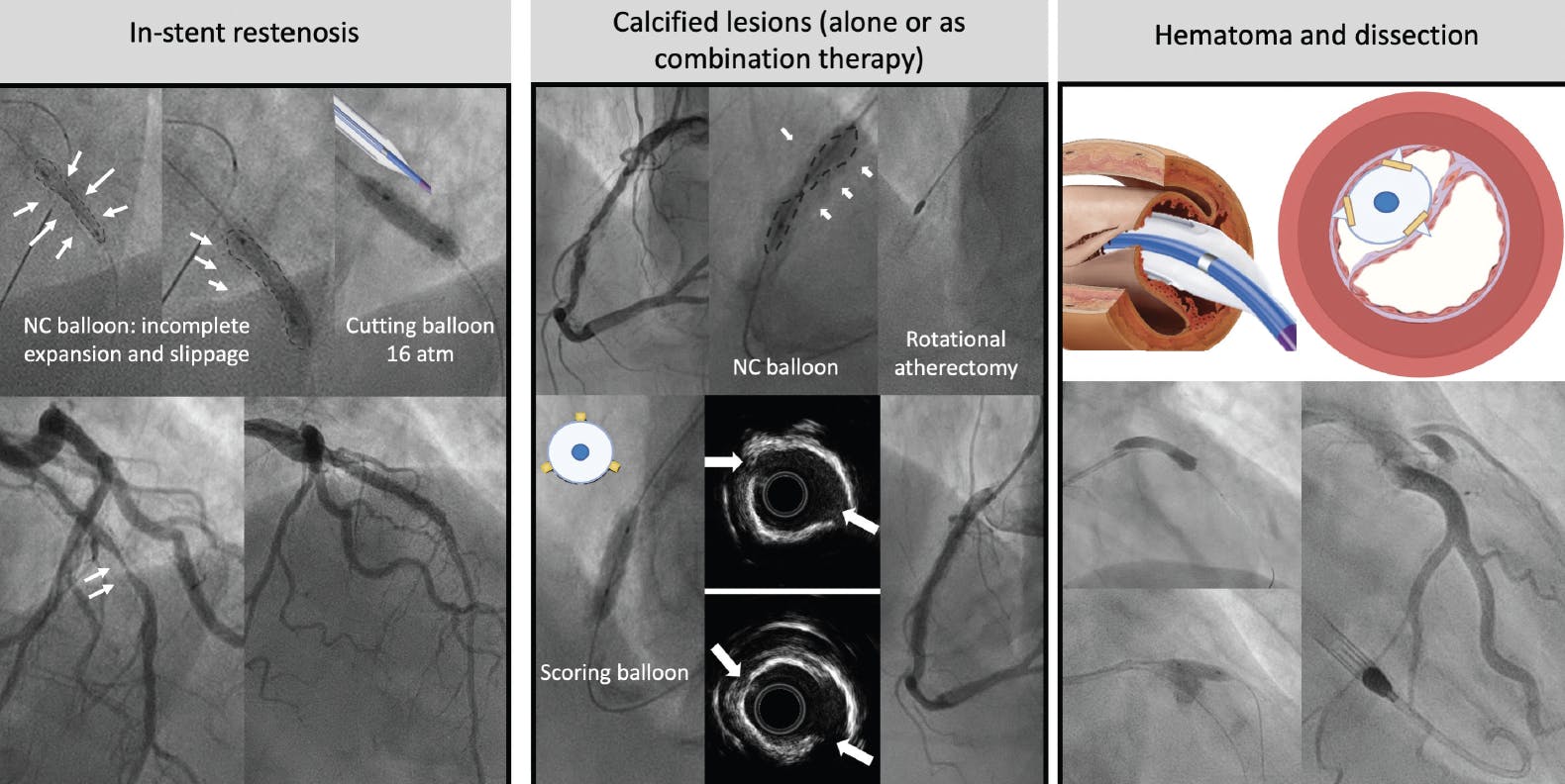
Figure 2. Severe ISR, successfully treated with cutting balloon inflation after failed NC balloon angioplasty (A). Combined use of rotational atherectomy and scoring balloon after failed NC balloon dilatation in a severely calcified lesion (B). Flow-limiting dissection of the left main artery, treated with multiple cutting balloon dilatation, resulting in flow restoration of the circumflex artery (C).
Calcified Lesions
For calcified lesions, cutting and scoring balloons can be used alone or combined with atherectomy. Concentric, focal, and superficial lesions as well as those with relatively thin calcified plaques are more likely to respond well to cutting and scoring balloons. In the COPS trial, calcified lesion preparation with high-pressure cutting balloon led to higher minimal stent area compared to NC balloons (8.1 ± 2 mm2 vs 7.3 ± 2.1 mm2). The benefit of the cutting balloon was more evident among patients with > 270° arc of calcium.3 In previous bench tests, the maximum principal stress on the vessel wall was obtained when the microblades were in front of the thinnest part of the calcification. If adequate expansion was not achieved, a second dilation might be successful after rotating the balloon.2 The main issues are balloon catheter stiffness (thus limiting its movements through tortuous and angulated lesions) and suboptimal balloon profile. Combined lesion preparation with rotational atherectomy and cutting balloon may overcome this challenges (Figure 2B). The strategy proved safe in previous studies, but benefits in terms of acute luminal gain appeared inconsistent.4,7
Coronary Dissections and Intramural Hematoma
The goal of cutting and scoring balloons in spontaneous and iatrogenic flow-limiting coronary dissection and intramural hematoma is to create multiple fenestrations between the true and false lumen (Figure 2C).8 This favors adequate distal flow recovery and should prevent abrupt vessel closure, while avoiding intramural hematoma propagation (milking). The approach can be useful in cases where the operator is unwilling to stent (eg, small vessel dissections, uncertainty about the correct wire positioning in the true lumen, concerns about adequate coverage of the intramural hematoma for its whole length).
CUTTING OR SCORING BALLOONS?
Few head-to-head comparisons of scoring versus cutting balloons are available, but the following considerations may guide the operator’s choice between the devices:
- Device crossability and trackability was previously better with scoring balloons compared to cutting balloons. This may be questionable today, as new-generation cutting balloons have been developed to have an improved profile.9
- In calcified lesions, the greater penetration depth with cutting balloon microblades may grant better plaque modification compared to scoring balloons.
- More evidence is currently available for scoring balloons compared to cutting balloons for treatment of ISR.
1. Kinoshita Y, Iwasaki K, Suzuki T. Verification of the differences of scoring effect in current scoring balloons. Cardiovasc Interv Ther. 2022;37:513-518. doi: 10.1007/s12928-021-00807-1
2. Song X, Adachi T, Kawase Y, et al. Efficacy of the Wolverine cutting balloon on a circumferential calcified coronary lesion: bench test using a three-dimensional printer and computer simulation with the finite element method . Cardiovasc Interv Ther. 2022;37:78-88. doi: 10.1007/s12928-020-00739-2
3. Mangieri A, Nerla R, Castriota F, et al. Cutting balloon to optimize predilation for stent implantation: the COPS randomized trial. Catheter Cardiovasc Interv. 2023;101:798-805. doi: 10.1002/ccd.30603
4. Allali A, Toelg R, Abdel-Wahab M, et al. Combined rotational atherectomy and cutting balloon angioplasty prior to drug-eluting stent implantation in severely calcified coronary lesions: the PREPARE-CALC-COMBO study. Catheter Cardiovasc Interv. 2022;100:979-989. doi: 10.1002/ccd.30423
5. Kufner S, Joner M, Schneider S, et al. Neointimal modification with scoring balloon and efficacy of drug-coated balloon therapy in patients with restenosis in drug-eluting coronary stents: a randomized controlled trial. JACC Cardiovasc Interv. 2017;10:1332-1340. doi: 10.1016/j.jcin.2017.04.024
6. Bonaventura K, Schwefer M, Yusof AKM, et al. Systematic scoring balloon lesion preparation for drug-coated balloon angioplasty in clinical routine: results of the PASSWORD observational study. Adv Ther. 2020;37:2210-2223. doi: 10.1007/s12325-020-01320-2
7. Sharma SK, Kini A, Mehran R, et al. Randomized trial of rotational atherectomy versus balloon angioplasty for diffuse in-stent restenosis (ROSTER). Am Heart J. 2004;147:16-22. doi: 10.1016/j.ahj.2003.07.002
8. Ito S, Ojio S, Suzuki T. A novel use of cutting balloon in treating coronary artery dissection that developed during PCI. J Invasive Cardiol. 2003;15:216-220.
9. Ishihara T, Iida O, Takahara M, et al. Improved crossability with novel cutting balloon versus scoring balloon in the treatment of calcified lesion. Cardiovasc Interv Ther. 2021;36:198-207. doi:10.1007/s12928-020-00663-5
Advertisement
Advertisement