Advertisement
Advertisement
May/June 2024
Ask The Experts: Lessons From the Renal Denervation Learning Curve
Experts share insights into lessons learned from clinical trials and real-world experience to date and the future of renal denervation.
With Herbert D. Aronow, MD, MPH; Michael Kunz, MD; Lucas Lauder, MD; and Felix Mahfoud, MD

Nearly half of all United States adults have hypertension (HTN), and blood pressure (BP) remains uncontrolled in nearly half of those individuals. Renal denervation (RDN) has emerged as a safe and effective treatment option for these patients. Over the past decade, as the evidence base supporting RDN has expanded, important lessons about this novel therapy have emerged.
LESSON 1
SYMPLICITY HTN-3 was a win.
The SYMPLICITY HTN-3 trial randomized 535 patients with resistant HTN to either radiofrequency RDN (rRDN) or sham therapy. Although it was negative on its primary endpoint (change in office BP at 6 months), forensic analysis of the trial’s design and results led to changes in patient selection, device characteristics, procedural technique, and endpoint selection in subsequent trials. Modification of these clinical trial attributes in sham-controlled pilot and pivotal trials yielded positive results, favoring RDN. Even more importantly, we learned that there was substantial room for improvement in our use of available medical and lifestyle therapies. Many patients in this trial screen failed because BP measured at their second prerandomization visit was better controlled. Additionally, among patients randomized to sham therapy, 6-month systolic and diastolic BP fell by nearly 12 and 5 mm Hg, respectively, when compared to baseline. The reasons for these observations were severalfold, but key among them was that significant BP reductions could be realized with greater attention to medical therapy and lifestyle intervention.
LESSON 2
RDN is complementary—not competitive—with medical therapy.
Trials of rRDN, ultrasound RDN (uRDN), and alcohol-mediated RDN have yielded statistically significant improvements in BP control that should translate into a reduced incidence of adverse clinical events over time. Nevertheless, many patients with uncontrolled HTN have BPs well above the American College of Cardiology/American Heart Association–recommended target of 130/80 mm Hg, and while the average observed reduction in office BPs across trials (~7 mm Hg systolic and ~4 mm Hg diastolic, respectively) may allow some patients to shed one or two antihypertensive agents while achieving BP goals, for many others, RDN will simply bring them closer to target. In short, while all achieved BP reductions are clinically important, RDN is unlikely to result in wholesale replacement of multiagent antihypertensive regimens. Optimal medical therapy will remain essential.
LESSON 3
Meticulous technique will be paramount if we are to mirror the efficacy and safety observed in clinical trials.
Although the safety profile of RDN devices in published clinical trials and real-world registries has been impressive, it is inevitable that when offered to much larger and more complex patient populations, complications will increase. Irrespective of which device is employed, vascular access site complications, renal artery dissections, and renal artery perforations will occur. Appropriate training and proctoring will be essential, and as always, careful attention to procedural technique will be of utmost importance. Likewise, given the absence of real-time operator feedback about the completeness of denervation when using currently available devices, comprehensive efforts will be required to denervate completely. For uRDN, appropriate balloon diameters must be confirmed through renal artery contrast injections prior to denervation, and the same balloon catheter should not be employed to denervate significantly larger or smaller contralateral or accessory renal arteries. For rRDN, RADIOSOUND-HTN taught us that current device iterations are only equivalent to uRDN when performed in both main and branch renal arteries. Finally, if clinical trial results are to be extrapolated to real-world settings, it will be imperative for operators to ablate renal sympathetic nerves carefully and completely in appropriately sized and selected vessels, irrespective of the device employed.
SUMMARY
We have learned a great deal from RDN clinical trials and real-world experience to date. No doubt, patients undergoing appropriately performed RDN will benefit greatly. Equally important, the much larger population of patients with uncontrolled HTN who do not undergo RDN are likely to derive benefit through renewed, better-organized national and local efforts at diagnosis and treatment of HTN.



Arterial HTN is the most important modifiable cardiovascular (CV) risk factor and a leading cause of death worldwide.1 Despite the availability of effective medical treatments proven to reduce CV morbidity and mortality, BP control remains unsatisfactorily low.2,3 Nonadherence to drug regimens is an important cause for both uncontrolled HTN and low BP control rates.4 Several device-based therapies, including catheter-based RDN, have been investigated in the last 2 decades as additional treatment options for the management of HTN. RDN reduces sympathetic nerve activity by modulating the afferent and efferent sympathetic nerves surrounding the renal arteries using thermal or chemical ablation.5 The early open-label SYMPLICITY HTN-1 and HTN-2 studies showed marked BP reductions after RDN.6,7 The randomized, sham-controlled SYMPLICITY HTN-3 trial evaluating RDN using the single-electrode Symplicity Flex (Medtronic) radiofrequency catheter system versus sham procedure (renal angiogram only) showed that both lowered office BP in patients with severe, resistant HTN without a significant difference between groups.8 However, the trial was limited by several shortcomings, including frequent changes of antihypertensive drugs, incomplete RDN procedures, and inadequate technical performance.9 The workup of SYMPLICITY HTN-3 marked the start of a steep learning curve (Figure 1). Histologic examination of cadaveric human renal arteries, for instance, showed that the number of potentially treatable nerves increases in the distal artery segments, and the postbifurcation segment was potentially identified as an attractive treatment area.10
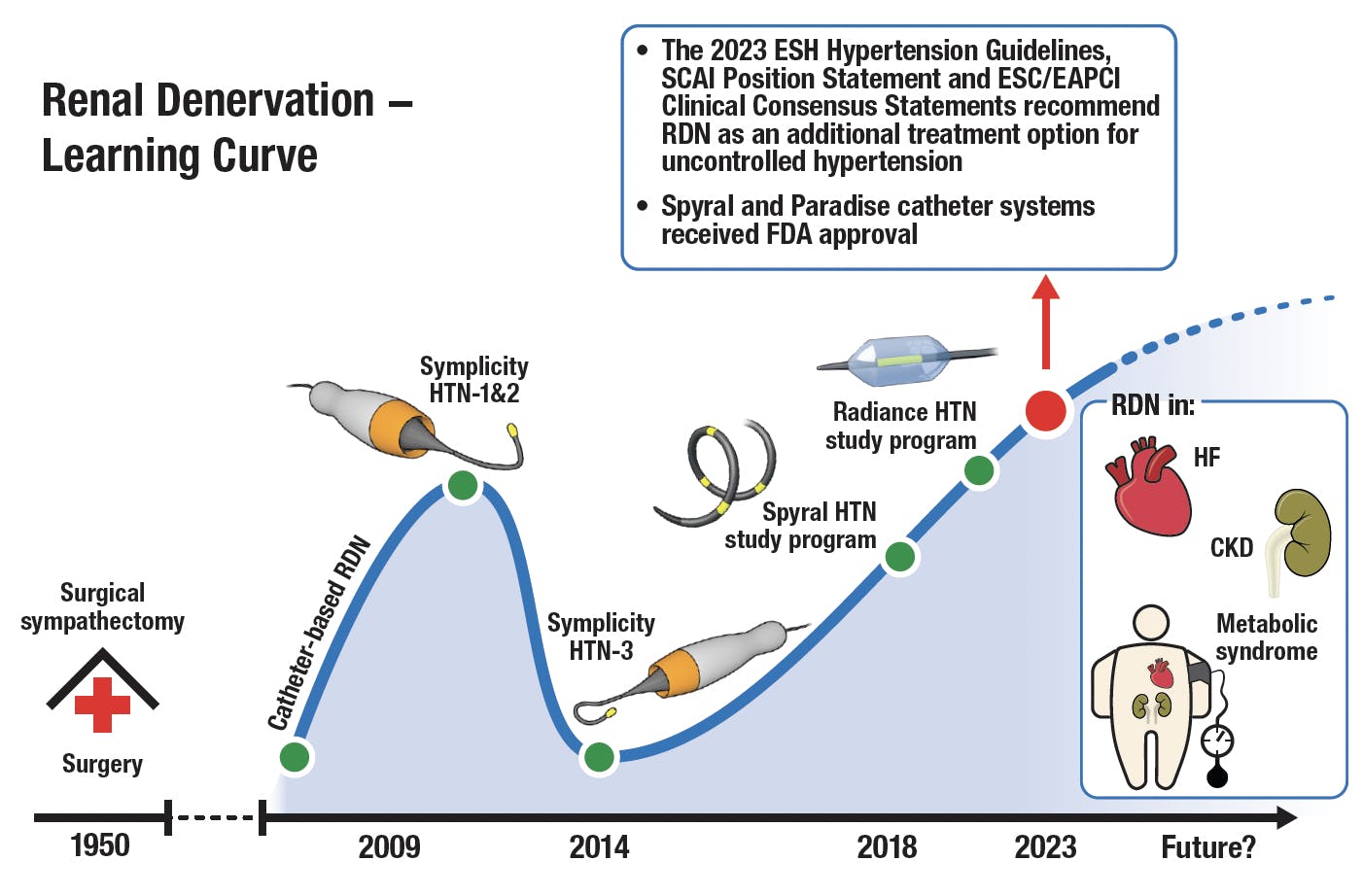
Figure 1. Graphic representation of the RDN learning curve. CKD, chronic kidney disease; EAPCI, European Association of Percutaneous Cardiovascular Interventions; ESC, European Society of Cardiology; ESH, European Society of Hypertension; HF, heart failure; SCAI, Society for Cardiovascular Angiography and Interventions. Symplicity Spyral, Medtronic; Paradise, Recor Medical.
APPLYING LESSONS LEARNED FROM INITIAL RDN TRIALS
To address the confounders identified in SYMPLICITY HTN-3, a set of second-generation, randomized, blinded, sham-controlled trials (SPYRAL HTN and RADIANCE HTN study program) were designed to provide proof of principle for the BP-lowering efficacy of RDN. rRDN and uRDN were associated with significant and sustained reductions in office and 24-hour ambulatory BP in patients with mild-to-moderate HTN without antihypertensive medication, as well as in those with treatment-resistant HTN.11-14 Based on these well-conducted RDN trials showing consistent BP reductions following the procedure, the European Society of Hypertension HTN guidelines and the European Society of Cardiology Council on Hypertension/European Association of Percutaneous Cardiovascular Interventions clinical consensus statement on RDN recommend that RDN be considered as a treatment option in patients with uncontrolled HTN despite treatment with three or more antihypertensive drugs including a diuretic (resistant HTN), or for patients who are unable to take antihypertensive drugs due to multiple drug intolerances.15,16
Because the sham-controlled trials only included patients with preserved renal function, RDN is currently only recommended in these patients (estimated glomerular filtration rate ≥ 40 mL/min/1.73 m2). Adequate patient selection with exclusion of secondary causes of HTN, operator experience with RDN techniques and technologies, and adequate technical performance of the procedure are indispensable for treatment success.15 Therefore, in Germany, a certification of RDN centers of excellence was established to guarantee optimal management of patients considered for RDN.
REMAINING QUESTIONS
Nevertheless, several open questions remain. First, the BP lowering observed after RDN is variable, and identifying patients with a higher likelihood of response is currently not possible. High baseline BP is the only predictor for future BP change.15 Second, intraprocedural parameters of acute treatment success are lacking. The usefulness of repeat RDN in patients with uncontrolled HTN after an initial RDN procedure is uncertain, and only one transradial catheter system is available at present. Third, it is unclear whether the BP reduction following RDN also improves CV morbidity and mortality. Additionally, RDN is also under investigation for other conditions associated with increased sympathetic nerve activity, including chronic heart failure with reduced (RE-ADAPT-HF [NCT04947670]) and preserved ejection fraction, atrial fibrillation, ventricular tachycardia, chronic kidney disease, obstructive sleep apnea, type 2 diabetes, and metabolic syndrome.15
CONCLUSION
The SYMPLICITY HTN-3 study nearly closed the chapter on RDN. However, in retrospect, it marked the beginning of a substantial learning curve not only in understanding RDN and the underlying physiology but also in clinical trial conduct. Moreover, RDN trials have reminded us of the importance of adherence to medication and the limitations of available BP measurements.17
1. Global Cardiovascular Risk Consortium; Magnussen C, Ojeda FM, Leong DP, et al. Global effect of modifiable risk factors on cardiovascular disease and mortality. N Engl J Med. 2023;389:1273-1285. doi: 10.1056/NEJMoa2206916
2. Williams B, Mancia G, Spiering W, et al. 2018 ESC/ESH guidelines for the management of arterial hypertension. Eur Heart J 2018;39:3021-3104. doi: 10.1093/eurheartj/ehy339
3. NCD Risk Factor Collaboration (NCD-RisC); Zhou B, Carrillo-Larco RM, Danaei G, et al. Worldwide trends in hypertension prevalence and progress in treatment and control from 1990 to 2019: a pooled analysis of 1201 population-representative studies with 104 million participants. Lancet. 2021;398:957-980. doi: 10.1016/S0140-6736(21)01330-1
4. Mahfoud F, Schmieder RE, Azizi M, et al. Proceedings from the 2nd European Clinical Consensus Conference for device-based therapies for hypertension: state of the art and considerations for the future. Eur Heart J. 2017;38:3272-3281. doi: 10.1093/eurheartj/ehx215
5. Tsioufis C, Mahfoud F, Mancia G, et al. What the interventionalist should know about renal denervation in hypertensive patients: a position paper by the ESH WG on the interventional treatment of hypertension. EuroIntervention. 2014;9:1027-1035. doi: 10.4244/EIJV9I9A175
6. Krum H, Schlaich MP, Sobotka PA, et al. Percutaneous renal denervation in patients with treatment-resistant hypertension: final 3-year report of the Symplicity HTN-1 study. Lancet. 2014;383:622-629. Published correction appears in Lancet. 2014;383:602. doi: 10.1016/S0140-6736(13)62192-3
7. Symplicity HTN-2 investigators; Esler MD, Krum H, Sobotka PA, et al. Renal sympathetic denervation in patients with treatment-resistant hypertension (the Symplicity HTN-2 trial): a randomised controlled trial. Lancet. 2010;376:1903-1909. doi: 10.1016/S0140-6736(10)62039-9
8. Bhatt DL, Kandzari DE, O’Neill WW, et al. A controlled trial of renal denervation for resistant hypertension. N Engl J Med. 2014;370:1393-1401. doi: 10.1056/NEJMoa1402670
9. Kandzari DE, Bhatt DL, Brar S, et al. Predictors of blood pressure response in the SYMPLICITY HTN-3 trial. Eur Heart J. 2015;36:219-227. doi: 10.1093/eurheartj/ehu441
10. Struthoff H, Lauder L, Hohl M, et al. Histological examination of renal nerve distribution, density, and function in humans. EuroIntervention. 2023;19:612-620. doi: 10.4244/EIJ-D-23-00264
11. Azizi M, Schmieder RE, Mahfoud F, et al. Endovascular ultrasound renal denervation to treat hypertension (RADIANCE-HTN SOLO): a multicentre, international, single-blind, randomised, sham-controlled trial. Lancet. 2018;391:2335-2345. doi: 10.1016/S0140-6736(18)31082-1
12. Kandzari DE, Böhm M, Mahfoud F, et al. Effect of renal denervation on blood pressure in the presence of antihypertensive drugs: 6-month efficacy and safety results from the SPYRAL HTN-ON MED proof-of-concept randomised trial. Lancet 2018;391:2346-2355. doi: 10.1016/S0140-6736(18)30951-6
13. Townsend RR, Mahfoud F, Kandzari DE, et al. Catheter-based renal denervation in patients with uncontrolled hypertension in the absence of antihypertensive medications (SPYRAL HTN-OFF MED): a randomised, sham-controlled, proof-of-concept trial. Lancet. 2017;390:2160-2170. doi: 10.1016/S0140-6736(17)32281-X
14. Azizi M, Schmieder RE, Mahfoud F, et al. Six-month results of treatment-blinded medication titration for hypertension control after randomization to endovascular ultrasound renal denervation or a sham procedure in the RADIANCE-HTN SOLO trial. Circulation. 2019;139:2542-2553. doi: 10.1016/S0140-6736(18)31082-1
15. Barbato E, Azizi M, Schmieder RE, et al. Renal denervation in the management of hypertension in adults. A clinical consensus statement of the ESC Council on Hypertension and the European Association of Percutaneous Cardiovascular Interventions (EAPCI). Eur Heart J. 2023;44:1313-1330. doi: 10.1093/eurheartj/ehad054
16. Mancia G, Kreutz R, Brunström M, et al. 2023 ESH guidelines for the management of arterial hypertension. The Task Force for the management of arterial hypertension of the European Society of Hypertension: endorsed by the International Society of Hypertension (ISH) and the European Renal Association (ERA). J Hypertens. 2023;41:1874-2071. doi: 10.1097/HJH.0000000000003480
17. Lauder L, da Costa BR, Ewen S, et al. Randomized trials of invasive cardiovascular interventions that include a placebo control: a systematic review and meta-analysis. Eur Heart J. 2020;41:2556-2569. doi: 10.1093/eurheartj/ehaa495
Advertisement
Advertisement