Advertisement
Advertisement
May/June 2021
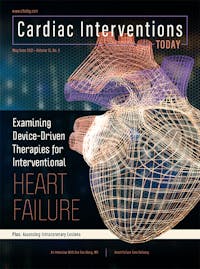
Examining Device-Driven Therapies for Interventional Heart Failure
By Ulrich Jorde, MD, and Nils Johnson, MD


Medical therapy has revolutionized the treatment of heart failure, and outcomes have improved quite dramatically since the introduction of β-blockers, neurohormonal blockers, and most recently, sodium glucose cotransporter-2 inhibitors. Yet heart failure remains a syndrome with high morbidity and mortality. A new era of device-based interventional heart failure has commenced and promises to have significant impact on the lives of those with this disease.
Our feature on interventional heart failure opens with Amit Alam, MD; Aasim Afzal, MD; and Susan M. Joseph, MD, presenting contemporary, percutaneous strategies for left ventricular reshaping and their promising experience thus far in studies.
As we have learned more about the pathophysiology and hemodynamic mechanism of acute cardiorenal syndrome, new regimens and device-based approaches have emerged. Emanuele Gallinoro, MD; Marc Vanderheyden, MD; and Jozef Bartunek, MD, walk us through some of these management options, including devices and therapies for managing renal afterload and preload, improving salt/volume hemostasis, and neuromodulation.
Next, Jan Griffin, MD, and Daniel Burkhoff, MD, consider interatrial shunt devices (IASDs) for reducing the left-sided filling pressures during exercise that are associated with heart failure with preserved ejection fraction. They discuss the six IASDs currently under investigation in trials and outline their characteristics and available data.
Also in this issue, we’ve assembled a subfeature on two hot topics in intracoronary lesion assessment. While distal fractional flow reserve (FFR) quantifies total disease burden along the entire vessel, a pullback maneuver can distinguish focal from diffuse patterns whose optimal treatment likely differs. The pressure pullback gradient metric, as detailed by Daniel Munhoz, MD; Jeroen Sonck, MD; and Carlos Collet, MD, brings an objective lens to what has historically been a visual impression. And what about after the procedure is complete? Bobby Ghosh, MD; Abdul Hakeem, MD; and Barry Uretsky, MD, continue the discussion by reviewing what we have learned about FFR measured after percutaneous coronary intervention, highlighting mechanisms, prognosis, and stent optimization
Our Today’s Practice column highlights heart failure management, with Ginger Biesbrock, PA-C, sharing best practices for transitional care management and key steps for building a transitional care pathway.
Finally, we interviewed Dee Dee Wang, MD, about building an interventional imaging program and recent steps forward in the field, three- and four-dimensional virtual and physical printing, and her experience with the American College of Cardiology’s Emerging Faculty program.
We invite you to enjoy these articles that speak to ongoing translation of cardiac pathophysiology into practical, device-based diagnosis and treatment.
Ulrich Jorde, MD
Nils Johnson, MD
Guest Chief Medical Editors
Advertisement
Advertisement