Advertisement
Advertisement
May/June 2021
Ventricular Reshaping Strategies in Heart Failure
Update on recent and ongoing clinical trials.
Approximately 64.3 million people have heart failure worldwide with an incidence and prevalence of more than 6 million, or > 2.5%.1 In the United States, roughly 60% of cases of congestive heart failure are due to ischemic cardiomyopathy.2 Both ischemic and nonischemic cardiomyopathy lead to adverse cardiac remodeling but with fairly different pathophysiology. Myocardial infarction leads to akinetic or dyskinetic myocardium, leading to increased wall stress. This leads to subsequent left ventricular dilatation, including a geometric change from ellipsoid to spherical.3 Afterload mismatch further increases adverse remodeling and neurohormonal activation. Despite revascularization after myocardial infarction, up to 20% of patients will undergo adverse remodeling.4 Nonischemic cardiomyopathies also undergo pathologic remodeling due to the culmination of a complex series of transcriptional, signaling, structural, and electrophysiological events occurring within the cardiac myocyte.5
Over the last few decades, with the introduction of new revascularization techniques and several drug classes that have shown improvement in mortality and morbidity, roughly 20% more people survive at 1-year and 5-year follow-up compared to the 1950s-1970s.1 Despite this, the mortality rate has remained stagnant with a high morbidity burden. This leaves a treatment gap that affects roughly 5 million patients just in the United States, even after guideline-directed medical therapies. Over the last decade, several percutaneous and surgical strategies have been developed to reduce symptom burden for chronic heart failure patients, reduce hospitalization, and improve overall quality of life and functional status.
SURGICAL VENTRICULAR REMODELING
One strategy to improve cardiac function is the concept of ventricular reconstruction. The first attempt at surgical restoration of the left ventricle (LV) was described by Cooley et al in 1958 in patients with anterior myocardial infarction aneurysms.4 In the 1980s, Dor introduced endoventricular circular patch repair that was deemed superior and became more widely utilized.6 Several variations of the Dor procedure have been adopted since then. The efficacy of surgical ventricular reconstruction in conjunction with coronary artery bypass grafting (CABG) was assessed in the STICH trial and failed to show a decrease in mortality, hospitalization, or improvement in symptoms despite showing a decrease in left ventricular volume when compared to undergoing CABG alone.7
Surgical ventricular reconstruction has also been explored in patients with dilated nonischemic cardiomyopathy. In 1985, Carpentier et al introduced dynamic cardiomyoplasty in patients with chronic heart failure. In this procedure, latissimus dorsi muscle is mobilized, drawn into the thorax, and wrapped around the heart and subsequently connected to a cardiostimulator to synchronously move with ventricular systole.8 An initial phase II, multicenter study showed improvement in left ventricular ejection fraction (LVEF), stroke volume, and stroke work index. The study also showed improvement in overall quality of life and New York Heart Association (NYHA) heart failure functional status.9 However, a prospective study with 68 patients who underwent this procedure failed to show improvement in peak oxygen consumption or cardiac index.10 Cardiomyoplasty has since been used in the setting of ventricular tumor excision, arrhythmogenic right ventricular dysplasia, and in conjunction with chronic resynchronization and defibrillator systems.11 Studies performed on cardiomyoplasty did show an increase in sudden cardiac death, which has limited the use of this strategy.
Another strategy for ventricular reduction with concomitant improvement in mitral regurgitation (MR) that gained initial traction in 2006 was the Coapsys device (Edwards Lifesciences), which was studied in the RESTOR-MV trial.12 The intent was to reduce functional MR and help improve symptoms with surgical ventricular remodeling. The device consisted of two epicardial pads connected by a flexible, suture-like cord passed through the ventricle with the help of imaging.13 This cord was then sequentially tightened to improve MR severity by improving coaptation of the leaflets. The final length of the cord was then determined by elimination of mitral insufficiency or maximum shortening of up to 35%.12 RESTOR-MV randomized patients with coronary artery disease and functional MR with LVEF > 25% to either annuloplasty with CABG or Coapsys device with CABG. The study showed both annuloplasty and Coapsys acutely reduced MR and annular dimension, but Coapsys showed a significantly greater LV reshaping compared to annuloplasty.12 The study left several questions unanswered as to the degree of scarring the device causes, as well as whether it excludes future valvular repairs. Unfortunately, the study was terminated early due to lack of funding, even with results showing a survival benefit during follow-up despite the control group’s lower degree of MR.11 Myocor went out of business in 2008, with patents purchased by Edwards Lifesciences. Edwards Lifesciences has yet to reveal any further investigation on this device.
In this article, we highlight contemporary less invasive strategies to aid in ventricular reshaping.
EPICARDIAL VENTRICULAR RESTORATION
Revivent Transcatheter System
Ventricular reduction by a minimally invasive surgical technique utilizing the Revivent-TC system (BioVentrix) has already demonstrated a stable reduction in left ventricular volumes in humans, and animal models have already revealed improvement in LVEF.14,15 The system is composed of polyester-covered titanium anchors (5 X 25 mm) attached to a polyethylene-ether-ether-ketone tether, which are placed on the right side of the interventricular septum and on the LV wall through a hybrid approach through percutaneous access in the right internal jugular vein and access to the LV through a left lateral thoracotomy approach. From outside the LV, a needle is used to puncture the LV and cross into the interventricular septum. Hemodynamics are monitored using a Swan-Ganz catheter. After reaching the right ventricle, the anchors are drawn together to allow apposition of the LV free wall to the septum. Positioning of the anchors to exclude scarred myocardium is achieved through fluoroscopic guidance and contrast injection in the LV.16
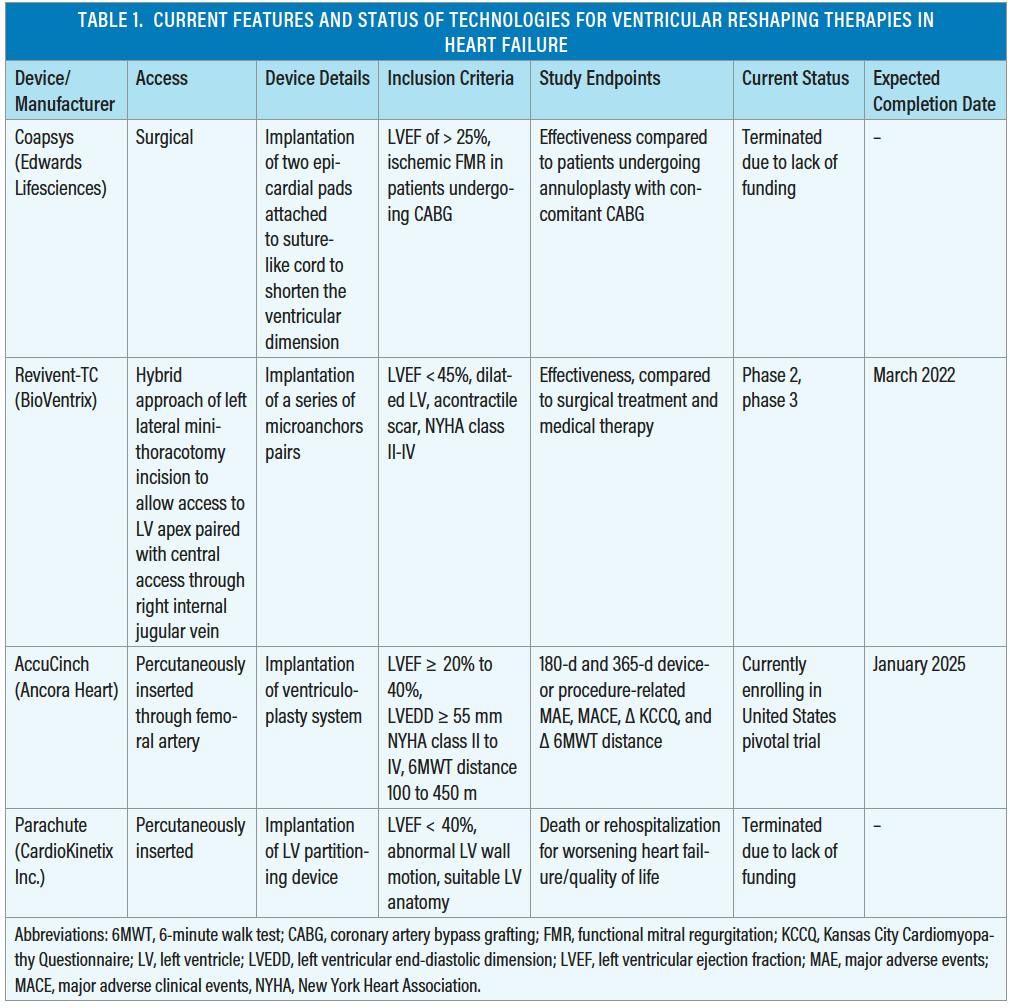
More recently, a prospective, multicenter, single-arm study across 22 centers in 12 countries in Europe was designed to assess the efficacy and safety of the device.16 Patients were included in the study if they had at least NYHA class II symptoms, LV dilatation and dysfunction caused by myocardial infarction, and akinetic and/or dyskinetic transmural scarred myocardium located in the anteroseptal, anterolateral, and/or apical regions. A total of 89 patients were enrolled and 86 patients were successfully treated (97%). At 1-year follow-up, the study found that all patients had significant and sustained reduction in LV volumes. In addition, a significant improvement in LVEF was observed (29 ± 8% vs 34 ± 9%; P < .005). Four patients (4.5%) died in the hospital and survival at 12 months was 90.6%. At baseline, 59% of heart failure (HF) patients were in NYHA class III compared with 22% at the 1-year follow-up. Improvements in Minnesota Living with Heart Failure Questionnaire (39 vs 26 points; P < .001) and 6-minute walk test (6MWT) (363 vs 416 m; P ≤ .001) were also reported. The most frequent observed adverse events were ventricular arrhythmias (14%) and bleeding (8.1%).3 In the United States, a similar pivotal trial to further assess the safety and efficacy of the device is underway (NCT02931240) (Table 1).
Ventriculoplasty
AccuCinch
The AccuCinch system (Ancora Heart) requires a retrograde approach percutaneously through the femoral artery for cinching of the anchors in the subannular space within the LV wall.17 The device is currently investigational, with preliminary analysis having a favorable safety profile with 97% freedom from device-related major adverse events at 30 days.18 In a multicenter, nonrandomized, prospective, early feasibility study to evaluate the efficacy and safety of the device, preliminary results suggest that AccuCinch implantation is feasible and safe.19 A total of 21 patients were treated with AccuCinch across eight sites with two patients not receiving the device before an implantation attempt due to anatomical limitations. There were no device-related adverse events during the procedure. A total of four patients had a procedure-related or hospitalization event within 30 days. Echocardiographic data indicated reductions of LV volume and MR, and improved LVEF at sequential 1-, 3-, and 6-month follow-up. Furthermore, 63% of patients had improved to NYHA class I/II at 6-month follow-up (baseline 13%) with improved Kansas City Cardiomyopathy Questionnaire quality of life scores (an increase from 50 to 65 points).19
Preliminary results with the AccuCinch system from Australia and Columbia assessing the procedural success, clinical safety, and major adverse cardiovascular events at 7 and 30 days, respectively, in the LVRECOVER (NCT02153892) and LVRESTORESA (NCT01899573) trials are promising. The CorCinch-EU study (NCT03183895) will complete enrollment in May 2022. In this prospective, nonrandomized, single-arm trial, the primary objectives are to evaluate the safety and performance of AccuCinch for the treatment of heart failure and functional MR in symptomatic adult patients, with or without functional MR and left ventricular remodeling due to dilated cardiomyopathy, who remain symptomatic despite optimized medical therapy. The aim is to enroll 132 participants across 24 centers in Europe.
In the United States, a prospective, randomized, multicenter study to study AccuCinch in patients with heart failure with reduced ejection fraction was launched in November 2020. The Corcinch-HF pivotal trial (NCT04331769) will compare AccuCinch to patients on guideline-directed medical therapy across 45 centers, with an enrollment goal of 400 participants, to support the submission of the company’s FDA premarket approval application (Table 1). The main primary outcomes evaluated will be device-related major adverse events at 180 and 365 days in addition to evaluation of Kansas City Cardiomyopathy Questionnaire scores and changes in 6MWT distance. To date, there have already been > 100 implants of the AccuCinch system worldwide.
VENTRICULAR PARTITIONING
Parachute
The umbrella-like Parachute device (CardioKinetix Inc.) consists of a fluoropolymer membrane stretched over a self-expanding nitinol frame ranging up to 95 mm in diameter when fully expanded. It is aimed to partition off the akinetic or the LV aneurysm in patients with ischemic heart failure.20
In the European and United States PARACHUTE feasibility trials, the observed rates of death or rehospitalization for HF were < 17% at 12 months. In a prospective, nonrandomized, observational study, the PARACHUTE III trial enrolled 100 patients in Europe and demonstrated that the device had favorable outcomes.21 The primary safety endpoint was procedural- or device-related major adverse cardiac cerebral events. Device implantation was successful in 97 (97%) patients. The secondary endpoints, LV volume reduction (P < .0001) and 6MWT distance improvement (P < .01) were also achieved. Despite the preliminary success reported, serial randomized trials were terminated because the company had closed (NCT01614652, NCT02543632) (Table 1). It remains unclear whether the use of the Parachute device will be continued.
CONCLUSION
Left ventricular reshaping strategies have been utilized for the past several decades, with variable success. Early surgical strategies showed no mortality benefit or improvement in quality of life, limiting their widespread adaptation. However, modified surgical reconstruction strategies have shown some improvement in symptom burden but none of the studies to date have shown a true mortality benefit. Over the last decade, several percutaneous options have been designed and are in various stages of development and approval.
Several current minimally invasive techniques for ventricular reshaping hold promise for the future. They have already demonstrated safety and efficacy endpoints. Improvements in quality-of-life questionnaires and 6MWT distances were observed. Additionally, echo parameters revealing reduction in volumes and improved ejection fractions have also been appreciated. However, most of the studies are based on early feasibility data, and we anxiously await the large-scale clinical data regarding their safety, clinical utility, and perhaps a mortality benefit from the current ongoing trials.
Despite the promising data with the advent of new devices and techniques, a fundamental key to success remains in optimization of guideline-directed medical therapy—this cannot be overstressed. As the fields of heart failure and structural cardiology continue to evolve, a heart team approach will be vital to identify and optimize the right patient for the right procedure at the right time.
1. Groenewegen A, Rutten FH, Mosterd A, Hoes AW. Epidemiology of heart failure. Eur J Heart Fail. 2020;22:1342-1356. doi: 10.1002/ejhf.1858
2. Ghali JK, Hu S, Zheng Z, et al. Surgical ventricular reconstruction. N Engl J Med. 2009;361:529-32.
3. Klein P, Anker SD, Wechsler A, et al. Less invasive ventricular reconstruction for ischaemic heart failure. Eur J Heart Fail. 2019;21:1638-1650. doi: 10.1002/ejhf.1669
4. Gaudron P, Eilles C, Kugler I, Ertl G. Progressive left ventricular dysfunction and remodeling after myocardial infarction. Potential mechanisms and early predictors. Circulation. 1993;87:755-763. doi: 10.1161/01.cir.87.3.755
5. Burchfield JS, Xie M, Hill JA. Pathological ventricular remodeling: mechanisms: part 1 of 2. Circulation. 2013;128:388-400. doi: 10.1161/CIRCULATIONAHA.113.001878
6. Di Donato M, Castelvecchio S, Menicanti L. Surgical treatment of ischemic heart failure: the Dor procedure. Circ J. 2009;73(Suppl A):A1-5. doi: 10.1253/circj.cj-08-1081
7. Jones RH, Velazquez EJ, Michler RE, et al. Coronary bypass surgery with or without surgical ventricular reconstruction. N Engl J Med. 2009;360:1705-1717. doi: 10.1056/NEJMoa0900559
8. Lehmann A, Faust K, Boldt J, et al. Dynamic cardiomyoplasty in patients with end-stage heart failure: anaesthetic considerations. Br J Anaesth. 1999;82:140-143. doi: 10.1093/bja/82.1.140
9. Dumcius A, Chekanov V, Vysockas V. Current status of cardiomyoplasty as surgical alternative for end-stage heart failure. Medicina (Kaunas). 2003;39:815-22.
10. Chachques J. Cardiomyoplasty: is it still a viable option in patients with end-stage heart failure? Eur J Cardio Thorac Surg. 2009;35;201-203. doi: 10.1016/j.ejcts.2008.09.028
11. Hendriks T, Schurer RAJ, Al Ali L, et al. Left ventricular restoration devices post myocardial infarction. Heart Fail Rev. 2018;23:871-883. doi: 10.1007/s10741-018-9711-2
12. Grossi EA, Woo YJ, Schwartz CF, et al. Comparison of Coapsys annuloplasty and internal reduction mitral annuloplasty in the randomized treatment of functional ischemic mitral regurgitation: impact on the left ventricle. J Thorac Cardiovasc Surg. 2006;131:1095-1098. doi: 10.1016/j.jtcvs.2005.11.046
13. Inoue M, McCarthy PM, Popović ZB, et al. The Coapsys device to treat functional mitral regurgitation: in vivo long-term canine study. J Thorac Cardiovasc Surg. 2004;127:1068-1076; discussion 1076-1077. doi: 10.1016/j.jtcvs.2003.12.005
14. Wechsler AS, Sadowski J, Kapelak B, et al. Durability of epicardial ventricular restoration without ventriculotomy. Eur J Cardiothorac Surg. 2013;44:e189-e192. doi: 10.1093/ejcts/ezt292
15. Cheng Y, Aboodi MS, Wechsler AS, et al. Epicardial catheter-based ventricular reconstruction: a novel therapy for ischaemic heart failure with anteroapical aneurysm. Interact Cardiovasc Thorac Surg. 2013;17:915-922. doi: 10.1093/icvts/ivt387
16. Pillay T, Neves P, Benetti F, et al. Minimal access left ventricular reconstruction. J Card Surg. 2021;36:300-306. doi: 10.1111/jocs.15117
17. Gooley RP, Meredith IT. The Accucinch transcatheter direct mitral valve annuloplasty system. EuroIntervention. 2015;11(Suppl W):W60-W61. doi: 10.4244/EIJV11SWA16
18. Jorde U, Polonetsky O, Kurlianskaya A, et al. TCT CONNECT-433 Catheter-based ventricular restoration in heart failure patients with reduced LVEF: 3-month outcomes. J Am Coll Cardiol. 2020;76(Supp 17):B185-B186. doi: 10.1016/j.jacc.2020.09.461
19. Reisman M, Wudel J, Martin S, et al. TCT-88: 6-month outcomes of an early feasibility study of the AccuCinch left ventricular repair system in patients with heart failure and functional mitral regurgitation. J Am Coll Cardiol. 2019;74(Supp 13):B88. doi: 10.1016/j.jacc.2019.08.129
20. Costa MA, Mazzaferri EL Jr, Sievert H, Abraham WT. Percutaneous ventricular restoration using the parachute device in patients with ischemic heart failure: three-year outcomes of the PARACHUTE first-in-human study. Circ Heart Fail. 2014;7:752-758. doi: 10.1161/CIRCHEARTFAILURE.114.001127
21. Thomas M, Nienaber CA, Ince H, et al. Percutaneous ventricular restoration (PVR) therapy using the Parachute device in 100 subjects with ischaemic dilated heart failure: one-year primary endpoint results of PARACHUTE III, a European trial. EuroIntervention. 2015;11:710-717. doi: 10.4244/EIJV11I6A143
Advertisement
Advertisement