Advertisement
Advertisement
May/June 2021
Device-Based Therapy of Acute Cardiorenal Syndrome in Heart Failure
Reviewing the therapeutic device-based approaches for acute CRS and their mechanisms of action and clinical experience.
By Emanuele Gallinoro, MD; Marc Vanderheyden, MD; and Jozef Bartunek, MD, PhD
Cardiorenal syndrome (CRS) includes a spectrum of pathologic conditions involving the heart and the kidneys in which an acute or chronic dysfunction in one organ may induce acute or chronic dysfunction of the other.1 Traditionally, the definition of CRS was cardio centric because it primarily identified interactions between the kidneys and other circulatory compartments, leading to increased circulating volume underlying exacerbation of heart failure (HF) symptoms and progression.
This definition remains the cornerstone of CRS because it is commonly observed in acute decompensated HF (ADHF). However, given the wide clinical spectrum of cardiorenal dysregulation, CRS was subsequently phenotyped into two major groups based on the predominant primum movens of the disease process: CRS and renocardiac syndrome. More recently, the Acute Dialysis Quality Initiative workgroup classified CRS into five types (Table 1) to highlight the bidirectional nature of heart-kidney interactions.2
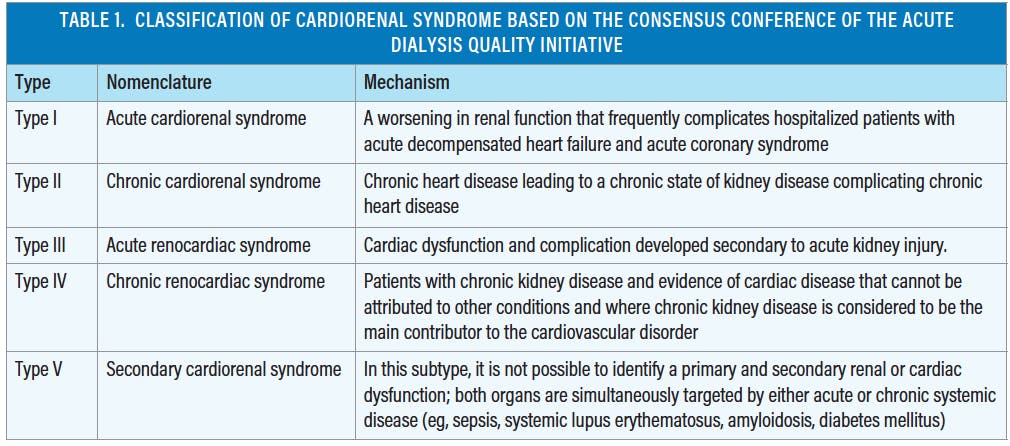
This article focuses on the use of device-based therapies for patients with acute CRS as a subset of acute HF (AHF) syndromes. In clinical practice, acute CRS in HF is described as “an extreme form of cardiorenal dysregulation in which therapy to relieve congestive symptoms of HF is limited by further decline in renal function.”2 Acute CRS represents an unmet clinical need associated with impaired diuretic responsiveness and poor clinical outcomes, and the search for novel therapeutic approaches is of utmost importance.
PATHOPHYSIOLOGY OF ACUTE CRS
The pathophysiology of acute CRS is complex. Traditionally, CRS was related primarily to reduced cardiac output causing impaired perfusion, with subsequent activation of renin-angiotensin-aldosterone axis, the sympathetic nervous system, and secretion of arginine vasopressin, all leading to volume overload.1 However, later data from the ADHERE registry demonstrated that the incidence of elevated serum creatinine was similar among patients with AHF and reduced versus preserved systolic function, thereby arguing against reduced cardiac output as the only primum movens for the syndrome.3 It is now recognized that acute CRS often develops in the presence of adequate cardiac output, and acute cardiorenal dilemma is perpetuated by synergistic hemodynamic and neurohumoral pathophysiologic mechanisms (Figure 1). The pivotal hemodynamic mechanism appears to be related to renal flow homeostasis within the encapsulated and nonelastic kidney parenchyma. Adequate renal blood flow (RBF) and glomerular filtration are maintained if the difference between arterial driving pressure and venous outflow pressures remains sufficiently large. Elevated central venous pressures (CVPs) leading to renal venous hypertension will increase renal resistance determined by encapsulated kidney parenchyma, precipitating impaired intrarenal blood flow and renal venous congestion.4
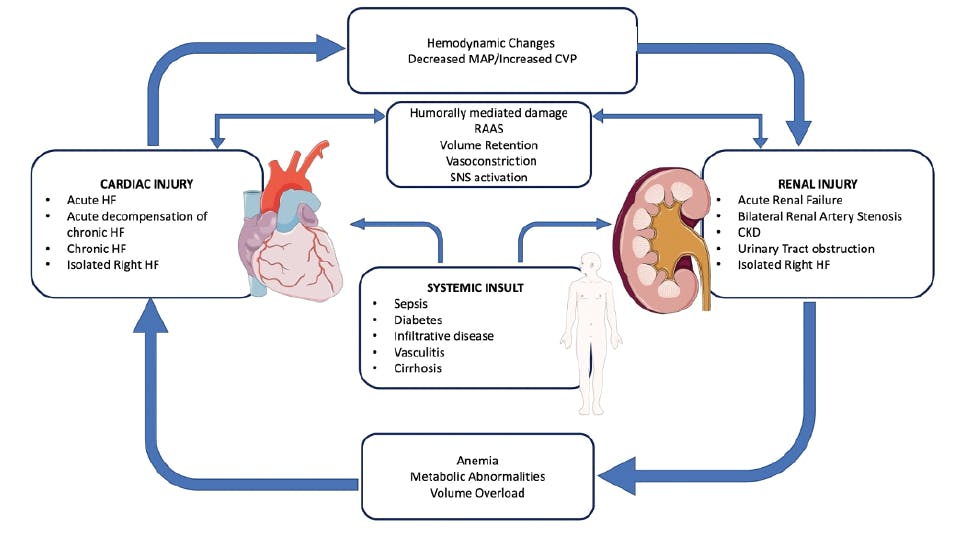
Figure 1. Pathophysiology of CRS. CKD, chronic kidney disease; MAP, mean arterial pressure; RAAS, renin-angiotensin-aldosterone system.
This postulate has been validated in patients with AHF using invasive hemodynamic monitoring, as well as in patients with increased intraabdominal pressure secondary to gut edema and abdominal ascites. In addition, neuromodulatory disbalance mediated by vascular baroreceptors may adversely impair renal perfusion. In this regard, AHF may also be exacerbated by volume redistribution and compartmentalization rather than being solely the consequence of excessive, overwhelming fluid retention, thus presenting a new paradigm shift in understanding the pathophysiology of acute CRS. A substantial number of AHF patients appear to have minimal blood volume increase, indicating that these patients have a vascular component of increased filling pressures independent of volume expansion. Hence, the perception of central congestion in these patients may lead to unnecessary diuresis that can lead to intravascular volume depletion, with CRS as the final result.
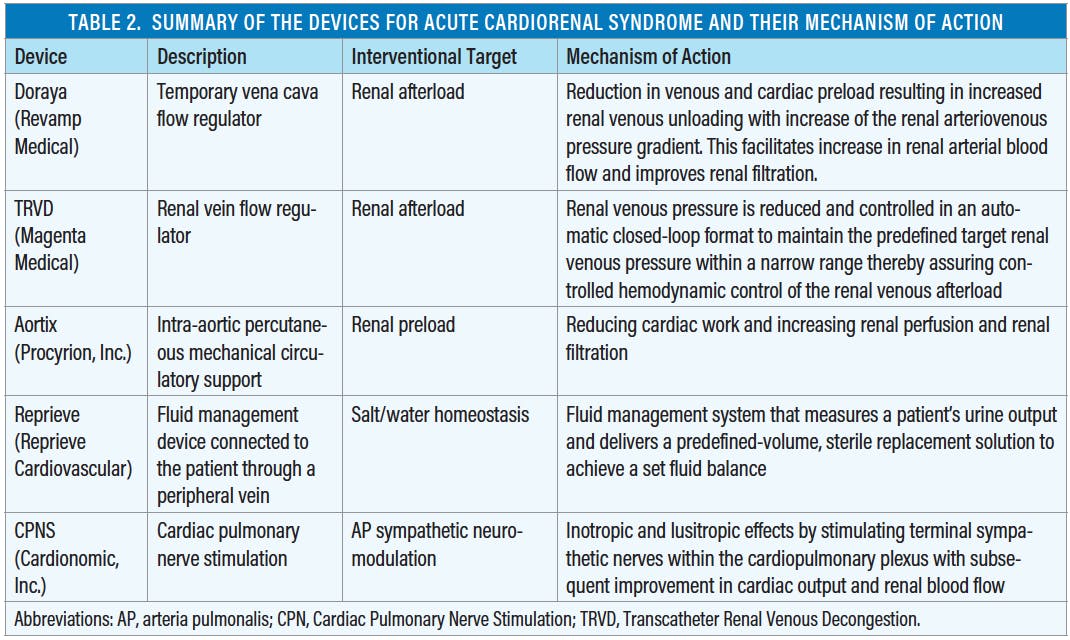
The granularity in understanding the pathophysiology of acute CRS led to development of new medical regimens and device-based approaches to disrupt adverse pathophysiologic traits. In this article, we first review emerging device-based approaches according to their primary mechanism of action (Table 2), focusing on devices targeting kidney hemodynamics and renal perfusion by altering renal venous afterload or arterial preload. Secondly, we highlight new devices acting on salt/volume homeostasis and neuromodulatory balance.
DEVICE-BASED MANAGEMENT OF RENAL AFTERLOAD AND PRELOAD IN ACUTE CRS
Doraya
The Doraya catheter (Revamp Medical), a vena cava flow regulator, is a temporary catheter-based device that is placed in the inferior vena cava (IVC) below the renal veins to apply partial, manageable venous return block for < 24 hours (Figure 2A). The mechanical flow obstruction temporarily relieves congestion from the heart, lungs, and kidneys in patients with poor response to diuretic therapy. The Doraya catheter is composed of a flexible nitinol frame mounted on the distal end of the catheter that adapts to vessel anatomy. The frame is covered in its distal portion by a hydrophilic polyurethane layer that restricts blood flow. Blood flow in the IVC is regulated by operator-controlled catheter activation. The maximum diameter of the frame is 25 mm, and with a 12-F outer diameter, the catheter provides access for hemodynamic monitoring through IVC blood pressure measurement above and below the site of flow restriction. These lumens may also serve for administration of nutrients and fluids, as well as for blood sampling. The catheter is compatible with standard 0.035-inch guidewires.
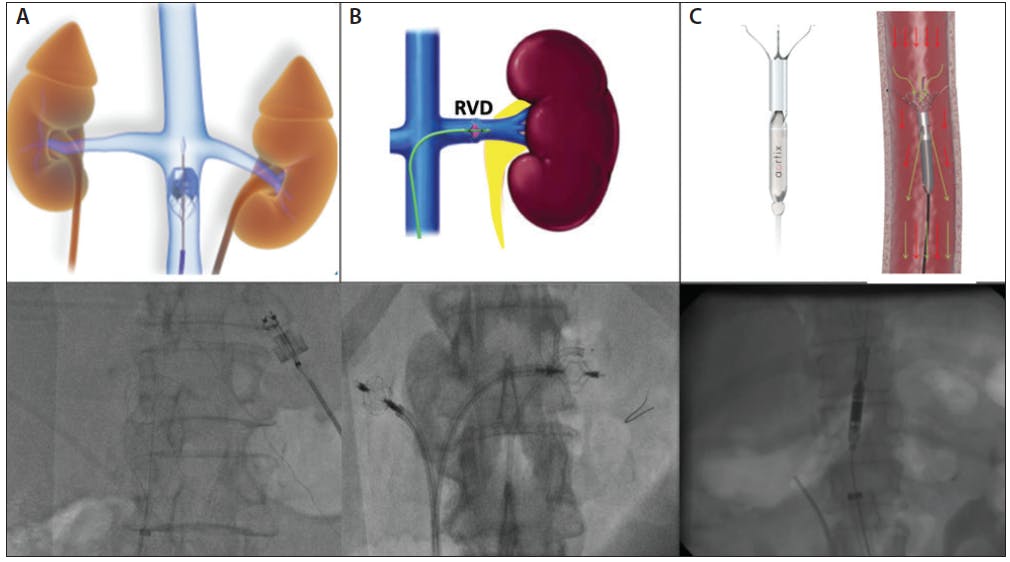
Figure 2. Devices targeting renal loading as the primary mechanism in volume management in acute CRS. Doraya (A), TRVD (B), Aortix (C).
Doraya reduces venous and cardiac preload through controlled obstruction of venous blood flow by adjusting the opening of the distal frame. This leads to renal venous unloading with increase of the renal arteriovenous pressure gradient that facilitates and increases renal arterial blood flow and improves renal filtration. The second effect is unloading of the left ventricle, with a reduction in intraventricular filling pressure, wall stress, and afterload and subsequent leftward shift of the Frank-Starling curve, leading to improved cardiac performance. This synergistically further augments renal perfusion, diuretic response, and redistribution of the excess fluid. Initial case-based experience demonstrated feasibility and provided initial clinical validation of the mechanism of action and its ability to overcome diuretic resistance in a patient with ADHF.5 A first-in-human (FIH) clinical study to assess device safety, effectiveness, and feasibility is ongoing (NCT03234647) in HF patients with systemic congestion and insufficient response to diuretic treatment, defined as failure to reduce weight or increase urine output within 24 hours in response to intravenous diuretics, with persistently elevated CVP > 12 mm Hg. Up to device removal, the therapeutic procedural regimen requires systemic anticoagulation to maintain advanced clotting time > 250 sec and dual antiplatelet therapy. Of note, despite hypothetical concern, no increase in peripheral edema has been observed so far.
Transcatheter Renal Venous Decongestion
The Transcatheter Renal Venous Decongestion (TRVD) system (Magenta Medical) is designed to relieve renal congestion via active propelling of the renal venous return to the vena cava. It consists of an over-the-wire, steerable, self-locking 8-F renal venous decongestion introducer, positioned in a renal vein through a percutaneous transfemoral venous approach and a renal venous decongestion catheter advanced through the introducer. A self-expandable, nonobstructive, axial flow, propeller-type pump is mounted on the distal tip of the TRVD catheter; it is crimped into the introducer and deployed within the renal vein (Figure 2B). The pump head includes a nitinol cage that protects the vein from the rotating propeller, which consists of a nitinol frame and silicone membrane. The distal tip of the TRVD catheter incorporates a high-fidelity micromanometer for measuring renal venous pressure (RVP). Target therapeutic pressures can be set separately for each renal vein. RVP is actively reduced and controlled in an automatic closed-loop format to maintain the predefined target RVP within a narrow range, thereby assuring controlled hemodynamic control of the renal venous afterload.
The system underwent extensive preclinical testing in an animal model using adjustable pressure increase in the IVC with an inflatable balloon. During periods of increased IVC pressure (20 mm Hg), urine output decreased from 21 to 10 ± 4 mL/min in the untreated kidneys (P < .002) but remained unchanged in the treated kidneys. This was associated with concordant changes in RBF and sodium excretion. Furthermore, cumulative urine output was higher after bilateral treatment compared with unilateral treatment. An FIH feasibility study consisted of 13 ADHF patients (age, 67 ± 12 years; left ventricular [LV] ejection fraction, 20% ± 7%) with elevated N-terminal (NT)-pro hormone BNP (brain natriuretic peptide), distension of the IVC, and a CVP > 14 mm Hg; all patients received intravenous loop diuretics.6 Along with demonstrating early safety and feasibility, the FIH experience showed consistent immediate RVP reduction and direct evidence of improved RBF. Acute improvement in renal hemodynamics preceded gradual decrease in right atrial. A new-generation device is currently being developed to allow placement of a single catheter into the IVC at the level of the renal veins that would unload the entire IVC segment, thereby simplifying the intervention without the need for selective renal vein cannulation and preprocedural imaging.
Aortix
The Aortix (Procyrion, Inc.) is an intra-aortic percutaneous mechanical circulatory support device deployed via a transfemoral approach using an 18-F delivery system. It consists of a 6-mm axial flow pump placed in the descending aorta that is designed to increase directly forward renal flow. As native flow enters the pump’s inlet, it is accelerated in the pump and exits in high-velocity jets directed downstream. These high-velocity jets entrain the native flow, and the acceleration of the flow momentum and its energy results in a net increase in overall aortic flow downstream (Figure 2C). By reducing cardiac work and increasing renal perfusion, the renal filtration is improved, and the negative cardiorenal feedback loop can be interrupted.7 A multicenter study to evaluate safety and clinical performance of the Aortix system in patients hospitalized with ADHF and worsening renal function refractory to medical therapy is ongoing (NCT04145635). Patients > 21 years who are admitted to the hospital with a primary diagnosis of ADHF (either reduced or preserved ejection fraction), persistent clinical signs and/or symptoms of congestion, worsening in renal function (serum creatinine increase by ≥ 0.3 mg/dL) despite 48 hours of intravenous diuretic therapy, and elevated CVP (≥ 10 mm Hg) or pulmonary capillary wedge pressure (≥ 20 mm Hg) can be enrolled.
DEVICE-BASED THERAPIES TO IMPROVE SALT/VOLUME HOMEOSTASIS
Reprieve System
Salt restriction leads to a reduction in chloride sensing by the macula densa in the distal nephron, which leads to a sodium-avid state in the kidney. Therefore, saline administration during aggressive therapy, which was initially considered a controversial treatment strategy, directly modulates sodium avidity and promotes its excretion.
This insightful paradigm has been introduced into the device-based approach by the Reprieve system (Reprieve Cardiovascular). It comprises an automated fluid management system that measures a patient’s urine output and delivers a predefined-volume, sterile replacement solution to achieve a clinician-set fluid balance. The device is connected to the patient through a peripheral vein cannula and urinary catheter, allowing feedback-loop monitoring and treatment adjustments. Practically, if the desired fluid balance was programmed to −150 mL/h and the patient’s urine output was 350 mL/h, the system would infuse 200 mL of sterile replacement solution to achieve the target fluid balance. By supplementing excess fluid loss, the intravascular fluid volume is maintained, ensuring stable cardiac output. By limiting net fluid loss, it is also expected that renal perfusion is maintained, thereby preventing the kidney from activating adverse compensatory mechanisms with sodium and fluid retention. In this regard, renal injury associated with diuretics and hemodynamic deterioration could be prevented. Early clinical studies have demonstrated clinical safety of these goal-directed dose adjustments based on natriuretic/diuretic feedback, with early efficacy signals of markedly improved diuresis and global patient improvement.8
DEVICE-BASED NEUROMODULATION IN ACUTE CRS
Cardiac Pulmonary Nerve Stimulation System
Cardionomic, Inc. has developed the proprietary Cardiac Pulmonary Nerve Stimulation (CPNS) system for cardiopulmonary plexus stimulation. The CPNS system consists of CN2, a single-use neuromodulation stimulation catheter, which is connected to a reusable external Cardionomic research stimulator with tablet software and a tablet. The CN2 catheter is placed into the right pulmonary artery via 16-F venous access (Figure 3). The CPNS system is intended to provide acute (up to 5 days) endovascular stimulation of the cardiopulmonary plexus in the right pulmonary artery in HF patients with ADHF. Its intended performance is LV contractility without significant heart rate increase to improve in-hospital outcomes.
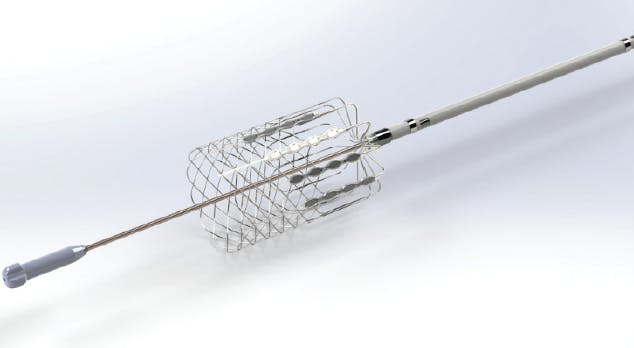
Figure 3. CN2 neuromodulation catheter with circular stimulation electrodes to be positioned in the right pulmonary artery for neuromodulation of cardiac nerves.
(Courtesy of Cardionomic, Inc.)
Early clinical experience using an acute stimulation protocol in fifteen HF patients with reduced ejection fraction demonstrated a consistent increase in LV contractility (LV dP/dt max), LV relaxation (LV dP/dt min), and blood pressure (mean arterial pressure), with minimal increase in heart rate.9 Cardionomic has begun a prospective, two-phased, multicenter study to evaluate the safety and performance of the CPNS system in patients with ADHF. In phase one (the lead-in phase), approximately 10 patients will receive CPNS therapy and standard of care. In phase two (the randomized phase), patients will be 1:1 randomized to CPNS therapy and standard of care (the treatment group) or standard of care alone (the control group). Patients will be followed for 6 months, and various safety, performance, and clinical measures will be collected.
CONCLUSION
Because of the prolonged hospitalization and increased mortality, management of acute CRS remains a burning clinical need. Recent advances in understanding of its hemodynamic mechanisms incited the emergence of new device-based approaches that aim to disrupt the detrimental spiral of cardiorenal feedback. Initial studies with several devices provided early clinical proof-of-concept validating their designated mechanism of action. Their further implementation through clinical development pathways calls on close multidisciplinary collaboration by developing dedicated interventional heart failure teams similar to those used in structural heart intervention. Future efforts should be dedicated to refined understanding of the responsive HF phenotype in conjunction with evolving standard of care.
1. Rangaswami J, Bhalla V, Blair JEA, et al. Cardiorenal syndrome: classification, pathophysiology, diagnosis, and treatment strategies: a scientific statement from the American Heart Association. Circulation. 2019;139:e840-e878. doi: 10.1161/CIR.0000000000000664
2. House AA, Anand I, Bellomo R, et al. Definition and classification of cardio-renal syndromes: workgroup statements from the 7th ADQI consensus conference. Nephrol Dial Transplant. 2010;25:1416-1420. doi: 10.1093/ndt/gfq136
3. Yancy CW, Lopatin M, Stevenson LW, et al. Clinical presentation, management, and in-hospital outcomes of patients admitted with acute decompensated heart failure with preserved systolic function: a report from the Acute Decompensated Heart Failure National Registry (ADHERE) database. J Am Coll Cardiol. 2006;47:76-84. doi: 10.1016/j.jacc.2005.09.022
4. Verbrugge FH, Guazzi M, Testani JM, Borlaug BA. Altered hemodynamics and end-organ damage in heart failure: impact on the lung and kidney. Circulation. 2020;142:998-1012. doi: 10.1161/CIRCULATIONAHA.119.045409
5. Dierckx R, Vanderheyden M, Heggermont W, et al. Treatment of diuretic resistance with a novel percutaneous blood flow regulator: concept and initial experience. J Card Fail. 2019;25:932-934. doi: 10.1016/j.cardfail.2019.08.017
6. Vanderheyden M, Bartunek J, Neskovic AN, et al. TRVD therapy in acute HF: proof of concept in animal model and initial clinical experience. J Am Coll Cardiol. 2021;77:1481-1483. doi: 10.1016/j.jacc.2021.01.029
7. Vora AN, Schuyler Jones W, DeVore AD, et al. First-in-human experience with Aortix intraaortic pump. Catheter Cardiovasc Interv. 2019;93:428-433. doi: 10.1002/ccd.27857
8. Biegus J, Zymlinski R, Siwolowski P, et al. Controlled decongestion by Reprieve therapy in acute heart failure: results of the TARGET-1 and TARGET-2 studies. Eur J Heart Fail. 2019;21:1079-1087. doi: 10.1002/ejhf.1533
9. Reddy VY, Petrů J, Málek F, et al. Novel neuromodulation approach to improve left ventricular contractility in heart failure: a first-in-human proof-of-concept study. Circ Arrhythm Electrophysiol. 2020;13:e008407. doi: 10.1161/CIRCEP.120.008407
Advertisement
Advertisement