Advertisement
Advertisement
May/June 2021
Heart Failure Care Delivery: A Multidisciplinary Approach to Effective Transitional Care
Key steps to developing a multidisciplinary heart failure management program.
Heart failure (HF) management has become increasingly complex as both the incidence and prevalence of HF have increased. Fortunately, through evidence-based guidelines, we have a roadmap to effective management of this serious condition that affects millions of patients. Earlier this year, the American College of Cardiology provided an Expert Consensus Decision Pathway, which focused on HF with reduced ejection fraction and included both medication updates as well as guidelines on how to deliver HF care.1 The guidelines included a recommendation for a multidisciplinary approach to provide a comprehensive method for effectively providing symptom and disease management for this patient population.
Although interventional cardiologists are typically not seen as HF specialists, HF is a primary reason for readmission after percutaneous coronary intervention (PCI) for both acute coronary syndrome patients and elective PCI. Developing an understanding of best practices for effective HF management during the transitional period and beyond is valuable for improving patient outcomes as well as managing the total cost of care. HF management and innovations in disease management, such as virtual care and the adoption of team-based care, have affected the overall experience of this particular patient population.
IDENTIFYING YOUR HF PATIENT POPULATION
The most recent statistics show 4.9 million Americans are affected by congestive heart failure, with 550,000 new cases diagnosed each year.2 HF is a serious and complex condition and can present problems when trying to properly identify the patient population. With high mortality rates that increase with age, HF continues to be the most common cause of hospitalization in patients aged ≥ 65 years. As Americans continue to age, it is crucial to diagnose and manage this vulnerable patient population using innovations in disease management. However, it is a challenging and ever-changing process to accurately identify patients who are at risk for HF and provide optimal care based on the latest evidence.
BEST PRACTICES FOR TRANSITIONAL CARE MANAGEMENT
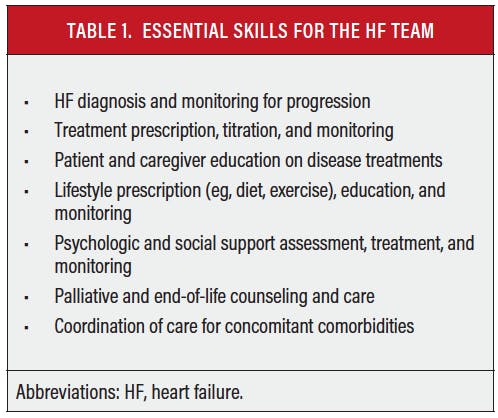
Effective patient care starts with the care team. Table 1 includes specific skills that have been identified as being essential for a HF care team. These are essential skills to ensure HF patients are diagnosed, monitored, and supported through each level of their disease. Providing education and counseling for those patients that may be facing new lifestyle changes or need additional monitoring not only improves the quality of life for the patient but also fosters better adherence to his/her prescribed treatment plan. Finally, coordination of care for patients requiring palliative care or facing concomitant comorbidities is also important for the HF team. Significant research has been done focused on reducing readmissions for HF patients, revealing three strategies to reduce all-cause readmissions through both 6 and 12 months.
Strong Clinical Team
Having a strong clinical team is essential to ensure proper care coordination for the HF patient population. The team will need to work with patients to understand their symptoms as they arise and support them through their care journey. In addition, advanced practice providers (APPs) can be valuable in providing clinical care in real time by acting as the provider on the ground, managing patients when they come into the clinic. Finally, having the physician involved is crucial so that the entire clinical team is providing and coordinating care locally for the patient. Some hospital entities have even developed transitional clinics to be a part of their readmission reduction plan. Many of those clinics use a team-based care approach to meet patient needs using top-of-license roles and responsibilities. Those programs see better results when the transitional program is embedded in the cardiology clinic where the cardiologist, who owns the care of the patient, can quickly decide and implement clinical and interventional care. That isn’t necessarily the case when it’s a hospital-driven program that’s not associated with the physicians who are managing the aftercare of the patient.
Comprehensive Discharge Planning and Follow-up Interventions
The next strategy is comprehensive discharge planning with follow-up interventions that incorporate patient and caregiver goal setting (eg, identifying weight management goals for each patient). HF patients have small fluctuations of weight on a daily basis that can indicate volume overload and be an early sign of decompensation. Creating individualized care plans that incorporate education and behavioral strategies while also ensuring the patient is receiving the right medications helps to keep him or her on the right treatment path from a clinical perspective. This can happen in two ways. The first option is in-person home visits through the use of a home health nurse, which not all programs have resources for. However, what better way to do medication reconciliation than sitting down with all of their bottles at their kitchen table and going through all of them? Some interesting ways that programs have done this is by utilizing local emergency medical services or home services. The second option is a telehealth-facilitated intervention emphasizing daily telephone monitoring and transmissions of physiologic measurements. This requires connecting with patients daily or weekly to issue a short questionnaire about their current symptoms, conduct a blood pressure reading, and check heart rate to ensure there are no signs of potential decompensation.
Patient Self-Management
The last strategy that has proven to improve outcomes is patient self-management. This incorporates telemonitoring tools, patient education, coping strategies to manage physical barriers and chronic diseases, and behavioral health strategies. This requires the clinical team or a team representative to develop a relationship with the patient to help them navigate their care plan. Building trust with patients so they feel they have a small but intimate support team to reach out to when they have questions or need to be seen is imperative. When setting up the care pathway, it is incredibly beneficial to have this small team know the patients and their health histories before the initial visit and along the care journey.
TRANSITIONAL CARE PATHWAY DEVELOPMENT
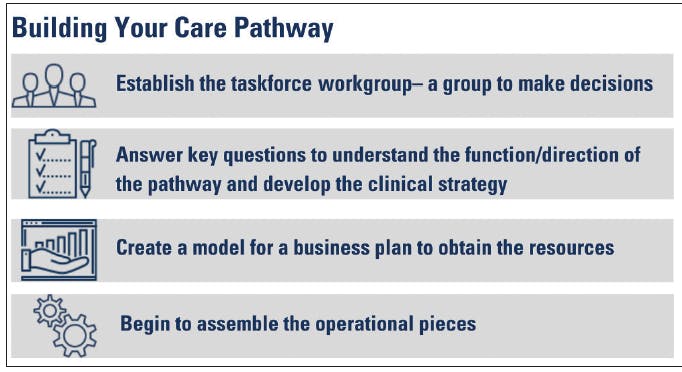
Figure 1 outlines key steps for building a transitional care pathway. The first step is establishing a task force or work group that will develop the clinic and meet regularly to monitor and improve patient outcomes. This team should include at least one physician champion and a clinical strategy leader who will provide insights for the rest of the team. Next is the operations leader or manager who can help lead the team, understand what resources are available, and work with decision-makers to get access to those resources. The clinical team—which should include a dedicated representative, typically an APP, who can get to know each patient, guide the rest of the care team for ongoing patient needs, and pull in the physician champion when necessary—will interact regularly to advance care for the HF patient population. Finally, it’s important to have a revenue cycle representative to ensure revenue is being captured properly, an information technology representative to ensure tracking is set up, and a quality representative to ensure patient-centered performance management. This team should come together to map out care objectives, define team roles and responsibilities, and understand patient volume, which will become the foundation of the clinical pathway.
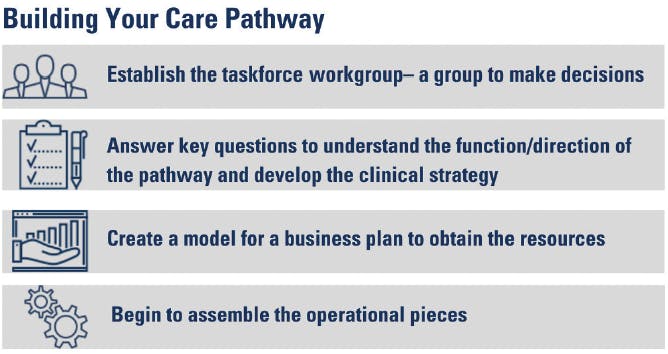
Figure 1. Key steps for building a transitional care pathway.
Outline Care Objectives
The program must determine what is needed to care for their HF patient population, taking into consideration how the plan will incorporate clinical disease and medication management and potential benefits of social work. Patient education and telephone support are also important to know who is answering calls and what information will be provided. Many HF patients have additional comorbidities that require care coordination with other specialists for ongoing or urgent needs as they arise. Then, the program should begin to map who the pathway will serve, how patients will be assigned, and a risk stratification plan. Finally, a series of measures for performance management should be created that includes readmission, patient and provider satisfaction, and the operating margin.
Define Team Roles and Responsibilities
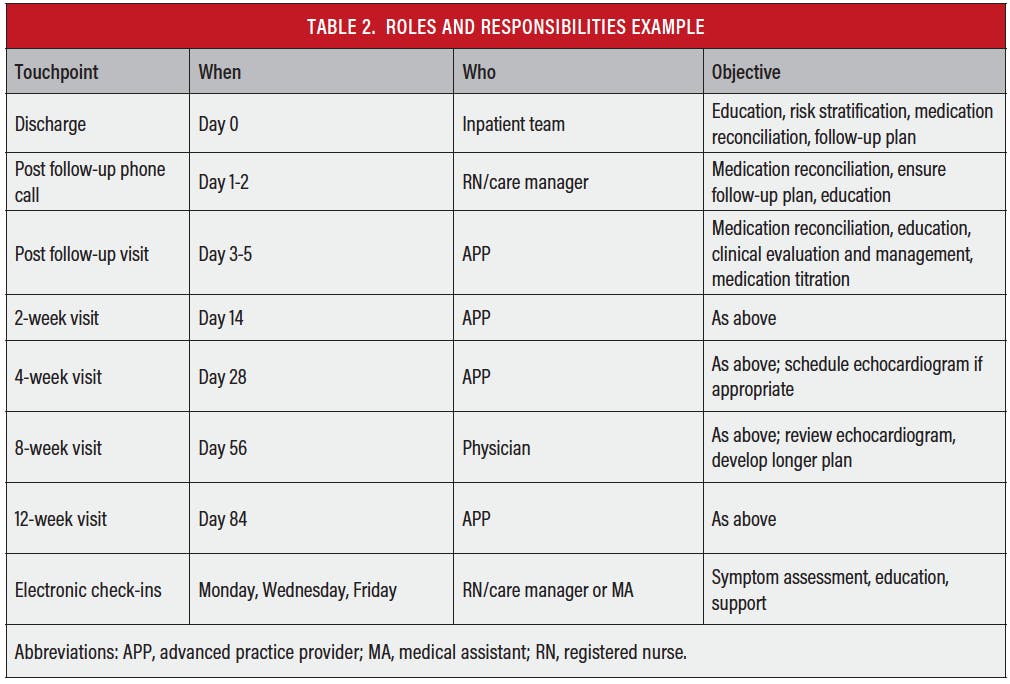
Identifying HF clinic responsibilities and defining roles and responsibilities for the team that will be managing HF patient care are important steps to ensure everyone is efficiently working together for the best patient outcome. Once the roles and responsibilities are determined, defined touchpoints can be mapped out, including when the touchpoint will take place, who will provide it, and the objective for that interaction as part of the care pathway (Table 2). There must be a lead physician who manages the care plan and works with the clinical team to monitor patients. Working closely with the physician champion, the APP conducts evaluation and management appointments and provides program oversight. The registered nurse and care management roles are in charge of patient tracking, phone calls, and education, collaborating with medical assistants who primarily provide clinic support. As patients transition home, each call needs to be managed, tracked, and documented, and assigning roles will ensure efficiency.
Understand Potential Volume
Finally, the team must determine the number of visits per week and required staffing. This can be done by reviewing the program’s patient population and history of patient discharges to identify those with significant comorbidities, readmissions, and emergency room visits. Based on the program’s capacity, patients at the highest risk should be targeted first. Although these data are not always easy to obtain, this step should not be skipped, as it will support the viability of the program.
CONCLUSION
Developing a multidisciplinary HF management program requires several key steps including patient population identification, care pathway development, care objective definitions, team assignments, and resource allocation. Determining best practices for treating HF patients and developing a system that works to predict outcomes are equally important to identifying and helping to treat HF patients. Taking a step-by-step approach will ensure program alignment, appropriate resource allocation, and effective care management for this high-risk patient population.
1. Writing Committee; Maddox TM, Januzzi JL Jr, Allen LA, et al. 2021 updates to the 2017 ACC expert consensus decision pathway for optimization of heart failure treatment: answers to 10 pivotal issues about heart failure with reduced ejection fraction: a report of the American College of Cardiology Solution Set Oversight Committee. J Am Coll Cardiol. 2021;77:772-810. doi: 10.1016/j.jacc.2020.11.022
2. Emory Healthcare. Health Failure Statistics. Accessed May 21, 2021. https://www.emoryhealthcare.org/heart-vascular/wellness/heart-failure-statistics.html.
Advertisement
Advertisement