Advertisement
Advertisement
March/April 2025
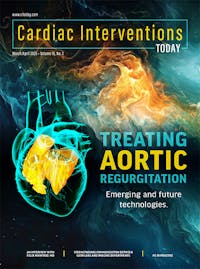
Emerging Options for Aortic Regurgitation
By Matti Adam, MD, and Jonathan Curio, MD


Aortic regurgitation (AR) remains underdiagnosed, and many patients may still be treated too late. However, in recent years, it has gained increased recognition as a highly relevant—yet challenging—condition in the spectrum of valvular heart disease. With novel diagnostic and interventional strategies being explored and ongoing advancements in transcatheter aortic valve replacement (TAVR) technology, the management of AR is rapidly evolving. This progress opens new opportunities to improve both patient quality of life and clinical outcomes. The emerging field of TAVR for AR is therefore defined by innovative valve designs, as well as refined diagnostic and procedural techniques.
We begin this issue with a comprehensive overview of AR evaluation. Takahiro Nishihara, MD; João L. Cavalcante, MD; and colleagues provide an in-depth discussion of multimodal imaging—highlighting the complementary role of echocardiography with cardiac MRI and CT in the assessment of AR.
Next, Joanna Bartkowiak, MD; Jonas Lanz, MD; Thomas Pilgrim, MD; and Fabien Praz, MD, follow with an analysis of epidemiological trends, current guideline perspectives, and anticipated future directions in this complex clinical entity. Sara Waezsada, MD, and Tanja K. Rudolph, MD, then explore the technical and clinical challenges of transcatheter treatment for pure AR—from off-label use to dedicated devices.
We asked Hendrik Wienemann, MD, to address a critical procedural question: Do we have a pacing problem in TAVR for AR? As the need for postprocedural pacemakers may be higher in this subset, implications for long-term outcomes warrant close attention.
Shifting gears briefly to aortic stenosis, Hemal Gada, MD, discusses a recent publication suggesting that early TAVR in asymptomatic patients may yield better outcomes than clinical surveillance—highlighting a possibly growing shift in treatment paradigms.
Elsewhere in this issue, we spotlight the increasingly prominent topic of pulmonary embolism (PE). Rohan Mundkur, MD; Akash Patel, MD; and Jonathan Paul, MD, emphasize the importance of a protocol-driven approach for acute PE intervention, with a practical focus on team setup and procedural readiness. Then, in an Ask the Experts column, Taisei Kobayashi, MD; Riyaz Bashir, MD; and Kenneth Rosenfield, MD, tackle the nuanced impact of clot location and distribution on therapeutic decision-making in PE.
Our Today’s Practice column, authored by Jaime Warren, discusses strategies for improving collaboration between cath labs and imaging departments, with the goal of optimizing workflow, communication, and patient outcomes.
Closing this issue is an exclusive interview with Felix Mahfoud, MD, who shares insights into his translational cardiology research on the autonomic nervous system and interorgan communication in cardiovascular disease, remaining hurdles and current priorities in renal denervation, and his roles within the European Society of Cardiology and European Association of Percutaneous Cardiovascular Interventions.
In conclusion, the evolving landscape of TAVR for AR offers exciting new possibilities to advance the care of patients with valvular heart disease. As technologies mature and clinical experience expands, well-designed studies and long-term data will be essential to refine strategies and optimize outcomes. Similarly, progress in the standardization and integration of PE treatment protocols—particularly in acute care settings—will play a key role in translating innovation into tangible clinical benefit.
Here’s to a future of innovation, dedicated technologies, and more personalized cardiovascular care.
Matti Adam, MD
Jonathan Curio, MD
Guest Chief Medical Editors
Advertisement
Advertisement