Advertisement
Advertisement
March/April 2025
An Interview With Felix Mahfoud, MD, MA
Prof. Mahfoud breaks down his translational cardiology research focused on the autonomic nervous system and interorgan communication in cardiovascular disease, remaining hurdles and research priorities for renal denervation, his work with the ESC and EAPCI, and more.
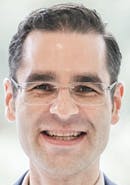
Translational cardiology is a key part of your work at the Mahfoud Lab at University Hospital Basel. Can you summarize what this type of research entails and how it seeks to improve care? What are some real-world examples of translational cardiology in clinical practice in your work?
Our research with our lab at University Hospital Basel focuses on translational cardiology, with a strong emphasis on the autonomic nervous system and interorgan communication in cardiovascular disease. This field bridges basic science and clinical application, aiming to translate novel discoveries into improved patient care. Our work seeks to uncover the mechanisms behind cardiovascular conditions and develop innovative interventions that can directly impact clinical practice.
A key aspect of our research is the study of how the autonomic nervous system influences cardiovascular function and disease progression. By investigating neural control mechanisms, we aim to develop targeted therapies that modulate autonomic activity, particularly in conditions such as hypertension (HTN), heart failure, and arrhythmias. Additionally, we explore interorgan communication, understanding how the heart interacts with the kidneys, brain, and other systems to drive disease progression.
Some of our work in translational cardiology has already influenced clinical practice in several ways. One example is renal denervation (RDN) for the treatment of uncontrolled HTN. By translating insights from basic research into minimally invasive interventions, we have contributed to refining procedural techniques and technologies for RDN and patient selection criteria. Another example is the development of machine learning (ML) algorithms to predict cardiovascular mortality risk using office and ambulatory blood pressure (BP) data, allowing for more personalized risk stratification. Our work also extends to exploring how metabolic diseases and inflammatory pathways interact with cardiovascular regulation, potentially opening new avenues for therapeutic intervention.
What is your long-term vision for the Mahfoud Lab? How do you hope to see it impact the field of interventional cardiology (IC)?
The long-term vision for our lab is to establish a leading center for innovation and education in IC, where cutting-edge research translates into tangible clinical advancements. We aim to drive forward the understanding of neuro-kidney-cardiovascular interactions and interventional treatments that improve patient outcomes. Through collaboration with international research networks, industry partners, and clinical practitioners, we hope to shape the future of IC with evidence-based approaches.
You are very involved in the European Society of Cardiology (ESC), serving as a Councillor of the Board and Chair of the Communication Committee. How have you seen the society evolve in recent years, and what do you think are its biggest strengths? Can you point to any upcoming ESC projects or initiatives you’re excited about?
I have witnessed a significant evolution within the ESC in recent years. The society has embraced digital transformation, expanding access to scientific knowledge through virtual congresses and online education. One of its greatest strengths is fostering interdisciplinary collaboration while providing a platform for guideline development that shapes global cardiovascular care. An exciting upcoming initiative involves the growing focus on artificial intelligence in cardiology, which has the potential to revolutionize diagnostics and patient management.
As a Councillor of the Board and Chair of the Communication Committee, our goal is to further enhance communication by delivering clear, strong, credible, and engaging messaging. We continuously adapt content and formats to meet the needs of an increasingly digital-centric audience. We are aligning our dissemination strategy with our channel objectives and audience expectations, ensuring the ESC remains a unifying force, nurturing a culture of collaboration, relationship-building, and belonging.
Another societal role of yours is Chair of the European Association of Percutaneous Cardiovascular Interventions (EAPCI) Scientific Documents Committee. What are some areas in the field of IC that would most benefit from a new consensus document or position paper?
The EAPCI Scientific Documents Committee has identified several key topics for upcoming consensus documents and position papers, including the management of paravalvular leak, bioresorbable scaffolds for coronary artery disease, and other important areas in IC.
As a leading voice in the field of HTN and RDN, how would you summarize the current state of RDN in Europe? What are the biggest remaining hurdles in wider use in Europe specifically?
RDN has evolved in Europe as an adjunct treatment option for HTN, particularly for patients with resistant HTN. Recent randomized, sham-controlled trials with improved designs and technologies have demonstrated significant and sustained reductions in BP and a favorable safety profile.
In response to these advancements, European medical societies have updated their guidelines. The ESC and the EAPCI have provided clinical consensus statements on RDN’s role in managing HTN.1,2 They emphasize patient selection, procedural techniques, and postprocedural care to optimize outcomes.
Furthermore, the European Society of Hypertension (ESH) and ESC released guidelines that reflect the evolving evidence base for RDN.3,4 These guidelines highlight the importance of integrating RDN into clinical practice for suitable patients, considering both its benefits and potential risks. In Europe, RDN is approved for use and is considered a viable option for patients with uncontrolled HTN despite medication adherence. Ongoing research continues to refine patient selection criteria and procedural methodologies to enhance the safety and efficacy of RDN. However, wider adoption faces hurdles such as reimbursement policies in some countries and physician awareness.
In a recent issue of Hypertension, you and colleagues determined that individual gene variants were not associated with BP response after RDN and that this should not be a priority for future study.5 Which areas are on the next horizon for study in the space of BP response prediction? With this knowledge, what are your current best practices for patient selection?
In our recent study published in Hypertension, we examined whether individual gene variants could predict BP response after RDN and found no such associations. This suggests that future research should focus more on phenotypic and functional markers rather than genetic predisposition alone. One promising area is the role of sympathetic nervous system activity as a predictor of response, as well as the integration of imaging and hemodynamic assessments into patient selection. Moving forward, our best approach for patient selection involves a combination of ambulatory BP monitoring, assessment of sympathetic overactivity, and careful exclusion of secondary causes of HTN.
When it comes to the future of RDN/HTN, what are the main priorities for your research over the next few years?
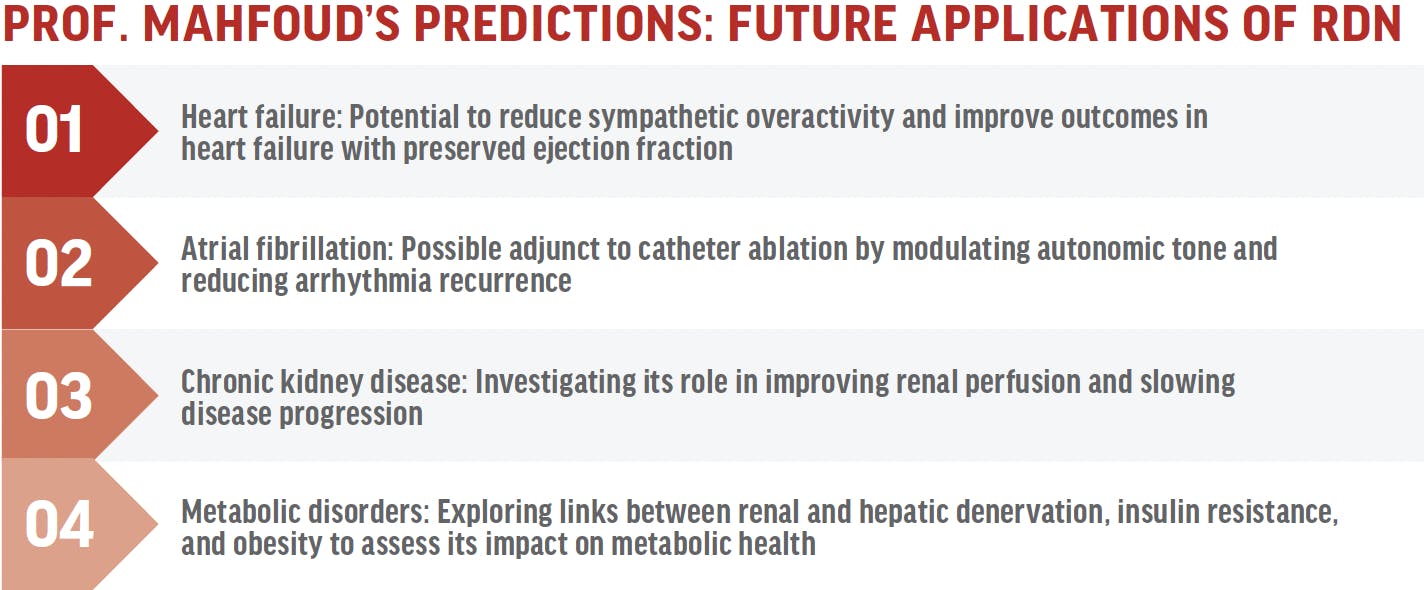
Over the next few years, our research will prioritize refining patient selection strategies for RDN, identifying potential biomarkers that can predict treatment response, expanding the understanding of its effects beyond HTN, and considering the impact of RDN on hard clinical outcomes like morbidity and mortality. Additionally, we aim to explore new neuromodulation-based therapies such as hepatic denervation, which could have applications in heart failure, arrhythmia management, and chronic kidney disease.
You and colleagues also developed and validated a ML-derived cardiovascular mortality risk calculator using office and ambulatory BP.6 Can you talk a bit about how this tool works?
Our team recently developed a ML-derived cardiovascular mortality risk calculator that integrates office and ambulatory BP data to provide individualized risk predictions. This tool works by analyzing key hemodynamic patterns and linking them with long-term cardiovascular outcomes. The ultimate goal is to improve risk stratification and provide clinicians with a more precise means of guiding treatment decisions. By incorporating continuous data from wearable devices and home monitoring systems, we hope to enhance its predictive accuracy and clinical utility.
You’re a big supporter of medical education and scientific symposia, both large national or global events and the more local specialized meetings. What is your advice for less experienced clinicians to make the most of these opportunities?
These events play a crucial role in professional development, and they should be approached with a mindset of active engagement. Attending key sessions, participating in discussions, and networking with colleagues can provide valuable insights and open doors for collaboration. Small, specialized meetings can be particularly beneficial for deepening expertise in a focused area, while large congresses offer exposure to cutting-edge research and a broader professional network.
In 2024, you moved from your role at Saarland University in Germany to University Hospital Basel in Switzerland. What has been your favorite part of living and working in Switzerland?
Moving from Saarland University in Germany to University Hospital Basel has been an exciting transition for me, both professionally and personally. One of the most rewarding aspects of living and working in Switzerland is the strong emphasis on teamwork, the highest-quality medical care, research collaboration, and innovation. Basel, in particular, offers a dynamic scientific environment with close ties between academia, industry, and clinical practice. The quality of life here is also exceptional, with a unique blend of cultural richness, excellent restaurants (including wines), and access to nature.
1. Barbato E, Azizi M, Schmieder RE, et al. Renal denervation in the management of hypertension in adults. A clinical consensus statement of the ESC Council on Hypertension and the European Association of Percutaneous Cardiovascular Interventions (EAPCI). Eur Heart J. 2023;44:1313-1330. Published correction appears in Eur Heart J. 2023;44:2439. doi: 10.1093/eurheartj/ehad054
2. Barbato E, Azizi M, Schmieder RE, et al. Renal denervation in the management of hypertension in adults. A clinical consensus statement of the ESC Council on Hypertension and the European Association of Percutaneous Cardiovascular Interventions (EAPCI). EuroIntervention. 2023;18:1227-1243. doi: 10.4244/EIJ-D-22-00723
3. Mancia G, Kreutz R, Brunström M, et al. 2023 ESH guidelines for the management of arterial hypertension the task force for the management of arterial hypertension of the European Society of Hypertension: endorsed by the International Society of Hypertension (ISH) and the European Renal Association (ERA). J Hypertens. 2023;41:1874-2071. Published correction appears in J Hypertens. 2024;42:194. doi: 10.1097/HJH.0000000000003480
4. McEvoy JW, McCarthy CP, Bruno RM, et al; ESC Scientific Document Group. 2024 ESC guidelines for the management of elevated blood pressure and hypertension. Eur Heart J. 2024;45:3912-4018. Published correction appears in Eur Heart J. Published online February 11, 2025.
5. Delles C, Schmieder RE, Daly R, et al. Response of blood pressure to renal denervation is not associated with genetic variants. Hypertension. 2025;82:118-125. doi: 10.1161/HYPERTENSIONAHA.124.23393
6. Guimarães P, Keller A, Böhm M, et al. Artificial intelligence-derived risk prediction: a novel risk calculator using office and ambulatory blood pressure. Hypertension. 2025;82:46-56. doi: 10.1161/HYPERTENSIONAHA.123.22529
Advertisement
Advertisement
Interested in reading more interviews?
To read more interviews with thought leaders in the interventional cardiology field, check out our Profiles & Perspectives hub.
Read More