Advertisement
Advertisement

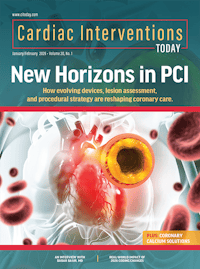
As patient populations undergoing percutaneous coronary intervention (PCI) become increasingly high risk and anatomies more demanding, thoughtful integration of imaging, lesion preparation, and adjunctive technologies is essential. The contributions in this PCI-focused edition of Cardiac Interventions Today reflect the field’s continued emphasis on precision-balancing innovation with evidence-based application to optimize procedural success and long-term outcomes.
Tobias Koch, MD; Michael Joner, MD; and Tobias Rheude, MD, start this issue’s discussion with an examination of the nuanced role of PCI in patients undergoing transcatheter aortic valve replacement, highlighting coronary assessment, revascularization thresholds, and procedural timing in this growing population.
Priyadarshini Dixit, MD; Sierra Fleming, MD; and Olga Toleva, MD, then provide a comprehensive review of high-risk atherosclerotic plaque, emphasizing how advanced invasive and noninvasive imaging can identify vulnerable features that transcend angiographic stenosis severity and may inform future preventive strategies.
As PCI grows increasingly complex, the need for hemodynamic support continues to expand. René Boudreau, MD, and Kevin Croce, MD, tackle next-generation temporary mechanical circulatory support platforms, focusing on emerging technologies designed to deliver robust support through smaller access profiles while minimizing bleeding and hemocompatibility-related complications.
Matteo Sturla, MD; Mauro Gitto, MD; and Pier Pasquale Leone, MD, outline a practical framework for drug-coated, balloon-based PCI, underscoring the rationale for metal-sparing approaches in select de novo and in-stent restenosis scenarios.
These contributions underscore that the success of contemporary PCI increasingly hinges on not only technique and technology but also thoughtful lesion preparation, setting the stage for this issue’s subfeature on coronary calcium solutions. First up, Yasser M. Sammour, MD; Andrew Murphy, MD; Robert Nicholson, MD; and Pratik Sandesara, MD, offer comprehensive examination of nodular coronary calcium management, detailing its pathogenesis and imaging characteristics, as well as the limitations of current modification strategies. Extending this theme, Jiho Han, MD, and Margaret McEntegart, MD, address the unique difficulties associated with severe calcification in chronic total occlusions, emphasizing the importance of preprocedural planning, intravascular imaging, and thoughtful escalation of calcium modification techniques. Finally, Shrilla Banerjee, MD; Jimmy L. Kerrigan, MD; and Aditya S. Bharadwaj, MD, are asked to detail their step-by-step PCI decision-making strategies for managing calcified nodules, including imaging, lesion preparation, calcium modification, and stent optimization.
Collectively, these perspectives highlight that modern PCI extends well beyond stent deployment alone. Success now depends on comprehensive physiologic and imaging assessment, deliberate strategy selection, and mastery of evolving tools designed to address increasingly complex coronary pathology. As technology advances and clinical evidence deepens, interventional cardiologists remain uniquely positioned to refine technique, expand therapeutic options, and improve care for patients with the most challenging cardiovascular disease.
In our Today’s Practice column, Nicole F. Knight, LPN, provides an assessment of how the 2026 coding changes will impact interventional cardiology and ambulatory surgery centers. Finally, we close this issue by interviewing Babar Basir, DO, on his work in modern cardiogenic shock care and his approach to research, mentorship, and building programs that advance patient care.
We hope this collection provides practical insights and sparks meaningful discussion as you navigate the complexities of modern interventional practice.
Louis Verreault-Julien, MD
Guest Chief Medical Editor
Advertisement
Advertisement