Advertisement
Advertisement
January/February 2026
DCBs for De Novo Lesions and ISR: Why, When, and How
A practical framework for adopting a metal-sparing PCI strategy across established and emerging coronary indications.
By Matteo Sturla, MD; Mauro Gitto, MD; and Pier Pasquale Leone, MD, MSc
Drug-coated balloons (DCBs) represent a meaningful adjunct to contemporary percutaneous coronary intervention (PCI), challenging the assumption that durable revascularization always requires permanent metal implantation. Their optimal use necessitates clarity on why avoiding permanent metal may be beneficial, when a DCB-based strategy is appropriate, and how it should be executed (Figure 1).
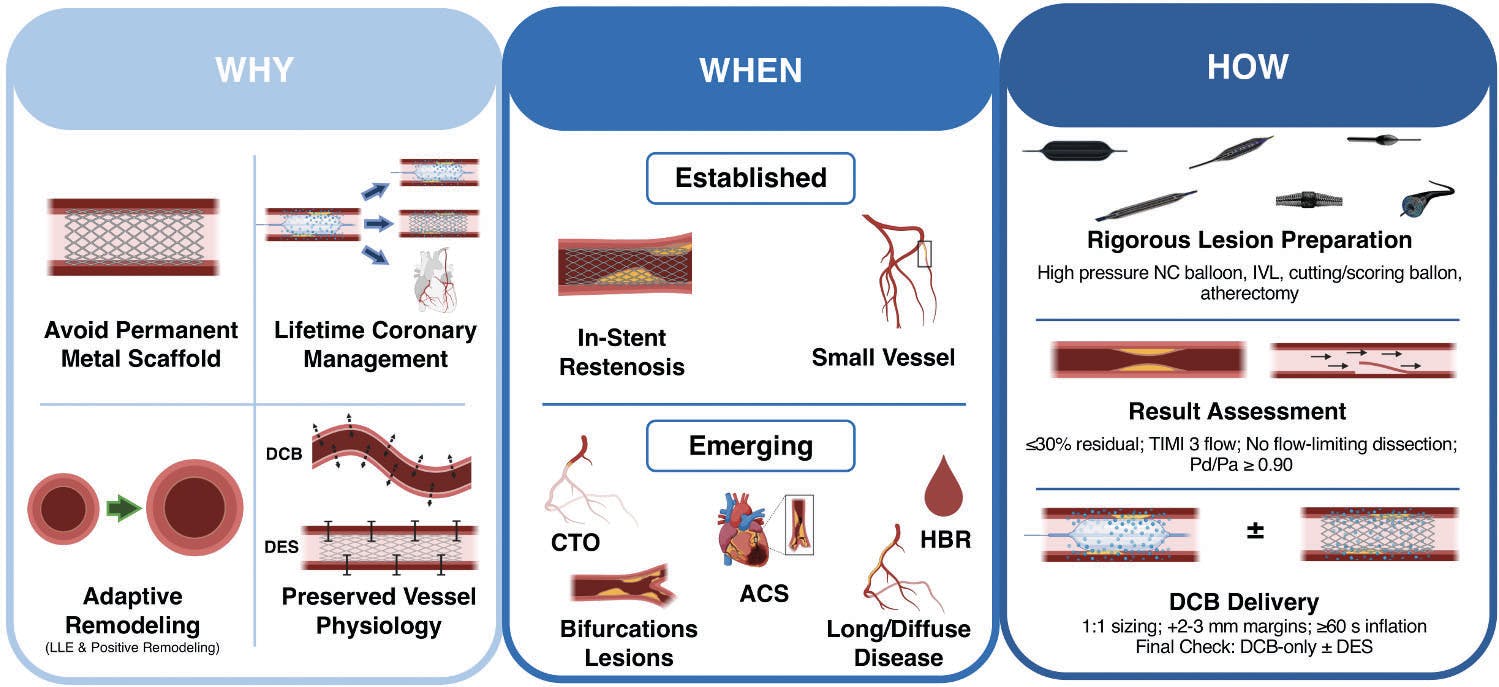
Figure 1. Conceptual rationale, clinical indications, and procedural execution of DCB PCI. Why: Avoidance of permanent metal, preservation of vessel physiology, and simplified long-term coronary management. When: Established use in ISR and SVD, with selective application in other anatomies. How: Rigorous lesion preparation, strict result assessment, and precise DCB delivery, with bailout stenting reserved for unstable results. ACS, acute coronary syndrome; CTO, chronic total occlusion; IVL, intravascular lithotripsy; LLE, late lumen enlargement.
WHY?
For more than 2 decades, drug-eluting stents (DESs) have defined PCI, offering the confidence of an immediate satisfactory result. Yet this success has fostered a reflexive dependency: When confronted with coronary disease of almost any morphology, we reach instinctively for “metal.” This “stent-first” mindset persists despite growing recognition that a permanent implant, while beneficial in many cases, imposes short- and long-term physiologic and clinical tradeoffs that are often underestimated at the time of PCI.1 Late adverse events continue to accumulate after DES implantation at approximately 2% per year, independently of stent generation, and may reach up to 8% per year in the setting of long and complex lesions. These events are driven not only by neointimal hyperplasia and neoatherosclerosis but also by the unavoidable consequences of caging an artery (eg, loss of vasomotion, impairment of positive remodeling) and the cumulative hazard of multiple layers of metal placed over a lifetime. The lifetime burden of metal, especially when PCI is repeated, becomes a nontrivial contributor to clinical events.
In contrast, DCBs separate the antiproliferative benefit of drug elution to the vessel wall from the permanence of a metallic scaffold. Indeed, the key concept of DCB is delivery of homogeneous, circumferential antiproliferative therapy to the target lesion without leaving any permanent implant, thus giving a chance for the vessel to heal and remodel. This “leave-nothing-behind” strategy aligns closely with the original, fundamental principles of angioplasty but enhanced by modern drug delivery, contemporary imaging and antithrombotic therapy, and rigorous lesion preparation. This conceptual shift carries practical consequences. Without metal, there is no foreign body to provoke chronic inflammation, no polymer to degrade, no nidus for late neoatherosclerosis, and no cumulative layering of stents that complicate future interventions. Such a strategy simplifies lifetime coronary management, preserving surgical options and facilitating future PCI in case of recurrence of disease. Stents remain indispensable in the case of vessel recoil and advanced dissections, but the premise that every significant stenosis demands a scaffold is no longer tenable. Many lesions, once adequately prepared, achieve a stable and acceptable angiographic result, and data increasingly show that these lesions can be safely treated with a DCB.
WHEN?
Established Indications
The strongest evidence for DCB use comes from two settings: in-stent restenosis (ISR) and de novo small vessel disease (SVD). Multiple randomized trials and meta-analyses have shown that DCBs are at least as effective as repeat DES for the treatment of ISR, with the advantage of avoiding a second, or third, metal layer. Outcomes are particularly favorable in focal ISR, ISR of bare-metal stents, multilayer ISR, and lesions involving large side branches where additional metal may compromise future access. Although a signal for increased efficacy of repeat DES implantation over DCB is present in DES ISR, the avoidance of additional metal remains a compelling mechanistic and clinical consideration in this setting.2 Notably, more recent randomized data highlight the markedly poor prognosis of multilayer ISR compared with single-layer ISR, underscoring the pathophysiological cost of cumulative metallic scaffolding and providing a strong rationale for metal-sparing strategies when feasible.3
Notably, more recent randomized data highlight the markedly poor prognosis of multilayer ISR compared with single-layer ISR, underscoring the pathophysiological cost of cumulative metallic scaffolding and providing a strong rationale for metal-sparing strategies when feasible. In addition, the randomized SELUTION4ISR trial showed that the Selution SLR sirolimus DCB (Cordis) strategy was noninferior to contemporary standard of care (predominantly repeat DES) for 1-year target lesion failure (TLF) in bare-metal stent ISR and DES ISR (including lesions with up to two prior stent layers), supporting the effectiveness of a metal-sparing approach in ISR.4
In SVD, the associated penalties of stent implantation (eg, strut-related lumen loss, high restenosis rate) make a “leave-nothing-behind” strategy especially attractive.5 Several trials have shown noninferiority of DCBs compared with DESs, although heterogeneity in trial design and definitions contributes to variability in outcomes. More recently, the individual, patient-level ANDROMEDA meta-analysis of randomized trials showed that paclitaxel-coated balloon angioplasty was associated with a lower risk of major adverse cardiac events at 3 years compared with DES in de novo SVD, driven primarily by reductions in myocardial infarction and target vessel revascularization; TLF remained similar between strategies.6 Taken together, these data support DCB as a rational alternative in small vessels where metallic scaffolding may impose greater long-term liability than benefit.7
Emerging Indications
Beyond ISR and SVD, enthusiasm for DCBs is expanding into clinical and anatomic scenarios where avoiding metal may offer downstream advantages. Long lesions, irrespective of vessel size, are appealing targets. In these segments, the cumulative metallic burden of a full-metal-jacket strategy increases the risk of restenosis, thrombosis, and technical challenges during future PCI or coronary artery bypass grafting. DCBs allow drug delivery to long segments without committing the patient to extensive scaffolding.
Recently, the randomized SELUTION DeNovo trial evaluated a Selution SLR DCB strategy allowing for bailout stenting versus routine DES implantation in an all-comer de novo PCI population (n = 3,341; target lesion diameter, 2-5 mm) and demonstrated noninferiority for 1-year target vessel failure.8 This provides contemporary randomized support for extending a DCB strategy beyond de novo SVD.
Bifurcation lesions are another promising frontier. In a provisional stenting strategy, DCBs can preserve side branch patency without jailing, while hybrid approaches (main branch DES with side branch DCB) reduce the need for complex two-stent techniques and their associated ischemic risk.
High-bleeding-risk (HBR) patients may derive particular benefit because DCB PCI avoids a permanent implant and may permit shorter durations of dual antiplatelet therapy (DAPT).9 Current consensus supports 1 month of DAPT after DCB; in patients with very high bleeding risk, even shorter regimens have been adopted safely in practice based on expert opinion.10 Early experience also suggests that some HBR patients may tolerate a single antiplatelet approach after DCB-only PCI, an appealing concept that requires further study but underscores the potential of a metal-free strategy to adapt to the realities of HBR patients.11
Chronic total occlusion lesions have also been discussed as a possible niche for DCB, with conceptual appeal similar to that of long lesions, but limited data make this an area of ongoing clinical curiosity rather than established practice.
Acute coronary syndromes, including ST-segment elevation myocardial infarction, represent another setting in which DCB use has generated interest as an alternative to routine stent implantation. In selected cases, DCB angioplasty may be appealing to avoid permanent metal implantation in vessels with marked vasoconstriction, high thrombotic burden, or uncertain reference vessel size at the time of primary PCI. Ongoing large-scale randomized studies such as COPERNICAN are therefore needed and will further define the role of DCB PCI in this setting.12
HOW?
The success of a DCB strategy depends almost entirely on what happens before the balloon is ever opened. Because the DCB provides no scaffolding, the operator must create a stable, fully acceptable angiographic result through meticulous lesion preparation. This philosophy makes DCB PCI a highly deliberate, technique-sensitive approach.
Lesion Preparation
Rigorous lesion preparation is the defining step in DCB PCI. The objective is to modify plaque and calcium, ensure full balloon expansion, and generate a stable lumen without significant recoil. A noncompliant (NC) balloon sized 1:1 to the reference angiographic vessel diameter is typically used for initial predilation, with prolonged inflations at high pressure. Full balloon expansion in at least two orthogonal views is critical; any persistent waist or asymmetry indicates insufficient plaque modification. When elastic recoil occurs after deflation, this reflects inadequate preparation rather than vessel instability, and the operator should escalate to specialty balloons, such as scoring or cutting balloons. These devices provide controlled plaque modification (especially valuable in fibrocalcific disease or ISR) and can reduce the chance of deep, uncontrolled dissections.
Calcified lesions deserve particular attention. Even when stenting is planned, insufficient calcium modification is a major cause of poor outcomes; in a DCB strategy, it is at least as critical. Underexpansion with NC or specialty balloons should prompt reassessment of balloon sizing or further plaque modification. Atherectomy, intravascular lithotripsy, or ultra-high-pressure balloons may be used at operator discretion, and regardless of the technique the endpoint is the same: full, symmetric balloon expansion with preserved vessel geometry.
In ISR, scoring or cutting balloons remain the first-line approach, with NC balloons used for optimization. When underexpansion is the underlying mechanism of stent failure, gradual and controlled high-pressure inflations are often required to correct the mechanical substrate before considering a DCB.
Assessing the Result
Before committing to DCB delivery, the angiographic result must be unequivocally acceptable. Key criteria include:
- No ischemic symptoms or electrocardiographic changes
- Residual diameter stenosis ≤ 30%
- No flow-limiting dissection
- Thrombolysis in myocardial infarction 3 flow without contrast hang-up
- Absence of progressive narrowing during observation
Coronary dissections are frequently observed after lesion preparation in DCB-based PCI; however, contemporary observational data suggest that non–flow-limiting dissections left untreated are not associated with increased TLF at midterm follow-up, supporting a selective physiology- and angiography-guided approach to bailout stenting.13 When uncertainty exists, particularly in diffusely diseased or tortuous segments, a pressure wire pullback can be revealing. A significant gradient (distal-to-aortic coronary pressure ratio [Pd/Pa] < 0.90) across a dissected or hazy segment suggests mechanical instability and should prompt reconsideration of stenting.14 Intravascular imaging is most useful before DCB application to assess plaque burden, calcium distribution, vessel size, and mechanism of ISR rather than assessment of dissection severity, and whether and how it could guide lesion preparation result assessment remains to be ascertained.15
DCB Delivery
Once a satisfactory preparation result is achieved, DCB delivery must be performed with deliberate care. The balloon diameter should again be 1:1 with vessel size, and the length should extend 2 to 3 mm beyond the prepared segment at both edges. The ability to deliver the final lesion preparation balloon without difficulty is a practical proxy for DCB deliverability. Transit time minimization should be aimed to reduce drug loss. Once positioned, the DCB is inflated at nominal pressure for at least 60 seconds to ensure adequate tissue uptake, with no evidence supporting repeated DCB inflations. After deflation, angiogram reevaluation is key. Because DCB inflations occur at low pressure, the post-DCB result should appear similar to the postpreparation result. Any deterioration (eg, flow-limiting dissection, significant recoil, residual stenosis > 30%, or residual significant Pd/Pa gradient, when adopted) suggests the need for bailout stent implantation. When a stent is required, it should cover the entire dissection plane and be sized appropriately to the true vessel diameter. In long disease, an upfront hybrid approach consisting of proximal short DES implantation and distal DCB angioplasty can reduce metal burden while preserving long-term treatment options.
CONCLUSION
DCBs represent a deliberate shift away from reflexive stent implantation toward a more nuanced approach to PCI. When applied in the appropriate clinical and anatomic settings and executed with rigorous lesion preparation and result assessment, DCB-based strategies can achieve effective revascularization while minimizing the long-term liabilities of permanent metal. As DCBs enter United States practice, their successful adoption will ultimately rest on a clear understanding of the why, when, and how of this metal-sparing approach.
1. Colombo A., Leone PP. Redefining the way to perform percutaneous coronary intervention: a view in search of evidence. Eur Heart J. 2023;44:4321-4323. doi: 10.1093/EURHEARTJ/EHAD215
2. Vrints C, Andreotti F, Koskinas KC, et al; ESC Scientific Document Group. 2024 ESC Guidelines for the management of chronic coronary syndromes. Eur Heart J. 2024;45:3415-3537. Published correction appears in Eur Heart J. 2025;46:1565. doi: 10.1093/eurheartj/ehae177
3. Kirtane AJ, Shlofmitz R, Moses J, et al. Paclitaxel-coated balloon for the treatment of multilayer in-stent restenosis: AGENT IDE subgroup analysis. J Am Coll Cardiol. 2025;86:502-511. doi: 10.1016/j.jacc.2025.05.062
4. Cutlip DE. Sirolimus-eluting balloon versus repeat drug-eluting stenting or balloon angioplasty for in-stent restenosis. Presented at: Transcatheter Cardiovascular Therapuetics; October 25-28, 2025; San Francisco, California.
5. Colombo A, Leone PP, Ploumen EH, von Birgelen C. Drug-coated balloons as a first choice for patients with de novo lesions: pros and cons. EuroIntervention. 2024;20:e120-e122. doi: 10.4244/EIJ-E-23-00034
6. Fezzi S, Giacoppo D, Fahrni G, et al. Individual patient data meta-analysis of paclitaxel-coated balloons vs. drug-eluting stents for small-vessel coronary artery disease: the ANDROMEDA study. Eur Heart J. 2025;46:1586-1599. Published correction appears in Eur Heart J. 2025;46:3197. doi: 10.1093/eurheartj/ehaf002
7. Leone PP, Heang TM, Yan LC, et al; Investigators OBOTE. Two-year outcomes of sirolimus-coated balloon angioplasty for coronary artery disease: the EASTBOURNE Registry. EuroIntervention. 2024;20:e831-e833. doi: 10.4244/EIJ-D-23-00966
8. Spaulding CM. One-year results of the SELUTION DeNovo trial comparing a strategy of PCI with a sirolimus-eluting balloon and provisional stenting versus systematic DES implantation to treat de novo coronary lesions. Presented at: Transcatheter Cardiovascular Therapuetics; October 25-28, 2025; San Francisco, California.
9. Sturla M, Feldman D, Scotti A, et al. HBR in interventional cardiology: “The DCB philosophy.” In: Cortese B, Rigattieri S, eds. High Bleeding Risk Patients in Interventional Cardiology. Springer; 2025:85-96.
10. Jeger RV, Eccleshall S, Wan Ahmad WA, et al; International DCB Consensus Group. Drug-coated balloons for coronary artery disease: third report of the international DCB consensus group. JACC Cardiovasc Interv. 2020;13:1391-1402. doi: 10.1016/j.jcin.2020.02.043
11. Räsänen A, Kärkkäinen JM, Eranti A, et al. Percutaneous coronary intervention with drug-coated balloon-only strategy combined with single antiplatelet treatment in patients at high bleeding risk: single center experience of a novel concept. Catheter Cardiovasc Interv. 2023;101:569-578. doi: 10.1002/ccd.30558
12. Sanz-Sánchez J, Santos Martínez S, Rumiz González E, et al. Reduced stent strategy versus conventional percutaneous coronary revascularization in patients presenting with STEMI: the COPERNICAN trial. Rev Esp Cardiol (Engl Ed). Published online May 22, 2025. doi: 10.1016/j.rec.2025.05.005
13. Gitto M, Leone PP, Gioia F, et al. Coronary artery dissection in drug-coated balloon angioplasty: incidence, predictors, and clinical outcomes. Am J Cardiol. 2025;239:28-35. doi: 10.1016/j.amjcard.2024.12.008
14. Leone PP, Mangieri A, Regazzoli D, et al. Drug-coated balloon angioplasty guided by postpercutaneous coronary intervention pressure gradient: the REDUCE-STENT retrospective registry. JACC Cardiovasc Interv. 2023;16:363-365. doi: 10.1016/j.jcin.2022.09.054
15. Leone PP, Colombo A. Intravascular ultrasound guides drug-coated balloon angioplasty toward better angiographic outcomes-but how? JACC Cardiovasc Interv. 2024;17:2193. doi: 10.1016/j.jcin.2024.07.019
Advertisement
Advertisement