Advertisement
Advertisement
September/October 2022
Transcatheter Edge-to-Edge Repair in Acute Decompensated Heart Failure
The feasibility of TEER for managing patients with severe mitral regurgitation in acute decompensated heart failure or cardiogenic shock.
By Ningyan Wong, MBBS; Nishtha Sodhi, MD; and D. Scott Lim, MD
Mitral regurgitation (MR) presenting with acute decompensated heart failure (ADHF) has the potential to spiral rapidly into cardiogenic shock (CS) and multiorgan failure and is associated with high mortality.1 The hemodynamic deterioration can be dramatic, especially if severe MR develops acutely between an unconditioned left atrium and ventricle that have not been previously exposed to significant MR and volume loading. The more notable etiologies of severe MR resulting in ADHF and CS include degenerative MR with a flail segment from ruptured chordae, acute decompensation in the background of chronic functional MR, and papillary muscle dysfunction or rupture after acute myocardial infarction (AMI).
Pharmacotherapy and mechanical circulatory support (MCS) may provide initial stabilization, but some patients remain refractory and progress to CS. In this critical state, mitral valve surgery for primary MR or advanced heart failure mechanical therapies for secondary MR are frequently at high to prohibitive risk.2
The advent of transcatheter technologies and techniques potentially brings less invasive options that may be of value in this subset of critically ill patients. Transcatheter edge-to-edge-repair (TEER) has the largest worldwide experience, but most of the established data are derived from stable patients who undergo TEER electively.3-5 This article reviews the available literature regarding TEER in ADHF, its role in the decompensated state, and the issue of afterload mismatch after MR correction.
CONTEMPORARY LITERATURE ON TEER IN ADHF
Multiple case reports, case series, and smaller studies have described the feasibility of TEER in ADHF and CS. We will discuss two of the larger studies in this section.
Using nationwide data from the Centers for Medicare and Medicaid Services in the United States, Tang et al conducted a propensity-match analysis of patients who had CS and underwent TEER.6 Of note, patients were included on the basis of being hospitalized for CS and having mitral valve disease; hence, the study included both primary and secondary MR etiologies. After matching, each arm had 596 patients. Those who underwent TEER had lower in-hospital mortality (odds ratio, 0.6; 95% CI, 0.47-0.77; P < .001) and 1-year mortality (hazard ratio, 0.76; 95% CI, 0.65-0.88; P < .001) compared to those who did not undergo TEER. This was driven predominantly by survival during the index hospital admission. Survival benefits associated with TEER were consistent across most subgroups, except in those requiring acute MCS and hemodialysis. This underscores the importance of patient selection and the timing of TEER, given that acute MCS and hemodialysis were initiated at a median of 1 and 0 days, respectively, prior to the TEER procedure.
The IREMMI registry evaluated patients with severe MR after an AMI who were treated with TEER at 18 centers in eight countries over an approximate 2-year follow-up.7 Patients who experienced CS before TEER (n = 50) were compared with those not in CS (n = 43). Although mortality was numerically higher in those with CS at 30 days (10% vs 2.3%; P = .207) and 7 months (16% vs 9.3%; P = .377), it was not statistically significant. These results are encouraging given the previous presumed assumption that patients in CS would naturally fare worse and TEER would have no role.
It must be acknowledged that it is difficult to collect data in this acutely ill cohort, and these studies have provided encouraging results on the feasibility of TEER in this subset of patients.
MANAGEMENT OF MR WITH ADHF AND THE ROLE OF TEER
Initial medical stabilization and the use of MCS as required are the first steps in the management of acute decompensation from MR. Coronary angiography and percutaneous coronary intervention should be performed early in the setting of AMI because resolution of ischemia-driven myocardial or papillary muscle dysfunction can improve MR severity and overall prognosis.8 For subsequent management, echocardiography (transesophageal, if necessary) to define the mechanism of MR is paramount (Figure 1).
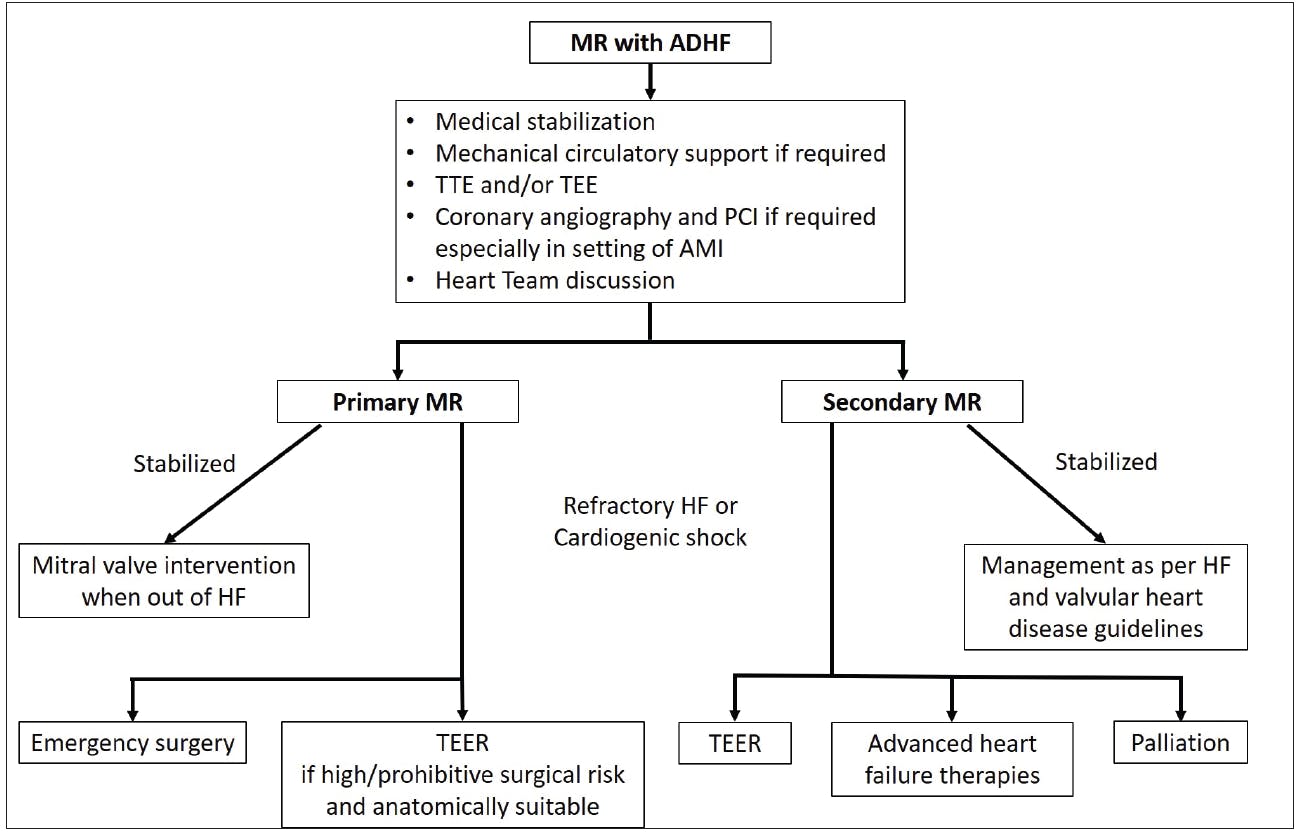
Figure 1. Proposed algorithm for the management of MR presenting with ADHF. HF, heart failure; TEE, transesophageal echocardiogram; TTE, transthoracic echocardiogram; PCI, percutaneous coronary intervention.
For primary MR, definitive treatment is targeted at the mitral valve apparatus. Intervention on the mitral valve, either surgical or percutaneous, should ideally be done when the patient is stabilized and out of heart failure. However, in the event of refractory heart failure or CS, emergency intervention may be unavoidable. Surgical mitral valve repair or replacement has been the mainstay of treatment, but if operative risks are very high or prohibitive, TEER is a reasonable alternative when anatomically suitable.
For secondary MR, the underlying degree of myocardial dysfunction frequently governs the overall prognosis. After successful stabilization, management follows the path of prevailing heart failure and valvular guidelines. But if the patient fails to improve, the decision must be made to proceed with either advanced heart failure mechanical therapies (such as left ventricular assist device [LVAD]) or transplant, TEER, or palliation.
TEER has the ability to create a desirable hemodynamic environment necessary for reversing the acutely spiraling disease course. After successful TEER, cardiac output increases, with improvement in end-organ tissue perfusion.9 In addition, left atrial pressure decreases along with relief of pulmonary congestion. In the past, this could only be achieved with open heart surgery, which carries with it the operative stresses, such as cardioplegia and cardiopulmonary bypass. Therefore, a less invasive transcatheter option is an attractive alternative to halt the downward progression of heart failure and CS from MR.
It is important to bear in mind that TEER does not necessarily have to be the definitive endpoint on intervention for the mitral valve. The presence of clips does not preclude future surgical valve replacement or in selected cases, repair. As for secondary MR, TEER can be either a definitive therapy, or serve as a bridge to LVAD or heart transplant. In the MitraBridge registry, 119 patients with advanced heart failure and functional MR (3-4+) who were potential heart transplant candidates underwent TEER with MitraClip (Abbott) as a bridging therapy.10 Beneficial results were demonstrated, with nearly one-quarter (23.5%) of patients removed from the heart transplant list due to clinical improvement and two-thirds (64%) remaining free from adverse events at 1 year (death, urgent heart transplant or LVAD implantation, first rehospitalization for heart failure). In addition, in the analysis by Tang et al, CS patients who received TEER had a lower incidence of the composite endpoint of death, LVAD implant, or heart transplant (hazard ratio, 0.66; 95% CI, 0.57-0.77; P < .001).6
The most challenging aspect of TEER remains the decision to proceed and the timing. If performed too early, insufficient time is given for the effects of medical therapy or other interventions to set in, and the patient is subjected to the unnecessary risks of a procedure under general anesthesia in the decompensated state. On the other hand, patients can deteriorate very rapidly, and it may be too late once multiorgan dysfunction ensues. The window of opportunity to intervene is frequently narrow. More often than not, intervention happens relatively late rather than early. Tang et al reported a median of 6 days (interquartile range, 2-13) after hospital admission before MitraClip, and the IREMMI registry reported a mean of 24 ± 22 days between onset of AMI and the procedural date.6,7 Thus, early multidisciplinary discussion and continuous evaluation with rapid response are required to improve outcomes.
AFTERLOAD MISMATCH AFTER TEER
Afterload mismatch resulting in acute left ventricular (LV) dysfunction is a debatable concern after MR correction. This was initially reported after mitral valve surgery and subsequently after TEER.11-13 The postulation is that the chronic volume-overload state from MR results in subclinical myocardial dysfunction that is masked by the low-impedance leak into the left atrium. With correction of MR, the only outlet for the LV is the high-impedance aorta, thus creating a situation of afterload mismatch and acute reduction in left ventricular ejection fraction (LVEF).11
Fortunately, in the limited literature available, the hemodynamic and clinical impact of afterload mismatch after TEER has been relatively forgiving. Melisurgo et al studied 73 patients with functional MR who underwent TEER and assigned them into two groups depending on whether afterload mismatch occurred.12 Afterload mismatch was defined in this study as an acute postoperative reduction of LVEF by 28% when compared to baseline. Nineteen (26%) patients experienced afterload mismatch after TEER but before hospital discharge, and LVEF was similar between both groups. There was no prognostic significance of afterload mismatch at 1 year, with similar survival between those with afterload mismatch versus those without (81.2 ± 9.9% vs 75.2 ± 8.7%, respectively; log-rank P = .44).
Jogani et al evaluated 62 patients with severe MR (73.8% functional MR) who underwent TEER for afterload mismatch.13 Afterload mismatch was assessed two ways: (1) acute LV depression, which was defined as a > 15% decrease in LVEF after TEER, or (2) acute adverse LV remodeling, which was defined as a > 15% increase in LV end-diastolic volume. Acute LV depression was experienced in 23% (n = 12) of patients but did not have any impact on clinical outcomes at 2 years (log-rank P = .80). Acute adverse LV remodeling was experienced in 15% (n = 8) of patients but did not have a clinical impact on short-term outcomes. However, acute adverse LV remodeling was associated with a worse longer-term prognosis, including a significantly higher mortality rate (75% vs 45%; log-rank P = .04) and a trend toward a higher rate of major adverse cardiovascular events (88% vs 68%; log-rank P = .80) at 2 years.
Although afterload mismatch occurs more commonly among those with baseline impaired LVEF, it can happen even with a seemingly preserved LV function.14 Studies by Melisurgo et al and Jogani et al suggest preliminary insights on factors that may identify postprocedure afterload mismatch, such as preprocedure LV dimensions and a high EuroSCORE II, respectively.12,13
Prophylactic inotropic agents and intra-aortic balloon pump prior to TEER, as well as complete versus incomplete MR correction, have been discussed as measures to reduce the effects of afterload mismatch, but robust evidence is lacking and hence cannot be formally recommended. Further research is needed to improve our understanding of the predictors of afterload mismatch and its significance, as well as if there is a need for preventive measures. Importantly, prompt recognition and intervention are critical to halt the downward spiral if clinically significant afterload mismatch occurs.
CONCLUSION
TEER is a feasible option for patients with severe MR in ADHF or CS. However, with the current literature available, it is difficult to provide strong general recommendations for this seemingly similar but heterogeneous group of patients. The decision to proceed with TEER and the timing of TEER should be individualized and made with comprehensive multidisciplinary heart team evaluation.
1. Arora S, Sivaraj K, Hendrickson M, et al. Prevalence and prognostic significance of mitral regurgitation in acute decompensated heart failure: the ARIC study. JACC Heart Fail. 2021;9:179-189. doi: 10.1016/j.jchf.2020.09.015
2. Lorusso R, Gelsomino S, De Cicco G, et al. Mitral valve surgery in emergency for severe acute regurgitation: analysis of postoperative results from a multicentre study. Eur J Cardiothorac Surg. 2008;33:573-582. doi: 10.1016/j.ejcts.2007.12.050
3. Feldman T, Foster E, Glower DD, et al. Percutaneous repair or surgery for mitral regurgitation. N Engl J Med. 2011;364:1395-1406. doi: 10.1056/NEJMoa1009355
4. Obadia JF, Messika-Zeitoun D, Leurent G, et al. Percutaneous repair or medical treatment for secondary mitral regurgitation. N Engl J Med. 2018;379:2297-2306. doi: 10.1056/NEJMoa1805374
5. Stone GW, Lindenfeld J, Abraham WT, et al. Transcatheter mitral-valve repair in patients with heart failure. N Engl J Med. 2018;379:2307-2318. doi: 10.1056/NEJMoa1806640
6. Tang GHL, Estevez-Loureiro R, Yu Y, et al. Survival following edge-to-edge transcatheter mitral valve repair in patients with cardiogenic shock: a nationwide analysis. J Am Heart Assoc. 2021;10:e019882. doi: 10.1161/JAHA.120.019882
7. Estevez-Loureiro R, Shuvy M, Taramasso M, et al. Use of MitraClip for mitral valve repair in patients with acute mitral regurgitation following acute myocardial infarction: effect of cardiogenic shock on outcomes (IREMMI registry). Catheter Cardiovasc Interv. 2021;97:1259-1267. doi: 10.1002/ccd.29552
8. Chua S, Hung J, Chung SY, et al. Primary percutaneous coronary intervention lowers the incidence of ischemic mitral regurgitation in patients with acute ST-elevated myocardial infarction. Circ J. 2010;74:2386-2392. doi: 10.1253/circj.cj-10-0435
9. Siegel RJ, Biner S, Rafique AM, et al. The acute hemodynamic effects of MitraClip therapy. J Am Coll Cardiol. 2011;57:1658-1665. doi: 10.1016/j.jacc.2010.11.043
10. Godino C, Munafò A, Scotti A, et al. MitraClip in secondary mitral regurgitation as a bridge to heart transplantation: 1-year outcomes from the International MitraBridge registry. J Heart Lung Transplant. 2020;39:1353-1362. doi: 10.1016/j.healun.2020.09.005
11. Ross J Jr. Afterload mismatch in aortic and mitral valve disease: implications for surgical therapy. J Am Coll Cardiol. 1985;5:811-826. doi: 10.1016/s0735-1097(85)80418-6
12. Melisurgo G, Ajello S, Pappalardo F, et al. Afterload mismatch after MitraClip insertion for functional mitral regurgitation. Am J Cardiol. 2014;113:1844-1850. doi: 10.1016/j.amjcard.2014.03.015
13. Jogani S, Van de Heyning CM, Paelinck BP, et al. Afterload mismatch after mitraclip implantation: intraoperative assessment and prognostic implications. J Invasive Cardiol. 2020;32:88-93.
14. Tang GHL, Cohen M, Dutta T, Undemir C. Afterload mismatch after transcatheter mitral valve repair with MitraClip for degenerative mitral regurgitation in acute cardiogenic shock. Catheter Cardiovasc Interv. 2018;92:E168-E171. DOI: 10.1002/ccd.27019
Advertisement
Advertisement