Advertisement
Advertisement
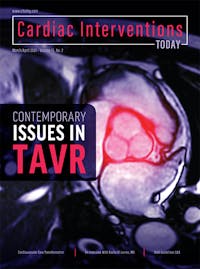
Over the past 2 decades, transcatheter aortic valve replacement (TAVR) has developed from a radical idea into the treatment of choice for the majority of patients with symptomatic severe aortic stenosis (AS) in the United States and Europe. Despite—and in some cases because of—the breakneck rate of adoption, there remain several unanswered clinical scenarios in which the safety and efficacy of TAVR remain unsettled. In this issue of Cardiac Interventions Today, we explore some of the most important outstanding questions in contemporary TAVR practice.
We begin with Akshay Kamath, MD; Shravan Rao, MD; Brett Sheridan, MD; Christian Spies, MD; and David Daniels, MD, as they tackle the challenges to transcatheter management of severe AS across a lifetime. They discuss TAV-in-TAV and how it can be used for intermediate- and low-risk patients.
Ole De Backer, MD; Ivan Wong, MD; and Lars Søndergaard, MD, review the recent data on structural valve deterioration and bioprosthetic valve failure after TAVR and surgical aortic valve replacement. Christine J. Chung, MD, outlines existing data on TAVR outcomes in bicuspid AS and procedural considerations to help refine patient selection and preprocedural planning.
Antonio Greco, MD, and Davide Capodanno, MD, discuss antithrombotic therapy and how it can be improved to provide favorable outcomes after transcatheter aortic valve implantation (TAVI).
Charan Yerasi, MD; Brian J. Forrestal, MD; and Toby Rogers, MD, address coronary obstruction risk of TAVR. They discuss the anatomic-, procedural-, and valve-related factors contributing to the risk of coronary obstruction and how to mitigate that risk.
Rajesh K. Kharbanda, PhD, provides an update on cerebral embolic protection in TAVI and reviews existing cerebral embolic protection devices and their clinical trial status.
In our panel discussion, we ask experts Gorav Ailawadi, MD; Mario J. Garcia, MD; Rishi Puri, MD; and Vinod H. Thourani, MD, about the newest American College of Cardiology and American Heart Association guidelines for TAVR and what they mean for the future.
Ginger Biesbrock, PA-C, hosts our Today’s Practice column for this issue, focusing on why the health care industry should embrace the pandemic as an innovation catalyst and how it will transform cardiovascular care.
Finally, we finish our TAVR issue with an interview with Rasha Al-Lamee, MA, who discusses with us the importance of research in cardiology care, thoughts on the ORBITA and EXCEL trials, and the effect of COVID-19 on the clinical trial landscape.
We were honored to invite this stellar cast of experts to guide us through the most relevant TAVR topics in contemporary clinical practice. Whether your interest is in the lifetime management of AS, structural valve deterioration, bicuspid valve therapies, post-TAVR therapeutics, coronary obstruction mitigation, cerebral embolic protection, or the application of the most recent United States guidelines for the management of aortic valve disease, we hope that you enjoy these contributions from this incredible set of master clinicians and educators. So, settle in and enjoy this edition of Cardiac Interventions Today on Contemporary Issues in TAVR.
James McCabe, MD, and Darren Mylotte, MD
Guest Chief Medical Editors
Advertisement
Advertisement