Advertisement
Advertisement
March/April 2021
TAVR Pitfalls: Addressing Coronary Obstruction Risk
Understanding the anatomic-, procedural-, and valve-related factors contributing to the risk of coronary obstruction and how to mitigate that risk.
By Charan Yerasi, MD; Brian J. Forrestal, MD; and Toby Rogers, MD, PhD
Due to FDA approval of transcatheter aortic valve replacement (TAVR) across all surgical risk profiles, the way we treat aortic stenosis has dramatically changed in recent years. However, coronary obstruction remains one of the most serious TAVR complications. Although rare, it is associated with high mortality.1 The risk of obstruction appears to be even higher with valve-in-valve (ViV) TAVR than with TAVR for native aortic stenosis. Data from the VIVID registry showed that out of 1,612 ViV procedures, a total of 37 (2.3%) patients had coronary obstruction that was associated with a high 30-day mortality of approximately 53%.2 Understanding the nuances and mechanisms of coronary obstruction during TAVR has become an essential skill and is a recurrent issue that all contemporary structural heart teams must consider (Figure 1).
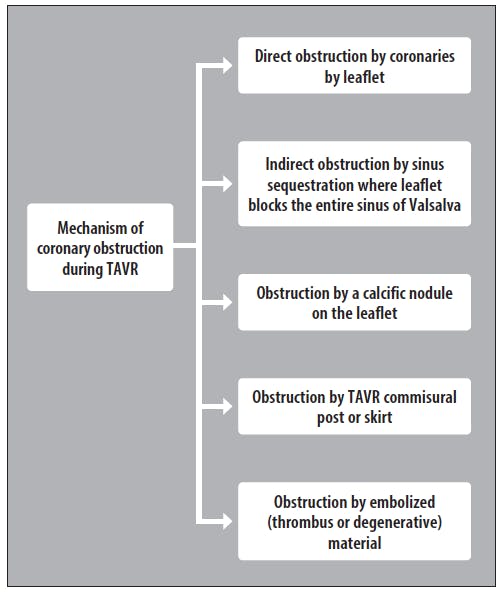
Figure 1. Mechanisms of coronary obstruction during TAVR.
RISK FACTORS FOR CORONARY OBSTRUCTION
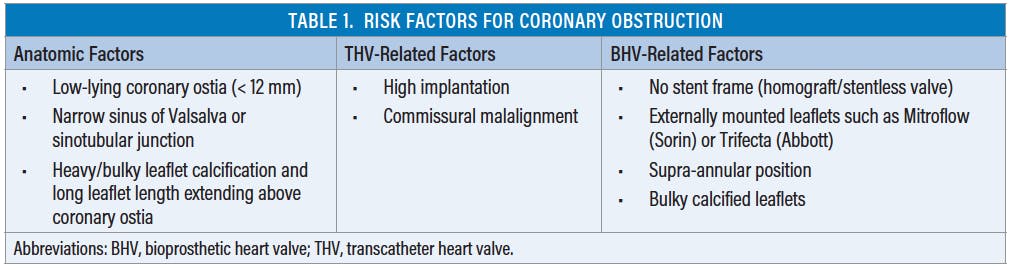
During both TAVR in native aortic valves and ViV, several factors contribute to the risk of coronary obstruction (Table 1). However, the differences between native aortic valve TAVR and ViV procedures should be taken into account during procedural planning.
Obstruction During TAVR for Native Aortic Valve Stenosis
As summarized in Table 1, several anatomic- and procedural-related factors increase the risk of coronary obstruction during TAVR for native aortic valve stenosis. The most significant anatomic risk factor for coronary obstruction is the combination of a low origin of the coronary arteries and an effaced (or narrow) sinus of Valsalva. This anatomic combination poses a risk of direct coronary obstruction by the native valve leaflets after TAVR deployment. During valve expansion, the native leaflets are displaced into the coronary sinus; if displaced far enough, the leaflets may occlude one or both coronary ostia. Other potential mechanisms of coronary obstruction include displacement of bulky calcific nodules into the coronary ostia and embolization of valve debris or thrombus down the coronary artery. CT is the best imaging modality for preprocedural planning to identify high-risk patients.
Procedural-related factors also play a role in obstruction risk at the time of TAVR. The inadvertent alignment of a transcatheter heart valve (THV) commissural post in front of the native coronary ostia may prevent blood flow into the coronary artery. With the self-expanding CoreValve Evolut THV (Medtronic), it is possible to reduce the likelihood of commissural malalignment by positioning the flush port of the delivery catheter to the 3 o’clock position during advancement through the iliofemoral arteries.3 Such maneuvers do not appear to be effective with the balloon-expandable Sapien 3 THV (Edwards Lifesciences) even if it is crimped with intentional commissural orientation on the balloon delivery catheter.3,4 Furthermore, the trend toward higher valve implants to reduce permanent pacemaker rates comes with the trade-off of increasing the obstruction risk of elevating the covered skirts of the newer-generation THVs further into the aorta, which may be a particular problem in patients with low coronaries and/or effaced sinus of Valsalva.
Obstruction During ViV TAVR
When considering ViV TAVR in either an existing surgical prosthesis or existing THV, several additional factors must be considered to evaluate the coronary obstruction risk. In particular, sinus sequestration becomes a more common mechanism of coronary obstruction due to the behavior of displaced prosthetic valve leaflets. As the THV is implanted, the leaflets of the first prosthesis are pinned open. In patients with low and narrow sinotubular junction, this creates a “tube graft” within the ascending aorta, which sequesters the sinuses of Valsalva and obstructs blood flow to the coronary arteries that arise therein (Figure 2). The risk appears to be highest when the surgical valve has externally mounted leaflets, which are not constrained by the commissural suture posts and are more easily displaced toward the coronaries.
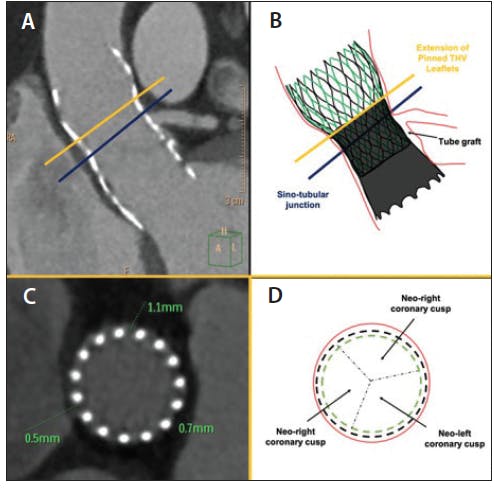
Figure 2. Sinus sequestration during ViV TAVR with a self-expanding valve within a self-expanding valve. Long-axis CT scan after TAVR showing relationship of the THV and the aortic root anatomy and corresponding schematic (A, B). Short-axis CT scan of the same patient at the level of the pinned leaflet plane and corresponding schematic (C, D).
Coronary obstruction from sinus sequestration is predicted to be an even bigger problem for TAVR-in-TAVR when the first valve is a self-expanding CoreValve Evolut THV. This is because the supra-annular THV leaflets lie high in the aorta and when pinned open during TAVR-in-TAVR, the leaflets will extend above the coronaries in most patients.5 If there is little or no space between the original THV and the aortic wall, the first THV becomes a tube graft.
To evaluate and identify patients at risk for coronary obstruction during ViV TAVR, two measurements are useful. The virtual valve-to-coronary (VTC) distance is obtained by simulating a virtual THV on preprocedural CT imaging and measuring from the virtual valve to the coronary ostia. The diameter of the virtual valve is determined by the size of the intended THV centered on the surgical bioprosthetic heart valve. A VTC distance of < 3 mm is considered high risk, 3 to 6 mm is considered intermediate, and > 6 mm is considered low risk. The virtual valve-to-sinotubular junction (VTSTJ) distance is the measurement of the virtual valve to the sinotubular junction. Typically, we consider a VTSTJ < 2 mm to be high risk. However, it is important to emphasize that these two measurements are by no means the only considerations. Patient anatomy, the existing surgical bioprosthesis, and the intended THV must all be factored into the risk assessment.
TECHNIQUES TO MITIGATE CORONARY OBSTRUCTION RISK
In patients identified to be high risk for coronary obstruction, it is always worth first revisiting surgical aortic valve replacement. However, many patients are not good surgical candidates due to anatomy or comorbidities. When TAVR is the only option, several techniques are available to mitigate the risk of obstruction, including the “chimney” or “snorkel” stenting technique, originally used for renal and mesenteric artery preservation after endovascular aortic aneurysm repair. In this technique, the stent is deployed in the coronary ostia, and the proximal portion of the stent is extended out into the aorta between the aortic wall and the THV, holding the offending leaflet out of the way and preserving coronary flow. In TAVR for native aortic valve stenosis, the “snorkeled” stents can be crushed between the THV stent frame and the aortic wall, potentially creating a nidus for late coronary stent thrombosis. During ViV TAVR, snorkel stenting is even less favorable given the likely higher risk of crushing the coronary stent.
In our opinion, leaflet modification using BASILICA (bioprosthetic or native aortic scallop intentional laceration to prevent iatrogenic coronary artery occlusion) is a more physiologic approach.6 This procedure uses catheters, a snare, and an electrified wire to lacerate the leaflet and create a triangular space that allows blood flow into the coronary artery. Early studies show that the BASILICA technique is both safe and effective in preventing coronary obstruction.7 It is important to highlight that BASILICA in its current form may not be a reliable strategy to prevent coronary obstruction during TAVR-in-TAVR because it might not achieve sufficient leaflet splay.8 Modifications of BASILICA may address this concern.9
CONCLUSION
Coronary obstruction during TAVR is a rare but devastating TAVR complication. Multiple anatomic-, procedural-, and valve-related factors contribute to this risk. Preprocedural CT imaging can identify high-risk patients and plan adjunctive procedures, such as BASILICA, to prevent coronary obstruction.
1. Dvir D, Webb J, Brecker S, et al. Transcatheter aortic valve replacement for degenerative bioprosthetic surgical valves: results from the global valve-in-valve registry. Circulation. 2012;126:2335-2344. doi: 10.1161/CIRCULATIONAHA.112.104505
2. Ribeiro HB, Rodés-Cabau J, Blanke P, et al. Incidence, predictors, and clinical outcomes of coronary obstruction following transcatheter aortic valve replacement for degenerative bioprosthetic surgical valves: insights from the VIVID registry. Eur Heart J. 2018;39:687-695. doi: 10.1093/eurheartj/ehx455
3. Tang GHL, Zaid S, Fuchs A, et al. Alignment of Transcatheter aortic-valve neo-commissures (ALIGN TAVR): impact on final valve orientation and coronary artery overlap. JACC Cardiovasc Interv. 2020;13:1030-1042. doi: 10.1016/j.jcin.2020.02.005
4. Rogers T, Greenspun BC, Weissman G, et al. Feasibility of coronary access and aortic valve reintervention in low-risk TAVR patients. JACC Cardiovasc Interv. 2020;13:726-735. doi: 10.1016/j.jcin.2020.01.202
5. Forrestal BJ, Case BC, Yerasi C, et al. Risk of coronary obstruction and feasibility of coronary access after repeat transcatheter aortic valve replacement with the self-expanding Evolut valve: a computed tomography simulation study. Circ Cardiovasc Interv. 2020;13:e009496. doi: 10.1161/CIRCINTERVENTIONS.120.009496
6. Khan JM, Rogers T, Greenbaum AB, et al. Transcatheter electrosurgery: JACC state-of-the-art review. J Am Coll Cardiol. 2020;75:1455-1470. doi: 10.1016/j.jacc.2020.01.035
7. Khan JM, Dvir D, Greenbaum AB, et al. Transcatheter laceration of aortic leaflets to prevent coronary obstruction during transcatheter aortic valve replacement: concept to first-in-human. JACC Cardiovasc Interv. 2018;11:677-689. doi: 10.1016/j.jcin.2018.01.247
8. Khan JM, Bruce CG, Babaliaros VC, et al. TAVR roulette: caution regarding basilica laceration for TAVR-in-TAVR. JACC Cardiovasc Interv. 2020;13:787-789. doi: 10.1016/j.jcin.2019.10.010
9. Greenbaum AB, Kamioka N, Vavalle JP, et al. Balloon-assisted BASILICA to facilitate redo TAVR. JACC Cardiovasc Interv. Published online December 19, 2020. doi: 10.1016/j.jcin.2020.10.056
Advertisement
Advertisement