Advertisement
Advertisement
March/April 2021
Cardiovascular Care Transformation Starts With Disruption
Why the health care industry should embrace the pandemic as an innovation catalyst.
With 2021 well underway, it’s important to take time to think about the long-term impact of the pandemic on the health care industry and patient care. Although history books will focus on the pandemic of 2020, the health care industry could and should focus on the disruptor of 2020. A disruptor is defined as something that interrupts an event, activity, or process by causing a disturbance or problem. A disruptor can also be a force for good when it causes radical change in an existing industry or market by means of innovation, a concept often highlighted in the business industry but rarely used in conjunction with changes in the health care industry. Accordingly, health care leaders and society at large agree change is needed. As opposed to small, incremental improvements, the health care industry needs a significant disruption. Viewed through the lens of disruption, innovation, and care transformation, there is no opportunity for change like the present.
The pandemic has created economic instability for most health care organizations and providers. Other effects include less desirable patient outcomes from poor access, missed care opportunities, worsening of existing health disparities due to lack of resources and technology needed to seek health care, and a burned-out health care workforce. Although these challenges aren’t new, they have all been amplified by the pandemic, and there is an increased urgency to implement solutions. Historic events, such as the 1918 flu pandemic, provide valuable insights into the effects of a public health emergency, both in the short and long term. From a health care delivery standpoint, many governments embraced new concepts of preventive medicine and socialized medicine after the 1918 flu pandemic. The United States also adopted the employer-based insurance plans that expanded access to health care for the general population.1 Fast forward to the 2020 pandemic and there are many opportunities for innovation in cardiovascular care with “hints” of transformation but no clear path to achieving true transformation.
Disruption creates a need for action. The type of action is a choice. For some, the action will be to look inward and make changes to do more with less. Others will look externally to see how the disruption has changed the industry and patient and provider needs and look to innovate and transform to better meet those needs. A review of this concept in the business industry would suggest that the former approach often leads to demise while the latter approach can lead to expansion into new services and markets creating a trajectory otherwise unforeseen.2
APPLYING INNOVATION AND TRANSFORMATION TO INTERVENTIONAL CARDIOVASCULAR CARE
There is a significant body of literature about leadership in health care. Effective organizations bring the right people to the table with requisite skills in both management and leadership.3,4
Interventional cardiovascular programs need to have an effective leadership and management structure to provide vision and foster an environment supportive of innovation and transformation. Applied to surviving during a time of disruption, management will tend to concentrate on preserving and improving the status quo, while leadership is about challenging the status quo and creating something different and more effective.5
Where does a program start? Three types of innovation have been described by Herzlinger,6 viewed through the lens of the COVID pandemic: (1) change the way consumers buy and use health care, (2) use technology to develop new products and treatments, and (3) generate new business models.
Change the Way Consumers Buy and Use Health Care
Early in the pandemic, MedAxiom described the rapid transition to virtual care through telehealth services in an April 2020 survey report on the impact of COVID-19 on cardiovascular organizations. According to the survey findings, most programs transitioned to a virtual delivery model in < 2 weeks, and changes in reimbursement and regulations that supported the transition closely followed (Figure 1).
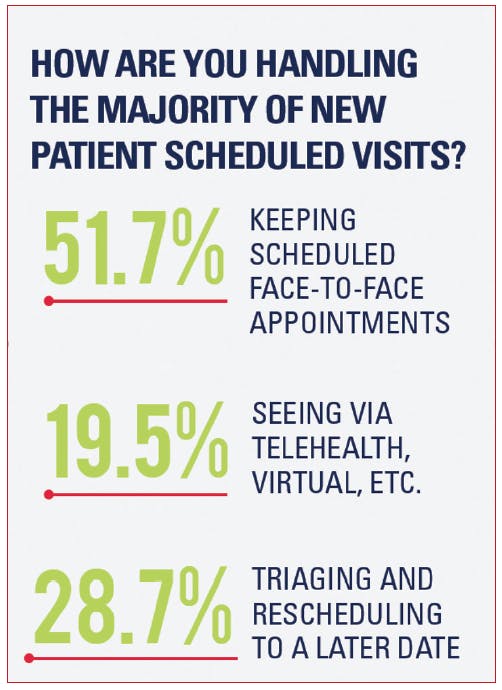
Figure 1. Results of the Medaxiom survey report on the impact of COVID-19 on cardiovascular organizations (April 2020).
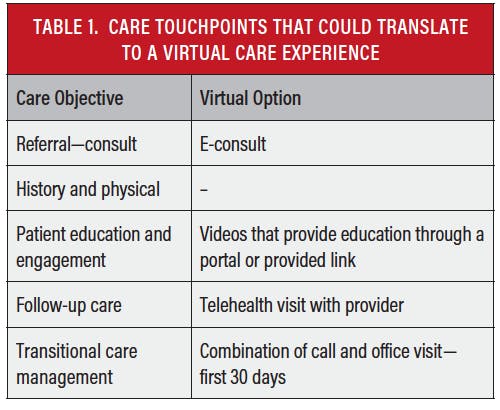
Numerous learnings stemmed from the transition to virtual care delivery. The transition highlighted the capability and ability to do this work effectively while putting a spotlight on disparities in access to health care. Patients without access to technology had an even harder time receiving necessary care. Further, the early pandemic forced a shift from preventive, routine care to urgent-only care. Many stories have been shared about patients who waited too long to seek care or missed routine evaluations only to present with acute needs. A shift in the health care delivery model needs to recognize those disparities and ensure access to routine, preventive care, as well as urgent needs. Virtual care worked and needs to stay, but it must evolve. A digital transformation must complement face-to-face care such that virtual care is embedded when and where it is most effective for communication, care coordination, and care delivery. For the procedural patient, there are several touchpoints that would lend themselves to a virtual care delivery option (Table 1).
Use Technology to Develop New Products and Treatments
Device, pharmacologic, and procedural therapies have all progressed in recent years. These innovations allow clinicians to provide therapies in much different ways than a decade ago. Structural heart is a great example where indications for transcatheter aortic valve replacement and transcatheter mitral valve repair are evolving as research is proving superior outcomes. For industry to ensure that patients are receiving the most effective management approach, shared care between interdisciplinary teams needs to be strengthened. Heart team shared decision-making has been found to be invaluable and is a class I indication. However, programs still struggle to implement a strong approach that allows for true collaboration, coordination of care, and care decision-making.
There are many other examples that will have an impact on work force needs, skill sets, operational processes, and changes in both provider and patient expectations. Team-based, multidisciplinary care will promote effective and efficient care. The pandemic has caused programs to redeploy providers, develop new care pathways, and redefine relationships with hospitalists, emergency physicians, intensivists, and each other. This redeployment of providers, which utilized skill sets in unique ways, was an innovation and proved the cardiovascular industry’s ability to adapt. Barriers that were economic and related to “turf” were broken down with ease and grace. However, solutions to support long-term transitions are required, and reimbursement changes and physician compensation models must adjust to support and encourage team-based care delivery. The pandemic forced an acceleration of this work for many programs; now, the work must continue at a pace that will support innovation and a true transformation of care.
Generate New Business Models
The traditional fee-for-service model is at a tipping point. The pandemic has shown that a reactive care delivery model in a fee-for-service–funded environment is ineffective. Limitations to elective procedures, ambulatory care services, and overall reluctance to seek health care has created an economic “perfect storm” for health care organizations. In addition, nonacute services that use acute care hospitals as their site of service came to a halt. This created both economic struggles and, more importantly, missed care opportunities. Now is the time to generate new business models that may involve horizontal or vertical integration of separate health care organizations or activities.
The cardiovascular industry recognizes the opportunity to transition many services to ambulatory surgical centers (ASCs) and office/outpatient departments. The pandemic has highlighted that having nonacute care sites of service is important. An example of a recent delivery innovation in the cardiovascular space is the transition of percutaneous coronary intervention (PCI) to an ASC. A position statement from the Society for Cardiovascular Angiography & Interventions in May 2020 stated that “the ability to perform PCI in an ASC has been made possible” and is happening effectively when structured appropriately.7 However, full adoption will require multiple changes, including health policy, economic alignment, facility planning, integration models, and operational structures.
CONCLUSION
As tragic as the last year was, the health care industry must embrace the 2020 pandemic as a disruptor and catalyst for innovation to author positive, lasting change. Dyad leadership, a vision for innovation, and utilizing lessons learned will allow true cardiovascular care transformation to occur. MedAxiom and its parent company, the American College of Cardiology, have a joint mission: “To transform cardiovascular care and improve heart health.” We are in the business of innovation and will work tirelessly to lead members with vision, education, organizational resources, and advocacy. Let’s transform cardiovascular care, together. Visit medaxiom.com to learn more about cardiovascular care transformation efforts.
1. Spinney L. Pale Rider: The Spanish Flu of 1918 and How It Changed the World. PublicAffairs; 2017.
2. Kim WC, Mauborgne R. Blue Ocean Strategy: How to Create Uncontested Market Space and Make Competition Irrelevant. Harvard Business Review Press; 2005.
3. Chazal RA, Montgomery MJ. The dyad model and value-based care. J Am Coll Cardiol. 2017;69:1353-1354. doi: 10.1016/j.jacc.2017.02.007
4. Fry ETA, Walsh MN. Cardiovascular health system leadership: an evolving model. J Am Coll Cardiol. 2018;71:575-576. doi: 10.1016/j.jacc.2017.12.039
5. O’Reilly CA 3rd, Tushman ML. Lead and Disrupt: How to Solve the Innovator’s Dilemma. Stanford University Press; 2016.
6. Herzlinger RE. Why innovation in healthcare is so hard. Harv Bus Rev. 2006;84:58-66, 156.
7. Ferraro R, Latina JM, Alfaddagh A, et al. Evaluation and management of patients with stable angina: beyond the ischemia paradigm: JACC state-of-the-art review. J Am Coll Cardiol. 2020;76:2252-2266. doi: 10.1016/j.jacc.2020.08.078
Advertisement
Advertisement