Advertisement
Advertisement
March/April 2021
Update on Cerebral Embolic Protection in TAVI
A review of existing cerebral embolic protection devices used in TAVI and their clinical trial status.
Transcatheter aortic valve implantation (TAVI) is now an established treatment option for patients with aortic stenosis who are at high risk for surgery, and the evidence supporting its safety and effectiveness in other patient groups is increasing.1 Although TAVI is less invasive, leads to faster recovery, and is associated with less morbidity than surgical valve replacement, there are potential major complications, including access site vascular injury, stroke, and death.
Stroke is an important but unpredictable complication associated with TAVI; it will become an even more important concern to patients and health care funders as TAVI is used to treat more patients, both as the proportion of older people increases in the population and as TAVI is used to treat younger patients at lower risk for surgery.2 TAVI patients report that maintaining independence is a more important treatment goal than preventing death, and other studies show that patients may regard stroke as a worse health state than death.3
There are multiple causes for stroke in this patient group, but most procedure-related strokes are ischemic and thought to be due to embolism of the valve and other materials into the cerebral circulation. Most occur early after TAVI (within 24-48 hours). TAVI-associated stroke leads to a prolonged hospital stay, a reduced chance of returning to independence, and a near sixfold increased risk of death within 30 days.4 Stroke increases the cost of the index hospitalization and doubles rehospitalization costs. Reducing the risk of stroke during TAVI, therefore, has important implications for improving patient outcomes and decreasing health care resources.
AVAILABLE EMBOLIC PROTECTION SYSTEMS
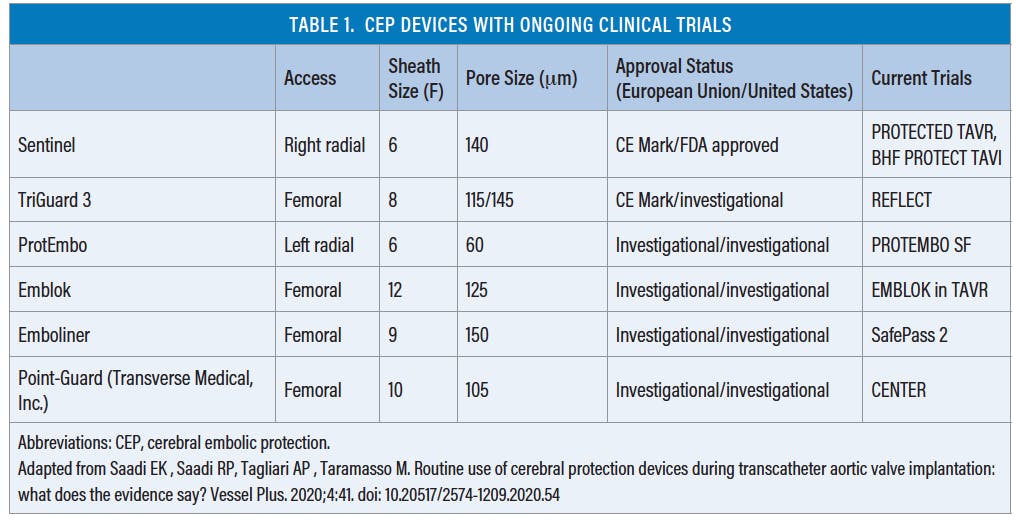
Several cerebral embolic protection (CEP) devices are currently being evaluated, at different stages of development and with varying evidence available (Table 1) . In broad terms, the devices reduce the risk of embolic debris reaching the brain by positioning mesh across the cerebral blood vessels to either capture or deflect the material destined for the brain circulation. Access site, sheath, mesh pore size, and extent of cerebral circulation protection vary across the devices. The ideal device would offer protection of the entire cerebral circulation, with ease of delivery and positioning, stability through the procedure, and association with clinical effectiveness and safety without the risk of damage to the cerebral vessels and access site.
The evidence supporting the use of CEP devices in TAVI is based on three broad lines of investigation.
- Proof-of-principle studies have confirmed that debris is retrieved from most CEP devices when they are examined after TAVI, suggesting that these devices reduce embolic debris reaching the brain.5
- Imaging studies using MRI to identify brain injury have confirmed that nearly 75% of patients had new brain lesions after TAVI and that use of CEP devices may be associated with reduced lesions. The significance of these clinically “silent” lesions in the TAVI population remains uncertain, but they have been associated with cognitive decline and dementia in other studies.6
- Clinical evidence from randomized trials (described in the following sections) were based on brain imaging surrogate endpoints but also gathered clinical outcomes, clinical case series and registry reports, and systematic reviews. Importantly, these studies have focused on surrogate endpoints, were not powered for hard clinical endpoints, have reported outcomes at different times after TAVI, and include a range of CEP devices.
Sentinel Cerebral Protection System
With three published randomized trials, the Sentinel cerebral protection system (Boston Scientific Corporation) is the most widely studied CEP system available. The SENTINEL trial included 363 patients with a primary endpoint of new lesion volume on MRI scans. The study was neutral for an effect of CEP on the imaging endpoint, but it did demonstrate a numerical trend toward stroke reduction, with 9.1% in the control arm versus 5.6% in the device arm (P = .25) .7 The CLEAN-TAVI trial included 100 patients with a primary endpoint based on MRI. There was a reduction in new lesions and volume of lesions in the CEP group but no reduction in neurologic events (10% minor stroke in both groups).8 The MISTRAL-C trial included 65 patients and had an imaging-based primary endpoint. There was a reduction in the proportion of patients with new lesions in the protected areas from 55% without CEP to 20% in the CEP group. This was associated with a numerical reduction in major stroke from 7% without CEP to 0% in the CEP group.9
A patient-level pooled analysis combining an observational series and data from the randomized SENTINEL and CLEAN-TAVI trials (N = 1,306) using propensity matching allowed comparison of 533 patients who underwent TAVI with CEP to 533 without CEP. In patients undergoing TAVI with CEP, there was evidence of a reduction in stroke at 72 hours after TAVI (10/533 [1.88%] vs 29/533 [5.44%]; odds ratio [OR], 0.35; 95% CI, 0.17-0.72; relative risk reduction, 65%; P = .0028), as well as a reduction in the combination of 72-hour mortality and stroke (11/533 [2.06%] vs 32/533 [6%]; OR, 0.34; 95% CI, 0.17-0.68; relative risk reduction, 66%; P = .0013).10 These studies suggest a clinical effect of CEP in reducing early stroke with a number needed to treat of approximately 25 (ie, treating 25 TAVI patients will reduce one stroke). However, caution is needed in interpreting these results because of the heterogeneity in the included studies.
Recently published registry-level data are consistent with a beneficial effect of Sentinel. In the Society of Thoracic Surgeons/American College of Cardiology Transcatheter Valve Therapy Registry, the rate of in-hospital stroke was not significantly lower when the Sentinel device was used according to an instrumental variable analysis (1.39% vs 1.54%; relative risk (RR) = 0.90; 95% CI, 0.68-1.13). However, secondary propensity-weighted analysis of the data showed a small reduction in the rates of in-hospital stroke (1.30% vs 1.58%; RR = 0.82; 95% CI, 0.69-0.97), in-hospital death or stroke (2.1% vs 2.5%; RR = 0.84; 95% CI, 0.73-0.98), 30-day stroke (1.9% vs 2.2%; RR = 0.85; 95% CI, 0.73-0.99), and 30-day death (1.7% vs 2.2%; RR = 0.78; 95% CI, 0.64-0.95) in patients receiving Sentinel.11 A propensity-weighted analysis of the National Inpatient Sample showed that Sentinel use was associated with a lower risk of in-hospital ischemic stroke (1% vs 3.8%; OR = 0.24; 95% CI, 0.09-0.62) and in-hospital death (0% vs 1%; P = .036).12
TriGuard 3 CEP Device
The DEFLECT III study of the TriGuard HDH embolic deflection device (Keystone Heart, a Venus Medtech company) was an exploratory study using MRI that included 85 patients. With CEP, there was a reduction in the number of new lesions (21% in the control group vs 11.5% in the CEP group), a numerical reduction of in-hospital stroke (5% in the control group vs 2% in the CEP group), and better performance on a delayed memory task at hospital discharge.13 The device has changed from a 250- to 130-μm pore size.
The REFLECT trial studied the TriGuard device, and the next-generation TriGuard 3 was studied in REFLECT II. Results have been presented in abstract recently, showing the safety of TriGuard 3 but not demonstrating superiority for the MRI efficacy endpoint.14 Further studies are planned to investigate the clinical efficacy of this device.
Emblok Embolic Protection System
The Emblok embolic protection system (Innovative Cardiovascular Solutions, LLC) contains a pigtail and filter that sit in the arch to protect all major cerebral vessels. A first-in-human study has been published, confirming that the device can be successfully positioned so that debris can be captured. The device is safe to use and feasible.15 Larger trials are planned.
ProtEmbo Cerebral Protection System
The ProtEmbo cerebral protection system (Protembis GmbH) is delivered by the left radial approach and is a deflection device that protects all major cerebral vessels. The PROTEMBO SF trial is a safety and feasibility study that has been completed but is not yet published.
Emboliner
The results of the SafePass 2 safety and technical performance study of the Emboliner (Emboline, Inc.) have been presented in abstract. The device was delivered successfully in all 31 patients, and debris was captured in all patients. In two-thirds of patients, there was at least one particle > 1 μm in size, and between 250 and 300 particles > 150 μm were detected. There were no safety concerns raised.
NEXT STEPS FOR MORE EVIDENCE
For CEP to be routinely used in clinical treatment, we need further robust data confirming a reduction in clinical stroke and safe, cost-effective improvement in health outcomes. These devices can remove debris and limit it reaching the brain, as well as reduce brain lesions on MRI, but there remains an important clinical discrepancy between the incidence of clinical stroke and what is seen on the MRI scan. The ascertainment of clinical stroke is another important confounder, with variation in stroke rates depending on whether there is routine neurologic assessment or self-reporting.
Two large clinical outcome trials testing the effect of CEP on clinical stroke using the Sentinel cerebral protection system are now underway: PROTECTED TAVR and the British Heart Foundation (BHF) PROTECT TAVI.16,17
Clinical trials are designed based on the incidence of the proposed primary endpoint and the anticipated treatment effect to determine the sample size. Although the published evidence is highly suggestive of a beneficial effect of CEP devices on clinical outcomes, these observational studies are limited by self-reported and nonadjudicated events or by the finding of a high incidence of stroke ascertained by routine pre- and postassessment by dedicated stroke assessors. Both ongoing large clinical endpoint randomized trials differ in the approach used for stroke ascertainment and therefore have different predicted baseline stroke rates; they also differ in the proposed treatment effect.
PROTECTED TAVR Study
The primary endpoint is all-cause stroke through 72 hours post-TAVI procedure or discharge (whichever comes first), as adjudicated by an independent clinical events committee (CEC) and using Neurologic Academic Research Consortium definitions. In this study, there is a formal assessment of neurology before and after for each patient. The incidence of stroke is assumed to be 4%, and the effect size is 50% relative risk reduction, giving an anticipated stroke rate of 2% in the treatment group, or 2% absolute risk reduction. The calculated sample size for this study is 3,000 patients. The study is underway with centers in the United States and Europe. Planned completion is 2022, with a planned adaptive design and interim analysis at 2,100 patients.
BHF PROTECT TAVI Study
The primary endpoint for this study is all-cause stroke through 72 hours post-TAVI procedure or discharge (whichever comes first), as adjudicated by an independent CEC. In this study, there is active ascertainment of the stroke outcome using a structured questionnaire, then triggering formal assessment of neurology if an event is suspected. The incidence of stroke is assumed to be 3%, and the effect size is 33% relative risk reduction, giving an anticipated stroke rate of 2% in the treatment group, or 1% absolute risk reduction. The calculated sample size for this study is 7,730 patients. The study is underway in the United Kingdom. Planned completion is 2025, with planned interim analysis at 3,826 and 5,360 patients. This study includes a formal cost-effectiveness analysis based on the United Kingdom health care system costings.
SUMMARY
The incidence of clinical stroke associated with TAVI remains an unpredictable and concerning complication. Intuitively, CEP devices should reduce the risk of stroke and improve outcomes. The evidence from mechanistic studies and registry data is supportive of the clinical effectiveness of CEP. Large-scale clinical trials focused on hard clinical outcomes are now underway to provide patients and clinicians with the evidence they need to understand the impact of CEP on outcomes after TAVI.
1. Baumgartner H, Falk V, Bax JJ, et al. 2017 ESC/EACTS guidelines for the management of valvular heart disease. Eur Heart J. 2017;38:2739-2791. doi: 10.1093/eurheartj/ehx391
2. Auffret V, Regueiro A, Del Trigo M, et al. Predictors of early cerebrovascular events in patients with aortic stenosis undergoing transcatheter aortic valve replacement. J Am Coll Cardiol. 2016;68:673-684. doi: 10.1016/j.jacc.2016.05.065
3. Coylewright M, Palmer R, O'Neill ES, et al. Patient-defined goals for the treatment of severe aortic stenosis: a qualitative analysis. Health Expect. 2016;19:1036-1043. doi: 10.1111/hex.12393
4. Vlastra W, Jimenez-Quevedo P, Tchétché D, et al. Predictors, incidence, and outcomes of patients undergoing transfemoral transcatheter aortic valve implantation complicated by stroke. Circ Cardiovasc Interv. 2019;12:e007546. doi: 10.1161/CIRCINTERVENTIONS.118.007546
5. Kroon H, von der Thusen JH, Ziviello F, et al. Heterogeneity of debris captured by cerebral embolic protection filters during TAVI. EuroIntervention. 2021;16:1141-1147. doi: 10.4244/EIJ-D-20-00744
6. Nombela-Franco L, Armijo G, Tirado-Conte G. Cerebral embolic protection devices during transcatheter aortic valve implantation: clinical versus silent embolism. J Thorac Dis. 2018;10:S3604-S3613. doi: 10.21037/jtd.2018.09.62
7. Kapadia SR, Kodali S, Makkar R, et al. Protection against cerebral embolism during transcatheter aortic valve replacement. J Am Coll Cardiol. 2017;69:367-377. doi: 10.1016/j.jacc.2016.10.023
8. Haussig S, Mangner N, Dwyer MG, et al. Effect of a cerebral protection device on brain lesions following transcatheter aortic valve implantation in patients with severe aortic stenosis: the CLEAN-TAVI randomized clinical trial. JAMA. 2016;316:592-601. doi: 10.1001/jama.2016.10302
9. Van Mieghem NM, van Gils L, Ahmad H, et al. Filter-based cerebral embolic protection with transcatheter aortic valve implantation: the randomised MISTRAL-C trial. EuroIntervention. 2016;12:499-507. doi: 10.4244/EIJV12I4A84
10. Seeger J, Kapadia SR, Kodali S, et al. Rate of peri-procedural stroke observed with cerebral embolic protection during transcatheter aortic valve replacement: a patient-level propensity-matched analysis. Eur Heart J. 2019;40:1334-1340. doi: 10.1093/eurheartj/ehy847
11. Cohen D. Cerebral embolic protection and TAVR outcomes: results from the TVT Registry. Presented at: Transcatheter Cardiovascular Therapeutics (TCT) 2020. October 16, 2020.
12. Megaly M, Sorajja P, Cavalcante JL, et al. Ischemic stroke with cerebral protection system during transcatheter aortic valve replacement. JACC Cardiovasc Interv. 2020;13:2149-2155. doi: 10.1016/j.jcin.2020.05.039
13. Lansky AJ, Schofer J, Tchétché D, et al. A prospective randomized evaluation of the TriGuard HDH embolic DEFLECTion device during transcatheter aortic valve implantation: results from the DEFLECT III trial. Eur Heart J. 2015;36:2070-2078. doi: 10.1093/eurheartj/ehv191
14. Moses JW. A randomized evaluation of the TriGUARD3 cerebral embolic protection device to reduce the impact of cerebral embolic lesions after transcatheter aortic valve implantation: the REFLECT II trial. Presented at: Transcatheter Cardiovascular Therapeutics (TCT) 2020. October 15, 2020.
15. Latib A, Mangieri A, Vezzulli P, et al. First-in-Man Study Evaluating the Emblok Embolic Protection System During Transcatheter Aortic Valve Replacement. JACC Cardiovasc Interv. 2020;13:860-868. doi: 10.1016/j.jcin.2019.11.017
16. PROTECTED TAVR: Stroke PROTECTion With SEntinel During Transcatheter Aortic Valve Replacement (PROTECTED TAVR). Clinicaltrials.gov website. Accessed February 25, 2021. https://clinicaltrials.gov/ct2/show/NCT04149535
17. British Heart Foundation Randomised Trial of Routine Cerebral Embolic Protection in Transcatheter Aortic Valve Implantation (BHF PROTECT-TAVI). ISRCTN registry website. Accessed February 25, 2021. http://www.isrctn.com/ISRCTN16665769
Advertisement
Advertisement