Advertisement
Advertisement

Since its inception as a “last-resort” therapy for inoperable patients, transcatheter aortic valve replacement (TAVR) has undergone a profound transformation and now represents the dominant form of aortic valve replacement in the United States. This growth in volume has been supported by many factors, including improved device technology, better operator proficiency, and expanding indications for TAVR. Nevertheless, this evolution demands a fundamental restructuring of how we target aortic stenosis care and requires that we move beyond the catheterization lab to address the significant gaps in diagnosis and referral that still leave many patients undertreated.
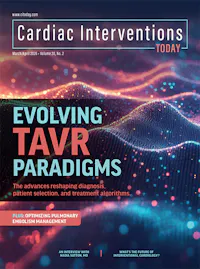
This issue of Cardiac Interventions Today explores these burgeoning frontiers, highlighting the strategies required to prepare health care systems for broader TAVR access. As the use of TAVR continues to expand, these articles provide a nuanced look at the strategic shifts defining the next era of valvular heart disease management.
First, Sumit R. Kumar, MD; Natalia C. Berry, MD; James T. DeVries, MD; Henry J. Tannous, MD; and Michael N. Young, MD, outline a practical three-pillar framework to support expanding TAVR eligibility that includes proactive diagnostics, integrated clinical workflows, and enhanced operational planning. Health systems must embrace this to ensure scalable, efficient, and high-quality care.
Next, Mohammad Forouzannia, MD; Yousif Ahmad, MD; and Sammy Elmariah, MD, examine persistent gaps in aortic stenosis care through the Target: Aortic Stenosis initiative, emphasizing that procedural success alone is insufficient; timely diagnosis, structured referrals, and multidisciplinary evaluation are essential to reduce underdiagnosis and ensure prompt, guideline-directed treatment.
Haytham Allaham, MD; Megan Coylewright, MD; and Mukta Srivastava, MD, then explore how automation and artificial intelligence (AI) have the potential to reshape the TAVR landscape by improving disease detection, reducing care disparities, enhancing imaging and procedural planning, and enabling more personalized decision-making.
A thoughtful discussion with Chad Kliger, MD; Kimberly A. Skelding, MD; Christine J. Chung, MD; and Adnan K. Chhatriwalla, MD, reflects on how the multidisciplinary heart team must adapt, by balancing efficiency with personalization, integrating advanced imaging earlier in decision-making, and leveraging emerging technologies such as AI while preserving shared accountability.
In our pulmonary embolism (PE) subfeature, Frances Mae West, MD; Thomas M. Todoran, MD; Andrew J. P. Klein, MD; and James Horowitz, MD, highlight the advantages and limitations of current tools and historic models, algorithmic approaches, and potential future directions. Continuing the PE conversation, Kenneth Rosenfield, MD, moderates a panel with Vivian L. Bishay, MD; Patrick Muck, MD; and Sameh Sayfo, MD, on needs and goals of next-generation PE response teams. To round out this PE series, we’ve included a summary of the 2026 American College of Cardiology/American Heart Association joint clinical practice guideline on the evaluation and management of acute PE, which introduced a new severity-based classification system and comprehensive recommendations spanning diagnosis, treatment, and follow-up care.
In our Today’s Practice column, Joel Sauer, MBA, and Ana A. Mercurio-Pinto, MHM, assess challenges facing the interventional cardiology workforce today, urging us to address structural burnout, lifestyle realities, physical toll, and rural access challenges.
Closing this issue is our featured interview series with Nadia Sutton, MD, who reflects on the intersection of clinical practice, engineering, and translational research in modern interventional cardiology.
As the landscape of TAVR continues to expand, the insights shared in this issue underscore that the future of TAVR success lies not just in the refinement of the valve itself but also in preparing our health care systems for the influx of patients who will be eligible for treatment. Ultimately, the transition from a specialized procedure to a comprehensive system of care requires a commitment to both clinical excellence and systemic agility. As we refine these evolving paradigms, the measure of our success will be defined by our ability to translate technological sophistication into equitable, lifelong outcomes for the global population of patients with aortic stenosis. I hope that the perspectives provided herein serve as both a guide and an inspiration as TAVR care continues to evolve in your own institutions.
Suzanne J. Baron, MD, MSc
Guest Chief Medical Editor
Advertisement
Advertisement