Advertisement
Advertisement
March/April 2026
Pulmonary Embolism Risk Stratification: Progress, Gaps, and the Path Forward
Key developments, lessons learned, where current tools fall short, and what’s in the pipeline.
By Frances Mae West, MD, MSc, FACP; Thomas M. Todoran, MD, MSc; Andrew J. P. Klein, MD; and James Horowitz, MD
Pulmonary embolism (PE) is a common and potentially life-threatening condition with presentations ranging from mild symptoms to circulatory collapse. Early and accurate risk stratification is essential to guide decisions regarding triage, monitoring, and the use of advanced therapies.
The current prognostic model utilizes a multidimensional framework that emphasizes clinical features, comorbidities, hemodynamics, right ventricular (RV) dysfunction, and myocardial injury. However, this approach may not adequately capture the heterogeneity of PE, particularly among normotensive patients who may have occult hemodynamic compromise. Novel biomarkers, echocardiographic indicators, clinical assessment tools, and new risk calculators reflect efforts to refine prognostic accuracy.
This article summarizes key developments in PE risk stratification, highlighting what has been learned, where current tools fall short, and what is in the pipeline to achieve a more nuanced and clinically actionable risk assessment.
EUROPEAN SOCIETY OF CARDIOLOGY PE CLASSIFICATION ALGORITHM
The European Society of Cardiology (ESC) algorithm is now the most widely used and internationally accepted comprehensive framework for risk stratification of PE patients. One of the key structural changes in the 2019 ESC guidelines mandated evaluation of RV function in all normotensive PE patients in the risk stratification schema (Figure 1).1 The prior 2014 ESC guidelines recommended assessment of RV function only in normotensive PE patients with a class III to IV PE Severity Index (PESI) or a simplified PESI (sPESI) ≥ 1.2 In this paradigm, patients with an sPESI score of 0 were classified as low risk without a radiographic assessment or biochemical assessment of RV function. This shift toward a more inclusive framework resulted in many patients who would have been categorized as low risk under the 2014 ESC guidelines being reclassified as intermediate risk according to the 2019 ESC criteria. In a large study of elderly patients diagnosed with PE, 45% of normotensive patients were classified as intermediate-high risk by the 2019 ESC algorithm compared to 24% by the 2014 ESC algorithm and 37% by PESI. In this cohort, only 19% were classified as low risk versus 32% comparing the 2019 and 2014 ESC criteria, respectively.3 Although more sensitive, the discriminatory power for all-cause mortality was lower in the 2019 ESC algorithm, as compared with the 2014 ESC algorithm or PESI (63.6% vs 71.5% and 75.2%, respectively). This presents a challenge in the current paradigm when considering patients for revascularization therapy and highlights a need for further refinement.
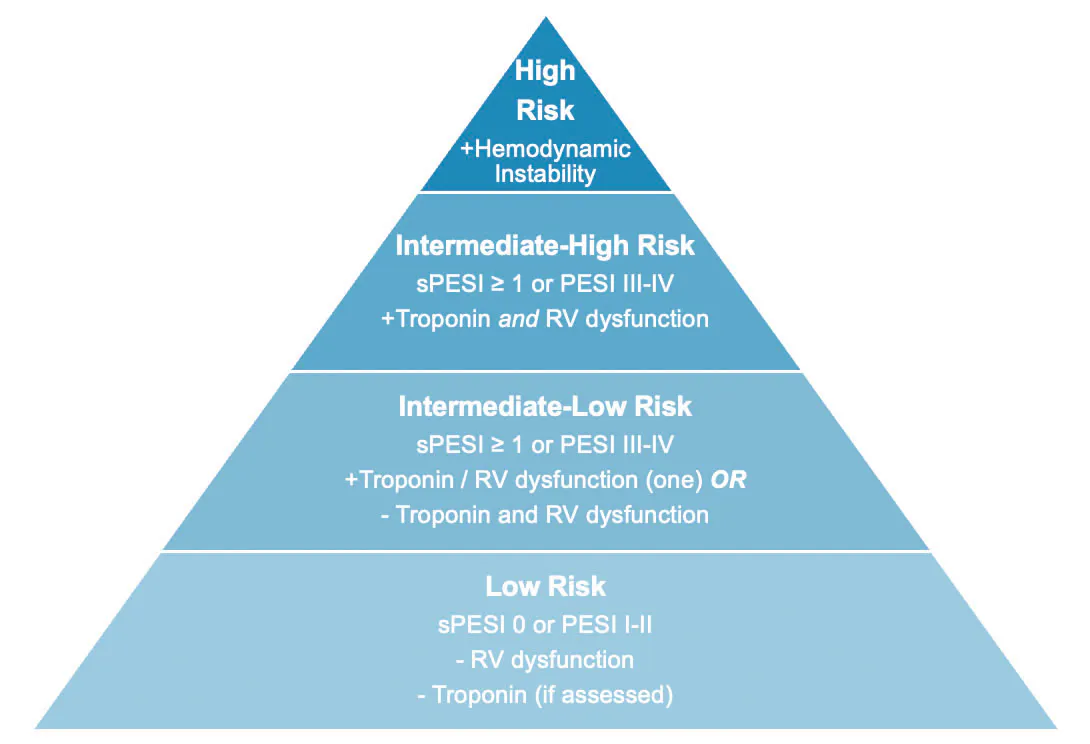
Figure 1. ESC 2019 risk stratification algorithm for acute PE. The ESC risk stratification framework for acute PE integrates hemodynamic status, clinical risk scores, imaging evidence of RV dysfunction, and cardiac biomarker assessment to categorize patients into high, intermediate-high, intermediate-low, or low-risk groups. The algorithm guides early prognostication and management decisions by distinguishing patients with overt hemodynamic instability from those who are normotensive but exhibit varying degrees of RV strain and myocardial injury. Adapted from Konstantinides SV, Meyer G, Becattini C, et al. 2019 ESC guidelines for the diagnosis and management of acute pulmonary embolism developed in collaboration with the European Respiratory Society (ERS). Eur Heart J. 2020;41:563. doi: 10.1093/eurheartj/ehz405
TROPONIN
Elevated troponin levels in patients with PE independently predict an increased risk of death and hemodynamic instability.4 The ESC 2019 guidelines do not recommend a specific troponin test, and both troponin I and troponin T testing now have high-sensitivity assays available. Although elevated high-sensitivity cardiac troponin tests in patients with chest pain and negative conventional troponin assays have been associated with increased nonfatal myocardial infarction and death, the same has not been shown to be true in patients with PE.5 In a registry of normotensive PE patients, nearly twice as many had positive high-sensitivity troponin I testing (31.7%) compared to conventional troponin I testing (16.7%).6 Interestingly, an elevated high-sensitivity and normal conventional troponin I level was not associated with death, hemodynamic collapse, or recurrent PE (odds ratio [OR], 1.12; 95% CI, 0.65-1.93) compared to patients with an elevated conventional troponin I level (OR, 2.84; 95% CI, 1.62-4.98).6 Yet, given the greater clinical sensitivity in detecting myocardial injury in the setting of myocardial infarctions, high-sensitivity troponin assays have been broadly adopted.7
HEART-TYPE FATTY ACID–BINDING PROTEIN
As an alternative biomarker to troponin assays, the heart-type fatty acid–binding protein (H-FABP) has emerged as potential biomarker in PE. H-FABP is released earlier than troponin, residing in myocardial cytoplasm, making it a useful marker for early risk stratification. H-FABP has been associated with an increased risk of short-term death and a complicated course, suggesting a prognostic role in PE patients.8 In a meta-analysis of 1,680 patients from nine studies, an elevated H-FABP (> 6 ng/mL) was associated with short-term mortality (OR, 40.78; 95% CI, 11.87-140.09), cardiopulmonary collapse, or need for thrombolytic therapy (OR, 32.71; 95% CI, 11.98-89.26).9 Moreover, a normal H-FABP may also be useful predicting an uncomplicated course. In a small cohort of normotensive PE patients, a negative H-FABP test predicted an excellent prognosis regardless of RV dysfunction on echocardiography.10 Although H-FABP shows promise as a biomarker in PE, the need for standardized laboratory assays and cutoff values and improved availability are pending prior to guideline endorsement.
COMPOSITE PE SEVERITY SCORE
From the PEITHO trial, we know that approximately 5% of patients with intermediate-high–risk PE experience hemodynamic decompensation.11 Several enriching criteria have emerged as possible predictors of patients who are at risk of decompensation. Of particular interest are those patients with normal blood pressure but reduced cardiac index, described as normotensive or subclinical shock.
A post hoc analysis of the FLASH registry found that one-third of normotensive patients had a cardiac index < 2.2 L/min/m2 on invasive measurements.12 This condition in which the systolic blood pressure remains > 90 mm Hg but with a low cardiac index is known as normotensive shock.
Although the FLASH registry included invasive cardiac index measurements for all patients, a noninvasive method to predict low cardiac index is of clinical interest. The composite PE severity (CPES) score consists of prespecified markers including RV dysfunction, elevated troponin, B-type natriuretic peptide (BNP), central thrombus burden, concomitant deep vein thrombosis (DVT), and tachycardia > 100 bpm and was assessed for its ability to identify patients with normotensive shock (Figure 2). The prevalence of patients with normotensive shock increased with an increasing CPES score, with 58% with a CPES score of 6 having normotensive shock.12
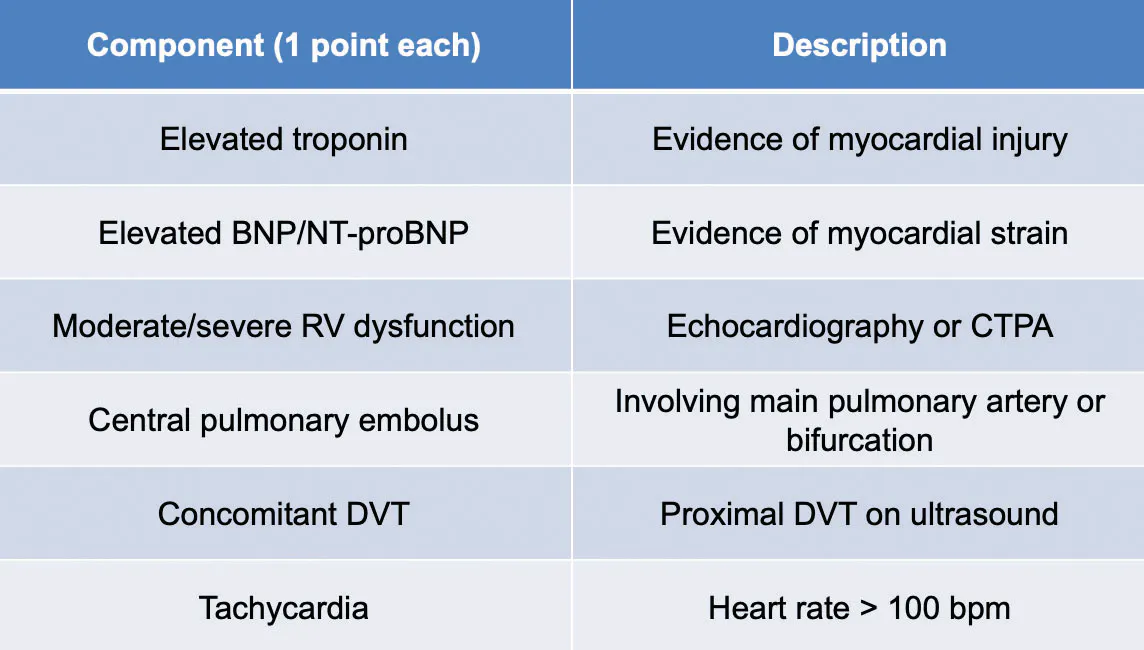
Figure 2. CPES score. The calculation of a composite shock score derived from the FLASH registry, in which points are assigned based on invasive hemodynamic and clinical variables reflecting circulatory compromise. One point each is given for: elevated troponin, elevated BNP, RV dysfunction (RV/LV > 1 on CT or moderate-severe reduced RV function on echocardiography), central PE location (saddle, concomitant DVT), and heart rate > 100 bpm, which are combined to quantify shock severity. The score is designed to identify patients who may be normotensive but have a low cardiac index, thereby providing a structured approach to detecting occult shock in acute PE. Adapted from Bangalore S, Horowitz JM, Beam D, et al. Prevalence and predictors of cardiogenic shock in intermediate-risk pulmonary embolism: insights from the FLASH registry. JACC Cardiovasc Interv. 2023;16:958-972. doi: 10.1016/j.jcin.2023.02.004
The CPES score was validated in a separate cohort of patients, with normotensive shock identified in 100% of patients with a CPES score of 6.13 Additionally, the CPES score provided incremental prognostic value for the prediction of poor outcome over baseline demographics and ESC intermediate-risk categories.14
Yet, when using a lower CPES score threshold ≥ 3, the positive predictive value for predicting a complicated course was low (20.5%).15 Furthermore, the CPES score requires that lower extremity ultrasound be performed on all PE patients to identify concomitant DVT, a diagnostic study that may not be immediately available in all clinical environments. Continued application in a prospective manner and in combination with currently accepted risk stratification tools could provide further evidence suggesting widespread use of the CPES score as an enriching prognostic factor.
NONINVASIVE SURROGATES OF LOW CARDIAC INDEX
Although invasive hemodynamics are not currently recommended or feasible as part of routine care in PE, noninvasive surrogates are obtainable. Stroke volume and cardiac output can be calculated with transthoracic ultrasound from calculated velocity time integrals (VTIs) of pulse-wave Doppler signals obtained at the left ventricular outflow tract (LVOT), RV outflow tract (RVOT), as well as from other locations.16,17 In fact, the VTI alone, a discrete value measured in centimeters, may be useful as a surrogate marker for stroke volume. LVOT VTI has previously been demonstrated to have good correlation to invasive cardiac output measurements in heart failure and critically ill populations.18,19 Low LVOT VTI has been identified as a marker of worse clinical outcomes in the advanced heart failure population as well.20
Two retrospective studies have investigated the role of RVOT VTI in intermediate-risk PE. Brailovsky et al reported a small cohort of intermediate-risk PE patients who were referred to catheter-based therapy. In this cohort, 46.3% had low cardiac index (< 2.2 L/min/m2), and among many echocardiographic parameters tested, only RVOT VTI was found to be a significant predictor of low cardiac index.21 An RVOT VTI < 9.5 cm had a 75% sensitivity and a 79% specificity for identifying low cardiac index.21 Additionally, in their larger cohort of intermediate-risk PE (including those not referred to catheter-based therapy), they found a higher rate of PE-related mortality among those with an RVOT VTI < 9.5 cm compared to those with RVOT VTI > 9.5 cm (13.6% vs 1.28%; P = .002).21 Yuriditsky et al report a retrospective review of 188 intermediate-risk PEs, among the 16% meeting a composite outcome of in-hospital mortality, cardiac arrest, or hemodynamic deterioration compared to those who did not, there was a significantly lower RVOT VTI (9 cm vs 13.4 cm; P < .0001).22
Two studies have also focused on the role of LVOT VTI in intermediate-risk PE. In a cohort of intermediate-risk PE, LVOT VTI ≤ 15 cm was associated with several poor clinical outcomes, including in-hospital mortality, cardiac arrest, shock, and need for rescue reperfusion therapy.23 In a large multihospital cohort of intermediate-risk PE patients, low stroke volume index (SVI), a variable derived from the LVOT VTI, was associated with poor PE composite outcome measures of in-hospital death and cardiorespiratory decompensation.24 Further, receiver operating characteristic curves were generated for SVI as well as several other commonly used risk stratification variables; SVI < 20 mL/m2 performed better in identifying poor outcomes compared to the Bova score, TAPSE (tricuspid annular plate systolic excursion), tricuspid regurgitant velocity, and RV/LV ratio (base), and SVI had similar performance to RV/LV ratio (mid cavity) and the discrete VTI value.24
Although larger prospective studies would be helpful in elucidating the role of noninvasive echocardiographic measurements in PE risk stratification, these are often limited by the availability of comprehensive transthoracic echocardiographic data from the index presentation. Artificial intelligence algorithms have been used to assist novice users in obtaining an LVOT VTI measurement to assess volume responsiveness in patients admitted to the intensive care unit (ICU) and may prove useful in obtaining prognostic echocardiographic data at the point of care.25
NATIONAL EARLY WARNING SCORE
The National Early Warning Score (NEWS) was originally developed as a tool to detect acute illness severity and clinical deterioration among inpatients across the National Health Service in the United Kingdom.26 A post hoc evaluation of the YEARS cohort found that NEWS performed well in identifying clinical deterioration, including ICU admission (AUC, 0.80) and 30-day mortality (AUC, 0.92), among PE patients.27 Using a threshold of ≥ 3 points, NEWS was a sensitive marker for ICU admission and 30-day mortality (92% and 100%, respectively) but was much less specific (53% and 52%, respectively). The NEWS showed moderate discriminatory power (AUC, 0.71) comparable to the CPES score (AUC, 0.74).14 The NEWS score is being studied in the HI-PEITHO study comparing outcomes of intermediate-high–risk PE patients randomized to ultrasound-facilitated catheter-directed thrombolysis plus anticoagulation versus anticoagulation alone.28 The NEWS will be studied as a standardized way to objectively monitor clinical decompensation and prevent premature crossover.28
SOCIETY FOR CARDIOVASCULAR ANGIOGRAPHY AND INTERVENTIONS SHOCK CRITERIA
The ESC 2019 criteria place hemodynamically unstable patients with confirmed PE into the high-risk category.1 Yet, even in high-risk PE patients, the spectrum of disease is quite broad and exists on a continuum. Patients can present in cardiac arrest undergoing CPR or with mild hypotension requiring low doses of vasopressor. Some groups suggest further stratification of this patient population recognizing patients with “catastrophic” PE as those with progressive shock despite multiple vasoactive medications, impending or active cardiac arrest, or persistent shock despite thrombolytic therapy. Patients who remain clinically stable on a single vasopressor alone without rapidly escalating are considered “stable” high risk.29 This group represents the extreme end of the PE severity spectrum, with in-hospital mortality approaching 42%, compared with approximately 17% among patients with noncatastrophic high-risk PE.30
This nomenclature is not well recognized in the literature and carries some ambiguity, with blurred lines between “stable” and “catastrophic” subclassifications, limiting its adoption into a classification schema. For example, vasopressor ceiling doses are not standardized and can differ dramatically by institution. Recognizing the need for a nondichotomous classification system with clear partitions, some experts have suggested using the Society for Cardiovascular Angiography and Interventions (SCAI) shock criteria. In this schema, patients with cardiogenic shock are grouped into five progressive stages (A through E) based on clinical examination, hemodynamic parameters, and biochemical markers of end-organ hypoperfusion.31
The SCAI shock classification schema incorporates RV failure phenotyping, suggesting potential applicability in patients with obstructive shock from PE. Parameters such as the right atrial pressure/pulmonary capillary wedge pressure ratio and the pulmonary artery pulsatility index can identify patients with RV failure and may be applicable to patients with acute cor pulmonale from PE.31 Additional studies that directly evaluate the application of SCAI staging in PE cohorts are needed to determine its prognostic utility and implications for clinical management in this population.
CONCLUSION
Recent advances have expanded the range of tools available for PE risk assessment, including biomarkers, echocardiographic measures, and risk calculators that may better identify patients at increased risk for clinical deterioration, particularly among normotensive populations. However, many of these approaches are constrained by modest specificity, variable availability, and uncertainty regarding how best to integrate them into existing risk stratification frameworks and routine clinical decision-making.
Risk stratification schemas are ultimately intended to guide patient triage, monitoring intensity, and clinical management. Ongoing randomized trials in intermediate- and high-risk PE populations comparing reperfusion strategies with standard care will be essential to refining current risk models and clarifying how risk categories should inform treatment selection. Even with improved prognostic accuracy, alignment of therapeutic recommendations across professional societies remains necessary to promote consistency among the multiple specialties involved in PE care. The persistence of guideline silos further highlights the importance of multidisciplinary PE response teams to coordinate assessment and inform treatment decisions.
Continued prospective evaluation and thoughtful integration of emerging tools with established frameworks will be needed to define their clinical role and ensure that advances in risk stratification translate into meaningful improvements in patient management.
1. Konstantinides SV, Meyer G, Becattini C, et al. 2019 ESC Guidelines for the diagnosis and management of acute pulmonary embolism developed in collaboration with the European Respiratory Society (ERS). Eur Heart J. 2020;41:543-603. doi: 10.1093/eurheartj/ehz405
2. Konstantinides SV, Torbicki A, Agnelli G, et al. 2014 ESC guidelines on the diagnosis and management of acute pulmonary embolism. Eur Heart J. 2014;35:3033-3069k. doi: 10.1093/eurheartj/ehu283
3. Moor J, Baumgartner C, Méan M, et al. Validation of the 2019 European Society of Cardiology risk stratification algorithm for pulmonary embolism in normotensive elderly patients. Thromb Haemost. 2021;121:1660-1667. doi: 10.1055/a-1475-2263
4. Elmewafy AT, Waller J, Alaguraja P, et al. The prognostic value of troponin in acute pulmonary embolism: a systematic review and meta-analysis. Catheter Cardiovasc Interv. 2025;106:3899-3916. doi: 10.1002/ccd.70243
5. Lipinski MJ, Baker NC, Escárcega RO, et al. Comparison of conventional and high-sensitivity troponin in patients with chest pain: a collaborative meta-analysis. Am Heart J. 2015;169:6-16.e6. doi: 10.1016/j.ahj.2014.10.007
6. Bikdeli B, Muriel A, Rodríguez C, et al. High-sensitivity vs conventional troponin cutoffs for risk stratification in patients with acute pulmonary embolism. JAMA Cardiol. 2024;9:64-70. doi: 10.1001/jamacardio.2023.4356
7. Januzzi JL Jr, Mahler SA, Christenson RH, et al. Recommendations for institutions transitioning to high-sensitivity troponin testing: JACC scientific expert panel. J Am Coll Cardiol. 2019;73:1059-1077. doi: 10.1016/j.jacc.2018.12.046
8. Ruan LB, He L, Zhao S, et al. Prognostic value of plasma heart-type fatty acid-binding protein in patients with acute pulmonary embolism: a meta-analysis. Chest. 2014;146:1462-1467. doi: 10.1378/chest.13-1008
9. Bajaj A, Rathor P, Sehgal V, et al. Risk stratification in acute pulmonary embolism with heart-type fatty acid-binding protein: a meta-analysis. J Crit Care. 2015;30:1151.e1-1151.e11517. doi: 10.1016/j.jcrc.2015.05.026
10. Puls M, Dellas C, Lankeit M, et al. Heart-type fatty acid-binding protein permits early risk stratification of pulmonary embolism. Eur Heart J. 2007;28:224-229. doi: 10.1093/eurheartj/ehl405
11. Meyer G, Vicaut E, Danays T, et al. Fibrinolysis for patients with intermediate-risk pulmonary embolism. N Engl J Med. 2014;370:1402-1411. doi: 10.1056/NEJMoa1302097
12. Bangalore S, Horowitz JM, Beam D, et al. Prevalence and predictors of cardiogenic shock in intermediate-risk pulmonary embolism: insights from the FLASH registry. JACC Cardiovasc Interv. 2023;16:958-972. doi: 10.1016/j.jcin.2023.02.004
13. Zhang RS, Alam U, Sharp ASP, et al. Validating the composite pulmonary embolism shock score for predicting normotensive shock in intermediate-risk pulmonary embolism. Circ Cardiovasc Interv. 2024;17:e013399. doi: 10.1161/CIRCINTERVENTIONS.123.013399
14. Zhang RS, Yuriditsky E, Zhang P, et al. Choosing the right tool: comparing risk stratification models in intermediate-risk pulmonary embolism. Catheter Cardiovasc Interv. 2025;106:1928-1936. doi: 10.1002/ccd.70016
15. Najarro M, Briceño W, Rodríguez C, et al. Shock score for prediction of clinical outcomes among stable patients with acute symptomatic pulmonary embolism. Thromb Res. 2024;233:18-24. doi: 10.1016/j.thromres.2023.11.011
16. Perera P, Mailhot T, Riley D, Mandavia D. The RUSH exam: rapid ultrasound in shock in the evaluation of the critically ill. Emerg Med Clin North Am. 2010;28:29-56, vii. doi: 10.1016/j.emc.2009.09.010
17. Blanco P. Rationale for using the velocity-time integral and the minute distance for assessing the stroke volume and cardiac output in point-of-care settings. Ultrasound J. 2020;12:21. doi: 10.1186/s13089-020-00170-x
18. Mercado P, Maizel J, Beyls C, et al. Transthoracic echocardiography: an accurate and precise method for estimating cardiac output in the critically ill patient. Crit Care. 2017;21:136. doi: 10.1186/s13054-017-1737-7
19. Gola A, Pozzoli M, Capomolla S, et al. Comparison of Doppler echocardiography with thermodilution for assessing cardiac output in advanced congestive heart failure. Am J Cardiol. 1996;78:708-712. doi: 10.1016/s0002-9149(96)00406-7
20. Tan C, Rubenson D, Srivastava A, et al. Left ventricular outflow tract velocity time integral outperforms ejection fraction and Doppler-derived cardiac output for predicting outcomes in a select advanced heart failure cohort. Cardiovasc Ultrasound. 2017;15:18. doi: 10.1186/s12947-017-0109-4
21. Brailovsky Y, Lakhter V, Weinberg I, et al. Right ventricular outflow doppler predicts low cardiac index in intermediate risk pulmonary embolism. Clin Appl Thromb Hemost. 2019;25:1076029619886062. doi: 10.1177/1076029619886062
22. Yuriditsky E, Mitchell OJL, Sista AK, et al. Right ventricular stroke distance predicts death and clinical deterioration in patients with pulmonary embolism. Thromb Res. 2020;195:29-34. doi: 10.1016/j.thromres.2020.06.049
23. Yuriditsky E, Mitchell OJ, Sibley RA, et al. Low left ventricular outflow tract velocity time integral is associated with poor outcomes in acute pulmonary embolism. Vasc Med. 2020;25:133-140. doi: 10.1177/1358863X19880268
24. Prosperi-Porta G, Solverson K, Fine N, et al. Echocardiography-derived stroke volume index is associated with adverse in-hospital outcomes in intermediate-risk acute pulmonary embolism: a retrospective cohort study. Chest. 2020;158:1132-1142. doi: 10.1016/j.chest.2020.02.066
25. Levy N, Meslin S, Barthélémy R, et al. Reliability of minimally trained operator’s left ventricular outflow tract velocity-time integral measurement guided by artificial intelligence: protocol for a multicentre randomised controlled trial. BMJ Open. 2025;15:e105624. doi: 10.1136/bmjopen-2025-105624
26. Williams B. The National Early Warning Score: from concept to NHS implementation. Clin Med (Lond). 2022;22:499-505. doi: 10.7861/clinmed.2022-news-concept
27. Bavalia R, Stals MAM, Mulder FI, et al. Use of the National Early Warning Score for predicting deterioration of patients with acute pulmonary embolism: a post-hoc analysis of the YEARS Study. Emerg Med J. 2023;40:61-66. doi: 10.1136/emermed-2021-211506
28. Klok FA, Piazza G, Sharp ASP, et al. Ultrasound-facilitated, catheter-directed thrombolysis vs anticoagulation alone for acute intermediate-high-risk pulmonary embolism: rationale and design of the HI-PEITHO study. Am Heart J. 2022;251:43-53. doi: 10.1016/j.ahj.2022.05.011
29. Carroll BJ, Larnard EA, Pinto DS, et al. Percutaneous management of high-risk pulmonary embolism. Circ Cardiovasc Interv. 2023;16:e012166. doi: 10.1161/CIRCINTERVENTIONS.122.012166
30. Kobayashi T, Pugliese S, Sethi SS, et al. Contemporary management and outcomes of patients with high-risk pulmonary embolism. J Am Coll Cardiol. 2024;83:35-43. doi: 10.1016/j.jacc.2023.10.026
31. Naidu SS, Baran DA, Jentzer JC, et al. SCAI SHOCK stage classification expert consensus update: a review and incorporation of validation studies: this statement was endorsed by the American College of Cardiology (ACC), American College of Emergency Physicians (ACEP), American Heart Association (AHA), European Society of Cardiology (ESC) Association for Acute Cardiovascular Care (ACVC), International Society for Heart and Lung Transplantation (ISHLT), Society of Critical Care Medicine (SCCM), and Society of Thoracic Surgeons (STS) in December 2021. J Am Coll Cardiol. 2022;79:933-946. doi: 10.1016/j.jacc.2022.01.018
Advertisement
Advertisement