Advertisement
Advertisement
September/October 2025 Supplement
Sponsored by Edwards Lifesciences
Creating an Efficient TAVR Case Day With Nurse-Administered Sedation
Increasing the efficiency of your TAVR program via minimalist procedural strategies, including a nurse-administered/physician-supervised (NAPS) sedation pathway.
By Brian Stegman, MD, FACC, FSCAI; Sara Dezell, APRN-CNS; Scott Scepaniak, RN; Stephen Kidd, MD, FACC; and Thom Dahle, MD, FACC, FSCAI
Transcatheter aortic valve replacement (TAVR) has dramatically changed patient access to aortic valve replacement and continues to change the way we think about aortic valve disease. In the years since its inception, TAVR has undergone significant changes both in procedural workflow and device iterations. In order to expand structural program bandwidth to handle increasing TAVR indications and emerging structural heart procedures, focus now needs to turn to optimizing programmatic efficiency in an effort to manage costs, maximize patient throughput, and optimize patient outcomes. There are several strategies that can improve efficiency, including minimalist procedural techniques, transition to catheterization lab or hybrid room, utilization of swing rooms, and various sedation strategies.
As the volume of structural heart procedures requiring sedation continue to increase, it can outpace the availability of dedicated anesthesia resources at some institutions. This has led to the adoption of nurse-administered sedation pathways similar to what is used for coronary procedures. While often referred to as “nurse-led sedation,” we believe this is a bit of a misnomer as it implies the nurse is operating independently, which is not the case. We believe this sedation strategy would be more appropriately named nurse-administered/physician-supervised (NAPS) sedation, suggesting that the supervising physician (TAVR operator) and nurse work as a team. In this article, we discuss how to develop a safe and efficient NAPS sedation pathway.
PROCEDURAL EFFICIENCY STRATEGIES
In 2016, Lauck et al originally described a focused program to decrease sedation and minimize resource use in TAVR.1 In this original publication, they endeavored to minimize procedural sedation using local or minimal conscious sedation, avoid central line placement and urinary catheter placement, remove temporary pacemaker at completion of the case when feasible, and provide early mobilization. In this study, they demonstrated a decrease in length of stay (2 days vs 3 days) with no difference in mortality, readmission, or major complication.
This concept of optimizing procedural resource utilization and simplifying the procedural process was further tested in two studies published in 2019. In the 3M study by Wood et al, investigators used a minimalist approach to the TAVR procedure: local anesthesia or minimal conscious sedation, minimal invasive lines and urinary catheters, no perfusionist in the room, and use of transthoracic echocardiography (TTE) rather than transesophageal echocardiography for postprocedure evaluation in high-, intermediate-, and low-procedural-volume medical centers.2 They were able to achieve an 80.1% next-day discharge rate without any change in procedural or postprocedural outcomes, including a 2.9% 30-day composite of all-cause mortality or stroke rate, a 2.4% vascular complication rate, and a 5.7% pacemaker rate. Furthermore, they had only a 1.5% rate of conversion to general anesthesia and saw no difference in outcomes between high-, intermediate-, and low-volume TAVR centers, suggesting the generalizability of this concept.2
The minimalist approach for TAVR was further supported in a publication in 2019 by Burns et al.3 In this study, they described transitioning from a model of general anesthesia with full surgical staffing to a more minimalist approach involving conscious sedation, omission of urinary catheters and central/invasive lines not required for the procedure, TTE for postimplantation evaluation, and a staffing model that no longer included perfusion or surgical support staff. The minimalist model demonstrated a shorter length of stay (2 vs 3 days; P < .001); lower requirements for postanesthesia care unit or intensive care unit; a greater rate of discharge directly to home (97% vs 85%; P < .001); no difference in mortality, cerebrovascular events, vascular complications, or bleeding; and no conversions to general anesthesia. Furthermore, variable costs per patient were decreased by 17.9% in this minimalist arm.3
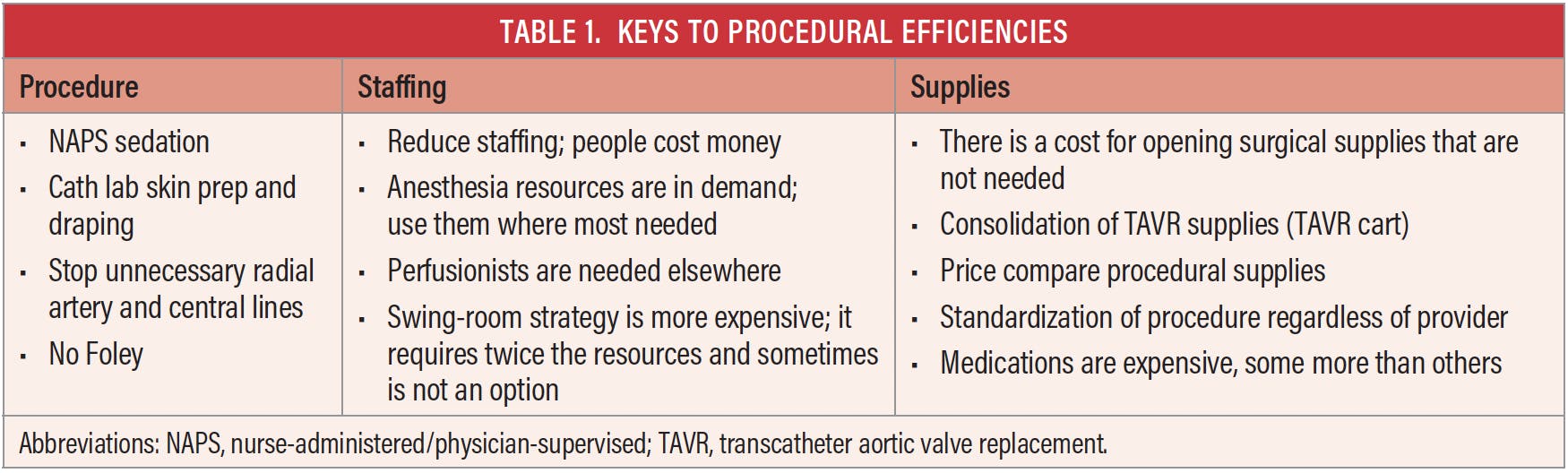
Additional focus on improving procedural and periprocedural efficiency was described by Pop et al, involving many of these outlined approaches while taking additional steps in optimizing room turnover and procedure day efficiency. This reportedly led to improvement in procedural times (goal < 45 min), as well as dramatically improving room turnover times to an average of approximately 15 minutes (national average, approximately 59 min).4 These parameters are in line with our experience when employing similar programs to improve procedure day efficiency using standard ultrasound-guided access, techniques minimizing invasive lines, catheterization lab prep and staffing model with NAPS sedation, and routine removal of all lines at the end of the procedure unless high-degree atrioventricular block is noted (Table 1).
NAPS SEDATION PATHWAY
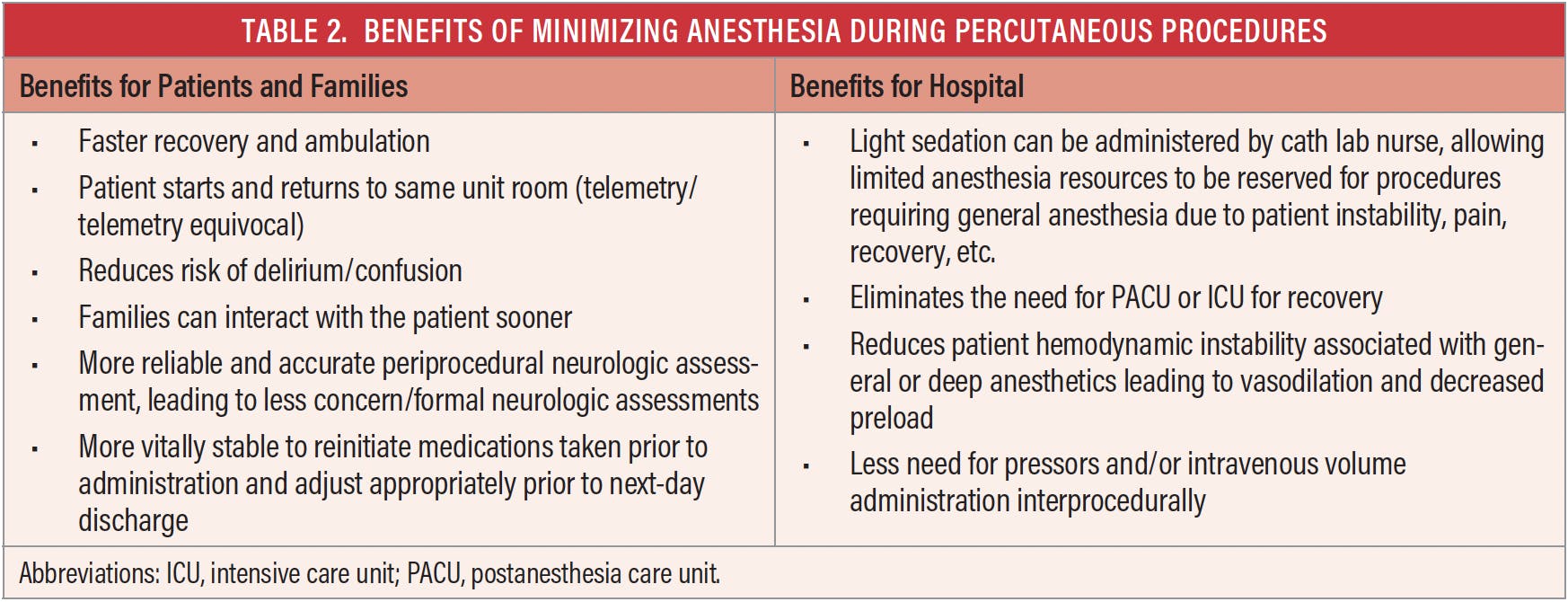
Nurse-administered/physician-supervised (NAPS) sedation differs from traditional anesthesia in that an interventionalist or cardiovascular surgeon performing TAVR monitors the hemodynamics and sedation needs of the patient, and the catheterization lab nurse administers the sedation, similar to the standard practice of other invasive cardiac procedures. While TAVR is a less invasive option than surgery, it still requires a high level of expertise to ensure the safety and comfort of patients undergoing the procedure. NAPS sedation in TAVR is guided by protocols that ensure patient safety while allowing nurses to administer sedative medications, monitor the patient’s response, and adjust doses as necessary. This approach is performed under the direct supervision of a physician and is supported by a multidisciplinary team, ensuring safety and compliance with institutional and regulatory guidelines. Demonstrated benefits of NAPS sedation to patients and the hospital system are shown in Table 2.
When deciding how to transition to a NAPS sedation pathway as standard practice for percutaneous TAVR, there are a few important steps to consider. First, it is important to bring together all stakeholders in every department to ensure clear communication throughout the entire process. Prior to setting a start date to transition to NAPS sedation, the procedural team should evaluate current best practices to ensure a fully optimized minimalist approach for efficient and safe procedures to improve patient comfort and decrease time on the table. All access should routinely be performed under ultrasound guidance with visualization of generous lidocaine administration all the way to the anterior wall of the vessel (approximately 10-20 mL in femoral access sites), with adequate time given for full local anesthetic effect. Care is taken to select sedation that is appropriate for the patient, allowing for minimal sedation in those who tolerate it and greater sedation in those who require it, while maintaining appropriate patient alertness. Further costs and time savings are achieved by no longer opening unnecessary surgical trays and considering patient prepping and draping consistent with that of a coronary angiogram.
An initial “structural team” of experienced staff creates a team that can be expanded and used for training to later include additional members after the process has been perfected. Finally, it is critical to involve your anesthesia team to create a stepwise plan for the transition to full NAPS sedation. This may include the presence of anesthesia during NAPS sedation for a predesignated number of cases or for higher-risk cases, until all parties are comfortable with the processes and consistent safety is demonstrated. Prior to anesthesia no longer being present during the cases, an emergency plan must be developed and agreed upon in the event the anesthesia team is needed for emergent services.
NURSING EDUCATION/TRAINING FOR NAPS SEDATION MODEL
The NAPS sedation model requires thorough training to ensure that nurses are equipped with the necessary knowledge and skills to manage the sedation process effectively. This training focuses on patient assessment, pharmacology of sedation drugs, monitoring sedation depth, recognizing and managing potential complications, and responding to any emergencies that may arise during the procedure. Nurses are also trained in the principles of patient-centered care, emphasizing communication and ensuring that patients are informed and comfortable throughout the procedure. Conveying a consistent message from the entire team about the planned level of sedation throughout is critical.
Sedation management in TAVR procedures is a delicate balance that requires constant monitoring and swift decision-making. NAPS sedation training typically covers multiple aspects of this balance.
- Patient Assessment: Nurses are trained to assess each patient’s medical history, sedation history and dosages received, comorbidities, and individual risk factors that may influence sedation protocols. This is critical for determining the appropriate sedation level and ensuring that the patient is stable throughout the procedure.
- Sedation Pharmacology: Nurses are educated on the various sedatives and analgesics used in TAVR procedures, including their mechanisms of action, dosing, and potential side effects. Typical dosage ranges include midazolam (1-4 mg), fentanyl (25-100 µg), ondansetron (4 mg), and phenylephrine (50-100 µg) as needed for hemodynamic support.
- Monitoring and Safety: Continuous monitoring of the patient’s vital signs, including heart rate, blood pressure, oxygen saturation, capnography, and level of consciousness, is a critical part of the sedation protocol and monitored by both the physician and registered nurse.
- Crisis Management: In the event of an emergency, such as an adverse reaction to a sedative, nurses are trained in rapid response techniques, including the use of reversal agents (eg, Romazicon, naloxone) or other appropriate airway interventions to stabilize the patient. This training ensures that nurses are prepared to handle any unexpected developments during the procedure.
It is important to have consistent messaging to manage the expectations of patients, family, and staff members for NAPS sedation and minimalist procedural techniques. Start the conversation regarding conscious sedation early on in consultation so that when final recommendations are made after heart team discussions the patient is fully aware of their sedation type. One technique to understand how each patient will individually tolerate minimal sedation is to assess their tolerance and calmness during a pre-TAVR coronary angiogram using only local lidocaine. We often tell patients, “We will use as much or as little sedation as necessary to make sure you are comfortable and stable during the procedure.” Individual nursing staff seeing the patients prior to the procedure all reiterate these optimal sedation expectations. These steps will ensure consistency among every member of the team and instill confidence in the patient and family.
CASE-DAY EFFICIENCY
Using these strategies appropriately can result in significant improvement in the efficiency of TAVR case days. By following this stepwise approach, we were able to improve the throughput of our program, manage costs, and optimize patient outcomes without the need for additional staff, catheterization labs (swing labs), or procedural days. In addition to these strategies to improve workflow efficiency, we have found it important to ensure that efficient nurse handoffs and seamless patient transfers occur while the procedural staff are tearing down and setting up the room in a coordinated efficient way. This leads to optimizing turnover times and case-day efficiency. An example of our typical TAVR day is shown in Figure 1 and has been consistently replicated for > 3 years. This has also allowed better utilization of our crucial anesthesia team for other structural procedures that require deeper sedation.
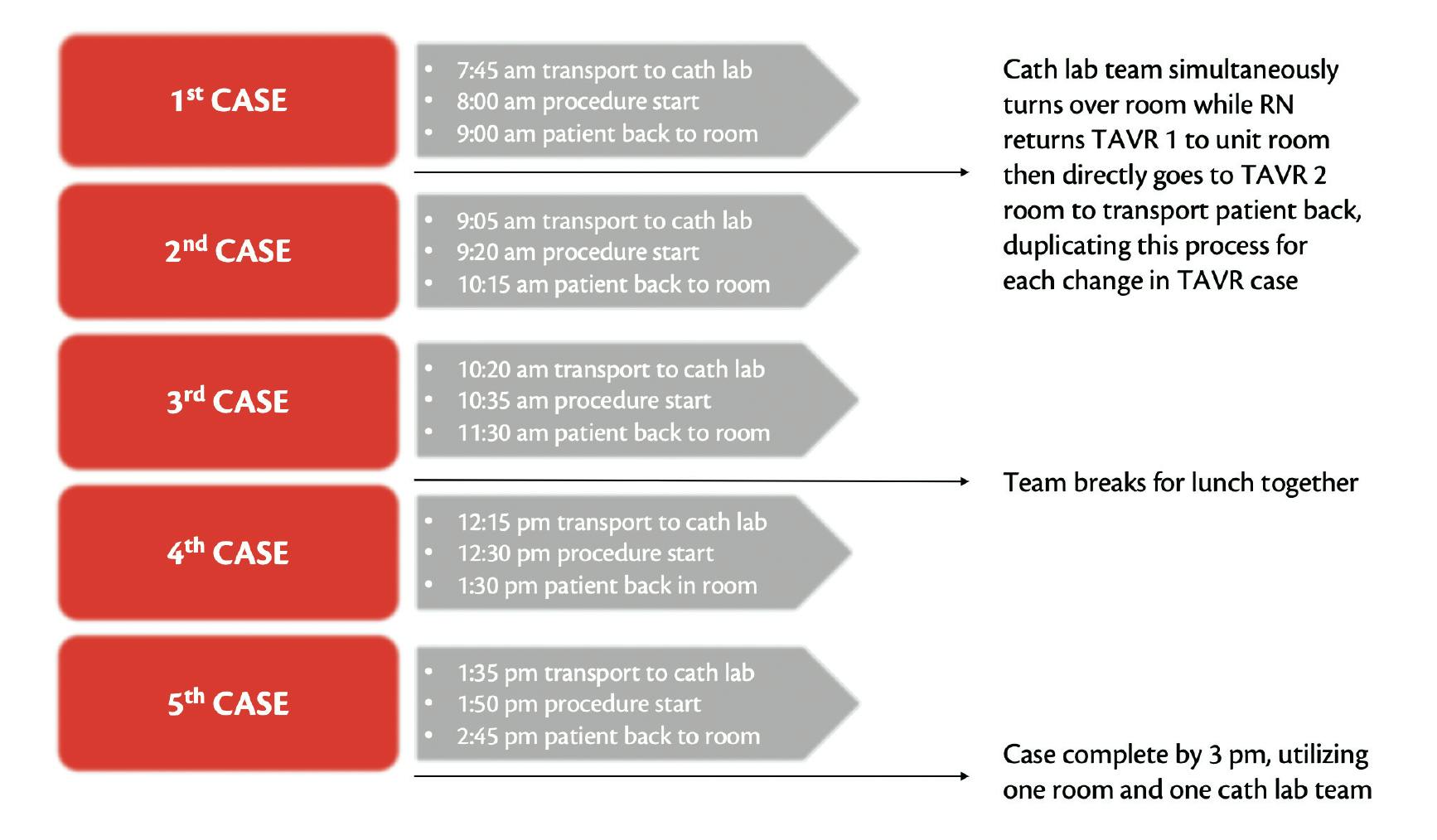
Figure 1. A typical TAVR day.
CONCLUSION
Combining these validated minimalist strategies in addition to more efficient sedation pathways can consistently lead to more efficient TAVR case days. This will allow further program growth and bandwidth of a structural heart program, without requiring additional staff and costly resources.
1. Lauck, SB, Wood, DA, et al. Vancouver transcatheter aortic valve replacement clinical pathway: minimalist approach, standardized care, and discharge criteria to reduce length of stay. Circ Cardiovasc Qual Outcomes. 2016,9:312-321. doi: 10.1161/CIRCOUTOMES.115.002541
2. Wood DA, Lauck SB, Cairns JA, et al. The Vancouver 3M (multidisciplinary, multimodality, but minimalist) clinical pathway facilitates safe next-day discharge home at low-, medium-, and high-volume transfemoral transcatheter aortic valve replacement centers. JACC Cardiovasc Interv. 2019;12:459-469. doi: 10.1016/j.jcin.2018.12.020
3. Burns MR, Schneider LM, Sorajja P, et al. Clinical and economic outcomes of the minimalist approach for transcatheter aortic valve replacement. Structural Heart. 2019;3:138-143. doi: 10.1080/24748706.2018.1560520
4. Pop A, Barrow F, Adib K, et al. Optimized patient care pathway. Cardiac Interv Today. 2023;17:23-30.
Advertisement
Advertisement