Advertisement
Advertisement
September/October 2025 Supplement
Sponsored by Edwards Lifesciences
TAVR Economics
How partnerships, a lean program, and a holistic view can grow structural heart programs.
By Andrei Pop, MD, and Michael Busky
Since its approval in 2012, transcatheter aortic valve replacement (TAVR) has evolved from a complex procedure requiring extensive personnel and hospital resources to a highly streamlined and often minimalistic procedure. As TAVR indications have expanded to include all patient surgical risk categories, the outcomes have remained excellent, reflecting improvements in technology and better understanding of all aspects of the procedure.1
TAVR has been widely adopted in academic and community hospitals and now represents the dominant form of aortic valve replacement (AVR) in the United States. In 2021, TAVR accounted for 47.5% of AVR performed in patients under the age of 65 years.2 Although initially seen as a cause for alarm given the lack of randomized data in patients in this age group, later data have confirmed that the treated patients were deemed by the valve team to be at increased risk for surgical complications.3 Indeed, the concept of the patient-centric, multidisciplinary heart team may be one of the most important contributions that TAVR has bestowed upon the field.
MINIMALISTIC TAVR
As TAVR has become increasingly streamlined, the safety of minimalistic TAVR has been demonstrated.4,5 The COVID pandemic and subsequent staff shortages brought a further impetus to move TAVR from the operating room to the cardiac cath lab to limit the size of the team involved and reduce length of stay. Structural volumes have also increased markedly, via expanding indications as well as the advent of new technologies. This has placed additional demands on the teams performing the procedures and created additional pressure on cath labs, imaging, and anesthesia.
Unique among the commonly performed structural procedures, TAVR is tied to a survival benefit, and TAVR delays carry a significant mortality risk for patients (3.7% per month in one series).6 Aortic stenosis (AS) has been shown to be vastly underdiagnosed and undertreated, even in major academic institutions7 and especially for underserved populations (in terms of sex, ethnicity, or socioeconomic background and also in terms of distance from TAVR centers).8
A range of interventions have been proposed to improve access to and the timeliness of treatment. Echo-mining software,9 AI-assisted diagnostic algorithms,10 automated referrals, and standardized echo reporting can facilitate getting patients to the heart team faster. Minimizing extraneous workup (eg, carotid duplex, pulmonary function test, urinalysis, coronary angiography) helps move patients from the heart team to treatment faster.11-14 Minimalistic TAVR with limited anesthesia (nurse-administered sedation or monitored anesthesia care [MAC]) facilitates patient recovery and allows for faster room turnaround and treatment of more patients per day in one room.15 Enhanced recovery protocols with ambulation as early as 2 to 4 hours postprocedure help expedite patient recovery and move the needle on reducing intensive care unit (ICU) usage and length of stay.16 One-day lengths of stay are now becoming the norm in many institutions, and same-day discharge has been shown to be safe in carefully selected patients.17,18
THE BENCHMARK PROGRAM AT ALEXIAN BROTHERS MEDICAL CENTER
The structural program at Alexian Brothers started in 2014 with TAVR procedures performed under general anesthesia in the cardiac cath lab. The first patient was treated under MAC in 2016, and a hybrid room was built in 2019 in the cardiac cath lab. Our program was the first commercial site to adopt the Edwards Benchmark program in March 2020. The Edwards Benchmark program is designed to align the multidisciplinary heart team on the minimalist TAVR approach to improve the patient care pathway through evidence-based best practices and peer-to-peer guidance. The contemporaneous advent of the COVID epidemic spurred a need to bypass the ICU for the majority of patients and emphasize next-day discharge. To further reduce the risk of nosocomial COVID transmission, a same-day discharge program that had been started in 2011 for PCI was expanded to include a wide range of procedures, including left atrial appendage occlusion (LAAO), transcatheter edge-to-edge repair (TEER), endovascular aneurysm repair, and thoracic endovascular aortic repair. The same-day discharge program for selected TAVR patients was started in July 2020.
Our program has gradually moved our staffing for TAVR patients from a maximalist to a minimalist approach. We currently perform TAVR under MAC (generally provided by a certified registered nurse anesthetist), supported by a scrub tech, a circulating registered nurse, and a recorder; one additional staff member may be available to facilitate room turnaround. After valve deployment, an echo tech obtains limited images. We generally only evaluate for paravalvular leak and pericardial effusion; a more extensive evaluation involving ventricular ejection fraction and transaortic gradients is performed in the holding area after the patient has recovered from anesthesia and can get out of bed/turn on their side to facilitate imaging. A housekeeper is assigned to the cath lab to expedite room turnaround. Most patients are awake throughout the procedure and sedation is terminated the moment the valve is deployed, allowing for a brief neurologic examination to be performed on the table. Patient recovery can be completed in the procedure room. This allows for the anesthesia provider to evaluate the next procedure as the patient is undraped, Doppler pulses are checked, and manual pressure is applied to the groin after administration of protamine (Table 1).
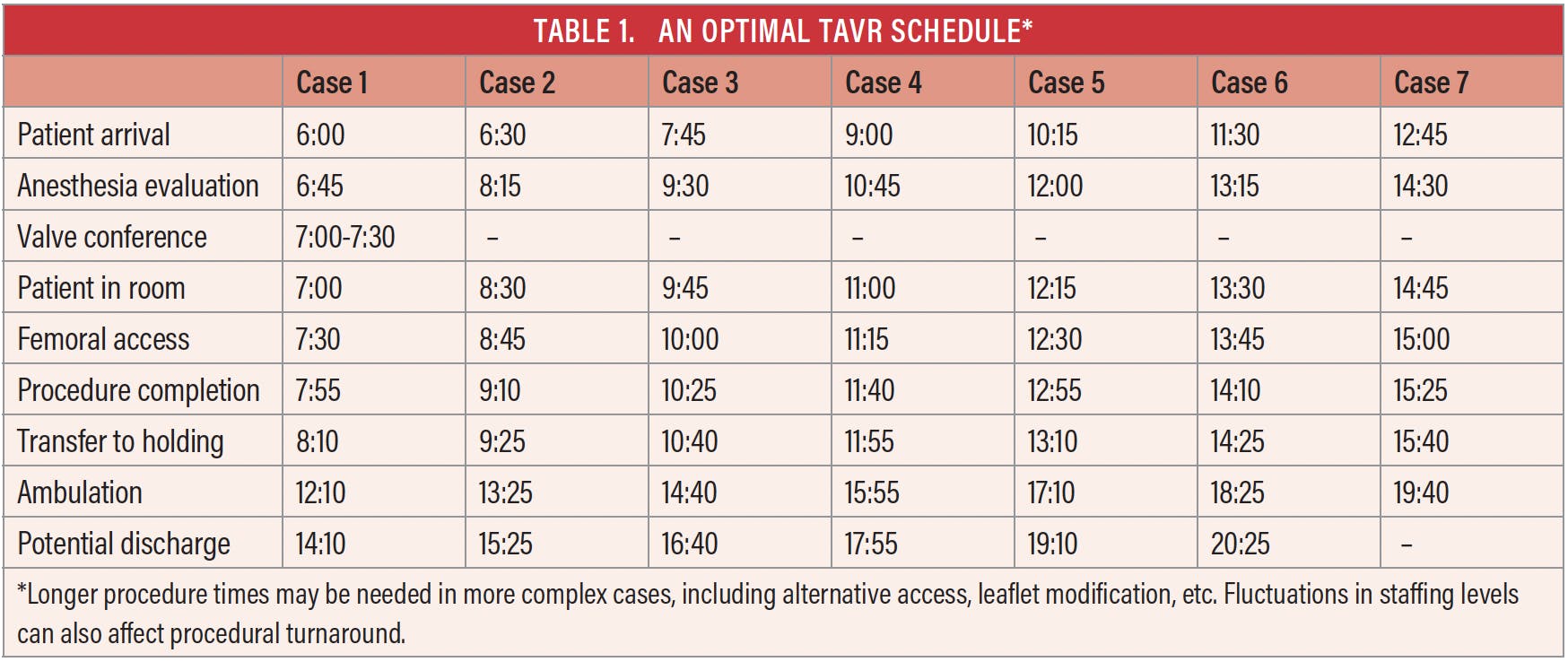
Since our program has transitioned to a limited staffing model for TAVR, we have seen no impact on outcomes and have observed an improvement in room turnaround. Our experience shows that additional staffing does not correlate with either increased safety or efficiency.
For most cases, only two ultrasound-guided access sites are obtained: femoral for the TAVR sheath and left radial for a pigtail. Most cases undergo pacing through the left ventricular wire, eliminating the need for another access site and risk of right ventricular injury from the pacing catheter. No central lines or Foley catheters are used.
In view of the known worse outcomes of patients who undergo emergent TAVR,19 we try to avoid these procedures, performing balloon aortic valvuloplasty and offering patients a chance to rehab and recover from any acute comorbidities whenever possible before performing TAVR on a more elective basis.
Despite the surgical team and perfusion no longer being involved in the TAVR team for most patients, all patients are evaluated independently in the valve clinic by a cardiologist and a surgeon. Cases are discussed in the multidisciplinary valve conference on a weekly basis and a cardiologist and surgeon are present for every TAVR case. We consider the lifetime management of patients with AS for every valve implant—both surgical and transcatheter options.
Most patients require a single valve team visit, and the CT scan is performed the same morning. We generally maintain the ability to treat patients within 5 to 7 days of valve team evaluation. The brief procedure time and quick room turnaround allows our team to perform six to seven standard transfemoral TAVRs in one room in one day, and it facilitates ad hoc case additions on other days when needed.
Besides closely monitoring complications and STS/ACC TVT Registry database outcomes, the program conducts quarterly economic reviews. Although reimbursement and valve costs are outside most program’s control, we closely monitor direct costs, including the cost and amount of equipment being used, general anesthesia use, ICU utilization, procedure time, time in room, room turnaround, length of stay, readmission rate, percentage of urgent TAVRs, and discharge destination.
THE ECONOMIC IMPACT OF A LEAN TAVR PROGRAM
As the field of structural interventions continues to expand, heart teams are required to participate in an ever-expanding range of procedures. TAVR, mitral and tricuspid TEER, LAAO, transcatheter tricuspid valve repair (TTVR), and transcatheter mitral valve repair (TMVR) procedures all compete for the same resources. At the same time, many programs are facing staffing challenges and high turnover, not only for cath lab staff but also for echo technicians, anesthesia providers, ICU, and general ward staff. Additionally, even as the population ages and cardiovascular diseases are projected to increase, the number of cardiologists retiring is outpacing the supply of new graduates.20
Improved diagnostics and the expansion of procedures to untreated populations—TAVR for asymptomatic AS, moderate AS, or aortic insufficiency; LAAO as first-line therapy for the prevention of cardio-embolic stroke in atrial fibrillation; percutaneous mitral valve replacement therapies—may add additional demands on already stretched providers and health systems. To accommodate the increasing demand for structural heart procedures, programs will need to increase capacity and decrease resource use, while maintaining outcomes, improving access to care, and minimizing patient wait times.
Implementing an efficient, minimalistic program that delivers good outcomes cannot be achieved overnight. This process needs to start with a strong administrator/physician leader dyad team and requires the participation of a range of stakeholders, including cardiologists, surgeons, anesthesiologists, and nursing. Transparency and data sharing on clinical and economic parameters is paramount, and savings need to return to the involved institutions and departments. Additionally, some redundancy needs to be maintained to account for inevitable surges in demand and decreases in staffing.
When confronted with the need for more streamlined procedures and economic efficiency, patient safety concerns are sometimes invoked. We now have solid clinical data demonstrating that minimalistic TAVR yields outcomes that are at least equivalent to traditional “maximalist” approaches. Enhanced recovery protocols have been widely adopted for surgical procedures and have improved patient outcomes while reducing length of stay.
Just because we have always done things this way does not mean that a better, more efficient way does not exist and should not be explored/adopted. At the same time, achieving economic efficiencies should never come at the expense of patient safety, and any deviation from prespecified safety endpoints should be closely scrutinized and addressed.
CONCLUSION
Since first becoming commercially available in the United States in 2012, TAVR has evolved considerably. In an age of limited resources and increasing volumes for a wide variety of structural procedures, as well as new TAVR indications, programs need to be lean and efficient in order to thrive and accommodate growth.
1. Vekstein AM, Wegermann ZK, Manandhar P, et al. Outcomes of transcatheter aortic valve replacement in low-risk patients in the United States: a report from the STS/ACC TVT registry. Circulation. 2025;151:1134-1146. doi: 10.1161/CIRCULATIONAHA.124.071838
2. Sharma T, Krishnan AM, Lahoud R, et al. National trends in TAVR and SAVR for patients with severe isolated aortic stenosis. J Am Coll Cardiol. 2022;80:2054-2056. doi: 10.1016/j.jacc.2022.08.787
3. Coylewright M, Grubb KJ, Arnold SV, et al. Outcomes of balloon-expandable transcatheter aortic valve replacement in younger patients in the low-risk era. JAMA Cardiol. 2025;10:127-135. Published correction appears in JAMA Cardiol. 2025;10:201 and JAMA Cardiol. 2025;10:202. doi: 10.1001/jamacardio.2024.4237
4. Wood DA, Lauck SB, Cairns JA, et al. The Vancouver 3M (multidisciplinary, multimodality, but minimalist) clinical pathway facilitates safe next-day discharge home at low-, medium-, and high-volume transfemoral transcatheter aortic valve replacement centers: the 3M TAVR study. JACC Cardiovasc Interv. 2019;12:459-469. doi: 10.1016/j.jcin.2018.12.020
5. Barbanti M, van Mourik MS, Spence MS, et al. Optimising patient discharge management after transfemoral transcatheter aortic valve implantation: the multicentre European FAST-TAVI trial. EuroIntervention. 2019;15:147-154. doi: 10.4244/EIJ-D-18-01197
6. Malaisrie SC, McDonald E, Kruse J, et al. Mortality while waiting for aortic valve replacement. Ann Thorac Surg. 2014;98:1564-70; discussion 1570-1. doi: 10.1016/j.athoracsur.2014.06.040
7. Li SX, Patel NK, Flannery LD, et al. Trends in utilization of aortic valve replacement for severe aortic stenosis. J Am Coll Cardiol. 2022;79:864-877. doi: 10.1016/j.jacc.2021.11.060
8. Nathan AS, Yang L, Yang N, et al. Racial, ethnic, and socioeconomic disparities in access to transcatheter aortic valve replacement within major metropolitan areas. JAMA Cardiol. 2022;7:150-157. doi: 10.1001/jamacardio.2021.4641
9. Généreux P, Sharma RP, Cubeddu RJ, et al. The mortality burden of untreated aortic stenosis. J Am Coll Cardiol. 2023;82:2101-2109. doi: 10.1016/j.jacc.2023.09.796
10. Wessler BS, Huang Z, Long GM Jr, et al. Automated detection of aortic stenosis using machine learning. J Am Soc Echocardiogr. 2023;36:411-420. doi: 10.1016/j.echo.2023.01.006
11. Condado JF, Jensen HA, Maini A, et al; Emory Structural Heart and Valve Center. Should we perform carotid doppler screening before surgical or transcatheter aortic valve replacement? Ann Thorac Surg. 2017;103:787-794. doi: 10.1016/j.athoracsur.2016.06.076
12. Pino JE, Shah V, Ramos Tuarez FJ, et al. The utility of pulmonary function testing in the preoperative risk stratification of patients undergoing transcatheter aortic valve replacement. Catheter Cardiovasc Interv. 2020;95:E179-E185. doi: 10.1002/ccd.28402
13. Clay A, Beaulac KR, Vazquez GMA, et al. 1510. Treatment of asymptomatic bacteriuria prior to transcatheter aortic valve replacement. Open Forum Infect Dis. 2018;5(suppl 1):S467. doi: 10.1093/ofid/ofy210.1339
14. Kondoleon NP, Layoun H, Spilias N, et al. Effectiveness of pre-TAVR CTA as a screening tool for significant CAD before TAVR. JACC Cardiovasc Interv. 2023;16:1990-2000. doi: 10.1016/j.jcin.2023.05.030
15. Fadah K, Khalafi S, Corey M, et al. Optimizing anesthetic selection in transcatheter aortic valve replacement: striking a delicate balance between efficacy and minimal intervention. Cardiol Res Pract. 2024;2024:4217162. doi: 10.1155/2024/4217162
16. Elison D, Casper M, Condos G, et al. Randomized trial of shortened supine bedrest following transfemoral transcatheter aortic valve replacement. J Soc Cardiovasc Angiogr Interv. 2025;4:102564. doi: 10.1016/j.jscai.2025.102564
17. Krishnan AM, Zhang G, Sharma T, et al. Trends and predictors of short length of stay following transcatheter aortic valve replacement. Cardiovasc Revasc Med. 2023;52:1-7. doi: 10.1016/j.carrev.2023.02.007
18. Barker M, Sathananthan J, Perdoncin E, et al. Same-day discharge post-transcatheter aortic valve replacement during the covid-19 pandemic: the multicenter PROTECT TAVR study. JACC Cardiovasc Interv. 2022;15:590-598. doi: 10.1016/j.jcin.2021.12.046
19. Deng Y, Wei S, Zhu L, Tao L. Effectiveness and safety of emergency transcatheter aortic valve replacement in patients with severe aortic stenosis complicated by cardiogenic shock: a systematic review and meta-analysis. Heart Lung. 2025;69:62-70. doi: 10.1016/j.hrtlng.2024.09.011
20. Fry ETA. Resigned to the “Great Resignation?”. J Am Coll Cardiol. 2022;79:2463-2466. doi: 10.1016/j.jacc.2022.05.004
Disclaimers
Please Note: The information provided is the experience of this speaker/facility, and Edwards Lifesciences has not independently evaluated these data. Outcomes are dependent upon a number of facility and surgeon factors which are outside Edwards’ control. These data should not be considered promises or guarantees by Edwards that the outcomes presented here will be achieved by any individual facility.
Important- Please Note: This information is provided as a general resource and is not intended to constitute medical advice or in any way replace the independent medical judgment of a trained and licensed physician with respect to any individual patient needs or circumstances. Coverage, reimbursement and health economics information provided by Edwards is gathered from third-party sources and presented for illustrative purposes only. This information does not constitute reimbursement or legal advice, and Edwards makes no representation or warranty regarding this information or its completeness, accuracy, or timeliness. Laws, regulations, and payer policies concerning reimbursement are complex and change frequently; service providers are responsible for all decisions relating to coding and reimbursement submissions.
Important Safety Information
Edwards SAPIEN 3, Edwards SAPIEN 3 Ultra, and Edwards SAPIEN 3 Ultra RESILIA Transcatheter Heart Valve System
Indications: The Edwards SAPIEN 3, SAPIEN 3 Ultra, and SAPIEN 3 Ultra RESILIA Transcatheter Heart Valve system is indicated to reduce the risks associated with progression from asymptomatic to symptomatic severe native calcific aortic stenosis in patients who are judged by a heart team to be appropriate for transcatheter heart valve replacement therapy.
The Edwards SAPIEN 3, SAPIEN 3 Ultra, and SAPIEN 3 Ultra RESILIA Transcatheter Heart Valve system is indicated for relief of aortic stenosis in patients with symptomatic heart disease due to severe native calcific aortic stenosis who are judged by a Heart Team, including a cardiac surgeon, to be appropriate for the transcatheter heart valve replacement therapy.
The Edwards SAPIEN 3, SAPIEN 3 Ultra, and SAPIEN 3 Ultra RESILIA Transcatheter Heart Valve system is indicated for patients with symptomatic heart disease due to a failing (stenosed, insufficient, or combined) surgical or transcatheter bioprosthetic aortic valve, or a native mitral valve with an annuloplasty ring who are judged by a heart team, including a cardiac surgeon, to be at high or greater risk for open surgical therapy (i.e., predicted risk of surgical mortality ≥ 8% at 30 days, based on the Society of Thoracic Surgeons (STS) risk score and other clinical co-morbidities unmeasured by the STS risk calculator).
The Edwards SAPIEN 3, SAPIEN 3 Ultra, and SAPIEN 3 Ultra RESILIA Transcatheter Heart Valve system is indicated for patients with symptomatic heart disease due to a failing (stenosed, insufficient, or combined) surgical bioprosthetic mitral valve who are judged by a heart team, including a cardiac surgeon, to be at intermediate or greater risk for open surgical therapy (i.e., predicted risk of surgical mortality ≥ 4% at 30 days, based on the Society of Thoracic Surgeons (STS) risk score and other clinical co-morbidities unmeasured by the STS risk calculator).
Contraindications: The valves and delivery systems are contraindicated in patients who cannot tolerate an anticoagulation/antiplatelet regimen or who have active bacterial endocarditis or other active infections, or who have significant annuloplasty ring dehiscence.
Warnings: Observation of the pacing lead throughout the procedure is essential to avoid the potential risk of pacing lead perforation. There may be an increased risk of stroke in transcatheter aortic valve replacement procedures, as compared to balloon aortic valvuloplasty or other standard treatments in high or greater risk patients. The devices are designed, intended, and distributed for single use only. Do not resterilize or reuse the devices. There are no data to support the sterility, nonpyrogenicity, and functionality of the devices after reprocessing. Incorrect sizing of the valve may lead to paravalvular leak, migration, embolization, residual gradient (patient-prosthesis mismatch), and/or annular rupture. Accelerated deterioration of the valve due to calcific degeneration may occur in children, adolescents, or young adults and in patients with an altered calcium metabolism. Prior to delivery, the valve must remain hydrated at all times and cannot be exposed to solutions other than its shipping storage solution and sterile physiologic rinsing solution. Valve leaflets mishandled or damaged during any part of the procedure will require replacement of the valve. Caution should be exercised in implanting a valve in patients with clinically significant coronary artery disease. Patients with pre-existing prostheses should be carefully assessed prior to implantation of the valve to ensure proper valve positioning and deployment. Do not use the valve if the tamper-evident seal is broken or the storage solution does not completely cover the valve (SAPIEN 3 and SAPIEN 3 Ultra only), the temperature indicator has been activated, the valve is damaged, or the expiration date has elapsed. Do not mishandle the delivery system or use it if the packaging or any components are not sterile, have been opened or are damaged (e.g., kinked or stretched), or if the expiration date has elapsed. Use of excessive contrast media may lead to renal failure. Measure the patient’s creatinine level prior to the procedure. Contrast media usage should be monitored. Patient injury could occur if the delivery system is not un-flexed prior to removal. Care should be exercised in patients with hypersensitivities to cobalt, nickel, chromium, molybdenum, titanium, manganese, silicon, and/or polymeric materials. The procedure should be conducted under fluoroscopic guidance. Some fluoroscopically guided procedures are associated with a risk of radiation injury to the skin. These injuries may be painful, disfiguring, and long-lasting. Valve recipients should be maintained on anticoagulant/antiplatelet therapy, except when contraindicated, as determined by their physician. This device has not been tested for use without anticoagulation. Do not add or apply antibiotics to the storage solution (SAPIEN 3 and SAPIEN 3 Ultra only), rinse solution, or to the valve. Balloon valvuloplasty should be avoided in the treatment of failing bioprostheses as this may result in embolization of bioprosthesis material and mechanical disruption of the valve leaflets. Do not perform stand-alone balloon aortic valvuloplasty procedures in the INSPIRIS RESILIA aortic valve for the sizes 19-25 mm. This may expand the valve causing aortic incompetence, coronary embolism or annular rupture. Transcatheter valve replacement in mitral annuloplasty rings is not recommended in cases of partial annuloplasty ring dehiscence due to high risk of PVL. Transcatheter valve replacement in mitral annuloplasty rings is not recommended in cases of partial (incomplete) annuloplasty rings in the absence of annular calcium due to increased risk of valve embolization. Transcatheter valve replacement in mitral annuloplasty rings is not recommended in cases of rigid annuloplasty rings due to increased risk of PVL or THV deformation.
Precautions: Long-term durability has not been established for the valve. Regular medical follow-up is advised to evaluate valve performance. Limited clinical data are available for transcatheter aortic valve replacement in patients with a congenital bicuspid aortic valve who are deemed to be at low surgical risk. Anatomical characteristics should be considered when using the valve in this population. In addition, patient age should be considered as long-term durability of the valve has not been established. Data on TAVR in patients with asymptomatic severe aortic stenosis are based on study of predominantly low surgical risk patients. Limited clinical data to inform benefit-risk considerations are available for TAVR in patients with asymptomatic severe aortic stenosis who are deemed to be at intermediate or greater surgical risk. Glutaraldehyde may cause irritation of the skin, eyes, nose, and throat. Avoid prolonged or repeated exposure to, or breathing of, the solution. Use only with adequate ventilation. If skin contact occurs, immediately flush the affected area with water; in the event of contact with eyes, seek immediate medical attention. For more information about glutaraldehyde exposure, refer to the Safety Data Sheet available from Edwards Lifesciences. If a significant increase in resistance occurs when advancing the catheter through the vasculature, stop advancement and investigate the cause of resistance before proceeding. Do not force passage, as this could increase the risk of vascular complications. As compared to SAPIEN 3, system advancement force may be higher with the use of SAPIEN 3 Ultra/SAPIEN 3 Ultra RESILIA THV in tortuous/challenging vessel anatomies. To maintain proper valve leaflet coaptation, do not overinflate the deployment balloon. Appropriate antibiotic prophylaxis is recommended post-procedure in patients at risk for prosthetic valve infection and endocarditis. Additional precautions for transseptal replacement of a failed mitral valve bioprosthesis include, the presence of devices or thrombus or other abnormalities in the caval vein precluding safe transvenous femoral access for transseptal approach; and the presence of an Atrial Septal Occluder Device or calcium preventing safe transseptal access. Special care must be exercised in mitral valve replacement to avoid entrapment of the subvalvular apparatus. Safety and effectiveness have not been established for patients with the following characteristics/comorbidities: non-calcified aortic annulus; severe ventricular dysfunction with ejection fraction < 20%; congenital unicuspid aortic valve; pre-existing prosthetic ring in the tricuspid position; severe mitral annular calcification (MAC); severe (> 3+) mitral insufficiency, or Gorlin syndrome; blood dyscrasias defined as leukopenia (WBC < 3000 cells/mL), acute anemia (Hb < 9 g/dL), thrombocytopenia (platelet count < 50,000 cells/mL), or history of bleeding diathesis or coagulopathy; hypertrophic cardiomyopathy with or without obstruction (HOCM); echocardiographic evidence of intracardiac mass, thrombus, or vegetation; a known hypersensitivity or contraindication to aspirin, heparin, ticlopidine (Ticlid), or clopidogrel (Plavix), or sensitivity to contrast media, which cannot be adequately premedicated; significant aortic disease, including abdominal aortic or thoracic aneurysm defined as maximal luminal diameter 5 cm or greater, marked tortuosity (hyperacute bend), aortic arch atheroma (especially if thick [> 5 mm], protruding, or ulcerated) or narrowing (especially with calcification and surface irregularities) of the abdominal or thoracic aorta, severe “unfolding” and tortuosity of the thoracic aorta; access characteristics that would preclude safe placement of the Edwards sheath, such as severe obstructive calcification or severe tortuosity; bulky calcified aortic valve leaflets in close proximity to coronary ostia; a concomitant paravalvular leak where the failing prosthesis is not securely fixed in the native annulus or is not structurally intact (e.g., wireform frame fracture, annuloplasty ring dehiscence); or a partially detached leaflet of the failing bioprosthesis that in the aortic position may obstruct a coronary ostium. For Left axillary approach, a left subclavian takeoff angle ~ ≥ 90° from the aortic arch causes sharp angles, which may be responsible for potential sheath kinking, subclavian/axillary dissection and aortic arch damage. For left/right axillary approach, ensure there is flow in Left Internal Mammary Artery (LIMA)/Right Internal Mammary Artery (RIMA) during procedure and monitor pressure in homolateral radial artery. Residual mean gradient may be higher in a “THV-in-failing prosthesis” configuration than that observed following implantation of the valve inside a native aortic annulus using the same size device. Patients with elevated mean gradient post procedure should be carefully followed. It is important that the manufacturer, model and size of the preexisting prosthesis be determined, so that the appropriate valve can be implanted and a prosthesis-patient mismatch be avoided. Additionally, pre-procedure imaging modalities must be employed to make as accurate a determination of the inner diameter as possible.
Potential Adverse Events: Potential risks associated with the overall procedure, including potential access complications associated with standard cardiac catheterization, balloon valvuloplasty, the potential risks of conscious sedation and/or general anesthesia, and the use of angiography: death; stroke/transient ischemic attack, clusters, or neurological deficit; paralysis; permanent disability; respiratory insufficiency or respiratory failure; hemorrhage requiring transfusion or intervention; cardiovascular injury including perforation or dissection of vessels, ventricle, atrium, septum, myocardium, or valvular structures that may require intervention; pericardial effusion or cardiac tamponade; thoracic bleeding; embolization including air, calcific valve material, or thrombus; infection including septicemia and endocarditis; heart failure; myocardial infarction; renal insufficiency or renal failure; conduction system defect which may require a permanent pacemaker; arrhythmia; retroperitoneal bleed; arteriovenous (AV) fistula or pseudoaneurysm; reoperation; ischemia or nerve injury or brachial plexus injury; restenosis; pulmonary edema; pleural effusion; bleeding; anemia; abnormal lab values (including electrolyte imbalance); hypertension or hypotension; allergic reaction to anesthesia, contrast media, or device materials; hematoma; syncope; pain or changes (e.g., wound infection, hematoma, and other wound care complications) at the access site; exercise intolerance or weakness; inflammation; angina; heart murmur; and fever. Additional potential risks associated with the use of the valve, delivery system, and/or accessories include: cardiac arrest; cardiogenic shock; emergency cardiac surgery; cardiac failure or low cardiac output; coronary flow obstruction/transvalvular flow disturbance; device thrombosis requiring intervention; valve thrombosis; device embolization; device migration or malposition requiring intervention; left ventricular outflow tract obstruction; valve deployment in unintended location; valve stenosis; structural valve deterioration (wear, fracture, calcification, leaflet tear/tearing from the stent posts, leaflet retraction, suture line disruption of components of a prosthetic valve, thickening, stenosis); device degeneration; paravalvular or transvalvular leak; valve regurgitation; hemolysis; device explants; nonstructural dysfunction; mechanical failure of delivery system and/or accessories; and non-emergent reoperation.
Edwards Crimper
Indications: The Edwards crimper is indicated for use in preparing the Edwards SAPIEN 3 transcatheter heart valve, Edwards SAPIEN 3 Ultra transcatheter heart valve, and the Edwards SAPIEN 3 Ultra RESILIA transcatheter heart valve for implantation.
Contraindications: There are no known contraindications.
Warnings: The device is designed, intended, and distributed for single use only. Do not resterilize or reuse the device. There are no data to support the sterility, nonpyrogenicity, and functionality of the device after reprocessing. Do not mishandle the device. Do not use the device if the packaging or any components are not sterile, have been opened or are damaged, or the expiration date has elapsed.
Precautions: For special considerations associated with the use of the Edwards crimper prior to THV implantation, refer to the THV Instructions for Use.
Potential Adverse Events: There are no known potential adverse events associated with the Edwards crimper.
CAUTION: Federal (United States) law restricts these devices to sale by or on the order of a physician.
Edwards, Edwards Lifesciences, Edwards Benchmark, Edwards SAPIEN, Edwards SAPIEN 3, Edwards SAPIEN 3 Ultra, INSPIRIS, INSPIRIS RESILIA, RESILIA, SAPIEN, SAPIEN 3, and SAPIEN 3 Ultra are trademarks or service marks of Edwards Lifesciences Corporation or its affiliates. PP--US-11412 v1.0
Advertisement
Advertisement