Advertisement
Advertisement
September/October 2025 Supplement
Sponsored by Edwards Lifesciences
How Optimized Is Your TAVR Program?
A look at patient access to care, using AI/echo mining, nurse-assisted sedation, capacity, and economics.
Transcatheter aortic valve replacement (TAVR) has revolutionized the management of severe aortic stenosis (AS), offering a minimally invasive alternative to surgical valve replacement. Since its FDA approval in 2011 for inoperable patients, indications have rapidly broadened. As of May 2025, the FDA has approved TAVR for asymptomatic severe AS based on data from the EARLY TAVR trial. Asymptomatic AS is only approved for the SAPIEN platform by Edwards Lifesciences. While this progress reflects the safety and efficacy of the procedure, it also introduces a host of challenges for health systems and clinicians tasked with identifying, evaluating, and treating an expanding pool of candidates.
CURRENT FDA-APPROVED INDICATIONS FOR THE SAPIEN PLATFORM
The SAPIEN platform currently has the following FDA-approved indications for TAVR:
- Symptomatic, severe AS in high-risk, intermediate-risk, and low-risk patients
- Asymptomatic severe AS (based on EARLY TAVR trial)
- Valve-in-valve procedures for failed bioprostheses
- Severe native AS with prior balloon valvuloplasty
- Paradoxical low-flow–low-gradient AS
KEY CHALLENGES IN TAVR PROGRAMS AND REFERRALS
Underdiagnosis and Delayed Referral
Many patients with severe AS, especially those who are elderly or have multiple comorbidities, remain undiagnosed until they present with heart failure or syncope. Studies suggest that a significant proportion of patients with echocardiographically confirmed severe AS are never referred to a cardiologist. Inconsistent access to echocardiography and limited awareness among primary care physicians contribute to this delay. Underrecognition is particularly common in asymptomatic patients, despite the new FDA approval encouraging earlier intervention.
Referral Inefficiencies and Fragmented Care
TAVR evaluation requires coordinated input from cardiologists, cardiac surgeons, imaging specialists, anesthesiologists, and valve programs. In many systems, referrals are hindered by fragmented care pathways, lack of structured referral networks, and poor communication across specialties. Regardless of symptoms, patients diagnosed with severe AS should be considered for a heart team evaluation. A growing metric of concern is the time from referral to implantation, which in high-performing systems should ideally be within 30 days to prevent clinical deterioration.
Institutional Workload and Capacity Strain
The expansion of TAVR indications has significantly increased procedural volumes. Many institutions report cath lab congestion, overburdened structural heart teams, and scheduling bottlenecks. Imaging departments, particularly echocardiography and CT, experience increased demand, straining both equipment and personnel. Without adequate investment in staffing and infrastructure, institutions risk compromising quality metrics and patient outcomes.
Staffing and Burnout
Structural heart programs rely heavily on highly specialized personnel. The growing TAVR volume exacerbates burnout among interventional cardiologists, cardiac surgeons, nurse navigators, and echo technologists. Turnover, particularly in nursing and technologist roles, disrupts continuity and delays patient throughput. Institutions must contend with the need to train new staff while maintaining procedural safety and efficiency.
Regulatory and Accreditation Hurdles
The Centers for Medicare & Medicaid Services (CMS) mandates specific institutional and team-based criteria for TAVR programs, including minimum procedural volumes, multidisciplinary heart teams, and outcomes reporting. While intended to ensure quality, these requirements can exclude smaller hospitals or those in rural areas, exacerbating geographic disparities in access. Hospitals may also be reluctant to take on high-risk patients whose outcomes could affect publicly reported performance metrics.
Risk Aversion and Case Selection Bias
To maintain strong outcomes and meet accreditation standards, some programs avoid high-risk or complex patients. This creates a feedback loop in which sicker patients are systematically excluded from referral or denied intervention, undermining the equitable promise of TAVR. Case selection pressures are intensified by the volume-outcome relationship inherent in CMS criteria.
Echo Mining and Screening Solutions
To address underdiagnosis, institutions are turning to echocardiographic data mining (“echo mining”). This involves using structured queries or AI tools, including large language model (LLM)–based technology, to scan echo databases for patients with criteria for severe AS (eg, aortic valve area < 1.0 cm2, mean gradient > 40 mm Hg) who have not been referred. For example, the CardioCare platform (egnite) uses LLM-based algorithms to analyze echo reports and flag potential candidates for structural heart evaluation. Several studies have shown that echo mining can identify large cohorts of patients with missed or delayed referrals.
In parallel, centralized echo screening programs are emerging to proactively flag moderate-to-severe AS in outpatient echo labs. These models, often managed by nurse navigators or care coordinators, help close the loop between diagnosis and referral. They are particularly effective in large, integrated health systems with high echo volumes.
Disparities in Access and Outcomes
Socioeconomic, racial, and geographic disparities persist in TAVR access. Rural hospitals may lack the infrastructure to host a TAVR program or the volume to meet CMS requirements. Minority populations may face systemic barriers to referral or diagnostic testing. Echo mining and centralized referral systems may help address these disparities by applying objective, guideline-based criteria to identify candidates.
Technology Integration and Workflow Limitations
Even with strong echo-mining programs, integration into clinical workflow can be challenging. Automated alerts and flagged reports require follow-up coordination. Electronic health record integration, natural language processing, and interoperability between imaging and clinical systems are still evolving. Many programs lack the information technology support or care coordinators to operationalize these tools effectively.
Future Directions and Policy Implications
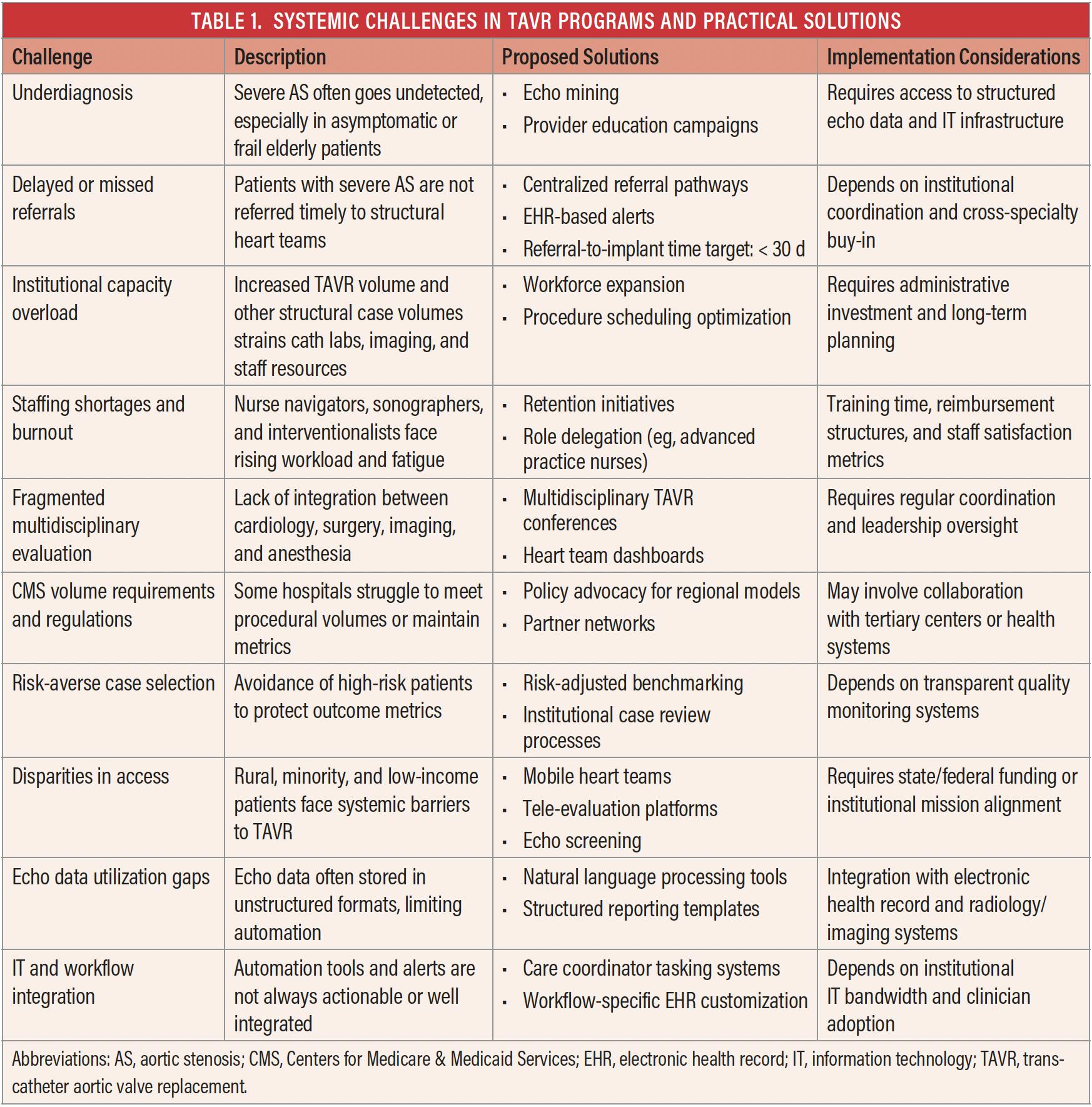
Efforts are underway to modernize TAVR accreditation criteria to reflect newer indications and care delivery models. Regional hub-and-spoke systems, mobile heart teams, and telemedicine consults offer ways to extend TAVR access to underserved areas. Policy reforms should prioritize resource flexibility, care equity, and support for innovation in screening and referral (Table 1).
CONCLUSION
As TAVR expands to include asymptomatic and lower-risk populations, institutions must adapt quickly to meet the rising demand. Challenges such as delayed diagnosis, fragmented referral pathways, institutional overload, and regulatory rigidity threaten to limit the reach of this life-saving procedure. Innovations like echo mining and structured screening programs offer promise but require institutional support and policy alignment to be effective. Addressing these barriers is essential to ensuring that all eligible patients can benefit from timely, equitable access to TAVR.
Acknowledgment of AI Assistance: Portions of this manuscript, including structural organization and language refinement, were developed with assistance from ChatGPT (OpenAI, GPT-4, 2025). The author reviewed all content to ensure accuracy, clinical integrity, and compliance with ICMJE guidelines.
Advertisement
Advertisement