Advertisement
Advertisement
2025 Digital Exclusive No. 3
A Cardiogenic Shock Challenge: Achieving 24-Hour Door-to-Lactate Clearance
SCAI President Srihari S. Naidu, MD, is challenging the interventional cardiology field and all members of the shock team to achieve a door-to-lactate clearance of 24 hours to improve cardiogenic shock outcomes.

As you took the helm as President of the Society for Cardiovascular Angiography & Interventions (SCAI) this year, you introduced a goal to create a door-to-lactate clearance (DLC) of 24 hours in the management of cardiogenic shock.1 Can you explain where the DLC concept originated and what the first steps will be to reach this goal?
When we embarked on the new SCAI SHOCK definition in 2019, the field needed a complete reboot. It had become clear that you cannot begin to treat a problem that you cannot even define. Numerous trials with cardiogenic shock as the inclusion criteria had such disparate definitions that the applicability and generalizability were highly questioned the moment they were published, and of course all were uniformly negative trials. With the advent of the SCAI SHOCK definition, the field has seen an enormous interest both clinically and scientifically in moving forward methodically and sequentially, leading to a tsunami of information, protocols, data points, and, importantly, a deeper understanding of the various phenotypes, etiologies, and trajectories of cardiogenic shock. In addition, several major organizations and industry partners are investing in this space to move the needle and improve outcomes, including the building of registries. As a result, what started out as an attempt to make a complicated disease simple and intuitive with a uniform definition has ballooned into something necessarily more complex but increasingly unwieldy.
The DLC came out of a desire to resimplify the field and refocus clinicians and the community at large on the most important “next step” problem after arriving at a diagnosis of cardiogenic shock: a focus on urgent and timely treatment with a clear and defined goal. This is where DLC comes in. What must individuals prioritize in the first hours to 1 day of diagnosing cardiogenic shock, and why?
In the last half decade, it has become clear that lactate is likely the best and most readily available and frequently ascertainable metric of global perfusion, and it has become increasingly clear to me that it should be used both at initial diagnosis and routinely until it has cleared—defined either by rapid reduction and/or dropping to < 2 mmol/L. Several registries have now documented, even in the sickest patients (defined as SCAI SHOCK stage E), that clearance of lactate within 24 hours achieves the lowest mortality, regardless of initial SCAI SHOCK stage.2 Although there are no proactive data to date, the totality of the data supports developing such a metric as a goal, especially in acute myocardial infarction shock, with of course certain caveats and pitfalls that must be discussed and fleshed out.
The first steps to moving on a DLC metric are articles such as this that discuss the concept in its early form. This will be followed by a formal SCAI position statement that we hope to simultaneously introduce and publish during the SCAI SHOCK annual symposium held September 18-20, 2025, in Tampa, Florida. That statement will outline the “why” of DLC, the data to date, how to use it in clinical practice, pearls and pitfalls, and, of course, a call to action.
Similar to the door-to-balloon (DTB) concept for ST-segment elevation myocardial infarction (STEMI) management, an important part of the DLC concept is that it is agnostic to location or time of diagnosis, which means it should include transfer situations and shock that develops inside the hospital and, by definition, also necessitates increased support and vigilance when there is more limited staff off-hours. The DLC concept pushes shock teams to be available and communicative at all hours, pushes systems to organize into hub-and-spoke models that track lactate at both institutions, and advocates for point-of-care (POC) lactate sampling in cath labs, intensive care units, and all critical care areas of the hospital (including the emergency department) for rapid assessment and decision-making.
Of course, the pitfalls are important, as are the unintended consequences—and these will be addressed in detail in the upcoming position statement by SCAI.
You note in support of the 24-hour DLC that quality registries will be crucial to achieving this. What hallmarks should such registries include, from patient access to optimal endpoints?
With any new metric, tracking how patients are treated and confirming that the metric is being used appropriately, regularly, and to good intent and effect is absolutely vital. In addition, registries can track the usage of a metric and make sure it is increasing. Further, registries will help build the case for whether the metric has been successful in improving survival in patients, despite etiology, first contact, or phenotype. These registries should include baseline information, including location of first diagnosis (including initial hospital setting), demographics, medical history, etiology, and initial SCAI SHOCK stage; laboratory and clinical information during the clinical course; escalation and de-escalation strategies; and ultimate outcomes at 24 hours, in hospital, 30 days, and 1 year.
The American Heart Association is in the process of creating such a registry as part of its Get With The Guidelines program.3 Such registries can not only track the frequency and values of lactate but also the overall clinical trajectory that is associated with these numbers. They can then aid in developing protocols and processes within variably resourced health systems to achieve the best survival for patients. Such a pattern recognition can then be used to promote best practices in different settings and among different teams and resources.
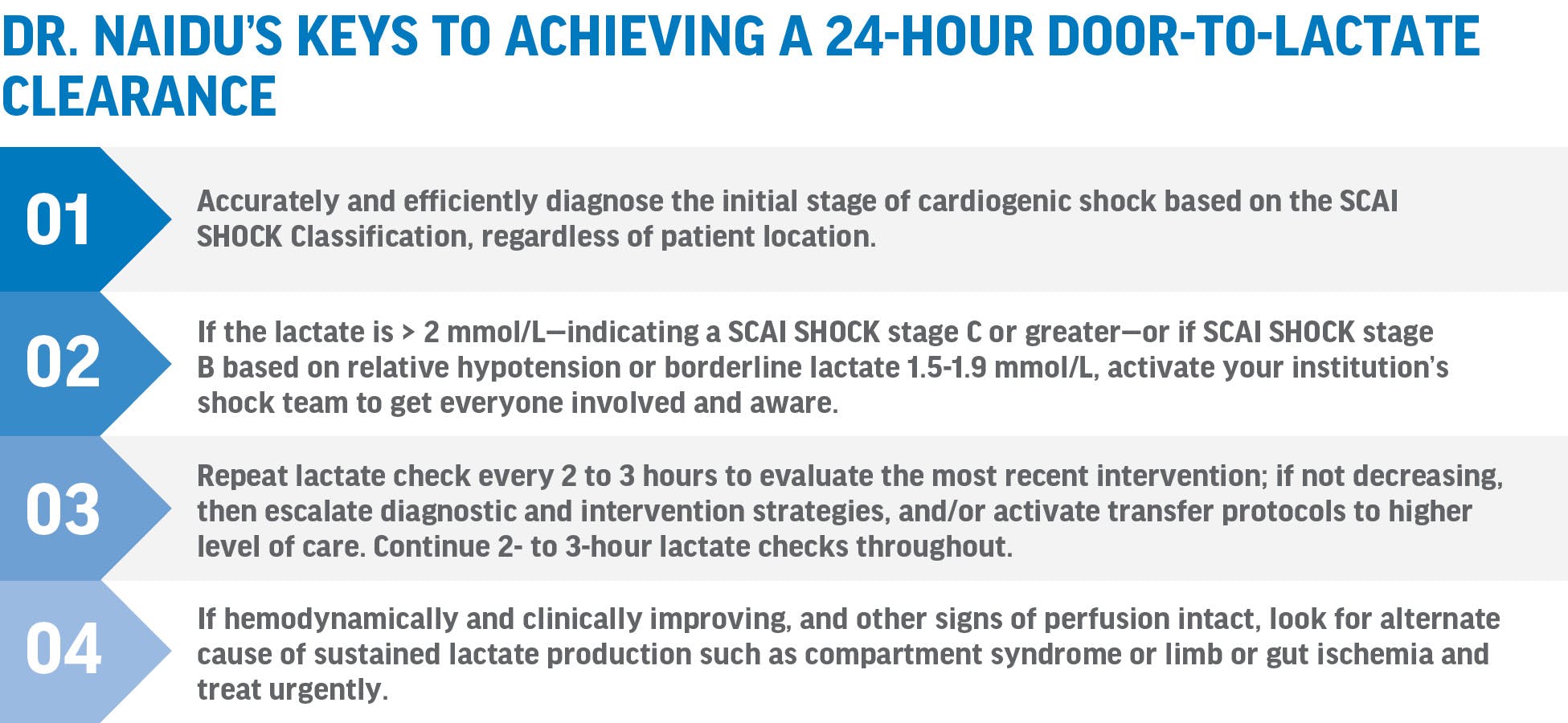
Based on our current understanding, what are three keys that shock teams can follow to aid in reaching a 24-hour DLC?
The first is of course to accurately and efficiently diagnose cardiogenic shock. That means having a high index of suspicion. The SCAI SHOCK definition purposefully starts with stage A, which includes all patients with the substrate to spiral into shock—in other words, we know which patients have a risk of developing shock, and we must start there. If you’re not sure, check the lactate and confirm it is normal and thus stage A or B. If it’s borderline, repeat it within 2 hours. But define the initial stage—that’s the first thing.
Second, if the lactate is > 2 mmol/L, indicating stage C or greater, trigger your shock team so everyone is on board. Stage B with higher lactate levels in 1.5-1.9 mmol/L should also potentially trigger the team. Sometimes this is a virtual team and sometimes it’s a real huddle, but in every case, all parties should be available and informed so that they can give their views on how to decrease the lactate by safely and effectively increasing perfusion. This may involve multiple departments in some cases, and multiple hospitals at times as well.
Third, of course, is to repeat the lactate check, potentially every 2 to 3 hours, to allow enough time for whatever intervention was performed to have a positive effect but not so long that we lose the opportunity to make a timely change in treatment if lactate is not down-trending. As cardiogenic shock spirals quickly, it is important to get ahead of this, and frequent lactate checks may be the best way to do this within the first 12 to 24 hours. If the lactate is decreasing, then we know perfusion must be up and there are no tissue loss complications occurring, including renal perfusion. But if not, then this should trigger escalation or transfer protocols and a deeper dive into improving perfusion, as well as a determination of whether there are nonperfusion aspects of sustained lactate levels, such as compartment syndrome or mesenteric ischemia.
What are the known hurdles to achieving a DLC of 24 hours? How can these hurdles be addressed at the hospital level?
Some hurdles are conceptual, such as pushing the concept out and gaining traction and buy-in among all stakeholders. The SCAI position statement, especially timed for the SCAI SHOCK conference where multiple stakeholders will be present, will get that started, and then databases and independent research will hopefully prove supportive while fine-tuning the metric and optimal protocols. Some others will be logistical: How do we educate nurses, fellows, and residents to be part of the shock teams? How can we get lactate in timely fashion in all units? It will be crucial to negotiate with the hospital to get POC machines and the quality assurance protocols in place to maintain them. In addition, educating on pearls and pitfalls and how to look holistically at organ system perfusion while starting with just the lactate will also remain paramount.
Hospitals will have to lean in and help support POC lactate protocols; education of nurses, residents, and fellows; promotion of shock teams and protocols; and assistance with transfer and other escalation protocols. One important aspect of the DLC is that it is agnostic to whether a patient presents to a smaller community hospital or a large academic medical center. In either case, all hospitals touching the patient should track and report the DLC and therefore must create hub-and-spoke models, oftentimes outside their primary financial hospital relationship, to get the DLC down within 24 hours. This is, of course, the right thing to do for the patient, and it may also help us think more collaboratively for our patients. State-based initiatives may be required, similar to the ones for DTB times for STEMI care.
What areas are in most need of revision in your planned update to the SCAI SHOCK classification, last published in 2021? Will the new classification aim to address your goal of a DLC of 24 hours?
In the new SCAI SHOCK definition update, planned for publication and presentation at the SCAI scientific sessions in Montreal in May 2026, we will update the classification scheme based on new data and then stratify patients by different etiologies, phenotypes, and hemometabolic profiles. Maintaining the same shock pyramid while allowing patients to right-size into different versions of that pyramid should aid in prognostication and help us understand treatment strategies and protocols based on these different aspects.
In addition to this, we will also update the tables to focus on metrics that are most useful. In this regard, the DLC will likely take more center stage in both diagnosis and treatment strategies and help drive systems of care toward a more uniform patient experience, ultimately improving survival across the board.
What recommendations would you suggest to existing shock teams to help revise their shock protocols in the next year?
Each shock team is unique, and one of the main dilemmas is how to orchestrate the best shock care at your institution, with your resources and your expertise. The role of the DLC and SCAI SHOCK stages is to overlay standardization on the shock teams, wherever they may be and whoever is on them, to improve care at each location. My recommendations, other than to look at your outcomes and feed those back into your system, are to start protocols at all feeder hospitals and think broader to emergency medical services (EMS) and hospitals not financially affiliated with your hospital. Like the old mantra of “time is muscle,” use the imperative that “time is lactate” and get all patients stabilized and treated so that the DLC is attained no matter where the diagnosis is made. This will require a systems approach to care that is resource and time-intensive.
The hub-and-spoke model within cardiogenic shock has really grown over the past few years. How do you see this model aiding in improving shock management and the goal of 24-hour DLC?
Many shock hospitals have organized this way but have not optimized protocols for diagnosis and initial safe management at the spoke hospitals. Furthermore, very few (if any) have organized the nonaffiliated hospitals in their area to prioritize optimal shock care. One of the main goals of the DLC is to get past this limitation in our health care system by forcing EMS and hospitals to prioritize this metric regardless of where they are first diagnosed, which means rapid assessment, stabilization, transfer, and escalation as appropriate to clear the lactate within 24 hours. By definition, the DLC has the ability to prioritize the patient over financial or allegiance factors and force physicians at different hospital systems to become reliable colleagues. We will need state regulations to push us in this direction from top down, while the clinical imperatives like DLC do so from the bottom up. As a member of the New York State Cardiac Advisory Council, I will certainly try to move us in this direction in New York State, and hopefully other states will follow in orchestrating shock care in all settings, regardless of hospital network. Patients deserve the best clinical care and a coordinated approach to their management, and I believe the SCAI SHOCK stages and DLC will help move us in this direction.
What advancements in tools may be needed to achieve your DLC goal?
Right now, lactate requires a machine and arterial blood gas (ABG) to determine the level. Although this is rapid, the cost of the machine and the requirement for ongoing quality assurance regulations are limitations to rapid rollout. Once validated, industry should focus on rapid bedside ABG/lactate machines so that in the field and in every setting a rapid assessment can be made, helping triage patients to the right center first. These and other innovations will naturally follow the evolution of clinical science to improve outcomes.
What ongoing and new research opportunities are happening to address advances in cardiogenic shock care?
This is an amazing time to be involved in the improvement of cardiogenic shock. From basic research on the shock cascade to novel therapies, and from protocols to devices, there is much to grow and learn within this field as it evolves. We need better and safer support devices, especially those that can bridge the patient for longer durations prior to a final destination or recovery. We need POC assessments that residents and fellows can do, such as that described above for ABG and lactate. We need observational data on optimal protocols and processes at different hospital sizes and levels of resources. And we need more randomized trials that focus on a few interventions or processes.
Together the goal will be to rapidly identify those in shock at earlier stages, rapidly treat and assess for improved perfusion, escalate safely as needed, and de-escalate equally rapidly—all these and more will need hard science to back it up and make sure we are doing what’s right for our patients and society. But at the end of the day, what a story it will be.
1. Naidu SS. Carrying the torch and fanning the flame: my vision and hope for SCAI. J Soc Cardiovasc Angiogr Interv. 2025;4:103651. doi: 10.1016/j.jscai.2025.103651
2. Hanson ID, Palomo A, Tawney A, et al. Acute myocardial infarction and stage E shock: insights from the RECOVER III study. J Soc Cardiovasc Angiogr Interv. 2025;4:102462. doi: 10.1016/j.jscai.2024.102462
3. American Heart Association. Get with the guidelines. Accessed July 18, 2025. https://www.heart.org/en/professional/quality-improvement/get-with-the-guidelines
Advertisement
Advertisement
Latest Digital Exclusives