Advertisement
Advertisement

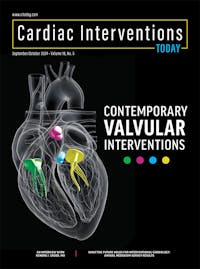
I am humbled and honored to serve as the Guest Chief Medical Editor for this issue of Cardiac Interventions Today. Transcatheter therapies have transformed the field of structural heart disease to provide treatment options for patients who once had limited to no options. As we look to treat and help even more patients, we must innovate and refine foundational transcatheter technologies. This issue showcases the sophistication in advanced techniques that have expanded technology utilization, while highlighting ongoing investigation of pathophysiologic and engineering challenges.
This issue also calls attention to the responsibility we all share to overcome treatment disparities and access inequalities to help care for all our patients, regardless of their zip code, race, or gender. This responsibility also includes radiation safety in our catheterization labs to protect, support, and include all. As we look toward diversifying and expanding our technology and patient population, we are encouraged by the progress in our field of interventional cardiology. Indeed, this issue celebrates contributions from a highly diverse and talented group of authors, whom I want to sincerely thank for their expertise. We invite you to take a journey with us through all four cardiac valves and the latest contemporary considerations for each.
2024’s spotlight has been on the tricuspid valve. With tricuspid repair and replacement technologies now commercially available in the United States, Anita W. Asgar, MD, and Anene Ukaigwe, MD, focus on clinical, anatomic, and echocardiographic considerations in choosing between a tricuspid transcatheter edge-to-edge repair (T-TEER) versus a transcatheter tricuspid valve replacement (TTVR) treatment strategy. The frontier of tricuspid imaging, specifically the utility of transesophageal echocardiography (TEE) and intracardiac echocardiography (ICE), are explored in depth by Nishath Quader, MD; Tsuyoshi Kaneko, MD; and Alan Zajarias, MD. The authors also shed insight into launching a new tricuspid valve program for those Heart Teams looking to venture given the FDA approvals of 2024.
As we strive to expand technology utilization beyond standard anatomies, Roosha Parikh, MD, and Jaffar M. Khan, MD, PhD, provide a broad overview of aortic leaflet, mitral leaflet, and septal modification, with a focus on rationale and general techniques.
Transcatheter technology has long focused on calcific aortic valve disease. Mohammed Ahmed, MD; Nishath Quader, MD; Marc Sintek, MD; Tsuyoshi Kaneko, MD; and Alan Zajarias, MD, explore management options and future directions of regurgitant aortic valve disease, including epidemiology and pathophysiology, early results and challenges with off-label and dedicated technology, and innovation needs. Although TAVR is standard of care for aortic stenosis, Shreya D. Mehta, BA, BS; Kriyana P. Reddy, BS; Jay S. Giri, MD, MPH; and Ashwin S. Nathan, MD, MS, examine the scope of racial, ethnic, and socioeconomic disparities in TAVR access. The authors discuss promising collaborative solutions, including the TARGET: Aortic Stenosis Initiative, to help provide care to underserved and underdiagnosed patients.
Mitral edge to edge repair (M-TEER) is now being considered beyond conventional “green zone” anatomies as discussed by Nidish Tiwari, MD; Muhammad Asim Shabbir, MD; and Nidhi Madan, MD, MPH. For those anatomies in which transcatheter mitral repair is not achievable, Ruby Satpathy, MD; Trinath K. Mishra, MD; and Chhabi Satpathy, MD, examine the past, present, and future of transcatheter mitral valve replacement (TMVR).
The pulmonic valve is no longer considered an isolated pediatric issue given the rising numbers of adults with congenital heart disease. Ada C. Stefanescu Schmidt, MD, and Shabana Shahanavaz, MD, share contemporary consideration in transcatheter pulmonary valve replacement, focusing on clinical evidence, current and forthcoming technology, and patient-centered decision-making.
As we expand therapeutic technologies, it is equally important we ensure the safety of our multidisciplinary teams. In a review of newer radiation protection technologies, Poonam Velagapudi, MD, MS; Lucy M. Safi, DO; Ajay J. Kirtane, MD, SM; and James Hermiller, MD, highlight efforts to reduce radiation exposure to operators and interventional echocardiographers.
It is an exciting time in the structural heart disease arena, as we strive to push the technology to help treat more patients—beyond basic anatomies and beyond barriers to care. It is our shared responsibility to do this in a safe manner as we champion and inspire for more diverse Heart Teams and more diverse patients. We hope that you find this issue of Cardiac Interventions Today valuable in your contemporary valvular practice.
Nishtha Sodhi Sood, MD, FACC, FSCAI
Guest Chief Medical Editor
Advertisement
Advertisement