Advertisement
Advertisement
September/October 2024
Leaflet Modification in Transcatheter Treatment of Valvular Heart Disease
Rationale and technical tips for aortic leaflet, mitral leaflet, and septal modification with BASILICA, LAMPOON, and SESAME.
By Roosha Parikh, MD, FACC, FASE, FSCCT, FSCMR, FASNC, and Jaffar M. Khan, MD, PhD
Techniques for leaflet modification have not only expanded therapeutic options for many patients who were previously ineligible for transcatheter therapies but also have expanded the skill set of structural interventionalists to include interventional “surgery.” Typically using commercially available tools and the application of transcatheter electrosurgery, the interventionalist can cut, resect, or modify valve tissue and myocardium, either as definitive therapy or to enable other transcatheter procedures.1 In this article, we provide a broad overview of aortic leaflet, mitral leaflet, and septal modification, with a focus on general techniques and rationale. References to detailed step-by-step guides are provided throughout.
AORTIC LEAFLET MODIFICATION
Coronary artery obstruction is a rare but often fatal complication of transcatheter aortic valve replacement (TAVR), and the risk of coronary obstruction is highest when TAVR is performed in bioprosthetic valves with externally mounted leaflets or in failed transcatheter heart valves (THVs).2,3 The BASILICA (bioprosthetic or native aortic scallop intentional laceration to prevent iatrogenic coronary artery obstruction) technique involves cutting the aortic leaflet prior to TAVR to prevent coronary obstruction (Figure 1).4
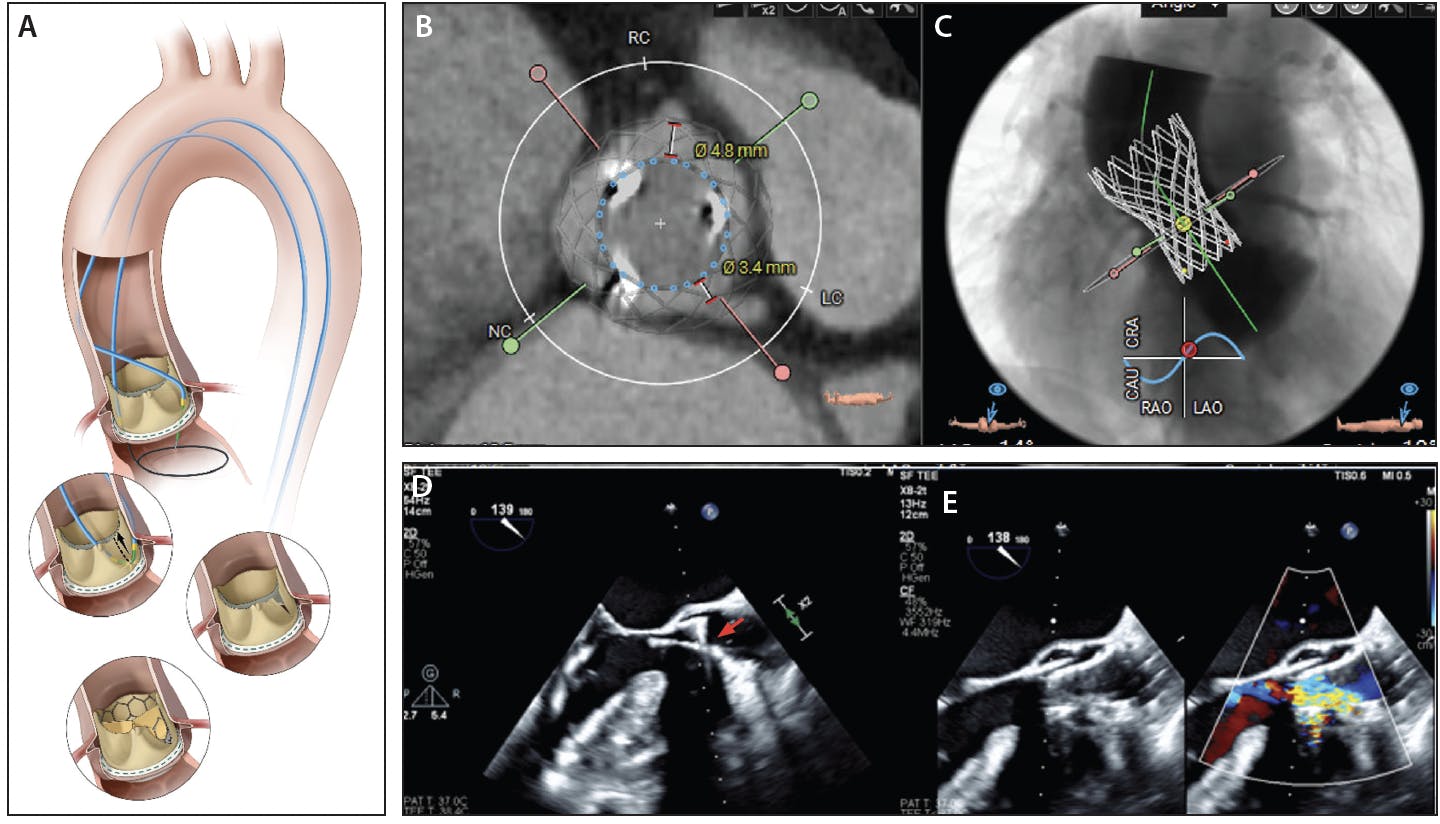
Figure 1. BASILICA: Illustration showing laceration of the left bioprosthetic aortic valve leaflet before TAVR to prevent coronary artery obstruction (A). Cardiac CT showing a virtual VTC distance of 3.4 mm for the left coronary, obtained by simulating a virtual THV and measuring the virtual valve to the coronary ostia (B). CT prediction of fluoroscopic projections with a virtual THV (C). Intraprocedural two-dimensional (2D) transesophageal echocardiogram (TEE) of a bioprosthetic valve in the aortic position with the snaring system and traversal catheter positioned through the “left” cusp of the bioprosthetic valve (red arrow) (D). Intraprocedural 2D TEE assessment of the lacerated bioprosthetic leaflet, with color Doppler showing eccentric aortic insufficiency after bioprosthetic leaflet laceration (E). Illustration in panel A reprinted from JACC: Cardiovascular Interventions, Vol 11, Khan JM et al, Transcatheter Laceration of Aortic Leaflets to Prevent Coronary Obstruction During Transcatheter Aortic Valve Replacement: Concept to First-in-Human, Pages 677-689, Copyright 2018, with permission from Elsevier.
Who Needs It?
A standardized approach is recommended to screen for coronary obstruction risk across diseased native valves, surgical bioprosthetic valves, and THVs.5 First, the neo-skirt plane is identified by demarcating the height of the diseased leaflets when they are displaced by the THV. For both native and bioprosthetic valves, this will be the height of the commissural attachments, which is the maximum height the leaflets can be displaced. If the neo-skirt height plane is higher than the level of the coronary arteries, the distance from the implanted THV to the coronary artery and from the implanted THV to the aortic wall (ie, virtual valve-to-coronary distance [VTC] and virtual valve-to-aorta distance [VTA], respectively) should be simulated and measured. If the VTC is < 4 mm or the VTA is < 2 mm, there is increased risk of coronary obstruction, and BASILICA should be considered.
How Does It Work?
When the aortic leaflet is cut down the middle, it splays when pushed aside during TAVR. If the cut is aligned to the coronary artery, it splays away from the coronary, preserving flow. If sinus sequestration is the predicted mode of obstruction, a central split will result in maximal splay and therefore maximal flow into the sinus.
How to Do It
Using commercially available equipment. BASILICA using commercially available equipment off label has been studied in a prospective trial and real-world registries.6,7 The technique involves traversing the base of the target aortic leaflet, from the aorta to left ventricular outflow tract (LVOT), with a 300-cm stiff guidewire that is electrified at 30 to 50 W through a standard electrosurgery generator. The guidewire is then snared in the LVOT, the midsection of the guidewire is denuded and kinked to create a flying V configuration to focus charge, and the snared tip is externalized while the flying V is advanced to straddle the leaflet. The guidewire is further electrified at 70 W, under slight tension and with a nonionic dextrose infusion to lacerate the leaflet.8
Using dedicated devices. Two devices dedicated for BASILICA are in clinical trials (NCT04952909, NCT05666713). The ShortCut device (Pi-Cardia) creates a mechanical cut in the leaflet using a blade that engages the leaflet base in a pincer motion and cuts the leaflet as the device is retracted. The Telltale system (Transmural Systems) uses dedicated catheters and an insulated wire and follows the conventional BASILICA sequence to create an electrosurgical cut.
Augmenting leaflet laceration. Increased leaflet splay may be necessary when treating failed and underexpanded THVs. In this case, the base of the leaflet can be ballooned prior to laceration.9 Furthermore, the base of the leaflet can be sequentially ballooned to completely mechanically disrupt the leaflet or enable intraleaflet deployment of the THV.10
Limitations
As with any advanced technique, there is a learning curve for these procedures, and regular practice is required to maintain skills in these techniques. Inadvertent mechanical leaflet avulsion may cause hemodynamic compromise prior to TAVR and may result in coronary obstruction from the avulsed leaflet flap. Cerebral embolic protection is generally recommended during these procedures.
MITRAL LEAFLET MODIFICATION
LVOT obstruction from displacement of the anterior mitral valve leaflet toward the interventricular septum is a leading cause of screen failure for transcatheter mitral valve replacement (TMVR).11 The LAMPOON (laceration of the anterior mitral leaflet to prevent outflow obstruction) technique involves cutting the anterior mitral valve leaflet prior to TMVR to prevent LVOT obstruction (Figure 2).12
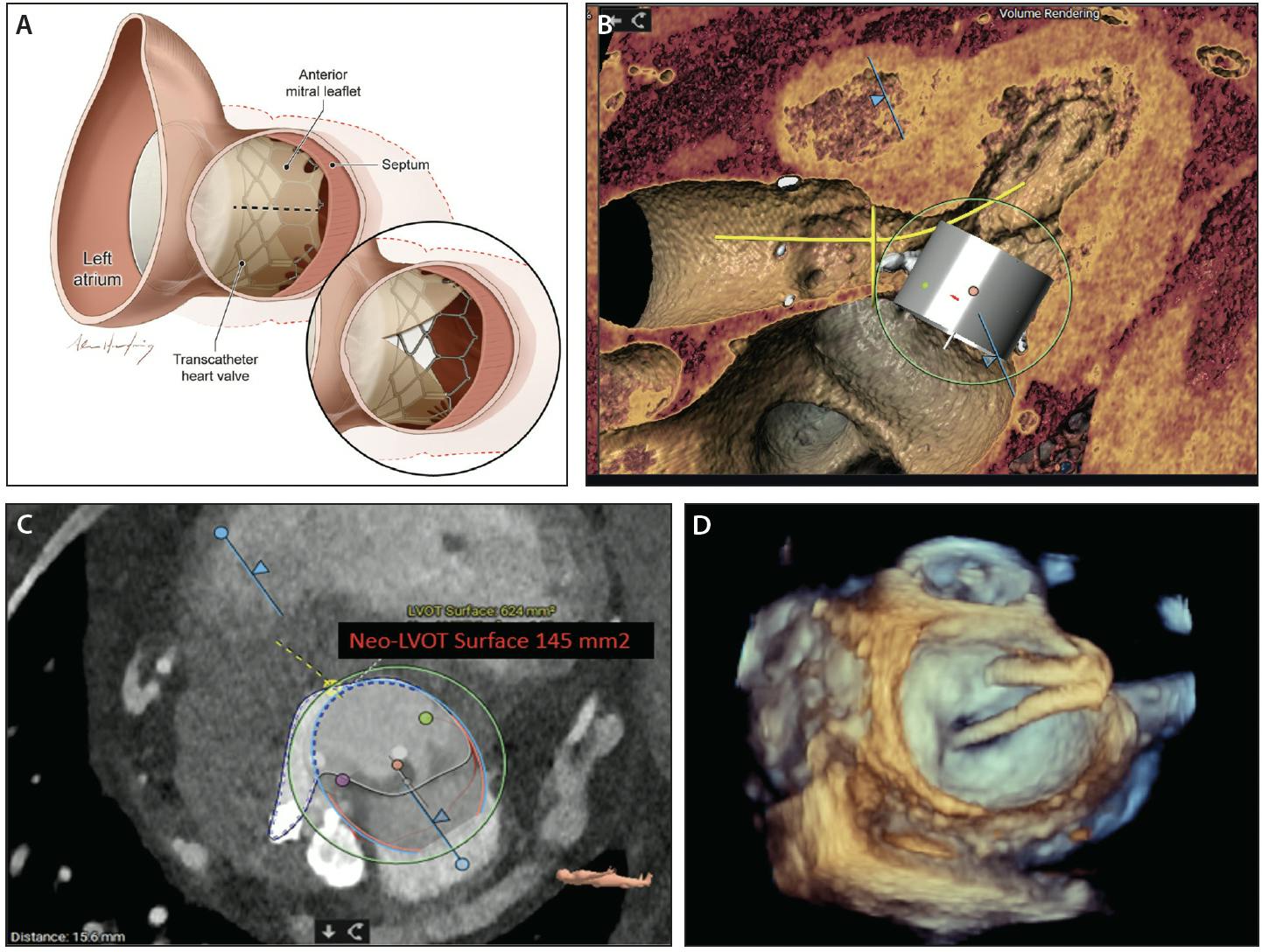
Figure 2. LAMPOON: Illustration demonstrating laceration of the anterior mitral valve leaflet from base to tip along the centerline (top image) (A); after LAMPOON TMVR, the split anterior mitral valve leaflet is shown with preserved chordae parting around a Sapien 3 valve (Edwards Lifesciences), preventing LVOT obstruction (bottom image) (A). Three-dimensional (3D) volume-rendered CT with a simulated Sapien 3 valve in a mitral position neo-LVOT trajectory (B). Multiplanar reconstruction view of the neo-LVOT measuring 145 mm2 when using a simulated Sapien 3 valve in the mitral position (C). Intraprocedural 3D TEE view of the mitral valve with one guiding catheter positioned that abuts the base of the A2 mitral scallop, while the other is placed retrograde across the mitral valve (D). Illustration in panel A reprinted from JACC: Cardiovascular Interventions, Vol 10, Vasilis C et al, Intentional Percutaneous Laceration of the Anterior Mitral Leaflet to Prevent Outflow Obstruction During Transcatheter Mitral Valve Replacement First-in-Human Experience, Pages 798-809, Copyright (2017), with permission from Elsevier.
Who Needs It?
LVOT obstruction risk is most accurately predicted by simulating the neo-LVOT using the intended THV. A neo-LVOT area < 200 mm2 portends increased risk of LVOT obstruction. Furthermore, a long anterior mitral leaflet can cause dynamic LVOT obstruction from systolic anterior motion as well as leaflet overhang that can interfere with transcatheter valve function. Typically, LAMPOON works in combination with a THV that has an open-cell design, allowing blood to flow through it when the anterior mitral leaflet is split or when the risk is from a long leaflet.
How Does It Work?
The anterior mitral valve leaflet is cut down the centerline. The chords are spared, and these pull the cut leaflets apart, splaying them away from the LVOT. This splay is magnified further when the THV is deployed, particularly in the setting of anteroposterior oversizing and flaring in the ventricle.
How to Do It
LAMPOON is currently performed using commercially available equipment. Dedicated devices for BASILICA could potentially be repurposed for transseptal delivery for LAMPOON, but these have not yet been applied in patients. LAMPOON was originally performed from the retrograde aortic approach, and this approach was studied in a prospective trial.13 However, contemporary practice is to perform LAMPOON from the antegrade transseptal approach due to greater ease of use.14
Tip-to-base LAMPOON. In the setting of valve-in-valve or valve-in–complete ring TMVR, lacerating the leaflet from tip to base is the preferred method. A venoarterial rail is created after transseptal puncture, delivery of a guidewire through the mitral and aortic valves along a chord-free trajectory, and snaring the guidewire in the aorta from the femoral artery. A flying V is created (as in BASILICA) and delivered to the mitral valve leaflet tip while externalizing the snared tip of the guidewire. The left atrial catheter is positioned at the center of the mitral leaflet under echocardiographic and fluoroscopic guidance. Tension is applied to both limbs of the guidewire during electrification at 70 W and dextrose flush until the guidewire meets the sewing ring. The cut is confirmed on echocardiography prior to equipment disassembly and TMVR.15
Base-to-tip LAMPOON. Base-to-tip LAMPOON is preferred in the setting of a native mitral valve or incomplete ring when there is no adequate backstop to atrial progression of wire laceration. Two deflectable transseptal sheaths are used: one for traversal from the left atrium to the LVOT through the base of the anterior mitral valve leaflet and the other for snaring in the LVOT. After traversal, the flying V is delivered to straddle the mitral leaflet. The vector of laceration is determined by aligning the two deflectable sheaths along the midline of the mitral leaflet. Laceration is performed by applying tension of both limbs of the guidewire during electrification at 70 W.16
Limitations
There is a learning curve for these procedures, and maintaining skills requires a certain regularity in performing them. In the setting of a small neo-LVOT, LAMPOON can only help when using a THV with an open-cell design.
MYOCARDIAL MODIFICATION
The techniques of guidewire traversal, snaring, and laceration described for valve leaflet laceration have been applied to the myocardium to augment the LVOT. The SESAME (septal scoring along the midline endocardium) procedure can be used to prevent LVOT obstruction from TMVR and also as septal reduction therapy for patients with obstructive hypertrophic cardiomyopathy (oHCM) (Figure 3).17
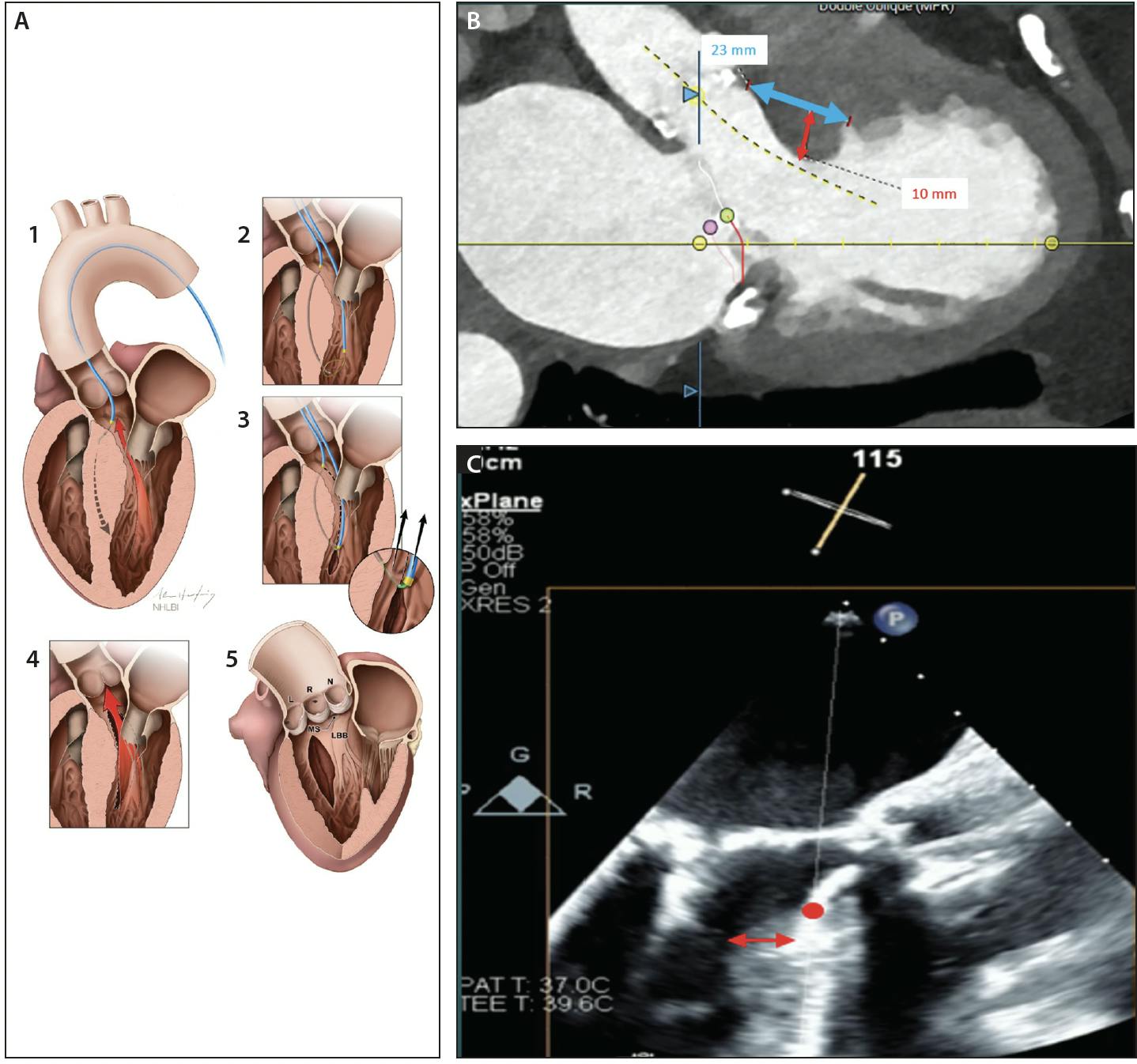
Figure 3. SESAME: Illustration depicting the SESAME procedure (A), where a guidewire is navigated through the interventricular septum (A1) then completes the intramyocardial trajectory and reenters the left ventricle cavity into a snare (A2). A lacerating surface is then electrified to create the myotomy (A3) leading to muscle splay and increased space in the LVOT, with increased blood flow (A4-A5). Cardiac CT showing trajectory of the neo-LVOT (yellow dotted line), length of the thickened basal interventricular septum targeted for wire traversal (blue arrow), and planned guidewire depth (red arrow) (B). Intraprocedural TEE (long-axis view) showing the guidewire navigating through the interventricular septum intramyocardially (red dot) and the depth of the guidewire in the septum (red arrow) (C). Illustration in panel A reprinted from Khan JM et al, Transcatheter Myotomy to Relieve Left Ventricular Outflow Tract Obstruction: The Septal Scoring Along the Midline Endocardium Procedure in Animals, Circulation: Cardiovascular Interventions, Volume 15, Issue 6.
Who Needs It?
Septal reduction therapy should be considered for patients with oHCM and provocable gradients of ≥ 50 mm Hg despite optimal medical therapy. Given that SESAME is a novel therapy, it is generally reserved for patients who either are not candidates or do not wish to undergo surgical myectomy or transcoronary alcohol septal ablation. SESAME is also used prior to TMVR to augment the LVOT in patients at risk of LVOT obstruction. Unlike LAMPOON, SESAME is agnostic to TMVR design.
How Does It Work?
SESAME is a myotomy without myectomy. In other words, a cut is made in the muscle without excision of muscle tissue, replicating the original surgery for oHCM. After muscle laceration, the muscle splays, creating increased room in the LVOT. The splay is greater with greater depth of laceration and is theoretically greater when cutting across circumferential muscle fibers. The muscle remodels over the subsequent weeks to further augment LVOT area.
How To Do It
A stiff guidewire is buried into the basal interventricular septum from a retrograde approach across the aortic valve. The guidewire is shaped and reinserted through a microcatheter and then navigated through the myocardium using echocardiography to determine the depth and length of myocardium traversed. The guidewire is directed to reenter the left ventricular cavity, where it is snared. The flying V is created and advanced through the myocardium while the snared guidewire tip is retrieved. The guidewire is electrified at 50 to 70 W while traction is applied to both ends of the guidewire, resulting in myocardial laceration.
Limitations
The procedure is novel, has not been studied prospectively, and long-term outcomes are unknown. However, the targeted nature of therapy in precisely directing the percutaneous myectomy is attractive in terms of safety, avoidance of the conduction system, and effectively reducing the septal bulge at the intended location.18
FUTURE DIRECTIONS
The need for these procedures is increasing as increasingly complex patients are being treated. Need for BASILICA and its variants is set to increase exponentially as cases of redo TAVR increase. Dedicated TMVR devices have been associated with high screen failure rates, but compatibility with LAMPOON or pairing with SESAME may significantly improve treatment rates. These dedicated devices are in development, which will increase the accessibility of these procedures.
1. Khan JM, Rogers T, Greenbaum AB, et al. Transcatheter electrosurgery: JACC state-of-the-art review. J Am Coll Cardiol. 2020;75:1455-1470. doi: 10.1016/j.jacc.2020.01.035
2. Ribeiro HB, Rodes-Cabau J, Blanke P, et al. Incidence, predictors, and clinical outcomes of coronary obstruction following transcatheter aortic valve replacement for degenerative bioprosthetic surgical valves: insights from the VIVID registry. Eur Heart J. 2018;39:687-695. doi: 10.1093/eurheartj/ehx455
3. Forrestal BJ, Case BC, Yerasi C et al. Risk of coronary obstruction and feasibility of coronary access after repeat transcatheter aortic valve replacement with the self-expanding Evolut valve: a computed tomography simulation study. Circ Cardiovasc Interv. 2020;13:e009496. doi: 10.1161/CIRCINTERVENTIONS.120.009496
4. Khan JM, Dvir D, Greenbaum AB, et al. Transcatheter laceration of aortic leaflets to prevent coronary obstruction during transcatheter aortic valve replacement: concept to first-in-human. JACC Cardiovasc Interv. 2018;11:677-689. doi: 10.1016/j.jcin.2018.01.247.
5. Khan JM, Kamioka N, Lisko JC, et al. Coronary obstruction from TAVR in native aortic stenosis: development and validation of multivariate prediction model. JACC Cardiovasc Interv. 2023;16:415-425. doi: 10.1016/j.jcin.2022.11.018
6. Khan JM, Greenbaum AB, Babaliaros VC, et al. The BASILICA trial: prospective multicenter investigation of intentional leaflet laceration to prevent TAVR coronary obstruction. JACC Cardiovasc Interv. 2019;12:1240-1252. doi: 10.1016/j.jcin.2019.03.035
7. Khan JM, Babaliaros VC, Greenbaum AB, et al. Preventing coronary obstruction during transcatheter aortic valve replacement: results from the multicenter international BASILICA registry. JACC Cardiovasc Interv. 2021;14:941-948. doi: 10.1016/j.jcin.2021.02.035
8. Bruce CG, Greenbaum AB, Babaliaros VC, et al. Safeguards and pitfalls for bioprosthetic or native aortic scallop intentional laceration to prevent iatrogenic coronary artery obstruction during transcatheter aortic valve replacement-the BASILICA technique. Ann Cardiothorac Surg. 2021;10:700-707. doi: 10.21037/acs-2021-tviv-26
9. Greenbaum AB, Kamioka N, Vavalle JP, et al. Balloon-assisted BASILICA to facilitate redo TAVR. JACC Cardiovasc Interv. 2021;14:578-580. doi: 10.1016/j.jcin.2020.10.056
10. Chan KE, Tai-Leung Chan D, Lam CS, et al. First-in-human undermining iatrogenic coronary obstruction with radiofrequency needle (UNICORN) procedure during valve-in-valve transcatheter aortic valve replacement. Circ Cardiovasc Interv. 2022;15:928-931. doi: 10.1161/CIRCINTERVENTIONS.122.012399
11. Forrestal BJ, Khan JM, Torguson R, et al. Reasons for screen failure for transcatheter mitral valve repair and replacement. Am J Cardiol. 2021;148:130-137. doi: 10.1016/j.amjcard.2021.02.022
12. Babaliaros VC, Greenbaum AB, Khan JM, et al. Intentional percutaneous laceration of the anterior mitral leaflet to prevent outflow obstruction during transcatheter mitral valve replacement: first-in-human experience. JACC Cardiovasc Interv. 2017;10:798-809. doi: 10.1016/j.jcin.2017.01.035
13. Khan JM, Babaliaros VC, Greenbaum AB, et al. Anterior leaflet laceration to prevent ventricular outflow tract obstruction during transcatheter mitral valve replacement. J Am Coll Cardiol. 2019;73:2521-2534. doi: 10.1016/j.jacc.2019.02.076
14. Lisko JC, Greenbaum AB, Khan JM, et al. Antegrade intentional laceration of the anterior mitral leaflet to prevent left ventricular outflow tract obstruction: a simplified technique from bench to bedside. Circ Cardiovasc Interv. 2020;13:e008903. doi: 10.1161/CIRCINTERVENTIONS.119.008903
15. Case BC, Khan JM, Satler LF, et al. Tip-to-base LAMPOON to prevent left ventricular outflow tract obstruction in valve-in-valve transcatheter mitral valve replacement. JACC Cardiovasc Interv. 2020;13:1126-1128. doi: 10.1016/j.jcin.2020.01.235
16. Case BC, Lisko JC, Babaliaros VC, et al. LAMPOON techniques to prevent or manage left ventricular outflow tract obstruction in transcatheter mitral valve replacement. Ann Cardiothorac Surg. 2021;10:172-179. doi: 10.21037/acs-2020-mv-25
17. Greenbaum AB, Khan JM, Bruce CG, et al. Transcatheter myotomy to treat hypertrophic cardiomyopathy and enable transcatheter mitral valve replacement: first-in-human report of septal scoring along the midline endocardium. Circ Cardiovasc Interv. 2022;15:e012106. doi: 10.1161/CIRCINTERVENTIONS.122.012106.
18. Greenbaum AB, Ueyama HA, Gleason PT, et al. Transcatheter myotomy to reduce left ventricular outflow obstruction. J Am Coll Cardiol. 2024;83:1257-1272. doi: 10.1016/j.jacc.2024.02.007
Advertisement
Advertisement