Advertisement
Advertisement
March/April 2024
Expert Outlook: What Are Your Main Concerns When Treating a Bicuspid Aortic Stenosis Patient With TAVR?
With Hasan Jilaihawi, MD, MRCP (UK), and Raj Makkar, MD, FACC


The first-in-human transcatheter aortic valve replacement (TAVR) was a 57-year-old man in cardiogenic shock with bicuspid aortic valve (BAV) stenosis, performed antegrade without rapid pacing by Alain Cribier in 2002.1 Despite this precocious application of the technology, the progress of TAVR in BAV has been extremely cautious since then. Both balloon-expandable and self-expanding TAVR have shown superiority or noninferiority to surgical aortic valve replacement in multiple multicenter randomized clinical trials in patients with low, intermediate, and high surgical risk.2-7 However, such trials have focused on tricuspid aortic valve anatomy, excluding BAV, and have been restricted in low surgical risk cohorts to older patients, mainly those aged > 65 years.
Despite this, TAVR is approved for use in BAV anatomy, after a few small industry-sponsored registries in highly selected patients and large proportions of anatomically excluded cases.8,9 Fortunately, large postmarket registries have demonstrated similarly favorable outcomes for TAVR in BAV and tricuspid aortic valve.10,11 This includes balloon-expandable data from the TVT registry,10 which studied 37,660 low-surgical-risk patients. Notably, only 8.6% from this cohort had BAV, in comparison to historical data from valves excised at the time of AVR demonstrating 59% of men and 46% of women with unicuspid/BAV morphology.12
This illustrates the careful application of TAVR in BAV by heart teams and highlights judicious concerns by heart teams that appropriately remain. These principal concerns focus on serious complications that can occur and be avoided through careful CT-guided case selection or procedural modification (Figure 1), with individual evaluation of the imaging-based TAVR risk and contextualization with the more established surgical risk matrix.
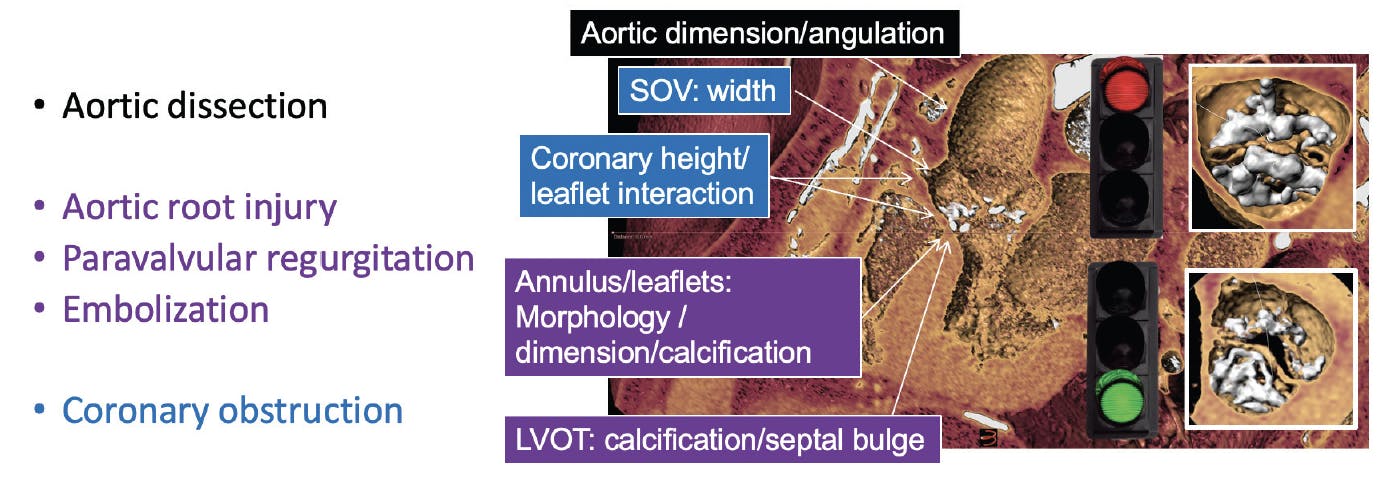
Figure 1. Serious complications after TAVR in BAV are predicted by CT parameters. Aortic dissection may be influenced by aortic dimension or angulation. Aortic root injury, PVR, and embolization are multifactorial and influenced by annular and inter-commissural dimensions, leaflet asymmetry and calcification, and raphe and left ventricular outflow tract calcification. Coronary obstruction may be influenced by coronary height, sinus of Valsalva width, and TAVR frame-leaflet interaction. Features of “red light” high TAVR risk may include severe raphe and leaflet calcium, whereas “green light” low TAVR risk cases do not have severe calcification and may have a “forme fruste” or “tricommissural” appearance with a V-shaped rather than slit-shaped orifice. LVOT, left ventricular outflow tract; SOV, sinus of Valsalva.
AORTOPATHY AND AORTIC INJURY
Ye et al reported a multicenter retrospective cohort study of 875 patients (predominantly from the Mayo Clinic Health System) with a BAV ascending aorta (AA) diameter ≥ 50 mm.13 In their cohort of predominantly (86%) male patients with a mean age of 60 years and mean follow-up of 7.5 years (interquartile range, 4-12), they reported, reassuringly, that the rate of dissection for patients with unoperated aortopathy was low at 1.8% and similar to the 1.9% risk of surgery; however, moderate or severe aortic stenosis conferred a twofold hazard ratio of aortic dissection.
In contrast, prognostic concerns have been raised for TAVR in the presence of aortopathy. Jia et al recently reported in a single-center research letter of 261 BAV patients undergoing TAVR that an absolute maximal AA diameter ≥ 45 mm was univariately associated with a 4.4-fold increased mortality risk after TAVR at a median follow-up of 3 years, with survival curves diverging early and continuing to diverge beyond 1 year.14 A larger multicenter study of > 1,000 patients showed a signal for increased 2-year cardiovascular mortality with an AA ≥ 45 mm (hazard ratio, 2.78; 95% CI, 1.39-5.56; P = .004).15 However, this was not significant on multivariate correction including factors such as calcified raphe, which was noted to be associated with AA dilatation.15 Also notable in this study, AA ≥ 45 mm was associated with moderate or severe paravalvular regurgitation (PVR) after TAVR, a long-established prognostic indicator after TAVR in tricuspid aortic valve.15,16
Regardless of the questions that remain, the totality of these data means that aortopathy remains one of our main concerns for TAVR in BAV, both at the time of the procedure (with a strict “no touch” approach in the presence of any AA dilatation for the optimization of immediate procedural outcomes with minimization of PVR and residual stenosis) and for close follow-up for progression of AA dilatation.
AORTIC ROOT/ANNULAR INJURY, PVR, EMBOLIZATION, AND THE IMPORTANCE OF SIZING
Aortic root or annular injury, PVR, and embolization are long-appreciated serious, prognostically important complications that fortunately have diminished greatly with the optimization of TAVR sizing and contemporary device iterations.16-18 Greater concern for these complications in BAV stems from the presence of eccentric and sometimes extreme supra-annular calcium, as well as asymmetric root morphology and dilatation.19 In view of these factors, TAVR sizing for BAV still raises considerable confusion and less predictability of outcomes than in tricuspid aortic valve. While some operators have favored well-defined annular sizing, others have abandoned this approach for less reproducible “supra-annular” sizing based on measurements at the level of the leaflets. The evidence thus far for optimal outcomes supports a modified annular sizing approach based on the annulus as well as a reproducible supra-annular measurement of intercommissural distance but with consideration of the pattern and extent of leaflet calcification.19,20 Recently, risk stratification in the form of “CT phenotyping” (most notably taking into account the extent of raphe and leaflet calcification) has helped identify not only “low TAVR risk” or “green light” cases in which annular sizing and frame expansion is more predictable19,21 but also “high TAVR risk” or “red light” cases in which annular sizing is less predictable.15 The latter cohort, not infrequently observed, remains one of our main concerns, less so in patients who have a surgical alternative to be directed to but rather in those who do not have a straightforward surgical option.
CORONARY OBSTRUCTION
Coronary obstruction is also a well-established, serious, and fortunately rare complication for TAVR in tricuspid aortic valve.22 In native TAVR, as for valve-in-valve, CT-derived measurements such as valve-to–coronary artery dimension (VTC) and coronary height are important predictors of coronary obstruction.23 Fortunately, in this respect, BAV is associated with taller coronary heights and larger sinus and, hence, VTC dimensions than tricuspid aortic valve. Nevertheless, when small sinus dimensions or borderline coronary heights are observed, concerns should be raised by the heart team as one factor favoring surgery in surgical candidates or procedural modification in nonsurgical candidates. Moreover, the presence of asymmetric calcium can result in asymmetric and sometimes unpredictable deployment with stent frame bias toward one coronary or the other.
CONCLUSION
TAVR can achieve excellent outcomes in highly selected patients with BAV anatomy. Our main concerns focus on the avoidance of serious complications in this heterogeneous group that is often younger and at lower surgical risk. We have only touched the surface of optimization of TAVR in this cohort, and expanded series with more sophisticated case selection and procedural modification algorithms will hopefully result in greater standardization and predictability of outcomes in a broader cohort of patients.
1. Cribier A, Eltchaninoff H, Bash A, et al. Percutaneous transcatheter implantation of an aortic valve prosthesis for calcific aortic stenosis: first human case description. Circulation. 2002;106:3006-3008. doi: 10.1161/01.cir.0000047200.36165.b8
2. Smith CR, Leon MB, Mack MJ, et al. Transcatheter versus surgical aortic-valve replacement in high-risk patients. N Engl J Med. 2011;364:2187-2198. doi: 10.1056/NEJMoa1103510
3. Makkar RR, Thourani VH, Mack MJ, et al. Five-year outcomes of transcatheter or surgical aortic-valve replacement. N Engl J Med. 2020;382:799-809. doi: 10.1056/NEJMoa1910555
4. Mack MJ, Leon MB, Thourani VH, et al. Transcatheter aortic-valve replacement in low-risk patients at five years. N Engl J Med. 2023;389:1949-1960. doi: 10.1056/NEJMoa2307447
5. Popma JJ, Reardon MJ, Khabbaz K, et al. Early clinical outcomes after transcatheter aortic valve replacement using a novel self-expanding bioprosthesis in patients with severe aortic stenosis who are suboptimal for surgery: results of the Evolut R U.S. Study. JACC Cardiovasc Interv. 2017;10:268-275. doi: 10.1016/j.jcin.2016.08.050
6. Van Mieghem NM, Deeb GM, Sondergaard L, et al. Self-expanding transcatheter vs surgical aortic valve replacement in intermediate-risk patients: 5-year outcomes of the SURTAVI randomized clinical trial. JAMA Cardiol. 2022;7:1000-1008. doi: 10.1001/jamacardio.2022.2695
7. Popma JJ, Deeb GM, Yakubov SJ, et al. Transcatheter aortic-valve replacement with a self-expanding valve in low-risk patients. N Engl J Med. 2019;380:1706-1715. doi: 10.1056/NEJMoa1816885
8. Williams MR, Jilaihawi H, Makkar R, et al. The PARTNER 3 bicuspid registry for transcatheter aortic valve replacement in low-surgical-risk patients. JACC Cardiovasc Interv. 2022;15:523-532. doi: 10.1016/j.jcin.2022.01.279
9. Forrest JK, Ramlawi B, Deeb GM, et al. Transcatheter aortic valve replacement in low-risk patients with bicuspid aortic valve stenosis. JAMA Cardiol. 2021;6:50-57. doi: 10.1001/jamacardio.2020.4738
10. Makkar RR, Yoon SH, Chakravarty T, et al. Association between transcatheter aortic valve replacement for bicuspid vs tricuspid aortic stenosis and mortality or stroke among patients at low surgical risk. JAMA. 2021;326:1034-1044. doi: 10.1001/jama.2021.13346
11. Forrest JK, Kaple RK, Ramlawi B, et al. Transcatheter aortic valve replacement in bicuspid versus tricuspid aortic valves from the STS/ACC TVT Registry. JACC Cardiovasc Interv. 2020;13:1749-1759. doi: 10.1016/j.jcin.2020.03.022
12. Roberts WC, Ko JM. Frequency by decades of unicuspid, bicuspid, and tricuspid aortic valves in adults having isolated aortic valve replacement for aortic stenosis, with or without associated aortic regurgitation. Circulation. 2005;111:920-925. doi: 10.1161/01.CIR.0000155623.48408.C5
13. Ye Z, Lane CE, Beachey JD, et al. Clinical outcomes in patients with bicuspid aortic valves and ascending aorta ≥ 50 mm under surveillance. JACC Adv. 2023;2:100626. https://doi.org/10.1016/j.jacadv.2023.100626
14. Jia Y, Tirado-Conte G, Montarello N, et al. Prognostic impact of ascending aortic dilatation in bicuspid TAVR patients. JACC Cardiovasc Interv. 2023;16:3057-3059. doi: 10.1016/j.jcin.2023.09.015
15. Yoon SH, Kim WK, Dhoble A, et al. Bicuspid aortic valve morphology and outcomes after transcatheter aortic valve replacement. J Am Coll Cardiol. 2020;76:1018-1030. doi: 10.1016/j.jacc.2020.07.005
16. Jilaihawi H, Makkar RR. Prognostic impact of aortic regurgitation after transcatheter aortic valve implantation. EuroIntervention. 2012;8(suppl Q):Q31-3. doi: 10.4244/EIJV8SQA7
17. Jilaihawi H, Kashif M, Fontana G, et al. Cross-sectional computed tomographic assessment improves accuracy of aortic annular sizing for transcatheter aortic valve replacement and reduces the incidence of paravalvular aortic regurgitation. J Am Coll Cardiol. 2012;59:1275-1286. doi: 10.1016/j.jacc.2011.11.045
18. Makkar RR, Jilaihawi H, Chakravarty T, et al. Determinants and outcomes of acute transcatheter valve-in-valve therapy or embolization: a study of multiple valve implants in the U.S. PARTNER trial (Placement of AoRTic TraNscathetER Valve Trial Edwards SAPIEN Transcatheter Heart Valve). J Am Coll Cardiol. 2013;62:418-430. doi: 10.1016/j.jacc.2013.04.037
19. Jilaihawi H, Chen M, Webb J, et al. A bicuspid aortic valve imaging classification for the TAVR era. JACC Cardiovasc Imaging. 2016;9:1145-1158. doi: 10.1016/j.jcmg.2015.12.022
20. Tchetche D, de Biase C, van Gils L, et al. Bicuspid aortic valve anatomy and relationship with devices: the BAVARD Multicenter Registry. Circ Cardiovasc Interv. 2019;12:e007107. doi: 10.1161/CIRCINTERVENTIONS.118.007107
21. Kawamori H, Yoon SH, Chakravarty T, et al. Computed tomography characteristics of the aortic valve and the geometry of SAPIEN 3 transcatheter heart valve in patients with bicuspid aortic valve disease. Eur Heart J Cardiovasc Imaging. 2018;19:1408-1418. doi: 10.1093/ehjci/jex333
22. Ribeiro HB, Rodes-Cabau J, Blanke P, et al. Incidence, predictors, and clinical outcomes of coronary obstruction following transcatheter aortic valve replacement for degenerative bioprosthetic surgical valves: insights from the VIVID registry. Eur Heart J. 2018;39:687-695. doi: 10.1093/eurheartj/ehx455
23. Khan JM, Kamioka N, Lisko JC, et al. Coronary obstruction from TAVR in native aortic stenosis: development and validation of multivariate prediction model. JACC Cardiovasc Interv. 2023;16:415-425. doi: 10.1016/j.jcin.2022.11.018
Advertisement
Advertisement