Advertisement
Advertisement
March/April 2024
Embolic Protection During TAVR: Where Do We Go After PROTECTED TAVR?
Where we stand with data on cerebral embolic protection and a discussion of current and future devices for reducing the burden of stroke during TAVR.
By Amit N. Vora, MD, MPH; Yousif Ahmad, MD, PhD; and Alexandra Lansky, MD
Stroke is one of the most feared complications after transcatheter aortic valve replacement (TAVR) and is associated with significant morbidity, mortality, and substantial economic impact. Contemporary clinically significant stroke rates range from 2% to 4%. However, the incidence of stroke often belies the true degree of neurologic injury, with most patients demonstrating perfusion abnormality after TAVR. In a patient-level pooled analysis from the Triguard (Keystone Heart) trials, the rate of disabling stroke according to the Valve Academic Research Consortium-2 (VARC-2) definition was approximately 1.2%, whereas 92% of patients had evidence of infarction on diffusion-weighted MRI.1
Despite changes in patient risk profiles over time as TAVR is used among lower-risk patients, the risk of stroke has been stubbornly consistent. Many adverse events with TAVR, such as mortality, vascular complications, or bleeding, follow a volume-outcome relationship wherein better outcomes are observed with greater site and operator experience. However, increasing site volume has not been shown to be associated with a lower incidence of stroke.2 Although risk factors for stroke appear to be patient and procedure related, risk prediction for stroke has generally been modest, with no widely used risk model to identify patients at highest risk for periprocedural stroke.
The timing of stroke after TAVR can also be variable, although most strokes occur within the first 72 hours postprocedure. Data from the FRANCE-2 registry, which captured procedural data from 3,191 patients from 2010 to 2011, demonstrated that the overall rate of a cerebrovascular event was 3.9%, with a median time to event of approximately 2 days from valve placement.3 Among all strokes within 30 days in the TVT registry, 68.4% occurred within the first 72 hours.4 As such, the majority of periprocedural ischemic strokes are felt to be embolic in origin. Sources of debris recovered from embolic filters include arterial wall fragments, acute thrombus, valve tissue, calcification fragments, myocardium, and foreign materials.5 Therefore, there has been significant effort over the past 15 years to reduce the deposit of embolic material within the cerebral vasculature, with technologies designed to capture or deflect embolic debris during TAVR.
CURRENT-GENERATION EMBOLIC PROTECTION
Currently, the only commercially available cerebral embolic protection (CEP) device in the United States is the Sentinel CEP device (Boston Scientific Corporation), which consists of two independent polyurethane filters (140-µm pore size) that capture and remove embolic material during TAVR. The device is inserted via a right radial or brachial approach, and the filters cover the innominate and left carotid arteries, protecting most (but not all) of the vascular territory perfusing the brain. The pivotal study leading to device approval in the United States was SENTINEL,6 which randomized 363 patients to a control imaging arm (n = 119), a device imaging arm (n = 121), and a safety arm (n = 123). The primary safety endpoint was a composite of major adverse cardiac and cerebrovascular events (MACCE) at 30 days, and the primary efficacy endpoint was reduction in new lesion volume in protected territories on MRI at 2 to 7 days. Comparing the device and control arms, there were no significant differences in 30-day rates of MACCE (7.3% vs 9.9%, respectively; P = .40) or stroke (5.6% vs 9.1%, respectively; P = .25); the rate of device-related vascular complications was also low (0.4%). Further, there was no significant reduction in new lesion volume on MRI in the device versus control arms (102.83 vs 177.98 mm3, respectively; P = .33). Nevertheless, despite the lack of demonstrated clinical benefit in the study, the device was deemed to be safe; it was approved by the United States FDA in 2017 and has been in clinical use since then. The uptake of CEP in the United States since then has been modest and may be due in part to site volume, device expense, and persistent uncertainty regarding its efficacy.7
PROTECTED TAVR AND ITS IMPLICATIONS
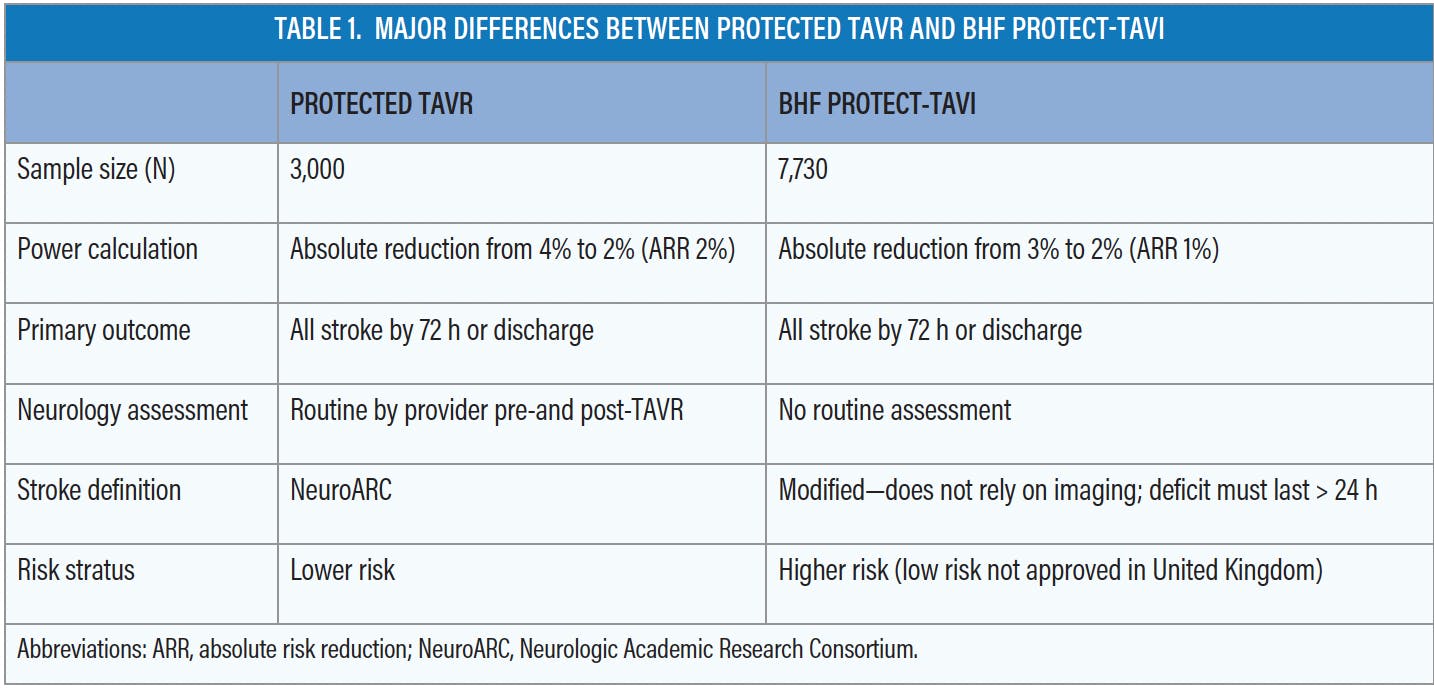
Given the inconclusive findings regarding stroke prevention with the Sentinel CEP device, the PROTECTED TAVR study was designed as a pragmatic randomized trial to evaluate the safety and efficacy of the device in a large randomized trial.8 A total of 3,000 patients were randomized to CEP (n = 1,501) versus control (n = 1,499). The primary endpoint was stroke within 72 hours (or prior to discharge), defined according to Neurologic Academic Research Consortium (NeuroARC) criteria.9 Importantly, all patients were examined at baseline and post-TAVR by a neurology professional (neurologist, neurology fellow, or neurology advanced practice provider). The total study size of 3,000 patients was intended to provide the trial with 90% power to show superiority with CEP if there was a stroke incidence of 4% in the control arm and 2% in the treatment arm. This was designed as the largest randomized study of TAVR to date.
The PROTECTED TAVR study found that the incidence of stroke within 72 hours or prior to discharge was 2.3% (34/1501) in the CEP arm and 2.9% (43/1499) in the control arm (risk difference, −0.6%; 95% CI, −1.7 to 0.5; P = .33) (Figure 1A).8 Disabling stroke occurred in 0.5% (8/1501) versus 1.3% (20/1499) of patients in the CEP and control arms, respectively (risk difference, −0.8%; 95% CI, −1.5 to −0.1). Comparing the CEP and control groups, there were no statistically significant differences in the safety composite endpoint of death or stroke (2.7% vs 3%) or neurologic composite endpoint of stroke, transient ischemic attack, or delirium (3.1% vs 3.7%). The rate of bleeding complications from the CEP device was 0.1% (due to radial bleeding). Importantly, treatment effect was consistent across subgroups: age, sex, Society of Thoracic Surgeons risk, valve morphology, prior stroke, valve choice, or pre- or postdilation.
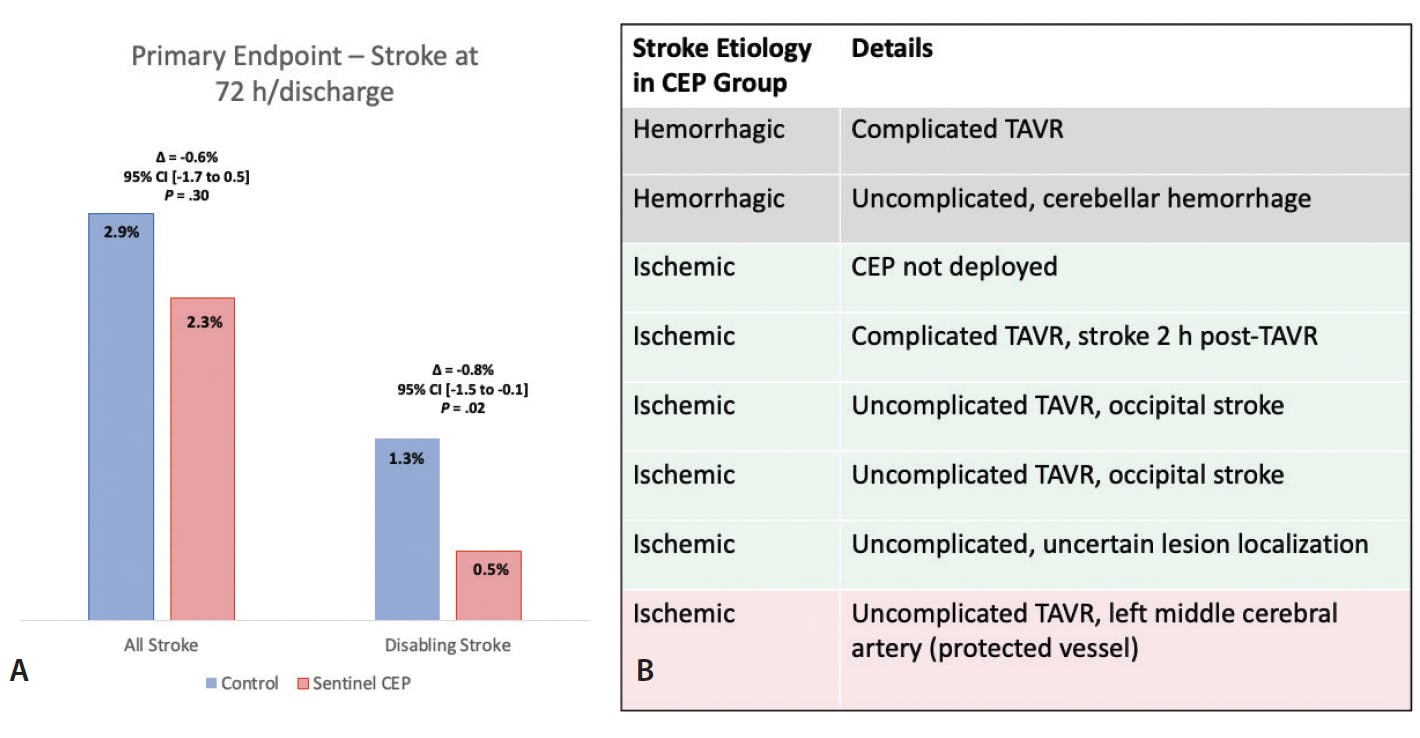
Figure 1. The primary results of the PROTECTED TAVR study (A). Additional clinical details regarding the eight disabling strokes among patients randomized to Sentinel CEP in PROTECTED TAVR (B). Data from Kapadia S. Cerebral embolic protection during transcatheter aortic valve replacement: the PROTECTED TAVR study. Presented at: TCT 2022; September 16-20, 2022; Boston, Massachusetts.
There are some important considerations to note when interpreting the results of this study. Although the trial was neutral with respect to the primary endpoint, the overall rate of stroke was lower than expected. Given that the study was powered to identify an absolute difference of 2% (from 4% in the control arm to 2% in the treatment arm), it is possible that the study was underpowered to detect a statistically significant difference given the contemporary stroke rates that were observed. Although it is challenging to look at statistically significant differences in a secondary endpoint when the primary endpoint of the study is neutral, of the eight disabling strokes in the CEP arm, only one occurred in a territory actually protected by the device. Two were hemorrhagic, one occurred in a patient where CEP was not deployed, one lesion location uncertain, and four occurred in an unprotected territory) (Figure 1B).8 There were also some geographic differences, with lower rates of stroke among CEP-treated patients in the United States compared with other territories.
THE FUTURE AFTER PROTECTED TAVR
BHF PROTECT-TAVI Study
In this setting, the currently ongoing BHF PROTECT-TAVI study will randomize 7,730 patients between the Sentinel CEP device and control. However, there are some important nuances for this study. First, the total sample size accounts for an expected stroke rate of 3% in the control arm and 2% in the treatment arm. Next, this study defines stroke as “a new or worsened focal or global neurologic deficit of presumed vascular origin, either ischemic or hemorrhagic, occurring after randomization persisting for > 24 hours or leading to death.” This stroke definition is slightly different from the NeuroARC definition that was used in PROTECTED TAVR. It does not rely exclusively on brain imaging but also specifies that the clinical deficit must exist for > 24 hours. Further, the populations may be modestly different given different risk profiles and risk indications in participating countries (Table 1). The study is currently enrolling, with results expected in 2026 and a subsequent pooled patient-level meta-analysis with PROTECTED TAVR to follow, with data from > 10,000 randomized patients.
Next-Generation Embolic Protection
It is important to note that the Sentinel device is an early generation device. It protects two of the three main cerebral vessels, leaving the left vertebral artery (and a portion of the posterior circulation) unprotected. It can only be deployed via the right radial/brachial approach, potentially limiting use among patients with poor vascular access (eg, dialysis patients). It also does not provide full body protection and allows for debris to flow into the descending aorta and interrupt perfusion to other vital organs.
There are several next-generation devices currently undergoing investigation (Table 2). The furthest along of these next-generation devices includes the Emboliner embolic protection catheter (Emboline, Inc.), a cylindrical nitinol filter with a 150-µm pore size that is deployed via a contralateral 9.5-F sheath and has a basket that remains in the descending aorta to allow for removal of all debris particles. Initial safety and efficacy data from the SafePass 2 study are encouraging,10 and the pivotal ProtectH2H trial is currently ongoing. ProtectH2H is randomizing up to 500 patients to Emboliner versus Sentinel, with device randomization stratified by TAVR device. The primary endpoint is noninferiority of 30-day MACCE (all-cause mortality, stroke, and stage 3 acute kidney injury as defined by VARC), with secondary endpoints including noninferiority to Sentinel for 30-day all-cause stroke and number of particles > 150 µm captured.
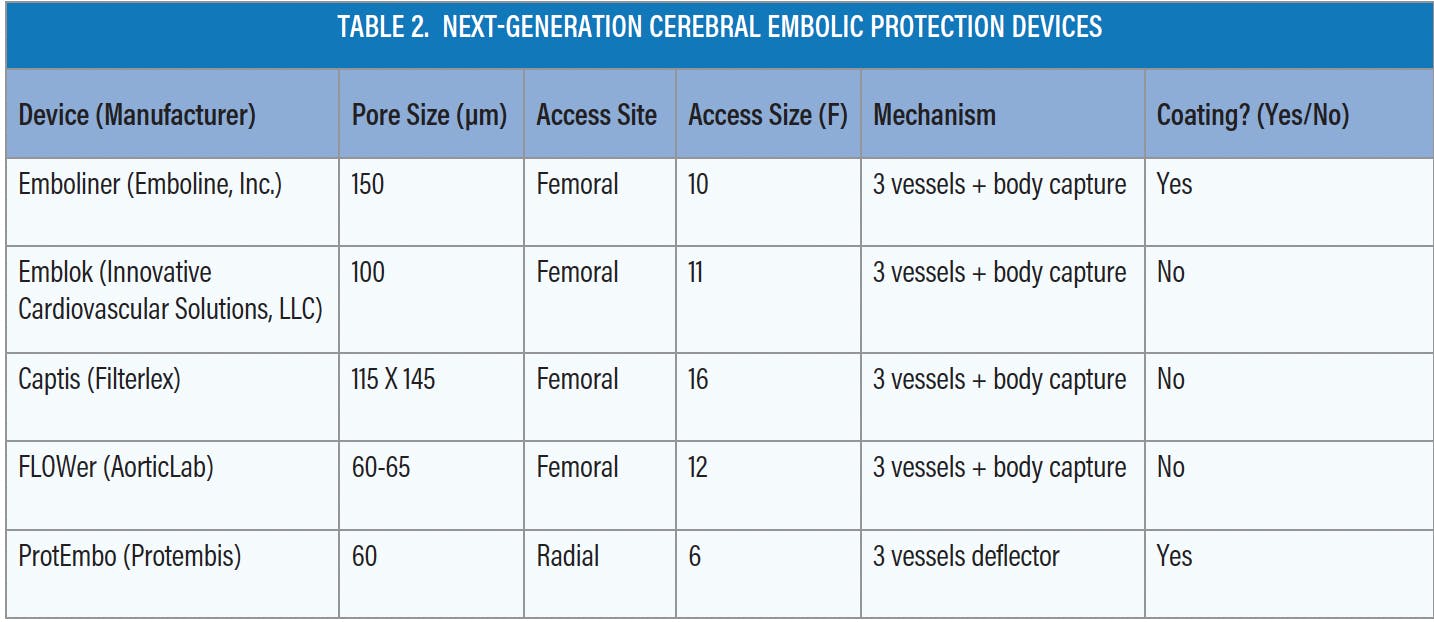
The Emblok embolic protection system (Innovative Cardiac Solutions, LLC) is an 11-F system housing a polyurethane mesh filter (125 µm) that covers all great vessels and incorporates a 4-F pigtail to allow for visualization during valve deployment. The first-in-human (FIH) study (n = 20) demonstrated good safety and efficacy, but the majority of patients continued to have embolic findings on diffusion-weighted MRI post-TAVR.11 The pivotal randomized study is currently ongoing and will randomize > 500 participants to Emblok versus Sentinel.
The Captis device (Filterlex) is designed to deflect particles at the aortic arch, then capture and remove them at the level of the descending aorta. The polyether ether ketone filter has a pore size of 115 X 145 µm, and the 16-F delivery system uses the same ipsilateral transfemoral access as the TAVR delivery system, obviating the need for secondary access. The FIH study evaluated safety and efficacy in 20 patients and demonstrated successful use in all patients with no cerebrovascular events.12
The FLOWer device (AorticLab) is a cylindrical mesh filter with a 60-µm pore size that conforms to the aortic arch to cover the great vessels. The device, which comes in three sizes, is deployed via a 12-F delivery system. The FIH study evaluated safety and efficacy against a historical performance goal; three (5.2%) patients experienced a stroke within the first 30 days (NCT04704258).13
The ProtEmbo device is a deflection filter deployed via a left radial approach. It consists of a 60-µm-size pore mesh covering a 38- X 70-mm nitinol frame to cover all three great vessels. The single-arm PROTEMBO C trial evaluated the safety and efficacy of the device in 41 patients and met its primary safety and performance endpoints against historical data.14
CONCLUSION
Acute ischemic stroke remains one of the most concerning complications after TAVR and has remained consistent despite newer technologies and lower-risk patient profiles. Although the PROTECTED TAVR study failed to meet its primary endpoint, the ongoing BHF PROTECT-TAVI study will provide additional valuable information on the role of the Sentinel CEP device in reducing periprocedural stroke. Finally, there are several novel next-generation devices that offer complete cerebral vasculature coverage currently under investigation, with the goal of reducing the incidence of this feared complication.
1. Lansky A. A pooled analysis of Triguard cerebral protection compared to unprotected transcatheter aortic valve replacement. Results of a pooled patient level analysis. Presented at: EuroPCR; May 18, 2016; Paris, France.
2. Carroll JD, Vemulapalli S, Dai D, et al. Procedural experience for transcatheter aortic valve replacement and relation to outcomes: the STS/ACC TVT Registry. J Am Coll Cardiol. 2017;70:29-41. doi: 10.1016/j.jacc.2017.04.056
3. Tchetche D, Farah B, Misuraca L, et al. Cerebrovascular events post-transcatheter aortic valve replacement in a large cohort of patients: a FRANCE-2 registry substudy. JACC Cardiovasc Interv. 2014;7:1138-1145. doi: 10.1016/j.jcin.2014.04.018
4. Huded CP, Tuzcu EM, Krishnaswamy A, et al. Association between transcatheter aortic valve replacement and early postprocedural stroke. JAMA. 2019;321:2306-2315. doi: 10.1001/jama.2019.7525
5. Kawakami R, Gada H, Rinaldi MJ, et al. Characterization of cerebral embolic capture using the Sentinel device during transcatheter aortic valve implantation in low to intermediate-risk patients: the SENTINEL-LIR study. Circ Cardiovasc Interv. 2022;15:e011358. doi: 10.1161/circinterventions.121.011358
6. Kapadia SR, Kodali S, Makkar R, et al. Protection against cerebral embolism during transcatheter aortic valve replacement. J Am Coll Cardiol. 2017;69:367-377. doi: 10.1016/j.jacc.2016.10.023
7. Lowenstern A, Hung A, Manandhar P, et al. Association of transcatheter aortic valve replacement reimbursement, new technology add-on payment, and procedure volumes with embolic protection device use. JAMA Cardiol. 2022;7:945-952. doi: 10.1001/jamacardio.2022.2608
8. Kapadia SR, Makkar R, Leon M, et al. Cerebral embolic protection during transcatheter aortic-valve replacement. N Engl J Med. 2022;387:1253-1263. doi: 10.1056/NEJMoa2204961
9. Lansky AJ, Messé SR, Brickman AM, et al. Proposed standardized neurological endpoints for cardiovascular clinical trials: an Academic Research Consortium initiative. J Am Coll Cardiol. 2017;69:679-691. doi: 10.1016/j.jacc.2016.11.045
10. Grubman D, Ahmad Y, Leipsic JA, et al. Predictors of cerebral embolic debris during transcatheter aortic valve replacement: the SafePass 2 first-in-human study. Am J Cardiol. 2023;207:28-34. doi: 10.1016/j.amjcard.2023.08.137
11. Latib A, Mangieri A, Vezzulli P, et al. First-in-man study evaluating the Emblok embolic protection system during transcatheter aortic valve replacement. JACC Cardiovasc Interv. 2020;13:860-868. doi: 10.1016/j.jcin.2019.11.017
12. Danenberg H, Vaknin-Assa H, Makkar R, et al. First-in-human study of the CAPTIS embolic protection system during transcatheter aortic valve replacement. EuroIntervention. 2023;19:e948-e952. doi: 10.4244/eij-d-23-00465
13. Sorropago A. FLOWer - The complete embolic protection device. Presented at: EuroPCR 2023; May 19 2023; Paris, France.
14. Jagielak D, Targonski R, Frerker C, et al. Safety and performance of a novel cerebral embolic protection device for transcatheter aortic valve implantation: the PROTEMBO C Trial. EuroIntervention. 2022;18:590-597. doi: 10.4244/EIJ-D-22-00238
Advertisement
Advertisement