Advertisement
Advertisement
March/April 2023
Mechanisms of Transcatheter Valve Degeneration
A translational perspective.
By Hacina Gill, BSc; David Meier, MD; Althea Lai, BSc; Geoffrey W. Payne, MSc, PhD; and Stephanie L. Sellers, MSc, PhD
Over the past 20 years, transcatheter aortic valve replacement (TAVR) with transcatheter heart valves (THVs) has proven to be a safe and effective alternative to surgical aortic valve replacement (SAVR) with bioprosthetic surgical heart valves (SHVs) or mechanical prostheses.1 While historically indicated for patients at high surgical risk, improvements in valve durability and design, the growing number of experienced operators, and consideration for patient preference have led to a shift in recommendations toward THV use in younger and lower-risk patients.2 This broadening of the recipient pool, along with the projected increase in heart valve diseases globally within the aging population, suggests an exponential increase in demand and use of THVs in the coming decades.3 Thus, studying and improving THV durability is crucial in meeting growing need.
There are four generally accepted modes of valve dysfunction: endocarditis, thrombosis, and nonstructural or structural deterioration.4-8 The diagnosis of valve endocarditis considers Duke Criteria for infective endocarditis (ie, positive blood culture, vegetation on echocardiography) and can lead to valve degeneration and failure.9 Subclinical and clinically significant thrombosis includes imaging findings of leaflet thickening and/or reduced leaflet motion with or without symptoms/sequelae of thromboembolic events or hemodynamic deterioration. Nonstructural valve degeneration describes mechanisms of degeneration that are extrinsic to the valve itself. This includes intra- and paraprosthesis regurgitation, pannus formation, valve malpositioning, patient-prosthesis mismatch, and valve embolization. This contrasts with structural valve degeneration (SVD), which encompasses permanent degenerative changes that are intrinsic to the valve leaflets, struts, or stents. Examples include fibrosis, wear and tear, disruption, flail, stent fracture or deformation, and calcification.4-8
Figure 1 demonstrates examples of these four modes of dysfunction from the bench to provide a translational example beyond typical clinical imaging modalities; Figure 1 shows THVs explanted due to dysfunction that have leaflet thrombosis, demonstrate serve leaflet calcification, or are from patients with prosthesis mismatch or endocarditis.
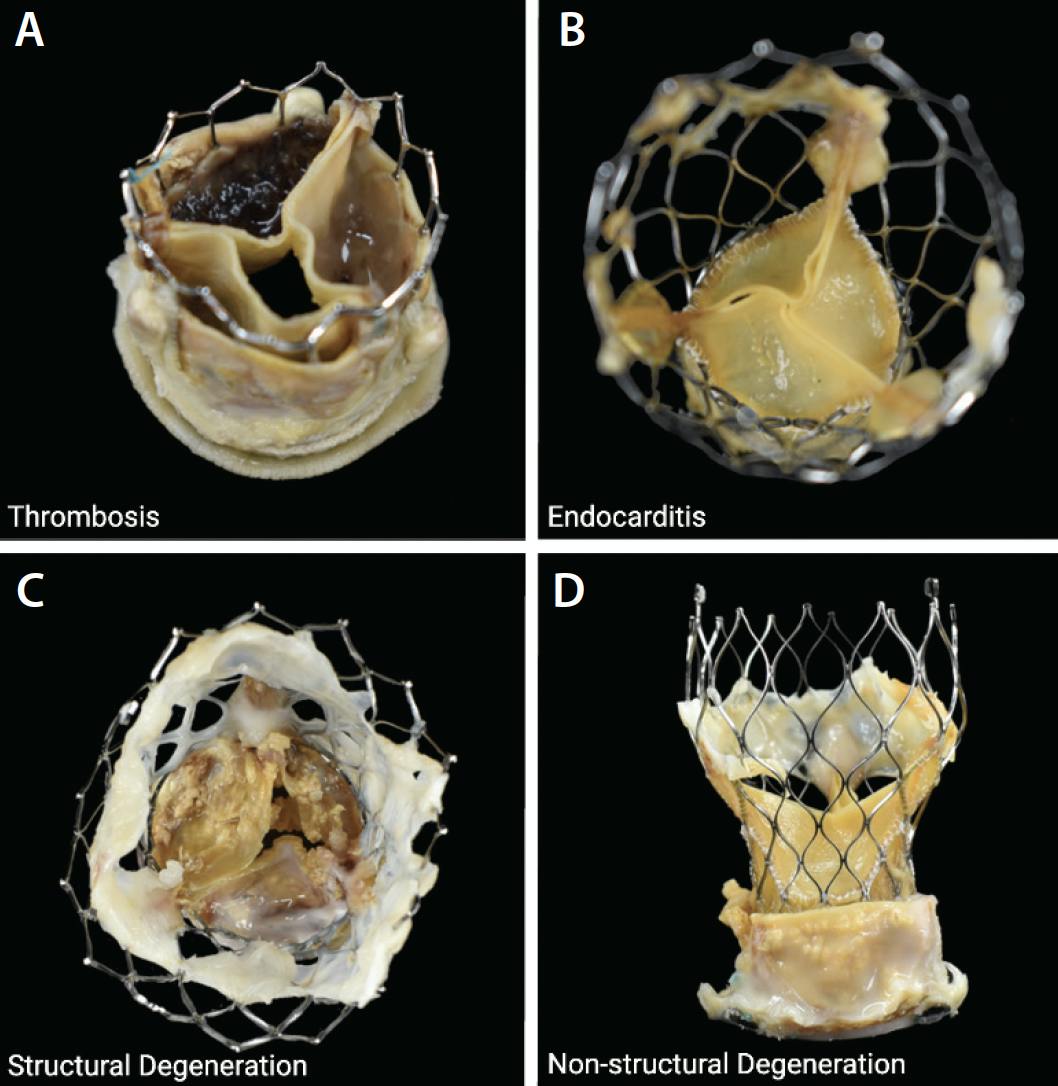
Figure 1. Modes of THV dysfunction: Explanted THV specimens provide insights to THV degeneration and dysfunction, including examples of leaflet thrombosis (A) in a VIV specimen, a THV explanted after endocarditis (B), structural degeneration characterized by expensive leaflet calcification (C), and an example of a VIV explanted due to patient-prosthesis mismatch (D).
TRANSCATHETER DEGENERATION
Clinical Insights
The study of THV outcomes and durability clinically, including their comparison to SHVs, is challenging. This is in part because of the relative infancy of the use of THVs and the rapidly evolving field of transcatheter valve replacement. This means that longer-term THV studies are limited to earlier-generation transcatheter devices that frequently have been replaced by new technologies. Moreover, rapidly advancing overall operator experience, as well as techniques to optimize factors such as device positioning, sizing, etc, potentially impact durability before long-term outcomes are available. Furthermore, the THV study population continues to evolve from generally older and higher-risk patients to lower-risk populations, resulting in a probable effect on durability and mechanisms of degeneration. Finally, the criteria for defining valve degeneration has evolved; current and recent guidelines focus on the use of imaging and valve functional evaluation.6-8,10,11 These approaches provide diagnostic but not granular or real-time mechanistic insights to degeneration. However, approaches using positron emission tomography (PET) tracers are beginning to allow such insight to valve degeneration in situ.12-14 In the 18F-sodium fluoride (18F-NaF) 18F-FAABULOUS study, the radiotracer 18F-NaF is used as a marker of calcific activity to determine SVD in TAVR and SAVR patients.12,13 Using 18F-NaF PET/CT imaging, this study has found comparable 18F-NaF uptake between TAVR and SAVR, suggesting similar rates of SVD. Furthermore, it has been found that the baseline uptake of 18F-NaF is associated with a resultant change in peak aortic velocity in both TAVR and SAVR and could, therefore, be a predictor and early marker of SVD. Interestingly, the uptake of NaF around the outside of the bioprosthesis suggests continued and active calcific disease progression of the native leaflets after TAVR, a unique feature of THVs that is not considered in SHVs. Interestingly, PET has also recently provided further functional insight to leaflet thrombus formation in surgical and transcatheter valves; 18F-GP-1, targeted to glycoprotein IIb/IIIa, was shown to be specific to activated platelets and targeted to areas of THV leaflet thrombus.14 This tracer revealed the common and enduring finding of activated platelets, which increased in clinical cases of leaflet thrombosis, did not bind to areas of leaflet fibrosis or calcification, and regressed in clinical thrombosis treated with anticoagulation.
Histopathological Analysis From the Clinic: A Timeline for THV Pathophysiology
Histologic analyses supported by imaging findings propose a likely timeline of pathophysiology of THVs and processes causing degeneration.15-17 Immediately after THV deployment, the bioprosthesis undergoes covering with the presence of CD31+ cells along the prosthesis, but morphologic analyses of these cells indicate an abnormal pseudostratified columnar hyperplasia phenotype, therefore suggesting prosthesis occupation by dysfunctional endothelial-like cells. This coincides with, or is immediately followed by, thrombus formation of varying degrees that can vary by implant duration, with inflammation a common and early finding of THV pathophysiology. Approximately 2 months after the procedure, fibrosis is found in combination with leaflet thrombus on explants and shows maturation over time, as characterized by morphologic and cellular changes of the matrix and increased decorin expression. Finally, signs of calcification appeared in THVs implanted for 4+ years, with the notable exception of endocarditis, which has been found to include calcification at much earlier time points. Figure 2 depicts major features of this timeline.15-17
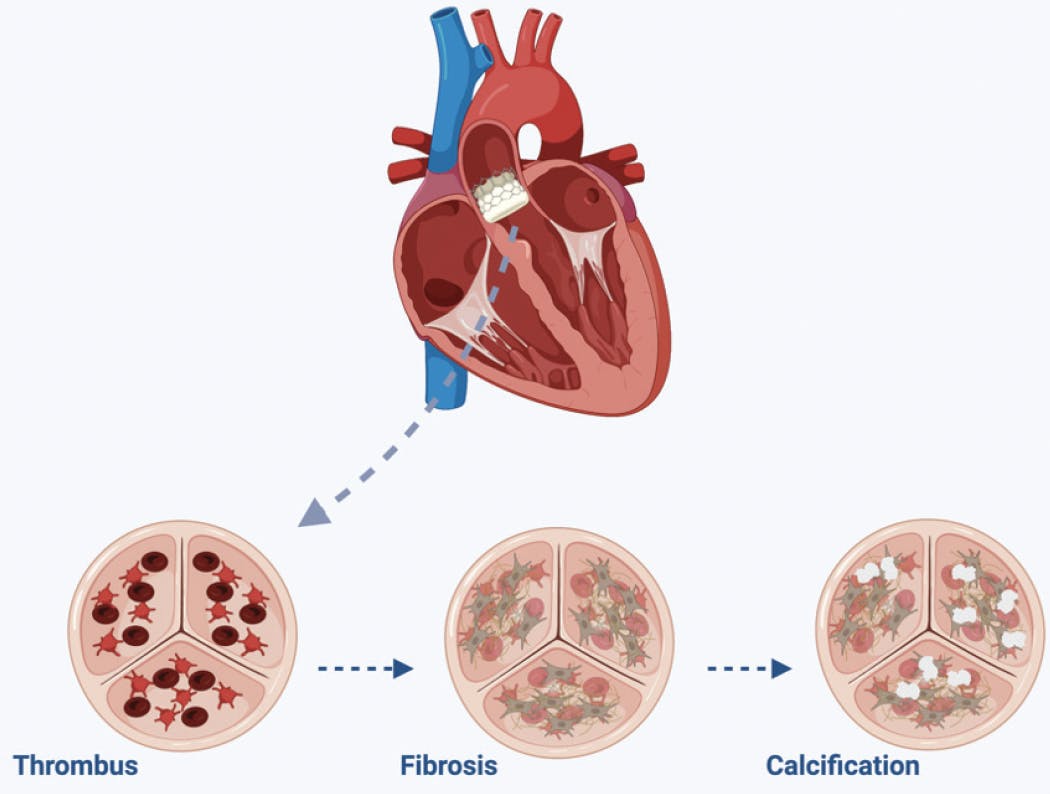
Figure 2. Steps of THV pathophysiology: Biological features of THV pathology contributing to dysfunction and degeneration are still being elucidated but include thrombus formation, fibrosis, and calcification for which timelines have been established by histopathology. This figure was made with Biorender.
TISSUE MECHANISMS OF DEGENERATION
Leaflet Structure and Mechanical Degradation
The native heart valve is a complex and bioactive structure capable of responding to its environment, performing self-repair, and maintenance. This is in stark contrast to the decellularized and uniform tissue used in surgical and transcatheter bioprosthetic heart valves (BHVs). Some of these differences are thought to explain why BHVs degenerate much faster than native heart valves.18 For instance, the lack of an active/functional barrier allows for the accumulation of micro- and macro-molecules, including calcium, calcium-binding proteins, lipid complexes, fibrin/fibrinogen and plasminogen, alkaline phosphatase, matrix metalloproteinases (MMPs), and serum albumin. The deposition of these molecules leads to changes in the landscape of the prosthesis by providing new ligand-binding domains and, through the continued functionality of various enzymes, can directly remodel collagen fibers.19
The extracellular matrix (ECM) structure of BHVs itself can lead to increased mechanical stress. Compared to native valves that utilize a complex arrangement and rearrangement of ECM components throughout the cardiac cycle, BHV leaflets have an overly rigid and simplistic collagen arrangement that does not adapt to the cardiac cycle.18,20 In diastole, the very low pressures cause the native heart valve leaflets to be stretched closed, collagen is aligned and uncrimped, and elastin is stretched to avoid leaflet prolapse. In systole, the opposite occurs, the native leaflets are bent open, collagen is crimped and unaligned, and elastin is relaxed and recoiled. In BHV leaflets, the collagen arrangement is locked in a “closed valve” position. This results in increasingly rigid leaflets, which reduces their ability to absorb strain.18,21
During tissue preparation, most BHVs are treated with glutaraldehyde, a cross-linking agent that improves stability and reduces antigenicity while maintaining the viscoelastic properties of collagen. However, glutaraldhehyde cross-linking also results in a stiffer, more rigid tissue matrix and residual aldehydes from the treatment can become attractive nuclei for calcification.22 Furthermore, elastin, glycosaminoglycans (GAGs), and proteoglycans (PGs) are often lost or damaged in the treatment process. Not only does this alter the elastic and structural properties of the matrix to reduce extensibility and increase stiffness, but PGs in particular are known to block certain areas of collagen fibers called “hole zones.” In the absence of PGs, calcium phosphates (CaPs) are known to grow from these collagen fiber hole zones.21
Beyond leaflet structure, of which there are many shared features between pericardial surgical and transcatheter valves, some mechanisms of leaflet damage that can contribute to degeneration are specific to THVs. These include (1) trauma from crimping, loading into a delivery catheter; (2) damage due to balloon expansion; and (3) noncircular or suboptimal deployment.23-25 While bench studies can look at the mechanisms and extent of this damage, examine their impact of biological response using in vitro systems or animal models, and assess potential wear over time using accelerated wear testing, studies linking these to long-term causes of SVD in patients are still needed.
Immune Response
A common response to the implantation of bioprostheses, including THVs, is the innate foreign body immune response. This response is generally triggered by damage to the surrounding tissue during implantation and is quickly followed by adsorption of serum protein and leukocyte adhesion, leading to thrombosis and inflammation at the implant site. Fibroblasts eventually attempt to seal off the foreign device from the rest of the body and so encapsulate it in excessive ECM.20,26-28
THV leaflets derived from porcine or bovine tissue contain two notable carbohydrates: galactose-alpha-1,3-galactose (α-Gal) and N-glycolylneuraminic acid (NeuGC). α-Gal and NeuGC are found in most mammalian membranes but are absent in humans. Furthermore, given their lack of amino groups or lack of accessible amino groups, these carbohydrates can evade cross-linking by glutaraldehyde. So, although glutaraldehyde treatment reduces antigenicity, it does not completely absolve it; the exposed antigens can attract immune cells, such as macrophages, which have a specific receptor for α-Gal, triggering an adaptive immune response.20,29-31 Several studies of BHV explants have identified occupation of the prosthetic valves. Furthermore, studies of THVs have identified some of the cell types to infiltrate THV leaflets,15-17 including analysis of enzymes expressed, which may contribute to THV degeneration. For example, MMPs have been noted in THVs and surgical bioprosthetic valves15,32 and are hypothesized to play a role in both tissue response and leaflet degradation.
Mechanisms of Calcification
Mechanisms of calcification can be classified in different ways, but two general groupings are passive and recipient-related calcification. Passive calcification describes the gradual deposition of CaP on cell debris, fibrosis, and degraded collagen fibers.33 Recipient-related calcification considers patient-specific factors that can accelerate calcification. This includes higher than average concentrations of serum calcium-binding proteins or CaP or low concentrations of fetuin A, conditions that can affect calcium metabolism such as hyperparathyroidism, end-stage renal disease, or growth spurts, as well as the recipients’ own cells34-37—for instance, macrophage mineralization through apoptosis or the creation of new calcification nuclei brought about by the iron released from recipient red blood cells that goes on to oxidize cell debris and ECM components.38
Figure 3 demonstrates some histopathologic findings of leaflet inflammation, mechanical leaflet damage, and leaflet calcification.

Figure 3. Histopathologic features of THV degenerative mechanisms: Features of degeneration mechanisms of THVs can be appreciated on histopathology and include inflammation (A), mechanical damage (B), and calcification (C).
FUTURE DIRECTIONS
Research that aims to uncover mechanisms of valve degeneration and seeks new methods to improve durability is paramount. As our knowledge continues to grow, an important future direction will be the consideration of the use of THVs in positions other than the aortic valve; it will be critical to consider if timelines and mechanisms of degeneration in these implants and patient populations differ. While no current analyses have provided insights on mechanisms of degeneration in a large cohort, case series and reports do provide some insights on tricuspid and mitral prostheses,39,40 including use of aortic THVs for valve-in-valve (VIV) procedures. Figure 4 shows features of some such VIV explants.

Figure 4. Nonaortic THV degeneration: Specimens from nonaortic positions are beginning to provide insights features of degeneration, including those from VIV implants including the tricuspid (A) and mitral (B) positions.
Much work also remains to improve aortic transcatheter valve durability. Given what we know about the mechanisms of THV degeneration, there would appear to be three general categories of research to improve durability: (1) targeting and reducing mechanical stress and improving leaflet structure, (2) methods to prevent and slow calcification processes, and (3) evading and suppressing the recipient’s immune response.
An important difference between BHV leaflets and native leaflets is a lack of cellularity and an overly static tissue matrix configuration that can make BHV leaflets unable to respond to their environment or self repair and maintain their structural integrity. This issue is being addressed by some groups working to produce more bioactive BHV leaflets that are better able to adapt and respond to their environment and the cardiac cycle.41,42 Furthermore, there is ongoing research into new methods of cross-linking and preparing BHV leaflet tissue. These include the use of diepoxides or genipin instead of glutaraldeyde.43-45 These methods seek to reduce mechanical stress, improve tissue structure and longevity, reduce affinity for CaP deposition, and better evade immune rejection.
Studies into methods to prevent and slow calcification include various anticalcific treatments such as FREE and Resilia (Edwards Lifesciences) that work to reduce exposed phospholipids, aldehydes, and other chemical groups that are known to promote CaP deposition.46,47 Furthermore, methods to improve decellularization of leaflet material are being explored. As retained cells and cellular debris can initiate immune reactions that can lead to calcification and SVD, this is a potentially impactful line of investigation.41
To reduce immunogenicity of THV implants, some groups are looking into the use of genetically modified porcine or bovine tissues—specifically, the use of strains of pigs and cows in which α-Gal and/or NeuGC is knocked out while often simultaneously increasing expression of various human proteins.48-50 Similarly, other research considers the use of various immunosuppressants, including steroid therapies, to evade and suppress the recipient’s immune response.51
1. Smith CR, Leon MB, Mack MJ, et al. Transcatheter versus surgical aortic-valve replacement in high-risk patients. N Engl J Med. 2011;364: 2187-2198. doi: 10.1056/NEJMoa1103510
2. Windecker S, Okuno T, Unbehaun A, et al. Which patients with aortic stenosis should be referred to surgery rather than transcatheter aortic valve implantation? Eur Heart J. 2022;43:2729-2750. doi: 10.1093/eurheartj/ehac105
3. Butany J, Schoen FJ. Cardiac valve replacement and related interventions. In: Cardiovascular Pathology. Academic Press; 2022:707-760.
4. Siddiqui RF, Abraham JR, Butany J. Bioprosthetic heart valves: modes of failure. Histopathology. 2009;55:135-144. doi: 10.1111/j.1365-2559.2008.03190.x
5. Pibarot P, Herrmann HC, Wu C, et al. Standardized definitions for bioprosthetic valve dysfunction following aortic or mitral valve replacement. JACC. 2022;80:545-561. doi: 10.1016/j.jacc.2022.06.002
6. Capodanno D, Petronio AS, Prendergast B, et al. Standardized definitions of structural deterioration and valve failure in assessing long-term durability of transcatheter and surgical aortic bioprosthetic valves: a consensus statement from the European Association of Percutaneous Cardiovascular Interventions (EAPCI) endorsed by the European Society of Cardiology (ESC) and the European Association for Cardio-Thoracic Surgery (EACTS). Eur Heart J. 2017;38:3382-3390. doi: 10.1093/eurheartj/ehx303
7. Dvir D, Bourguignon T, Otto CM, et al. Standardized definition of structural valve degeneration for surgical and transcatheter bioprosthetic aortic valves. Circulation. 2018;137:388-399. doi: 10.1161/CIRCULATIONAHA.117.030729
8. Genereux P, Piazza N, Alu MC, et al. Valve Academic Research Consortium 3: updated endpoint definitions for aortic valve clinical research. Eur Heart J. 2021;42:1825-1857. doi: 10.1093/eurheartj/ehaa799
9. Lamas CC, Eykyn SJ. Suggested modifications to the Duke criteria for the clinical diagnosis of native valve and prosthetic valve endocarditis: analysis of 118 pathologically proven cases. Clin Infect Dis. 1997;713-719. doi: 10.1086/513765
10. Costa G, Criscione E, Todaro D, et al. Long-term transcatheter aortic valve durability. Interv Cardiol. 2019;14:62-69. doi: 10.15420/icr.2019.4.2
11. Sellers SL, Blanke P, Leipsic JA. Bioprosthetic heart valve degeneration and dysfunction: focus on mechanisms and multidisciplinary imaging consideration. Radiology Cardiothorac Imaging. 2019;1:e190004. doi: 10.1148/ryct.2019190004
12. Cartlidge TRG, Doris MK, Sellers SL, et al. Detection and prediction of bioprosthetic aortic valve degeneration. J Am Coll Cardiol. 2019;73:1107-1119. doi: 10.1016/j.jacc.2018.12.056
13. Kwiecinski J, Tzolos E, Cartlidge TRG, et al. Native aortic valve disease progression and bioprosthetic valve degeneration in patients with transcatheter aortic valve implantation Circulation. 2021;144:1396-1408. doi: 10.1161/CIRCULATIONAHA.121.056891
14. Bing R, Deutsch M, Sellers SL, et al. 18F-GP1 positron emission tomography and bioprosthetic aortic valve thrombus. JACC Cardiovasc Imaging. 2022;15:1107-1120. doi: 10.1016/j.jcmg.2021.11.015
15. Sellers SL, Turner CT, Sathananthan J, et al. Transcatheter aortic heart valves: histological analysis providing insight to leaflet thickening and structural valve degeneration. JACC Cardiovasc Imaging. 2019;12:135-145. doi: 10.1016/j.jcmg.2018.06.028
16. Yahagi K, Ladich E, Kutys R, et al. Pathology of balloon-expandable transcatheter aortic valves. Catheter Cardiovasc Interv. 2017;90:1048-1057. doi: 10.1002/ccd.27160
17. Yahagi K, Torii S, Ladich E, et al. Pathology of self-expanding transcatheter aortic valves: findings from the CoreValve US pivotal trials. Catheter Cardiovasc Interv. 2018;91:947-955. doi: 10.1002/ccd.27314
18. Velho TR, Pereira RM, Fernandes F, et al. Bioprosthetic Aortic Valve Degeneration: a Review from a Basic Science Perspective. Braz J Cardiovasc Surg. 2022, 37:239-250.
19. Marro M, Kossar AP, Xue Y, et al. Noncalcific mechanisms of bioprosthetic structural valve degeneration. J Am Heart Assoc. 2021;10:e018921. doi: 10.1161/JAHA.120.018921
20. Kostyunin AE, Yuzhalin AE, Rezvova MA, et al. Degeneration of bioprosthetic heart valves: update 2020. J Am Heart Assoc. 2020;9:e018506. doi: 10.1161/JAHA.120.018506
21. Tseng H, Grande-Allen KJ. Microstructure of the aortic valve: implications for valvular mechanics and function. In: Advances in Cardiovascular Research. Nova Science Publishers; 2009:1-18.
22. Zheng C, Ding K, Huang X, et al. Nonglutaraldehyde crosslinked bioprosthetic heart valves based on 2-isocyanatoethyl methacrylate crosslinked porcine pericardium with improved properties of stability, cytocompatibility and anti-calcification. Composites Part B: Engineering. 2022;230:109504.
23. Alavi SH, Groves EM, Kheradvar A. The effects of transcatheter valve crimping on pericardial leaflets. Ann Thorac Surg. 2014;97:1260-1266. doi: 10.1016/j.athoracsur.2013.11.009
24. Meier D, Payne GW, Mostaco-Guidolin LB, et al. Timing of bioprosthetic valve fracture in transcatheter valve-in-valve intervention: impact on valve durability and leaflet integrity. EuroIntervention. 2023;18:1165-1177. doi: 10.4244/EIJ-D-22-00644
25. Sellers SL, Sathananthan J, Bouchareb R, et al. Impact of over-expansion on SAPIEN 3 transcatheter heart valve pericardial leaflets. Structural Heart. 2020;4:214-220.
26. Human P, Zilla P. The neglected villain of bioprosthetic degeneration: inflammatory and immune processes. J Long Term Eff Med Implants. 2017;27:159-180. doi: 10.1615/JLongTermEffMedImplants.v27.i2-4.50
27. Tod TJ, Gohres RA, Torky M, et al. Influence of tissue technology on pannus formation on bioprosthetic heart valves. Cardiovasc Eng Technol. 2021;12:418-425. doi: 10.1007/s13239-021-00530-1
28. Morris AH, Stamer DK, Kyriakides TR. The host response to naturally‐derived extracellular matrix biomaterials. Semin Immunol. 2017;29:72-91. doi: 10.1016/j.smim.2017.01.002
29. Perota A, Lagutina I, Duchi R, et al. Generation of cattle knockout for galactose‐α1,3‐galactose and N‐glycolylneuraminic acid antigens. Xenotransplantation. 2019;26:e12524. doi: 10.1111/xen.12524
30. Lee W, Long C, Ramsoondar J, et al. Human antibody recognition of xenogeneic antigens (NeuGc and Gal) on porcine heart valves: could genetically modified pig heart valves reduce structural valve deterioration? Xenotransplantation. 2016;23:370-380. doi: 10.1111/xen.12254
31. Jin R, Greenwald A, Peterson MD, et al. Human monocytes recognize porcine endothelium via the interaction of galectin 3 and alpha‐GAL. J Immunol. 2006;177:1289-1295. doi: 10.4049/jimmunol.177.2.1289
32. Kostyunin AE, Glushkova TV, Lobov AA, et al. Proteolytic degradation is a major contributor to bioprosthetic heart valve failure. J Am Heart Assoc. 2023;12: e028215. doi: 10.1161/JAHA.122.028215
33. Simionescu DT. Prevention of calcification in bioprosthetic heart valves: challenges and perspectives. Expert Opin Biol Ther. 2004;4:1971-1985. doi: 10.1517/14712598.4.12.1971
34. Shen M, Marie P, Farge D, et al. Osteopontin is associated with bioprosthetic heart valve calcification in humans. C R Acad Sci III. 1997;320:49-57. doi: 10.1016/s0764-4469(99)80086-9
35. Lee S, Levy RJ, Christian AJ, et al. Calcification and oxidative modifications are associated with progressive bioprosthetic heart valve dysfunction. J Am Heart Assoc. 2017;6:e005648. doi: 10.1161/JAHA.117.005648
36. Ketteler M, Bongartz P, Westenfeld R, et al. Association of low fetuin-A (AHSG) concentrations in serum with cardiovascular mortality in patients on dialysis: a cross-sectional study. Lancet. 2003;361:827-833. doi: 10.1016/S0140-6736(03)12710-9
37. Côté N, Pibarot P, Clavel MA. Incidence, risk factors, clinical impact, and management of bioprosthesis structural valve degeneration. Curr Opin Cardiol. 2017;32:123-129. doi: 10.1097/HCO.0000000000000372
38. Christian AJ, Lin H, Alferiev IS, et al. The susceptibility of bioprosthetic heart valve leaflets to oxidation. Biomaterials. 2014;35:2097-2102. doi: 10.1016/j.biomaterials.2013.11.045
39. Sellers SL, Lai A, Salcudean H, et al. Evaluation of an explanted tiara transcatheter mitral valve. JACC Case Reports. 2020;2:528-532. doi: 10.1016/j.jaccas.2020.01.026
40. Cheung DY, Duan B, Butcher JT. Current progress in tissue engineering of heart valves: multiscale problems, multiscale solutions. Expert Opin Biol Ther. 2015;15:1155-1172. doi: 10.1517/14712598.2015.1051527
41. Lopez-Moya M, Melgar-Lesmes P, Kolandaivelu K, et al. Optimizing glutaraldehyde-fixed tissue heart valves with chondroitin sulfate hydrogel for endothelialization and shielding against deterioration. Biomacromolecules. 2018;19:1234-1244. doi: 10.1021/acs.biomac.8b00077
42. Lim HG, Kim SH, Choi SY, Kim YJ. Anticalcification effects of decellularization, solvent, and detoxification treatment for genipin and glutaraldehyde fixation of bovine pericardium. Eur J Cardiothorac Surg. 2011;41:383-390. doi: 10.1016/j.ejcts.2011.05.016
43. Xi T, Ma J, Tian W, et al. Prevention of tissue calcification on bioprosthetic heart valve by using epoxy compounds: a study of calcification tests in vitro and in vivo. J Biomed Mater Res. 1992;26:1241-1251. doi: 10.1002/jbm.820260913
44. van Wachem PB, Brouwer LA, Zeeman R, et al. In vivo behavior of epoxy-crosslinked porcine heart valve cusps and walls. J Biomed Mater Res. 2000;53:18-27. doi: 10.1002/(sici)1097-4636(2000)53
45. Pibarot P, Dumesnil JG. Prosthetic heart valves: selection of the optimal prosthesis and long-term management. Circulation. 2009;119:1034-1048. doi: 10.1161/CIRCULATIONAHA.108.778886
46. Meuris B, De Praetere H, Strasly M, et al. A novel tissue treatment to reduce mineralization of bovine pericardial heart valves. J Thorac Cardiovasc Surg. 2018;156:197-206. doi: 10.1016/j.jtcvs.2018.01.099
47. Flameng W, Hermans H, Verbeken E, et al. A randomized assessment of an advanced tissue preservation technology in the juvenile sheep model. J Thorac Cardiovasc Surg. 2015;149:340-345.
48. Perota A, Lagutina I, Duchi R, et al. Generation of cattle knockout for galactose-α1,3-galactose and N-glycolylneuraminic acid antigens. Xenotransplantation. 2019;26:e12524. doi: 10.1111/xen.12524
49. Lee W, Long C, Ramsoondar J, et al. Human antibody recognition of xenogeneic antigens (NeuGc and Gal) on porcine heart valves: could genetically modified pig heart valves reduce structural valve deterioration? Xenotransplantation. 2016;23:370-380. doi: 10.1111/xen.12254
50. Rahmani B, et al. A durable porcine pericardial surgical bioprosthetic heart valve: a proof of concept. J Cardiovasc Translational Res. 2019;12:331-337.
51. Eishi K, et al. Calcific degeneration of bioprosthetic aortic valves in patients receiving steroid therapy. J Heart Valve Dis. 1996;5:668-672.
Advertisement
Advertisement