Advertisement
Advertisement
March/April 2023
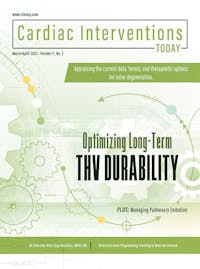
Management of THV Degeneration

It has been over 20 years since the first transcatheter aortic valve replacement (TAVR) for severe aortic stenosis. This transformative procedure—once only reserved for high-risk patients for surgery—has become the dominant therapy for the treatment of calcific aortic stenosis. TAVR is now a therapy that is offered to all patients irrespective of surgical risk. Although many of the early concerns such as vascular complications, stroke, and annular rupture have been largely mitigated, there are new unknown variables that will affect younger patients. Patients with longevity are more likely to have transcatheter heart valve (THV) degeneration that may require reintervention.
Current treatment options include surgical explantation or redo TAVR. In this issue, we detail current evidence and expert opinion as it relates to issues relevant to THV degeneration and potential treatment options, which will be critical to the lifetime management of patients.
To kick off our coverage, Hacina Gill, BSc; David Meier, MD; Althea Lai, BSc; Geoffrey W. Payne, PhD; and Stephanie L. Sellers, PhD, provide a translational perspective on the mechanisms of THV degeneration. Then, Nicholas J. Montarello, MD; Lars Søndergaard, MD; and Ole De Backer, MD, consider the contemporary clinical evidence on long-term TAV durability as a potential driver of TAVR adoption in younger populations.
A highlight of our coverage is a focus on THV degeneration solutions. Rim Halaby, MD, and Toby Rogers, MD, kick off this section by summarizing current approaches. Luigi Pirelli, MD; Derek R. Brinster, MD; and Gilbert Tang, MD, provide a technical guide and data review of surgical explantation of THVs and the SURPLUS technique. David Meier, MD; Stephane Fournier, MD; and I provide key concepts and risk management for procedural planning of redo TAVR. To conclude our coverage, Ady Orbach, MD, and Uri Landes, MD, review the challenges of managing valve failure and the current data on redo TAVR outcomes.
In our Today’s Practice column, Ginger Biesbrock, DSC, discusses how structural heart programming is evolving to meet demand through standardized programs, reducing overlicensure, and tracking referral/throughput measures.
Our featured interview column highlights Vijay Kunadian, MBBS, who discusses her passion for addressing the unmet needs of underserved populations with cardiovascular disease, updates on the SENIOR-RITA and TWILIGHT trials, and why research is vital to providing the best care for patients.
Contemporary Update on Pulmonary Embolism

This issue’s coverage of pulmonary embolism (PE) features Daniel Heikali, MD, and Suhail Dohad, MD, who detail contemporary trends in diagnosis and management. Megan Burke, MD, and Sameer J. Khandhar, MD, then tell us about the role of hemodynamic support in managing right ventricular failure in PE.
Guest Chief Medical Editor
S. Jay Mathews, MD
Highlighted in this issue are a number of key considerations with regard to THV degeneration and therapeutic options for a degenerated THV. Although the key issues have been identified, all of these areas have limited experience or data to date. We have been fortunate that many of the cautionary procedural considerations have been identified from prior experience treating failed surgical valves, particularly related to the risk of coronary obstruction. However, there are a number of other considerations that are yet to be fully understood. The unique designs of different THVs and the multitude of different potential combinations of THVs may lead to unique issues related to leaflet kinematics and fluid flow dynamics that are unique to redo TAVR. The creation of a tall neoskirt or leaflet overhang are unique to redo TAVR and may influence valve function, thrombosis, and durability in the long term. Future efforts must be made to further understand issues related to lifetime management of aortic stenosis and will encompass incorporating basic, translational, and clinical research.
Since the early introduction of TAVR, the multidisciplinary heart team has been crucial for assessing suitability for TAVR. The heart team will continue to play a crucial role in younger patients with longevity and procedural planning for both the index TAVR and subsequent future procedures over a patient’s lifetime. Given the multitude of potential considerations, it is likely that a tailored approach will be required with an individualized approach for each patient.
Guest Chief Medical Editor
Janarthanan Sathananthan, MD
Advertisement
Advertisement