Advertisement
Advertisement
January/February 2023
Transcatheter Structural Heart Disease Interventions and Women’s Health: Review of Current Data and Future Directions
A review of sex-specific differences in patients undergoing TAVR, TEER, and LAAO and the importance of increasing female representation in clinical trials.
By Lina Ya’Qoub, MD; Nadeen N. Faza, MD; Islam Y. Elgendy, MD; and Vaikom S. Mahadevan, MD
Transcatheter structural heart disease (SHD) interventions have been increasingly performed in the past decade, with growing evidence demonstrating their safety and efficacy in patients with valvular and nonvalvular SHD.1-5 There is a growing interest in assessing the clinical outcomes of cutting-edge technologies in women and understanding the differences as well as the factors that would impact women undergoing these transcatheter therapies.6 This article highlights the current data in commonly performed structural heart interventions, including transcatheter aortic valve replacement (TAVR), transcatheter edge-to-edge repair (TEER) using the MitraClip device (Abbott), and left atrial appendage occlusion (LAAO). The importance of increasing the representation of women in randomized clinical trials is also discussed.
SEX-SPECIFIC DIFFERENCES IN PATIENTS UNDERGOING TAVR
TAVR has become the most commonly performed transcatheter SHD intervention in the current era as a result of multiple trials in the past few years demonstrating its safety and efficacy across the entire spectrum of severe symptomatic aortic stenosis (AS) irrespective of surgical risk.1-6 TAVR has changed the paradigm of management for patients with AS.1,2
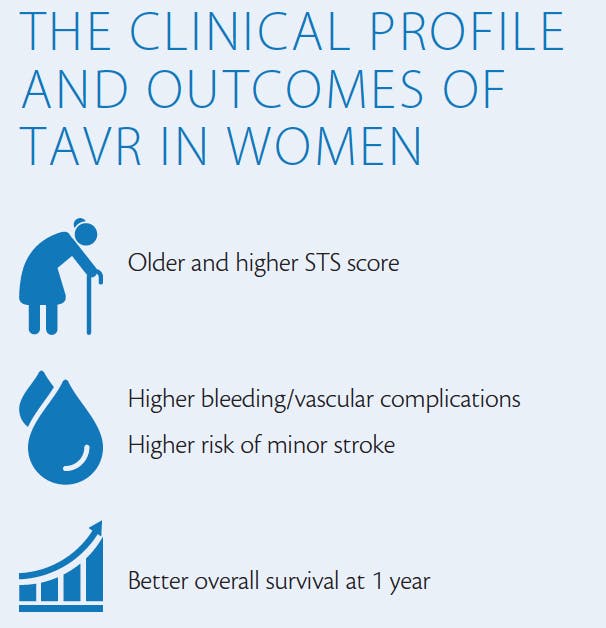
Several registries and meta-analyses have evaluated the sex-specific outcomes in patients undergoing TAVR (see The Clinical Profile and Outcomes of TAVR in Women sidebar).2-5 An analysis of the TVT registry from 2011 to 2014, which included 23,652 patients (49.9% were women), showed that women undergoing TAVR were older, had higher rates of chronic kidney disease and porcelain aorta, and higher Society of Thoracic Surgery (STS) scores compared with men.2 Women also had higher rates of vascular complications and bleeding, consistent with published literature in other percutaneous procedures.2-6 However, women had lower all-cause mortality at 1 year compared with men (21.3% vs 24.5%; P < .001).2 These findings were similar to CENTER, another large global database, which included 12,381 patients (58% were women) from 2007 to 2018 and demonstrated that women had higher rates of hypertension, chronic kidney disease, and were at increased risk for life-threatening or major bleeding.3 However, the rates of stroke and all-cause mortality were similar between women and men at 30 days.3 The Gulf TAVR registry, which included 795 patients (44% were women) from 2017 to 2019, showed that after TAVR, although women had higher rates of hospitalization due to cardiac causes, including myocardial infarction, the rate of mortality was lower in women compared with men (4.3% vs 6.3%).4 The WIN-TAVI registry was a prospective observational registry across 18 sites in Europe and one site in the United States that included 1,019 intermediate- to high-risk women who underwent TAVR for significant AS between January 2013 and December 2015. Women had low rates of mortality (12.5%) and stroke (2.2%) at 1 year, with the EuroSCORE I, baseline atrial fibrillation (AF), and prior percutaneous coronary intervention found as independent predictors of 1-year death or stroke.5 Collectively, these findings support that although women had higher rates of short-term complications after TAVR, they had lower rates of mortality at 1 year. The analysis of sex differences in the PARTNER II S3 trial of high- and intermediate-risk cohorts showed no significant differences in survival or major strokes between the sexes but a higher rate of minor strokes and vascular complications in females.7
SEX-SPECIFIC DIFFERENCES IN PATIENTS UNDERGOING TEER
TEER of the mitral valve using the MitraClip device has been increasingly performed for both primary and secondary mitral regurgitation (MR) based on the results of the EVEREST II and COAPT trials, respectively.8,9 The result of these trials were reflected in the American College of Cardiology guidelines for the management of valvular heart disease guidelines.8-12 Based on the EVEREST II trial, the guidelines gave TEER a class IIa recommendation for severe primary MR in patients at prohibitive or high surgical risk with feasible anatomy as long as the life expectancy is at least 1 year.8-10 Similarly, based on the results of the COAPT trial, the guidelines gave TEER a class IIa recommendation for patients with symptomatic cardiomyopathy and chronic severe secondary MR despite optimal guideline-directed medical therapy.8-10
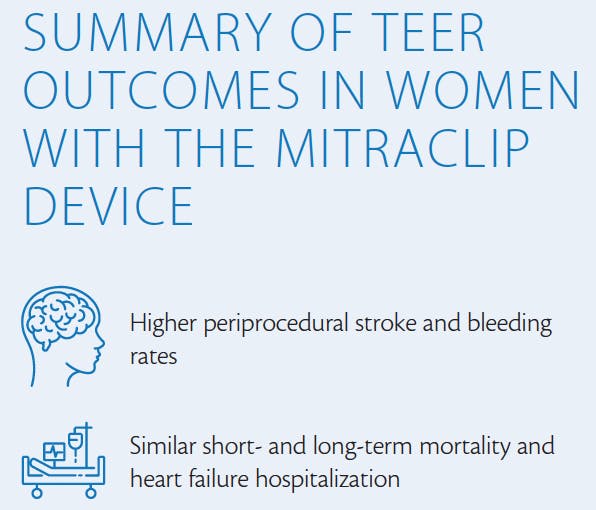
Several studies evaluated the sex-specific differences in patients undergoing TEER using the MitraClip device.11,12 In a meta-analysis of 11 studies, there were no differences in the rates of procedural success, short- and long-term mortality, and heart failure hospitalization at 12 months between men and women. However, women had higher rates of periprocedural stroke and bleeding. The higher rate of stroke in women could be attributed to the fact that women included in the analysis were older and women are at higher risk of atrial arrhythmias, including AF. Additionally, women had higher rates of bleeding, which could be explained by their lower body weight and older age. Women derive benefit from these interventions and have comparable favorable survival outcomes to men after undergoing these procedures, and as such, recognizing that these complications are more common in women is important to mitigate these risks.11 The Summary of TEER Outcomes in Women With the MitraClip Device sidebar summarizes the sex-specific differences in patients undergoing TEER of the mitral valve using MitraClip.
SEX-SPECIFIC DIFFERENCES IN PATIENTS UNDERGOING LAAO
The Watchman device (Boston Scientific Corporation) was the first LAAO device to be approved by the FDA in 2015 based on the results of the two trials, PROTECT AF and PREVAIL.13,14 Both trials compared the device to warfarin and showed that the Watchman device was noninferior to warfarin for the reduction in ischemic stroke in patients with nonvalvular AF.13,14 Similarly, the Amplatzer Amulet (Abbott) device was FDA approved in 2021 after the Amulet investigational device exemption trial.15
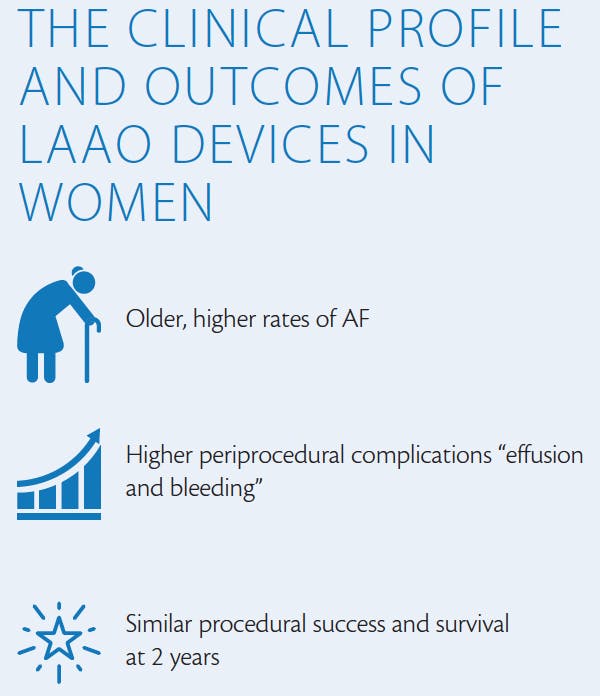
A few studies evaluated the sex-specific outcomes in patients undergoing LAAO devices (see The Clinical Profile and Outcomes of LAAO Devices in Women sidebar).16,17 In an analysis from the NCDR LAAO registry, which included 49,357 patients undergoing LAAO using the Watchman device (41.3% were women), women were older and had higher rates of AF and prior stroke.16 There was no difference in the rate of procedural success; however, women had higher rates of periprocedural complications as compared with men, including pericardial effusion (1.2% vs 0.5%) and major bleeding (1.7% vs 0.8%).16 Another prospective study, which included 1,088 patients (64.5% were women) with AF undergoing LAAO using the Amulet device, demonstrated no difference in the procedural success or short- or long-term outcomes, including ischemic stroke, systemic embolism, and cardiovascular death, at 2 years between women and men.17 In addition, the absolute risk reduction in ischemic stroke was numerically greater in women (from 7.6% to 2.1% per year) compared with men (6.2% to 2.2% per year), suggesting a greater benefit of the Amulet device for LAAO in women. There was no difference in major bleeding between women and men in this study.17
UNDERREPRESENTATION OF WOMEN IN CLINICAL TRIALS
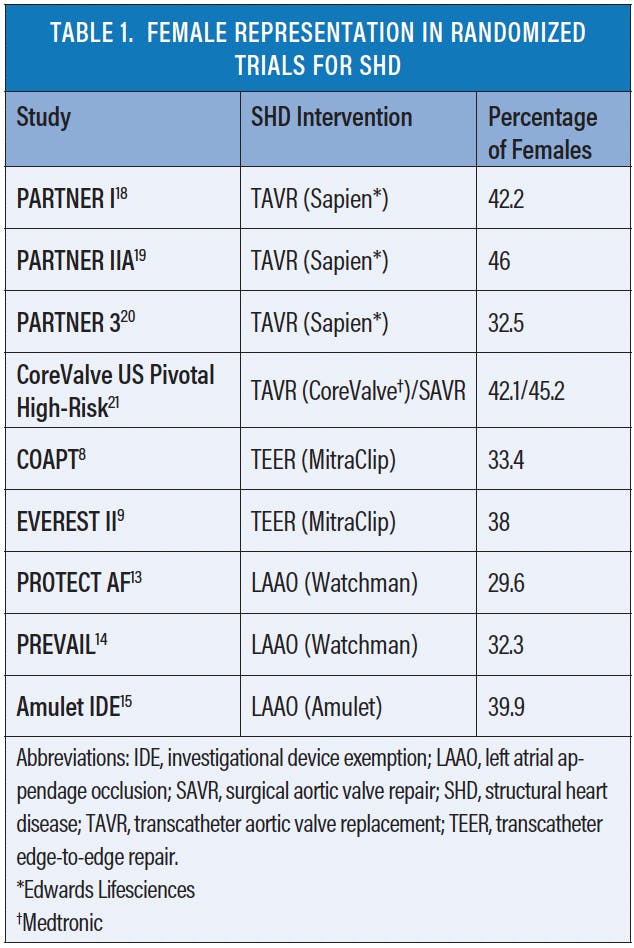
The representation of women in randomized clinical trials remains relatively low. Table 1 summarizes female representation in randomized clinical trials for SHD.8,9,13-15,18-21 Although many of these conditions (AS and AF) are more prevalent among older women as compared with men, underrepresentation of women in landmark clinical trials is important to highlight, as our clinical practice and guidelines are based on these randomized trials, and underrepresentation of women may mask the efficacy and safety of these cutting-edge devices in women.
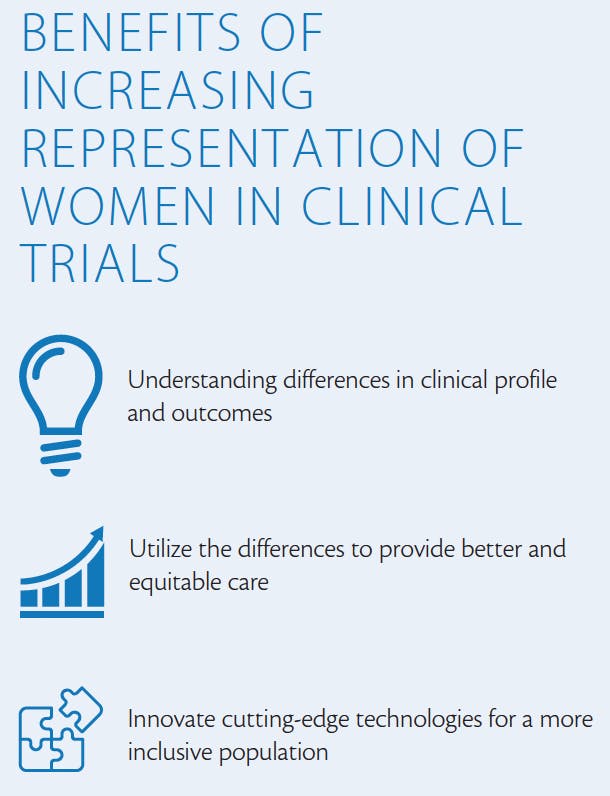
Underrepresentation of women in trials is due to factors occurring at multiple levels, including referral bias at the provider level, eligibility criteria and recruitment process at the trial level, and logistical barriers in participation and follow-up at the patient level. It is worth mentioning that a recent study has revealed that female-led clinical trials in AF resulted in greater female enrollment.22 This underscores the pivotal role that women can play in SHD, with the goal of understanding the clinical differences between men and women and advocating for equity and equality in SHD care for all patients, irrespective of sex (see the Benefits of Increasing Representation of Women in Clinical Trials sidebar).
CONCLUSION
The innovations in SHD interventions have exponentially evolved over the past decade, as cutting-edge transcatheter therapies are being performed for both valvular and nonvalvular heart disease. Although there are differences in the clinical profiles and outcomes of transcatheter therapies, these differences should encourage us to understand the reasons behind these differences, seek to increase enrollment of women in trials involving these cutting-edge technologies, and provide the best care for our patients.
1. Sharma T, Krishnan AM, Lahoud R, et al. National trends in TAVR and SAVR for patients with severe isolated aortic stenosis. J Am Coll Cardiol. 2022;80:2054-2056. doi: 10.1016/j.jacc.2022.08.787
2. Chandrasekhar J, Dangas G, Yu J, et al. Sex-based differences in outcomes with transcatheter aortic valve therapy: TVT registry from 2011 to 2014. J Am Coll Cardiol. 2016;68:2733-2744. doi: 10.1016/j.jacc.2016.10.041
3. Vlastra W, Chandrasekhar J, García Del Blanco B, et al. Sex differences in transfemoral transcatheter aortic valve replacement. J Am Coll Cardiol. 2019;74:2758-2767. doi: 10.1016/j.jacc.2019.09.015
4. Alasnag M, Alanazi N, Al-Shaikh S, et al. WIN Gulf TAVR registry: describing sex differences in patient characteristics, prognosis, and outcomes. J Soc Cardiovasc Angiog Interv. 2022;1:100509. doi: 10.1016/j.jscai.2022.100509
5. Chieffo A, Petronio AS, Mehilli J, et al. 1-year clinical outcomes in women after transcatheter aortic valve replacement: results from the first WIN-TAVI registry. JACC Cardiovasc Interv. 2018;11:1-12. doi: 10.1016/j.jcin.2017.09.034
6. Ya’qoub L, Lemor A, Dabbagh M, et al. Racial, ethnic, and sex disparities in patients with STEMI and cardiogenic shock. JACC Cardiovasc Interv. 2021;14:653-660. doi: 10.1016/j.jcin.2021.01.003
7. Szerlip M, Gualano S, Holper E, et al. Sex-specific outcomes of transcatheter aortic valve replacement with the SAPIEN 3 valve: insights from the PARTNER II S3 high-risk and intermediate-risk cohorts. JACC Cardiovasc Interv. 2018;11:13-20. doi: 10.1016/j.jcin.2017.09.035
8. Stone GW, Lindenfeld J, Abraham WT, et al. Transcatheter mitral-valve repair in patients with heart failure. N Engl J Med. 2018;379:2307-2318. doi: 10.1056/NEJMoa1806640
9. Feldman T, Foster E, Glower DD, et al. Percutaneous repair or surgery for mitral regurgitation. N Engl J Med. 2011;364:1395-1406. doi: 10.1056/NEJMoa1009355
10. Otto CM, Nishimura RA, Bonow RO, et al. 2020 ACC/AHA guideline for the management of patients with valvular heart disease: executive summary: a report of the American College of Cardiology/American Heart Association joint committee on clinical practice guidelines. Circulation. 2021;143:e35-e71. doi: 10.1161/CIR.0000000000000932
11. Ya’Qoub L, Gad M, Faza NN, et al. Sex differences in outcomes of transcatheter edge-to-edge repair with MitraClip: a meta-analysis. Catheter Cardiovasc Interv. 2022;99:1819-1828. doi: 10.1002/ccd.30110
12. Ya’qoub L, Faza N, Khalique O, et al. Intraprocedural cardiac complications of transcatheter aortic and mitral valve interventions: “the eyes do not see what the mind does not know.” Cardiovasc Revasc Med. 2022;36:144-152. doi: 10.1016/j.carrev.2021.05.001
13. Holmes DR, Reddy VY, Turi ZG, et al. Percutaneous closure of the left atrial appendage versus warfarin therapy for prevention of stroke in patients with atrial fibrillation: a randomised non-inferiority trial. Lancet. 2009;374:534-542. doi: 10.1016/S0140-6736(09)61343-X
14. Holmes DR Jr, Kar S, Price MJ, et al. Prospective randomized evaluation of the Watchman left atrial appendage closure device in patients with atrial fibrillation versus long-term warfarin therapy: the PREVAIL trial. J Am Coll Cardiol. 2014;64:1-12. doi: 10.1016/j.jacc.2014.04.029
15. Lakkireddy D, Thaler D, Ellis CR, et al. Amplatzer amulet left atrial appendage occluder versus Watchman device for stroke prophylaxis (Amulet IDE): a randomized, controlled trial. Circulation. 2021;144:1543-1552. doi: 10.1161/CIRCULATIONAHA.121.057063
16. Darden D, Duong T, Du C, et al. Sex differences in procedural outcomes among patients undergoing left atrial appendage occlusion: insights from the NCDR LAAO registry. JAMA Cardiol. 2021;6:1275-1284. doi: 10.1001/jamacardio.2021.3021
17. De Caterina AR, Nielsen-Kudsk JE, Schmidt B, et al. Gender difference in left atrial appendage occlusion outcomes: results from the Amplatzer™ Amulet™ observational study. Int J Cardiol Heart Vasc. 2021;35:100848. doi: 10.1016/j.ijcha.2021.100848
18. Mack MJ, Leon MB, Smith CR, et al. 5-year outcomes of transcatheter aortic valve replacement or surgical aortic valve replacement for high surgical risk patients with aortic stenosis (PARTNER 1): a randomised controlled trial. Lancet. 2015;385:2477-2484. doi: 10.1016/S0140-6736(15)60308-7
19. Arora S, Ramm CJ, Misenheimer JA, Vavalle JP. TAVR in intermediate-risk patients: a review of the PARTNER 2 trial and its future implications. J Heart Valve Dis. 2016;25:653-656.
20. Mack MJ, Leon MB, Thourani VH, et al. Transcatheter aortic-valve replacement with a balloon-expandable valve in low-risk patients. N Engl J Med. 2019;380:1695-1705. doi: 10.1056/NEJMoa1814052
21. Reardon MJ, Kleiman NS, Adams DH, et al. Outcomes in the randomized CoreValve US pivotal high risk trial in patients with a Society of Thoracic Surgeons risk score of 7% or less. JAMA Cardiol. 2016;1:945-949. doi: 10.1001/jamacardio.2016.2257
22. Khan SU, Raghu Subramanian C, Khan MZ, et al. Association of women authors with women enrollment in clinical trials of atrial fibrillation. J Am Heart Assoc. 2022;11:e024233. doi: 10.1161/JAHA.121.024233
Advertisement
Advertisement