Advertisement
Advertisement
January/February 2023
STEMI Care and Shock in Female Patients
Measures to adopt to advance primary and secondary prevention strategies that directly target women.
By Mansi Oberoi, MD; M. Chadi Alraies, MD; and Poonam Velagapudi, MD, MS
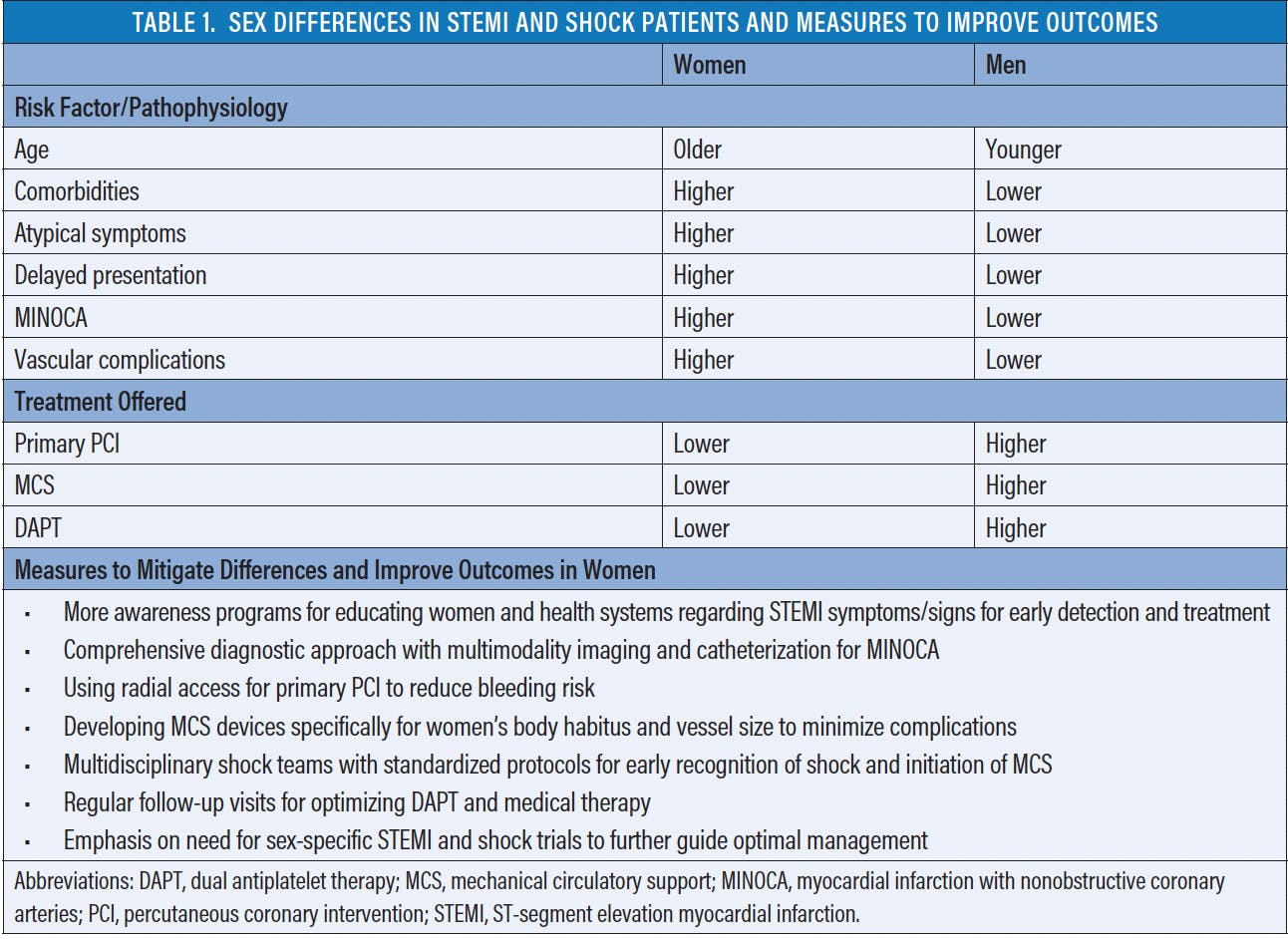
Despite advancements in ST-segment elevation myocardial infarction (STEMI) care and existing standardized recommendations for its management,1,2 gender differences in STEMI treatment and outcomes persist.3 Data from several registries have shown worse outcomes and higher mortality in female patients with STEMI compared to men, both during hospitalization and after discharge.4,5 The worse prognosis in female patients with STEMI may be related to differences in risk factors, presentation, and treatments offered to women, such as lower use of guideline-recommended therapies and less access to revascularization.6 Similarly, STEMI-related cardiogenic shock (CS) and mortality are higher in women.7,8 Although primary PCI is the therapy of choice in female patients with STEMI complicated by CS,9 they are offered fewer revascularization and mechanical circulatory support (MCS) devices, leading to worse outcomes.10 There is a paucity of sex-specific safety, efficacy, and outcomes data for MCS use during STEMI and CS. Table 1 highlights the disparities in STEMI care and CS management in female patients and measures to mitigate them.
RISK FACTORS AND PATHOPHYSIOLOGY OF STEMI IN WOMEN
Female patients with STEMI generally have worse cardiovascular risk profiles than men,8 with higher rates of comorbidities, including diabetes, obesity, hypertension, and renal disease. They tend to be older at the time of presentation and often have atypical chest pain and pain in other locations (epigastric, back, shoulder, or neck pain),11,12 leading to delayed presentation, diagnosis, and management. Time to first medical contact is, on average, ≥ 40 minutes for women.3 The higher risk profile and delayed care can result in worse outcomes and higher mortality in women with STEMI. Studies have shown that personal, educational interventions (addressing knowledge gaps and psychological barriers to timely treatment) individually or as part of any visit with a health care team can achieve a significant reduction in prehospital delay in patients with acute coronary syndrome.13 Individualized education by physicians along with awareness programs and mass media campaigns should be organized to educate female patients and health systems regarding STEMI symptoms/signs for early diagnosis and management.
The pathophysiology of myocardial infarction (MI) differs between male and female patients. In addition to the classic plaque rupture and thrombus formation generally described in men, studies have identified other mechanisms of MI in women. MI with nonobstructive coronary arteries (MINOCA) is more common in women than men and is associated with a 3.4% all-cause mortality at 1 year.14 Mechanisms of MINOCA include plaque disruption, coronary vasospasm, embolism, microvascular dysfunction, and spontaneous coronary artery dissection (SCAD), which need to be differentiated from MINOCA mimickers (myocarditis, Takotsubo cardiomyopathy, and nonischemic cardiomyopathy).15 These mechanisms highlight the need for sex-specific management approaches in MI. This entails a comprehensive diagnostic approach with the combination of intravascular ultrasound (IVUS), optical coherence tomography (OCT), cardiac MRI, provocative spasm testing, and coronary flow reserve assessment. The treatment is tailored toward the underlying diagnosis. For instance, nitrates and long-acting calcium channel blockers are used in coronary vasospasm.16 Coronary embolism/thrombosis is treated with antithrombotic agents and targeted therapies for underlying thrombophilia.17 SCAD, defined as the nonatherosclerotic, noniatrogenic, nontraumatic separation of the coronary artery wall, is the underlying cause of MI in 22% to 43% of women younger than 50 years.18,19 It is managed conservatively except in cases of CS and high-risk patients with ongoing/recurrent ischemia, sustained ventricular arrhythmia, or large proximal territory disease where revascularization is warranted.20
PRIMARY PERCUTANEOUS CORONARY INTERVENTION FOR STEMI IN WOMEN
Despite the proven efficacy of primary PCI in female patients with STEMI, women are 10% to 20% less likely to receive invasive angiography and PCI than men, irrespective of age.3,11 Some plausible causes for a more conservative approach in women include higher bleeding risk due to smaller vessel size, older age at presentation, multiple comorbidities, delayed presentation (eg, symptom to door), and frailty.21
Bleeding and vascular complications are more frequent in female patients undergoing PCI in STEMI compared with men and are not entirely explained by differences in age and comorbidities.11,22 Subgroup analyses of the RIVAL and SAFE-PCI trials demonstrated a reduction in vascular complications with radial artery access as compared to femoral artery access in women.23,24 Although radial access is preferred, it may not be technically feasible in some women due to smaller vessel size and increased likelihood of radial arterial spasm.24 In such cases, ultrasound-guided femoral access during PCI should be used, which reduces the rates of bleeding and vascular complications comparable to that seen with radial access, especially in women.25 Despite the strong evidence, radial access has not been universally implemented in women, highlighting the need to spread awareness among physicians and in systems.
Women constitute only 20% to 30% of patients enrolled in STEMI trials complicated by CS, raising the possibility that results may not be generalizable to female patients. Based on the CULPRIT-SHOCK trial, recent guidelines recommend culprit-only revascularization in STEMI cases complicated by CS.26,27 This is likely because multivessel PCI requires longer procedure times and increased contrast loads, which are unfavorable in acutely ill and unstable patients.28 In a sex-based analysis of this trial, the primary outcome (mortality or need for renal replacement therapy) favored culprit lesion–only PCI over multivessel PCI in men (42% vs 55%, respectively) but was not significant in women (56% vs 55%, respectively) (P = .11 for interaction).7 Future studies focused on female patients with STEMI are needed to understand the best revascularization strategy in women with STEMI and CS.
Although there is no long-term excess bleeding risk with potent P2Y12 inhibitors in women,29 dual antiplatelet therapy (DAPT) in women is often underprescribed compared with men, leading to inadequate medical treatment and worse outcomes after PCI. Standardized DAPT protocols after PCI and regular follow-up on medication compliance may help solve this problem. At our institution, the University of Nebraska Medical Center, we routinely prescribe aspirin and prasugrel or ticagrelor to all patients and arrange for a 1-month follow-up visit to the clinic after PCI. This provides a chance to review patient medications to ensure the appropriate DAPT therapies are in place.
MECHANICAL CIRCULATORY SUPPORT
CS is more likely to develop in female patients with STEMI and increases the mortality risk.30 This is likely due to delayed recognition and management of STEMI in women and higher mechanical complications after MI, including papillary muscle rupture, mitral regurgitation, and ventricular septal rupture.31 The use of MCS in STEMI patients has been associated with decreased complication rate, which was attributed to decreasing left ventricular wall stress from unloading the left ventricle, reducing left ventricular end-diastolic volume, and lowering ventricular pressure and oxygen demand.32-34
In addition to timely revascularization, MCS using an intra-aortic balloon pump (IABP), Impella pump (Abiomed) extracorporeal membrane oxygenation, or right-sided support may be necessary to provide hemodynamic support in STEMI patients with CS.35 Although none of these devices have shown a mortality benefit in STEMI,33,36 they have been shown to improve hemodynamics. The 2021 American College of Cardiology/American Heart Association and 2017 European Society of Cardiology guidelines recommend consideration of MCS (class IIb recommendation) in select/refractory cases of STEMI complicated by CS and recommend against the routine use of IABP (class III recommendation).1,2 Despite this, MCS devices remain underused in women with STEMI and CS. This is likely due to their smaller body and vessel size. Because MCS devices require large-bore access, physicians might be reluctant to implant such devices in female patients with smaller arteries, due to concerns about a higher complication risk. Currently, there are limited data on gender-specific outcomes of MCS in CS. However, the one-size-fits-all design of current devices might prevent the detection of differences, and these devices might need to be optimized for female patients. Devices and cannulas specifically designed for female patients might reduce device-related complications. Consequently, this could unmask a potential benefit from MCS in female patients.
It is essential to have a multidisciplinary team approach for management of STEMI patients with CS. “Shock teams,” including specialists from interventional cardiology, critical care medicine or anesthesia, heart failure, cardiothoracic surgery, perfusion services, and nursing, with standardized protocols help in early identification of shock, invasive hemodynamic monitoring, optimal use of vasopressors and inotropes, and early MCS, thus improving outcomes.37 We have adopted a similar approach and have seen significant improvements. The cardiology fellow or attending activates the shock pager, which dispatches the page consisting of the shock conference call number and unique code. Using the code, the on-call heart failure specialist, interventional cardiologist, cardiothoracic surgeon, and critical care anesthesiologist join the conference call and have a discussion regarding management and therapeutic options, including the need for MCS. The patient continues to be managed by the heart team until resolution of CS, or until a decision is made to de-escalate care respecting the patient’s or family’s wishes.
CONCLUSION
Women with STEMI have delayed presentation, are older with higher comorbidities and bleeding risk, and are less likely to receive early revascularization and MCS, leading to worse outcomes and higher mortality than men. It is critical to adopt measures to advance primary and secondary prevention strategies that directly target women. More awareness programs should be employed to educate women and health systems regarding STEMI symptoms/signs for early detection and treatment. Further STEMI and shock trials should be designed specifically for women to guide optimal management. Collaboration with the device programs should be considered to develop MCS devices designed specifically for women’s body habitus and vessel size to minimize complications, and institutions should have multidisciplinary shock teams with standardized protocols for early recognition and treatment of shock, including initiation of MCS where indicated.
1. Lawton JS, Tamis-Holland JE, Bangalore S, et al. 2021 ACC/AHA/SCAI guideline for coronary artery revascularization: a report of the American College of Cardiology/American Heart Association Joint Committee on Clinical Practice Guidelines. J Am Coll Cardiol. 2022;79:e21-e129. doi: 10.1016/j.jacc.2021.09.006
2. Ibanez B, James S, Agewall S, et al. 2017 ESC Guidelines for the management of acute myocardial infarction in patients presenting with ST-segment elevation: the task force for the management of acute myocardial infarction in patients presenting with ST-segment elevation of the European Society of Cardiology (ESC). Eur Heart J. 2018;39:119-177. doi: 10.1093/eurheartj/ehx393
3. Shah T, Haimi I, Yang Y, et al. Meta-analysis of gender disparities in in-hospital care and outcomes in patients with ST-segment elevation myocardial infarction. Am J Cardiol. 2021;147:23-32. doi: 10.1016/j.amjcard.2021.02.015
4. Wang S, Zhang Y, Cheng Q, et al. Sex disparity in characteristics, management, and in-hospital outcomes of patients with ST-segment elevated myocardial infarction: insights from Henan STEMI registry. Cardiol Res Pract. 2022;2022:2835485. doi: 10.1155/2022/2835485
5. Alabas OA, Gale CP, Hall M, et al. Sex differences in treatments, relative survival, and excess mortality following acute myocardial infarction: national cohort study Using the SWEDEHEART registry. J Am Heart Assoc. 2017;6:e007123. doi: 10.1161/jaha.117.007123
6. Stehli J, Martin C, Brennan A, et al. Sex differences persist in time to presentation, revascularization, and mortality in myocardial infarction treated with percutaneous coronary intervention. J Am Heart Assoc. 2019;8:e012161. doi: 10.1161/jaha.119.012161
7. Rubini Gimenez M, Zeymer U, Desch S, et al. Sex-specific management in patients with acute myocardial infarction and cardiogenic shock: a substudy of the CULPRIT-SHOCK trial. Circ Cardiovasc Interv. 2020;13:e008537. doi: 10.1161/circinterventions.119.008537
8. Gabani R, Spione F, Arevalos V, et al. Sex differences in 10-year outcomes following STEMI: a subanalysis from the EXAMINATION-EXTEND trial. JACC: Cardiovasc Interv. 2022;15:1965-1973. doi: 10.1016/j.jcin.2022.07.038
9. Koeth O, Zahn R, Heer T, et al. Gender differences in patients with acute ST-elevation myocardial infarction complicated by cardiogenic shock. Clin Res Cardiol. 2009;98:781-786. doi: 10.1007/s00392-009-0080-7
10. Ya'qoub L, Lemor A, Dabbagh M, et al. Racial, ethnic, and sex disparities in patients with STEMI and cardiogenic shock. JACC Cardiovasc Interv. 2021;14:653-660. doi: 10.1016/j.jcin.2021.01.003
11. Cenko E, Yoon J, Kedev S, et al. Sex differences in outcomes after STEMI: effect modification by treatment strategy and age. JAMA Intern Med. 2018;178:632-639. doi: 10.1001/jamainternmed.2018.0514
12. Lichtman JH, Leifheit EC, Safdar B, et al. Sex differences in the presentation and perception of symptoms among young patients with myocardial infarction: evidence from the VIRGO study (Variation in Recovery: Role of Gender on Outcomes of Young AMI Patients). Circulation. 2018;137:781-790. doi: 10.1161/circulationaha.117.031650
13. Hoschar S, Albarqouni L, Ladwig K-H. A systematic review of educational interventions aiming to reduce prehospital delay in patients with acute coronary syndrome. Open Heart. 2020;7:e001175.
14. Pasupathy S, Lindahl B, Litwin P, et al. Survival in patients with suspected myocardial infarction with nonobstructive coronary arteries: a comprehensive systematic review and meta-analysis from the MINOCA Global Collaboration. Circ Cardiovasc Qual Outcomes. 2021;14:e007880. doi: 10.1161/circoutcomes.121.007880
15. Yildiz M, Ashokprabhu N, Shewale A, et al. Myocardial infarction with non-obstructive coronary arteries (MINOCA). Front Cardiovasc Med. 2022;9:1032436. doi: 10.3389/fcvm.2022.1032436
16. Slavich M, Patel RS. Coronary artery spasm: current knowledge and residual uncertainties. Int J Cardiol Heart Vasc. 2016;10:47-53. doi: 10.1016/j.ijcha.2016.01.003
17. Ortega-Paz L, Galli M, Capodanno D, et al. The role of antiplatelet therapy in patients with MINOCA. Front Cardiovasc Med. 2021;8:821297. doi: 10.3389/fcvm.2021.821297
18. Nishiguchi T, Tanaka A, Ozaki Y, et al. Prevalence of spontaneous coronary artery dissection in patients with acute coronary syndrome. Eur Heart J Acute Cardiovasc Care. 2016;5:263-270. doi: 10.1177/2048872613504310
19. Nakashima T, Noguchi T, Haruta S, et al. Prognostic impact of spontaneous coronary artery dissection in young female patients with acute myocardial infarction: a report from the Angina Pectoris-Myocardial Infarction multicenter investigators in Japan. Int J Cardiol. 2016;207:341-348. doi: 10.1016/j.ijcard.2016.01.188
20. Lionakis N, Briasoulis A, Zouganeli V, et al. Spontaneous coronary artery dissection: a review of diagnostic methods and management strategies. World J Cardiol. 2022;14:522-536. doi: 10.4330/wjc.v14.i10.522
21. Hellgren T, Blöndal M, Jortveit J, et al. Sex-related differences in the management and outcomes of patients hospitalized with ST-elevation myocardial infarction: a comparison within four European myocardial infarction registries. Eur Heart J Open. 2022;2:oeac042. doi: 10.1093/ehjopen/oeac042
22. Yu J, Mehran R, Grinfeld L, et al. Sex-based differences in bleeding and long term adverse events after percutaneous coronary intervention for acute myocardial infarction: three year results from the HORIZONS-AMI trial. Catheter Cardiovasc Interv. 2015;85:359-368. doi: 10.1002/ccd.25630
23. Pandie S, Mehta SR, Cantor WJ, et al. Radial versus femoral access for coronary angiography/intervention in women with acute coronary syndromes: insights from the RIVAL trial (Radial Vs femorAL access for coronary intervention). JACC Cardiovasc Interv. 2015;8:505-512. doi: 10.1016/j.jcin.2014.11.017
24. Rao SV, Hess CN, Barham B, et al. A registry-based randomized trial comparing radial and femoral approaches in women undergoing percutaneous coronary intervention: the SAFE-PCI for Women (Study of Access Site for Enhancement of PCI for Women) trial. JACC Cardiovasc Interv. 2014;7:857-867. doi: 10.1016/j.jcin.2014.04.007
25. Koshy LM, Aberle LH, Krucoff MW, et al. Comparison of radial access, guided femoral access, and non-guided femoral access among women undergoing percutaneous coronary intervention. J Invasive Cardiol. 2018;30:18-22.
26. Neumann FJ, Sousa-Uva M, Ahlsson A, et al. 2018 ESC/EACTS guidelines on myocardial revascularization. Eur Heart J. 2019;40:87-165. doi: 10.1093/eurheartj/ehy394
27. Thiele H, Akin I, Sandri M, et al. One-year outcomes after PCI strategies in cardiogenic shock. N Engl J Med. 2018;379:1699-1710. doi: 10.1056/NEJMoa1808788
28. de Waha S, Jobs A, Eitel I, et al. Multivessel versus culprit lesion only percutaneous coronary intervention in cardiogenic shock complicating acute myocardial infarction: a systematic review and meta-analysis. Eur Heart J Acute Cardiovasc Care. 2018;7:28-37. doi: 10.1177/2048872617719640
29. Schreuder MM, Badal R, Boersma E, et al. Efficacy and safety of high potent P2Y(12) inhibitors prasugrel and ticagrelor in patients with coronary heart disease treated with dual antiplatelet therapy: a sex-specific systematic review and meta-analysis. J Am Heart Assoc. 2020;9:e014457. doi: 10.1161/jaha.119.014457
30. Khalid L, Dhakam SH. A review of cardiogenic shock in acute myocardial infarction. Curr Cardiol Rev. 2008;4:34-40. doi: 10.2174/157340308783565456
31. Wong SC, Sleeper LA, Monrad ES, et al. Absence of gender differences in clinical outcomes in patients with cardiogenic shock complicating acute myocardial infarction. A report from the SHOCK Trial registry. J Am Coll Cardiol. 2001;38:1395-1401. doi: 10.1016/s0735-1097(01)01581-9
32. Sauren LD, Accord RE, Hamzeh K, et al. Combined Impella and intra-aortic balloon pump support to improve both ventricular unloading and coronary blood flow for myocardial recovery: an experimental study. Artif Organs. 2007;31:839-842. doi: 10.1111/j.1525-1594.2007.00477.x
33. Seyfarth M, Sibbing D, Bauer I, et al. A randomized clinical trial to evaluate the safety and efficacy of a percutaneous left ventricular assist device versus intra-aortic balloon pumping for treatment of cardiogenic shock caused by myocardial infarction. J Am Coll Cardiol. 2008;52:1584-1588. doi: 10.1016/j.jacc.2008.05.065
34. Kawashima D, Gojo S, Nishimura T, et al. Left ventricular mechanical support with Impella provides more ventricular unloading in heart failure than extracorporeal membrane oxygenation. ASAIO J. 2011;57:169-176. doi: 10.1097/MAT.0b013e31820e121c
35. Lo N, Magnus Ohman E. Mechanical circulatory support in ST-elevation myocardial infarction. In: Watson TJ, Ong PJL, Tcheng JE, eds. Primary Angioplasty: A Practical Guide. Springer; 2018:253-273.
36. Thiele H, Zeymer U, Neumann FJ, et al. Intraaortic balloon support for myocardial infarction with cardiogenic shock. N Engl J Med. 2012;367:1287-1296. doi: 10.1056/NEJMoa1208410
37. Tehrani BN, Truesdell AG, Psotka MA, et al. A standardized and comprehensive approach to the management of cardiogenic shock. JACC Heart Fail. 2020;8:879-891. doi: 10.1016/j.jchf.2020.09.005
Advertisement
Advertisement