Advertisement
Advertisement
January/February 2023
Left Main Disease and Bifurcation Revascularization in Female Patients
A review of current data and female representation in clinical trials evaluating left main coronary artery disease and bifurcation lesion revascularization.
Emerging clinical evidence from prospective all-comer registries and randomized controlled trials (RCTs) has provided a solid basis for percutaneous coronary intervention (PCI) as a treatment option in selected patients with complex lesions, including unprotected left main coronary artery (LMCA) and bifurcation disease. Complex lesions are technically challenging and are associated with a higher risk of major adverse cardiac events (MACE). Recent improvements in technical expertise and available devices have led to a lower risk of adverse events after complex PCI. However, the effect of sex on PCI outcomes in more complex disease, including LMCA and bifurcation disease, is still poorly understood.
ATHEROSCLEROTIC DISEASE OF THE LMCA
Current Data
For decades, coronary artery bypass grafting (CABG) has been recommended as the standard of care as a revascularization strategy for significant LMCA disease based on historical clinical trials demonstrating a survival benefit of CABG over medical therapy alone.1-3 In the modern era, a number of RCTs have compared the effectiveness of PCI and CABG in terms of mortality and major adverse cardiac or cerebrovascular event (MACCE) outcomes.4-7 Although these trials had differences in design, inclusion criteria, and primary composite endpoints, meta-analyses (including four major clinical trials) have demonstrated no consistent mortality benefit of CABG over PCI but a reduction in MACCE based on lower rates of recurrent myocardial infarction (MI) and repeat revascularization in patients with low to intermediate SYNTAX (Synergy Between PCI with Taxus and Cardiac Surgery) score.8-11 Importantly, patients with highly complex coronary artery disease (CAD) (SYNTAX score ≥ 33) were underrepresented in these clinical trials, and subset analyses at 5 and 10 years clearly demonstrated superiority of CABG over PCI in these patients with regard to reduction in MACCE and improved survival.12-14 Special consideration must also be given to patients with comorbid diabetes and/or reduced left ventricular (LV) systolic function, as available data suggest CABG provides added benefit in terms of reduction in MACCE and survival in this cohort.15-18
The recently updated 2021 American College of Cardiology (ACC)/American Heart Association (AHA)/Society for Cardiovascular Angiography and Interventions (SCAI) guidelines for coronary artery revascularization reflect these data in recommending revascularization with CABG to treat LMCA as a class I recommendation in stable ischemic heart disease in nondiabetic patients.19 Additionally, LMCA revascularization with PCI to improve mortality over medical therapy alone is recommended as a reasonable strategy in cases for which PCI can provide equivalent revascularization to that possible with CABG (class IIa). The 2018 European Society of Cardiology (ESC)/European Association for Cardio-Thoracic Surgery (EACTS) guidelines on myocardial revascularization similarly recommend either CABG or PCI as a revascularization strategy for LMCA disease with low SYNTAX score (0-22) and CABG over PCI in cases of high SYNTAX score (≥ 33).20 Notably, both the ACC/AHA/SCAI and ESC/EACTS guidelines endorse the use of intravascular ultrasound if PCI revascularization is pursued and favor CABG over PCI in patients with diabetes or LV systolic dysfunction. Finally, both current guidelines strongly endorse the implementation of shared decision-making and involvement of the heart team for cases of LMCA CAD (class I recommendation).
Female Representation in Clinical Trials
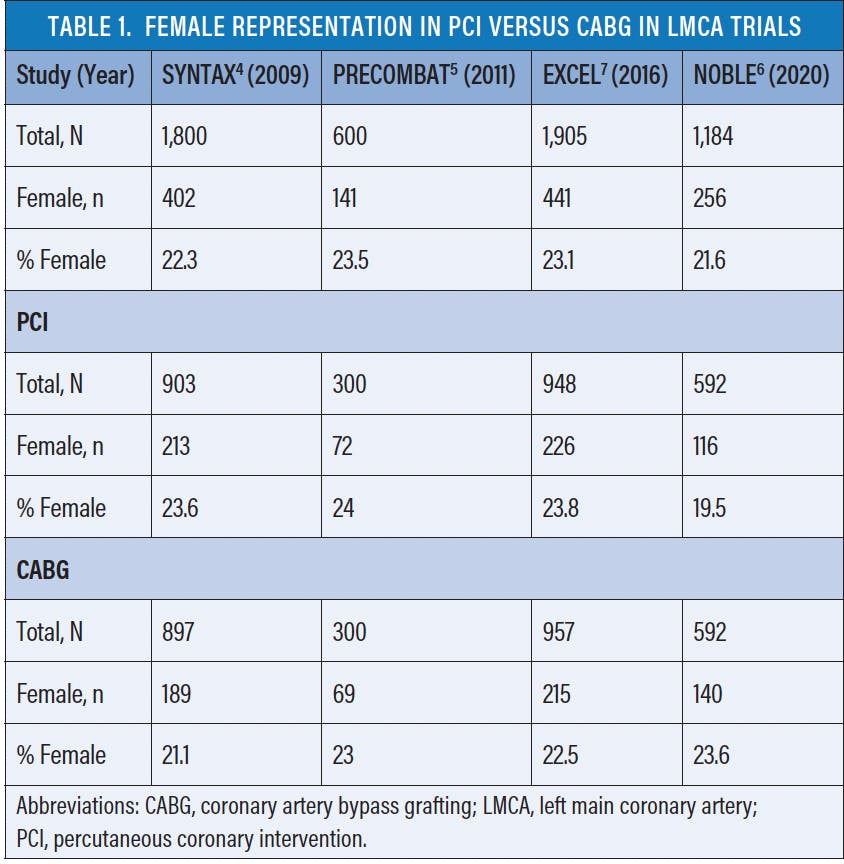
Despite the overall low prevalence of LMCA disease in the general population, isolated CAD of the LMCA is more common in women compared to men.21 Unfortunately, females are classically underrepresented in large-scale clinical trials, as is the case in landmark clinical trials evaluating CABG and PCI in LMCA disease (Table 1).4-7 As a result, a paucity of data exists to guide management of female patients with LMCA disease. Data from trials comprised of largely male cohorts are often extrapolated for the management of female patients, which becomes problematic because several studies have demonstrated worse outcomes in females as compared with males for both PCI and CABG.22-26 In response to data deficiency, several meta-analyses of available clinical trials have evaluated sex differences in outcomes for patients undergoing PCI and CABG (Table 2).23-26 Although these analyses do not specifically examine utility for either technique in LMCA disease or compare revascularization strategies head-to-head, these data should be considered to inform clinical practice in the female patient.
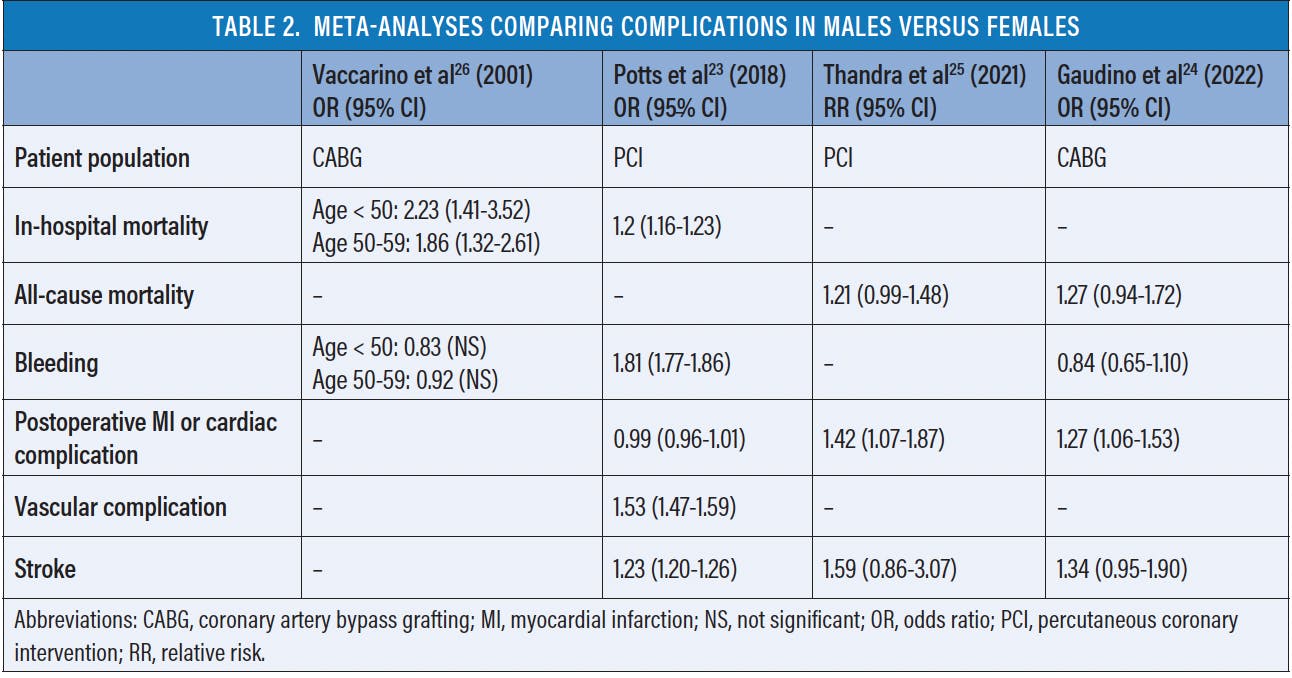
An analysis of 23 CABG and 48 PCI studies identified higher rates of complications and unadjusted in-hospital mortality in females compared with males.22 This study importantly identified that compared with males, females were more often older with high rates of diabetes, hypertension, and congestive heart failure at the time of revascularization. Although these outcome differences diminished after adjustment for risk factors such as age, gender disparities still existed even after this adjustment. Use of arterial grafts in the setting of CABG was also noted to be less frequent in females.
In a separate pooled analysis of four major CABG trials including 13,193 patients (2,714 female) followed for a mean of 5 years after CABG, females were found to have a higher adjusted incidence of MACCE but similar mortality compared to males.24 The higher incidence of MACCE was mostly driven by higher rates of recurrent MI and repeat revascularization. This study also identified that disparities in outcomes between males and females were inversely associated with age and appeared to diminish at age 75 years. Interestingly, this observation was also noted in a large-scale CABG registry including 511,187 patients (15,178 female), which found that female patients aged < 50 years had risk-adjusted mortality rates after CABG that were twice as high compared with males (but overall in-hospital mortality rates were low in this age group).26 In the same registry-based study, the differences in operative outcomes also seemed to diminish with increasing age.
As discussed previously, data examining sex differences for patients specifically undergoing PCI for LMCA disease are sparse due to low female representation in clinical trials. One meta-analysis of six studies (five observational and one post hoc RCT) identified similar rates of all-cause and cardiac mortality but higher rates of MACCE in females versus males after LMCA PCI.25 The higher rate of MACCE in females was largely driven by higher rates of MI, which is consistent with sex outcome differences after PCI in general.
REVASCULARIZATION OF BIFURCATION LESIONS
Current Data
Bifurcation lesions account for 20% of all PCIs and have been associated with worse clinical outcomes when compared with nonbifurcation lesions. Although there is no universally accepted definition for complex PCI, bifurcation PCI is considered technically challenging. The latest European guidelines on myocardial revascularization recommend a provisional single-stent strategy for non-LMCA bifurcation lesions. Alternatively, a planned two-stent technique is advised for bifurcations that include long (> 5 mm) ostial disease in a large side branch (≥ 2.75 mm) or anticipated difficulty in accessing an important side branch after main branch stenting, as well as true distal LMCA bifurcations.20 LMCA and complex bifurcation lesions add to CAD complexity per ACC/AHA/SCAI guidelines for myocardial revascularization.19 Despite several randomized trials, no uniform recommendations as to optimal stenting strategy exists.
Female Representation in Clinical Trials
Recent pooled evidence derived from large clinical trials of modern drug-eluting stent (DES) platforms showed similar safety and efficacy profiles of contemporary DES use in men and women.27 However, findings from separate adjusted studies investigating sex disparities in PCI are inconsistent. Female sex has been shown to be associated with worse clinical outcomes after PCI, including in-hospital mortality.28,29 Moreover, women undergoing complex PCI have been found to have a higher 3-year risk of MACE (adjusted hazard ratio [HR], 1.63; 95% CI, 1.45-1.83; P < .0001).30
Patient characteristics beyond lesion complexity and the technique used are likely relevant when examining sex differences in patients undergoing complex PCI. Women undergoing complex PCI are often older and have a higher burden of comorbidities such as diabetes mellitus, hypertension, and hypercholesterolemia than their male counterparts, which is partly explained by a delayed onset of CAD in this subgroup.31
Whether these sex disparities also exist in bifurcations is still poorly understood. Data extracted from registries on bifurcation PCI also reported that women are older, have more comorbidities, and have more complex disease, with a higher rate of angiographically determined calcification (Figure 1).32 Randomized data are scarce because women are often underrepresented even in landmark trials on bifurcation stenting strategies, and it is a matter of debate whether procedural and clinical outcomes might differ among women according to the strategy and technique.
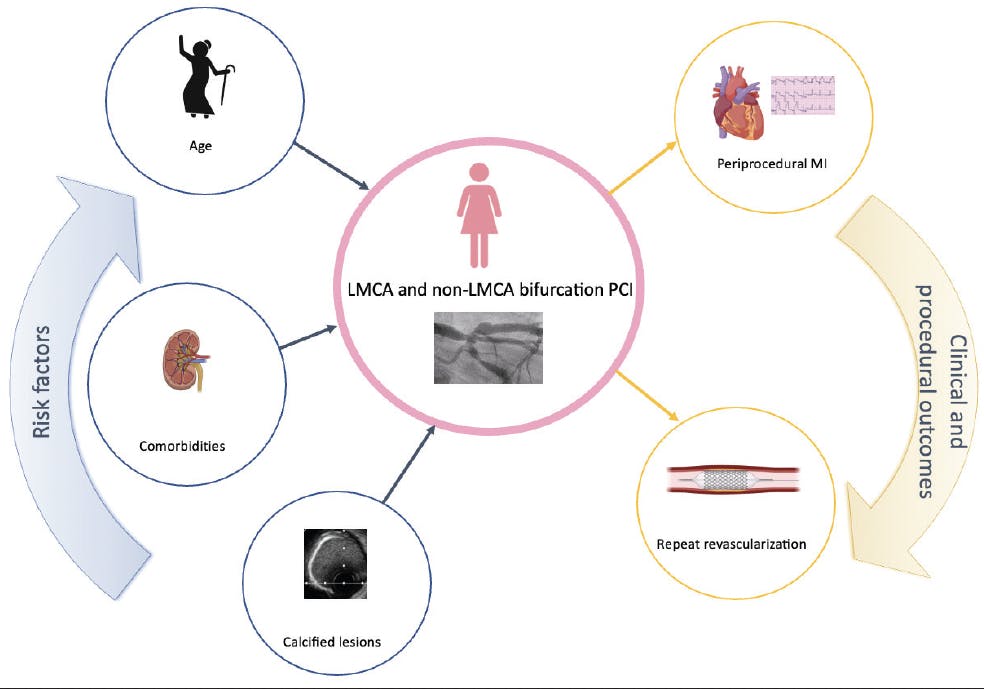
Figure 1. Risk factors and procedural and clinical outcomes in women undergoing LMCA and non-LMCA bifurcation lesion PCI.
Provisional stenting has been recommended as the default technique for most bifurcation lesions. The “keep-it-simple” one-stent recommendation as the “standard” approach for the treatment of bifurcation lesions has been challenged by recent RCTs on two-stent strategies for complex bifurcation lesions. The DEFINITION II trial found a significantly lower rate of target lesion failure (TLF) with the two-stent technique versus provisional stenting. Sex was not an independent predictor of TLF.33
Recently, the provisional stenting philosophy has been reinforced by the EBC MAIN study, where a stepwise, layered approach was compared to a systematic two-stent technique (n = 467, 23.5% women) in true distal LMCA bifurcation stenosis. However, gender-specific data were not reported.34
In the context of the elective two-stent strategy, emerging data support double-kissing crush (DK crush).35 The DKCRUSH-V trial randomized symptomatic patients with a distal LMCA lesion to either DK crush or a provisional strategy in a 1:1 fashion and reported sex-specific subanalysis results. In the women subgroup, TLF (the primary endpoint) occurred in 7.3% in the DK crush group versus 16.7% in the provisional stenting group (HR, 0.44; 95% CI, 0.13-1.52). Sex was not a predictor of TLF at 1 year in patients treated with the DK crush technique compared with provisional stenting (P = .858).35
The presence of coronary artery calcium is associated with higher risk of stent malapposition and underexpansion, leading to higher risk of intrastent restenosis and stent thrombosis. Moderate to severe calcium has been found in 25% of women undergoing PCI with DES in RCTs, and female sex has been associated with worse clinical profile and increased ischemic risk. The presence of a calcified plaque and more specifically a calcium arc > 60° at the minimal lumen area site in either the distal LMCA or left anterior descending coronary artery ostium has been found as an independent predictor of poststenting left circumflex narrowing.36
Randomized data support the use of intravascular imaging in the context of bifurcation lesions.37 To date, sex-specific features identified by intravascular imaging have been described, but no validated references have been defined to standardize optimization criteria. Studies dedicated to evaluating outcomes after revascularization of bifurcation lesions in women and the potential role of intravascular imaging are desperately needed.
CLINICAL CARE OF THE FEMALE PATIENT
Although data on female representation in LMCA and non-LMCA bifurcation disease are currently lacking, many aspects of current guidelines can be employed when caring for the female patient. First and foremost, decisions regarding a revascularization strategy require a multidisciplinary team discussion to provide a tailored, patient-centered approach. This discussion should integrate clinical factors, procedural considerations, operator and institutional experience, current practice guidelines, and patient preference after being adequately informed of all options. Although scarcity of RCT data in women creates a challenge, several studies have demonstrated poorer outcomes for women versus men with both CABG and PCI revascularization strategies. Observational and retrospective data suggest a higher operative mortality in younger females undergoing LMCA revascularization as compared with males, but overall mortality rates were low in this age group and these findings have not been corroborated by RCTs. Similarly, observational registries suggest that females undergoing complex and bifurcation lesion PCI are at higher risk of MACE. Underepresentation of women in landmark trials and the lack of sex-specific analysis determine the paucity of randomized data.
Until more evidence becomes available for the female patient, clinical care should focus on providing the most complete revascularization possible in accordance with current ACC/AHA/SCAI and ESC/EACTS guidelines while being mindful that female patients may experience higher rates of complications, recurrent MI, and repeat revascularization with either revascularization strategy as compared to their male counterparts (Figure 1).
1. Campeau L, Corbara F, Crochet D, Petitclerc R. Left main coronary artery stenosis: the influence of aortocoronary bypass surgery on survival. Circulation. 1978;57:1111-1115. doi: 10.1161/01.cir.57.6.1111
2. Takaro T, Peduzzi P, Detre KM, et al. Survival in subgroups of patients with left main coronary artery disease. Veterans Administration Cooperative Study of Surgery for Coronary Arterial Occlusive Disease. Circulation. 1982;66:14-22. doi: 10.1161/01.cir.66.1.14
3. Caracciolo EA, Davis KB, Sopko G, et al. Comparison of surgical and medical group survival in patients with left main coronary artery disease. Long-term CASS experience. Circulation. 1995;91:2325-2334. doi: 10.1161/01.cir.91.9.2325
4. Serruys PW, Morice MC, Kappetein AP, et al. Percutaneous coronary intervention versus coronary-artery bypass grafting for severe coronary artery disease. N Engl J Med. 2009;360:961-972. doi: 10.1056/NEJMoa0804626
5. Park SJ, Kim YH, Park DW, et al. Randomized trial of stents versus bypass surgery for left main coronary artery disease. N Engl J Med. 2011;364:1718-1727. doi: 10.1056/NEJMoa1100452
6. Holm NR, Mäkikallio T, Lindsay MM, et al. Percutaneous coronary angioplasty versus coronary artery bypass grafting in the treatment of unprotected left main stenosis: updated 5-year outcomes from the randomised, non-inferiority NOBLE trial. Lancet. 2020;395:191-199. doi: 10.1016/S0140-6736(19)32972-1
7. Stone GW, Sabik JF, Serruys PW, et al. Everolimus-eluting stents or bypass surgery for left main coronary artery disease. N Engl J Med. 2016;375:2223-2235. doi: 10.1056/NEJMoa1610227
8. Kuno T, Ueyama H, Rao SV, et al. Percutaneous coronary intervention or coronary artery bypass graft surgery for left main coronary artery disease: A meta-analysis of randomized trials. Am Heart J. 2020;227:9-10. doi: 10.1016/j.ahj.2020.06.001
9. Ahmad Y, Howard JP, Arnold AD, et al. Mortality after drug-eluting stents vs. coronary artery bypass grafting for left main coronary artery disease: a meta-analysis of randomized controlled trials. Eur Heart J. 2020;41:3228-3235. doi: 10.1093/eurheartj/ehaa135
10. Sabatine MS, Bergmark BA, Murphy SA, et al. Percutaneous coronary intervention with drug-eluting stents versus coronary artery bypass grafting in left main coronary artery disease: an individual patient data meta-analysis. Lancet. 2021;398:2247-2257. doi: 10.1016/S0140-6736(21)02334-5
11. Gallo M, Blitzer D, Laforgia PL, et al. Percutaneous coronary intervention versus coronary artery bypass graft for left main coronary artery disease: a meta-analysis. J Thorac Cardiovasc Surg. 2022;163:94-105.e15. doi: 10.1016/j.jtcvs.2020.04.010
12. Mohr FW, Morice MC, Kappetein AP, et al. Coronary artery bypass graft surgery versus percutaneous coronary intervention in patients with three-vessel disease and left main coronary disease: 5-year follow-up of the randomised, clinical SYNTAX trial. Lancet. 2013;381:629-638. doi: 10.1016/S0140-6736(13)60141-5
13. Thuijs DJFM, Kappetein AP, Serruys PW, et al. Percutaneous coronary intervention versus coronary artery bypass grafting in patients with three-vessel or left main coronary artery disease: 10-year follow-up of the multicentre randomised controlled SYNTAX trial. Lancet. 2019;394:1325-1334. doi: 10.1016/S0140-6736(19)31997-X
14. Morice MC, Serruys PW, Kappetein AP, et al. Five-year outcomes in patients with left main disease treated with either percutaneous coronary intervention or coronary artery bypass grafting in the synergy between percutaneous coronary intervention with taxus and cardiac surgery trial. Circulation. 2014;129:2388-2394. doi: 10.1161/CIRCULATIONAHA.113.006689
15. Lee K, Ahn JM, Yoon YH, et al. Long-term (10-year) outcomes of stenting or bypass surgery for left main coronary artery disease in patients with and without diabetes mellitus. J Am Heart Assoc. 2020;9:e015372. doi: 10.1161/JAHA.119.015372
16. Nagendran J, Bozso SJ, Norris CM, et al. Coronary artery bypass surgery improves outcomes in patients with diabetes and left ventricular dysfunction. J Am Coll Cardiol. 2018;71:819-827. doi: 10.1016/j.jacc.2017.12.024
17. The BARI Investigators. Influence of diabetes on 5-year mortality and morbidity in a randomized trial comparing CABG and PTCA in patients with multivessel disease: the Bypass Angioplasty Revascularization Investigation (BARI). Circulation. 1997;96:1761-1769. doi: 10.1161/01.cir.96.6.1761
18. Petrie MC, Jhund PS, She L, et al. Ten-year outcomes after coronary artery bypass grafting according to age in patients with heart failure and left ventricular systolic dysfunction: an analysis of the extended follow-up of the STICH trial (Surgical Treatment for Ischemic Heart Failure). Circulation. 2016;134:1314-1324. doi: 10.1161/CIRCULATIONAHA.116.024800
19. Writing Committee Members, Lawton JS, Tamis-Holland JE, Bangalore S, et al. 2021 ACC/AHA/SCAI guideline for coronary artery revascularization: executive summary: a report of the American College of Cardiology/American Heart Association joint committee on clinical practice guidelines. J Am Coll Cardiol. 2022;79:197-215. doi: 10.1016/j.jacc.2021.09.005
20. Sousa-Uva M, Neumann F-J, Ahlsson A, et al. 2018 ESC/EACTS guidelines on myocardial revascularization. Eur J Cardiothorac Surg. 2019;55:4-90. doi: 10.1093/ejcts/ezy289
21. Giannoglou GD, Antoniadis AP, Chatzizisis YS, et al. Prevalence of narrowing >or=50% of the left main coronary artery among 17,300 patients having coronary angiography. Am J Cardiol. 2006;98:1202-1205. doi: 10.1016/j.amjcard.2006.05.052
22. Kim C, Redberg RF, Pavlic T, Eagle KA. A systematic review of gender differences in mortality after coronary artery bypass graft surgery and percutaneous coronary interventions. Clin Cardiol. 2007;30:491-495. doi: 10.1002/clc.20000
23. Potts J, Sirker A, Martinez SC, et al. Persistent sex disparities in clinical outcomes with percutaneous coronary intervention: insights from 6.6 million PCI procedures in the United States. PLoS One. 2018;13:e0203325. doi: 10.1371/journal.pone.0203325
24. Gaudino M, Di Franco A, Alexander JH, et al. Sex differences in outcomes after coronary artery bypass grafting: a pooled analysis of individual patient data. Eur Heart J. 2021;43:18-28. doi: 10.1093/eurheartj/ehab504
25. Thandra A, Jhand A, Guddeti R, et al. Sex differences in clinical outcomes following percutaneous coronary intervention of unprotected left main coronary artery: a systematic review and meta-snalysis. Cardiovasc Revasc Med. 2021;28:25-31. doi: 10.1093/eurheartj/ehab504
26. Vaccarino V, Abramson JL, Veledar E, Weintraub WS. Sex differences in hospital mortality after coronary artery bypass surgery: evidence for a higher mortality in younger women. Circulation. 2002;105:1176-1181. doi: 10.1161/hc1002.105133
27. Stefanini GG, Baber U, Windecker S, et al. Safety and efficacy of drug eluting stents in women: a patient-level pooled analysis of randomised trials. Lancet. 2013;382:1879-1888. doi: 10.1016/S0140-6736(13)61782-1
28. Kunadian V, Qiu W, Lagerqvist B, et al. Gender differences in outcomes and predictors of all-cause mortality after percutaneous coronary intervention (data from United Kingdom and Sweden). Am J Cardiol. 2017;119:210-216. doi: 10.1016/j.amjcard.2016.09.052
29. Lansky AJ, Hochman JS, Ward PA, et al. Percutaneous coronary intervention and adjunctive pharmacotherapy in women: a statement for healthcare professionals from the American Heart Association. Circulation. 2005;111:940-953. doi: 10.1161/01.CIR.0000155337.50423.C9
30. Giustino G, Baber U, Aquino M, et al. Safety and efficacy of new generation drug-eluting stents in women undergoing complex percutaneous coronary artery revascularization: from the WINDES collaborative patient-level pooled analysis. JACC Cardiovasc Interv. 2016;9:674-684. doi: 10.1016/j.jcin.2015.12.013
31. Doolub G, Tonino PAL, Kedev S, et al. Impact of sex on clinical outcomes in patients undergoing complex percutaneous coronary angioplasty (from the e-ULTIMASTER Study). Am J Cardiol. 2023;186:71-79. doi: 10.1016/j.amjcard.2022.10.023
32. Schamroth Pravda N, Perl L, Greenberg G, et al. Impact of sex on outcomes of bifurcation lesion percutaneous coronary intervention: results from a single-centre prospective registry. Coron Artery Dis. 2022;31:31-36. doi: 10.1097/MCA.0000000000001039
33. Zhang JJ, Ye F, Xu K, et al. Multicentre, randomized comparison of two-stent and provisional stenting techniques in patients with complex coronary bifurcation lesions: the DEFINITION II trial. Eur Heart J. 2020;41:2523-2536. doi: 10.1093/eurheartj/ehaa543
34. Hildick-Smith D, Egred M, Banning A, et al. The European Bifurcation Club Left Main Coronary Stent study: a randomized comparison of stepwise provisional vs. systematic dual stenting strategies (EBC MAIN). Eur Heart J. 2021;42:3829-3839. doi: 10.1093/eurheartj/ehab283
35. Chen SL, Zhang JJ, Han Y, et al. Double kissing crush versus provisional stenting for left main distal bifurcation lesions. DKCRUSH-V randomized trial. J Am Coll Cardiol. 2017;70:2605-2617. doi: 10.1016/j.jacc.2017.09.1066
36. Mintz GS, Lefèvre T, Lassen JF, et al. Intravascular ultrasound in the evaluation and treatment of left main coronary artery disease: a consensus statement from the European Bifurcation Club. EuroIntervention. 2018;14:e467-e474. doi: 10.4244/EIJ-D-18-00194
37. Tarantini G, Fovino LN, Varbella et al. A large, prospective, multicentre study of left main PCI using a latest-generation zotarolimus-eluting stent: the ROLEX study. EuroIntervention. Published online August 31, 2022. doi: 10.4244/EIJ-D-22-00454
Advertisement
Advertisement