Advertisement
Advertisement
March/April 2022
TAVR Versus SAVR in Bicuspid Aortic Valve Stenosis
Design considerations for a trial comparing transcatheter and surgical aortic valve replacement in patients with bicuspid aortic valve stenosis.
By Philippe Nuyens, MD; Xi Wang, MD; Maarten Vanhaverbeke, MD, PhD; Angelo Quagliana, MD, PhD; Laurence Campens, MD, PhD; and Lars Søndergaard, MD, Prof, PhD
During the last decade, transcatheter aortic valve replacement (TAVR) has evolved as an alternative therapy to surgical aortic valve replacement (SAVR) in elderly patients with symptomatic aortic stenosis (AS) across all surgical risk categories.1,2 This is reflected in the recent European3 and American guidelines4 on the management of patients with valvular heart disease, in which transfemoral TAVR should be considered for patients with symptomatic AS who are aged ≥ 75 and 65 years, respectively.
As the indication for TAVR expands toward younger patients, it can be expected that more patients with bicuspid aortic valve (BAV) will be treated due to the higher prevalence of BAV among younger patients with AS requiring valve intervention. Data from the Copenhagen University Hospital show that 20% to 25% of patients < 75 years referred for TAVR have a BAV (unpublished data; Figure 1). Although TAVR has demonstrated favorable short-term outcomes in elderly patients with BAV, there is a knowledge gap about the role of TAVR in younger patients with longer life expectancy because BAV has been an exclusion criterion in all TAVR versus SAVR trials.
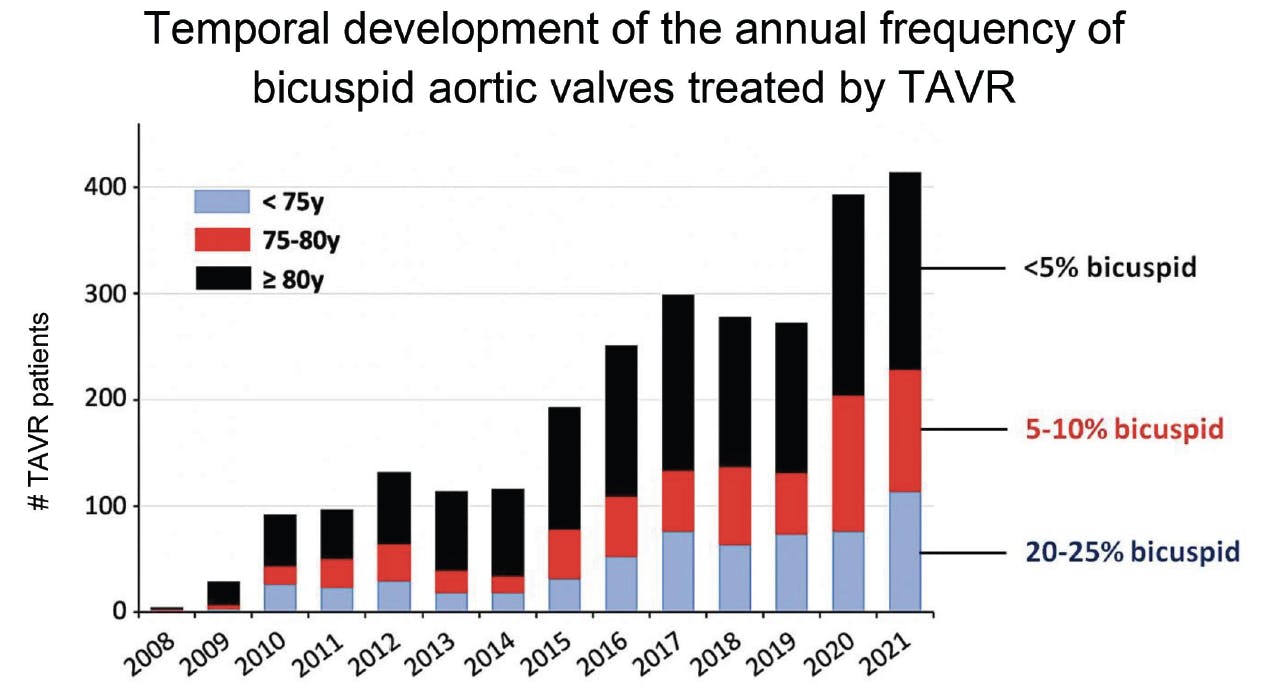
Figure 1. Prevalence of BAV according to age in patients with symptomatic AS treated with TAVR at the Copenhagen University Hospital.
Although no randomized clinical trial has compared SAVR and TAVR in severe symptomatic AS in BAV, the NOTION II study (NCT02825134) is currently enrolling patients with BAV who are at a younger age and low surgical risk.
Data regarding TAVR in BAV are mostly collected from registries. However, these registries lack a detailed description of the BAV phenotype, and they are prone to patient selection bias toward patients at high surgical risk and favorable BAV anatomies for TAVR. Therefore, these registries are no substitute for all-comer randomized controlled trials (RCTs) between SAVR and TAVR in this specific population. Nonetheless, they do raise concerns regarding higher rates of paravalvular leak (PVL), stroke, and need for permanent pacemaker implantation (PPI) after TAVR as compared with tricuspid aortic valves (TAVs).5 However, it seems that higher valve implantations, increased operator experience, and newer-generation devices have mitigated these risks.6
This article provides an overview of BAV classification and morphology, existing evidence, and concerns when treating BAV patients with TAVR. Furthermore, a design for an RCT comparing TAVR versus SAVR in patients with severe symptomatic BAV stenosis is proposed.
BAV MORPHOLOGY AND CLASSIFICATION
The diagnosis of BAV in patients with severe AS can be challenging. Echocardiography has a low sensitivity regarding the diagnosis of BAV, missing up to four out of five patients with BAV in an older population compared to CT.7 Furthermore, BAV represents a collection of various aortic valve morphologies and often coincides with aortopathy. The most common forms of aortopathy are dilatation of the ascending aorta, which is present in up to 50% of BAV patients,8 and coarctation aorta.9 Therefore, a detailed CT-based assessment of patients with severe AS is mandatory.
The most commonly used system is the Sievers classification of BAV,10 which divides BAV anatomies based on their number of raphe (type 0, type 1, and type 2). The BAV type 1 is the most common variant, representing 90% of patients in the Western world. A further subdivision in the type 1 morphology is made according to the position of the raphe in relation to the left (L), right (R), or non (N) coronary cusp. The L-R fusion represents 71% of patients with BAV type 1, while the type 1 R-N and type 1 L-N are found in 15% and 3%, respectively, of patients. Type 0 and type 2 represent approximately 6% and 5% of patients, respectively (Figure 2).10

Figure 2. Sievers classification of BAV. AP, anteroposterior; L, left coronary cusp; N, noncoronary cusp; R, right coronary cusp. Adapted from Sievers HH, et al. J Thorac Cardiovasc Surg. 2007;133:1226-1233. *Prevalence of the BAV subtype.
CONCERNS TREATING BAV STENOSIS WITH TAVR
Valve Morphology and Associated Aortopathy
During SAVR in BAV stenosis, the native calcified valve is explanted, whereas it remains in situ during TAVR. This may impact procedural risk, valve function, and durability. As reported by Yoon et al,11 calcified raphe and excessive leaflet calcifications, which were present in 26% of patients, were associated with more periprocedural complications (moderate-to-severe paravalvular regurgitation and aortic root injury) and an increased 30-day and 2-year all-cause mortality rate as compared to BAV without these risk features. Furthermore, aortopathy, left ventricular outflow tract calcium, and annulus eccentricity are associated with adverse outcomes in TAVR. The presence of aortic dilatation may indicate concomitant replacement and thereby exclude TAVR in patients who are eligible for surgery, as well as pose a risk for vascular complication in patients treated with TAVR.
Paravalvular Leak
Early experience with TAVR in BAV revealed an increased risk of PVL as compared to TAV.12,13 However, more recent studies show an improved outcome—in selected patients—with use of current-generation devices including external sealing skirts.14-16 Thus, the risk of moderate-to-severe aortic regurgitation, based on a recent analysis from the United States Society of Thoracic Surgeons/American College of Cardiology Transcatheter Valve Therapy registry, was 2.7% in BAV patients compared to 2.1% in TAV patients.5
Stroke
Because BAV is associated with a larger calcium burden compared to TAV,17 balloon predilatation is frequently required. Together with the manipulation of the delivery system and the stent frame in the calcified aortic annulus, this may explain the reported higher 30-day stroke rate for TAVR in BAV compared to TAV (2.5% vs 1.6%).16 Cerebral protection devices may potentially mitigate this risk.
Permanent Pacemaker Implantation
Both PPI and new-onset left bundle branch block after TAVR have been associated with increased risk of mortality and hospitalization for heart failure, which are concerns particularly in younger patients with longer life expectancy. It is well described that the length of the membranous septum is associated with a risk for new conduction abnormalities after TAVR. Interestingly, Hamdan et al reported that the median length of the membranous septum is shorter in patients with BAV as compared with TAV.18,19 This may partly explain the increase in the need for PPI after TAVR in BAV compared to TAV.12,16 Higher valve implantation, together with avoiding aggressive oversizing, may reduce interaction with the conductance system, which has been shown to reduce the need for PPI in patients with BAV.20
Valve Durability and Device Success
Limited data exist on the durability of transcatheter heart valves (THVs) in BAV. However, there is a concern that a noncircular stent frame configuration and underexpansion of the inflow portion of the stent frame in BAV21 may influence valve durability, particularly for THVs with intra-annular leaflet position. Although the impact of subclinical leaflet thrombosis on valve durability is unknown, it is reassuring that several reports show similar rates of this phenomenon in BAV and TAV at 30 days or 1 year after TAVR.22,23 Furthermore, the mean transvalvular gradients at 30 days and 1 year are comparable for BAV and TAV.21,24 These data nonetheless only reflect short-term follow-up, and long-term data are still missing.
Study Design Issues
There are some important considerations that need to be considered when setting up an RCT investigating the role of TAVR versus SAVR in BAV. First, is there sufficient equipoise to randomize these patients between SAVR and TAVR, and will there be enough patients? Given the already acceptable short-term results in recent large registries using newer-generation THV in BAV, it could be argued whether a trial is still justified and if the outcome will change our clinical practice.
Second, should the trial have a real-world all-comers design, or should anatomic factors be considered when choosing inclusion and exclusion criteria? If so, which anatomic phenotypes should be studied?
Third, what would the outcomes look like? Is the aim to prove that TAVR is safe in BAV, noninferior, or even superior to SAVR in BAV? Which endpoints should be used: clinical, echocardiographic, cardiac CT based, and/or patient centered? What is the optimal length of follow-up in these young patients with longer life expectancies?
Fourth, which THV should be used? Are the currently available devices optimized for tackling this specific anatomy, or can future models be adapted to BAV anatomy?
Fifth, is the timing right to undertake an RCT, or should we still gather more information from large prospective registries to correctly identify patients who could benefit most from TAVR or SAVR, as well as a better understanding of technical issues related to TAVR for BAV (eg, valve sizing and deployment techniques)? And, finally, will the industries conduct such trials given the already widespread use, or should funding be raised elsewhere?
PROPOSED STUDY DESIGN
An RCT involving TAVR versus SAVR in BAV may be beneficial. A proposed study design is shown in Figure 3. Such an RCT might include the following:
- Address a population that has not yet been extensively studied (eg, younger patients at low surgical risk with a life expectancy > 10 years)
- Only include BAV type 1 without high-risk features, such as excess leaflet calcification in combination with calcified raphe
- Exclude significant aortic dilatation
- Randomize patients in a 1:1 fashion between SAVR and TAVR
- Use all commercially, newer-generation THV devices for TAVR with a patient-tailored approach
- Use a composite of all-cause mortality, stroke, and rehospitalization (related to the procedure, the valve, or heart failure) as the primary endpoint at 1 year
- Report on procedure-related major vascular complication, major bleeding, new permanent pacemaker, PVL, cardiac structural complications, and aorta-related events
- Perform a yearly assessment of (1) safety: all-cause mortality, stroke, and aorta-related events (aorta dilatation, dissection, and intervention); (2) valve durability: bioprosthetic valve dysfunction/failure and reintervention; and (3) patient-centered outcomes: quality of life and functional status questionnaires
- Report events according to Valve Academic Research Consortium (VARC)-3 criteria25

Figure 3. Proposed study algorithm for an RCT between SAVR and TAVR in patients with a BAV and severe symptomatic AS. BVD, bioprosthetic valve dysfunction; BVF, bioprosthetic valve failure; QOL, quality of life.
The collection of these data should be embedded into large registries and involve multiple centers worldwide, reporting on patient and CT baseline characteristics, clinical endpoints, and echocardiographic data. Finally, patients who are excluded from the study but were still treated with TAVR should be followed-up in a separate registry to collect valuable outcomes data in these hostile anatomies.
CONCLUSION
Although TAVR has delivered promising results in comparison with SAVR, a large knowledge gap remains in treating patients with BAV because they were excluded from previous landmark RCTs. Newer-generation devices have demonstrated promising short-term results with largely comparable outcomes between BAV and TAV patients undergoing TAVR, although some reports of higher rates of stroke, pacemaker rate, and PVL raise concerns. Furthermore, some specific anatomic features such as excessive calcification and calcified raphe coincide with increased adverse risks in this growing group of younger patients with BAV. Therefore, well-designed RCTs comparing outcomes between SAVR and TAVR in well-selected BAV patients with long follow-up are necessary before changing clinical practice.
1. Mack MJ, Leon MB, Thourani VH, et al. Transcatheter aortic-valve replacement with a balloon-expandable valve in low-risk patients. N Engl J Med. 2019;380:1695-1705. doi: 10.1056/NEJMoa1814052
2. Popma JJ, Deeb GM, Yakubov SJ, et al. Transcatheter aortic-valve replacement with a self-expanding valve in low-risk patients. N Engl J Med. 2019;380:1706-1715. doi: 10.1056/nejmoa1816885
3. Vahanian A, Beyersdorf F, Praz F, et al. 2021 ESC/EACTS guidelines for the management of valvular heart disease. Eur Heart J. 2022;43:561-632. doi: 10.1093/eurheartj/ehab395
4. Otto CM, Nishimura RA, Bonow RO, et al. 2020 ACC/AHA guideline for the management of patients with valvular heart disease: a report of the American College of Cardiology/American Heart Association joint committee on clinical practice guidelines. 2021;143:e72-e227. doi: 10.1161/CIR.0000000000000923
5. Halim SA, Edwards FH, Dai D, et al. Outcomes of transcatheter aortic valve replacement in patients with bicuspid aortic valve disease: a report from the Society of Thoracic Surgeons/American College of Cardiology Transcatheter Valve Therapy registry. Circulation. 2020;141:1071-1079. doi: 10.1161/CIRCULATIONAHA.119.040333
6. Yoon SH, Lefèvre T, Ahn JM, et al. Transcatheter aortic valve replacement with early- and new-generation devices in bicuspid aortic valve stenosis. J Am Coll Cardiol. 2016;68:1195-1205. doi: 10.1016/j.jacc.2016.06.041
7. Kim WK, Liebetrau C, Fischer-Rasokat U, et al. Challenges of recognizing bicuspid aortic valve in elderly patients undergoing TAVR. Int J Cardiovasc Imaging. 2020;36:251-256. doi: 10.1007/s10554-019-01704-8
8. Yoon SH, Makkar R. Transcatheter aortic valve replacement for bicuspid aortic valve: challenges and pitfalls. Interv Cardiol Clin. 2018;7:477-488. doi: 10.1016/j.iccl.2018.06.006
9. Siu SC, Silversides CK. Bicuspid aortic valve disease. J Am Coll Cardiol. 2010;55:2789-2800. doi: 10.1016/j.jacc.2009.12.068
10. Sievers HH, Schmidtke C. A classification system for the bicuspid aortic valve from 304 surgical specimens. J Thorac Cardiovasc Surg. 2007;133:1226-1233. doi: 10.1016/j.jtcvs.2007.01.039
11. Yoon SH, Kim WK, Dhoble A et al. Bicuspid aortic valve morphology and outcomes after transcatheter aortic valve replacement. J Am Coll Cardiol. 2020;76:1018-1030. doi: 10.1016/j.jacc.2020.07.005
12. Mylotte D, Lefevre T, Søndergaard L, et al. Transcatheter aortic valve replacement in bicuspid aortic valve disease. J Am Coll Cardiol. 2014;64:2330-2339. doi: 10.1016/j.jacc.2014.09.039
13. Bauer T, Linke A, Sievert H, et al. Comparison of the effectiveness of transcatheter aortic valve implantation in patients with stenotic bicuspid versus tricuspid aortic valves (from the German TAVI registry). Am J Cardiol. 2014;113:518-521. doi: 10.1016/j.amjcard.2013.10.023
14. Yoon SH, Sharma R, Chakravarty T, et al. Clinical outcomes and prognostic factors of transcatheter aortic valve implantation in bicuspid aortic valve patients. Ann Cardiothorac Surg. 2017;6:463-472. doi: 10.21037/acs.2017.09.03
15. Perlman GY, Blanke P, Dvir D, et al. Bicuspid aortic valve stenosis: favorable early outcomes with a next-generation transcatheter heart valve in a multicenter study. JACC Cardiovasc Interv. 2016;9:817-824. doi: 10.1016/j.jcin.2016.01.002
16. Makkar RR, Yoon SH, Leon MB, et al. Association between transcatheter aortic valve replacement for bicuspid vs tricuspid aortic stenosis and mortality or stroke. JAMA. 2019;321:2193-2202. doi: 10.1001/jama.2019.7108
17. Roberts WC, Janning KG, Ko JM, et al. Frequency of congenitally bicuspid aortic valves in patients ≥ 80 years of age undergoing aortic valve replacement for aortic stenosis (with or without aortic regurgitation) and implications for transcatheter aortic valve implantation. Am J Cardiol. 2012;109:1632-1636. doi: 10.1016/j.amjcard.2012.01.390
18. Hamdan A, Nassar M, Schwammenthal E, et al. Short membranous septum length in bicuspid aortic valve stenosis increases the risk of conduction disturbances. J Cardiovasc Comput Tomogr. 2021;15:339-347. doi: 10.1016/j.jcct.2020.10.002
19. Hamdan A, Guetta V, Klempfner R, et al. Inverse relationship between membranous septal length and the risk of atrioventricular block in patients undergoing transcatheter aortic valve implantation. JACC Cardiovasc Interv. 2015;8:1218-1228. doi: 10.1016/j.jcin.2015.05.010
20. Xiong TY, Liao YB, Li YJ, et al. Permanent pacemaker implantation after transcatheter aortic valve replacement in bicuspid aortic valve patients. J Interv Cardiol. 2018;31:878-884. doi: 10.1111/joic.12546
21. Tchetche D, de Biase C, van Gils L, et al. Bicuspid aortic valve anatomy and relationship with devices: the BAVARD multicenter registry. Circ Cardiovasc Interv. 2019;12:e007107. doi: 10.1161/CIRCINTERVENTIONS.118.007107
22. Forrest JK, Ramlawi B, Deeb GM, et al. Transcatheter aortic valve replacement in low-risk patients with bicuspid aortic valve stenosis. JAMA Cardiol. 2021;6:50-57. doi: 10.1001/jamacardio.2020.4738
23. Zhu G, Fan J, Zhou D, et al. Subclinical leaflets thrombosis after transcatheter replacement of bicuspid vs. tricuspid aortic valve. Front Cardiovasc Med. 2021;8:1-10. doi: 10.3389/fcvm.2021.790069
24. Vincent F, Ternacle J, Denimal T, et al. Transcatheter aortic valve replacement in bicuspid aortic valve stenosis. Circulation. 2021;143:1043-1061. doi: 10.1161/CIRCULATIONAHA.120.048048
25. VARC-3 WRITING COMMITTEE; Généreux P, Piazza N, Alu MC, et al. Valve Academic Research Consortium 3: updated endpoint definitions for aortic valve clinical research. J Am Coll Cardiol. 2021;77:2717-2746. doi: 10.1016/j.jacc.2021.02.038
Advertisement
Advertisement