Advertisement
Advertisement
March/April 2022
TAV-in-TAV
Management strategies and outcomes.
By Arber Kodra, MD; Luigi Pirelli, MD; Craig Basman, MD; Sean Wilson, MD; Denny Wang, BS; and Chad Kliger, MD
Transcatheter aortic valve (TAV) replacement (TAVR) is now a well-established therapy for patients with high or prohibitive surgical risk and severe aortic stenosis. More recently, indications have been expanded to treat patients at increasingly lower surgical risk and younger ages.1 Although the current incidence of structural valve deterioration (SVD) is low, so far, the increasing use of transcatheter heart valves (THVs) necessitates the need to review the possible ways to manage degenerated THVs. With contemporary surgical aortic valve (SAV) replacement (SAVR), the incidence of reoperation for SVD at 5 years is < 3%. At 10, 15, and 20 years after SAVR, the incidence reaches 5%, 10% to 20%, and 40% to 50%, respectively.2-5 The recent long-term follow-up of the NOTION trial showed that TAVR and SAVR have similar durability at 8 years.6 Assuming a similar timeline for THVs and as the use of TAVR increases, management of SVD in THVs will be critical for a successful lifetime management strategy in patients with longer life expectancy. This article discusses the management strategies, role of imaging, associated concerns, and outcomes with this important care pathway in the lifetime management of valvular heart disease (Figure 1).
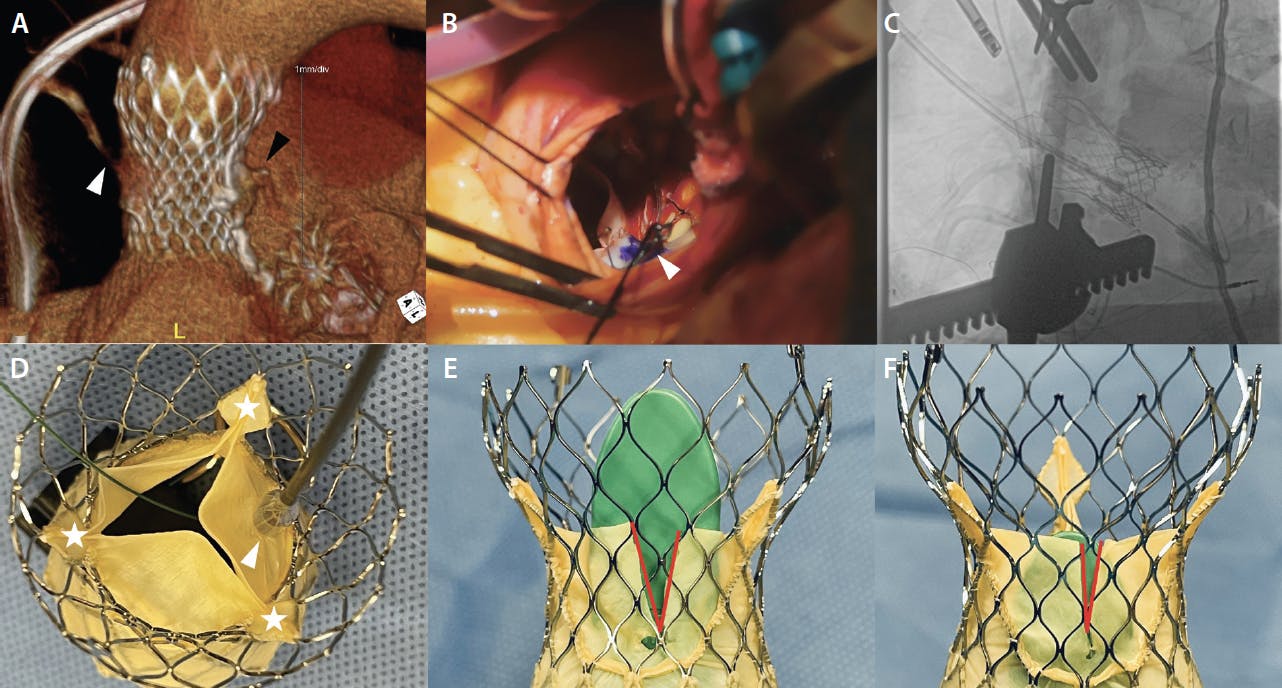
Figure 1. Three-dimensional rendering of an Evolut CoreValve (Medtronic) via CT. Right coronary artery (white arrowhead) and left main coronary artery (black arrowhead) are identified below the top of the valve commissures (26 mm from base, ie, risk plane) (A). For SURPLUS TAVR, the aorta is marked before leaflet resection (white arrow) to achieve intraoperative commissural alignment (B). A Sapien S3 Ultra valve (Edwards Lifesciences) is deployed under fluoroscopy such that the bottom of both valve frames line up (C). For balloon-assisted BASILICA, a 5-mm coronary balloon (arrowhead) is inflated across aortic valve leaflet prior to laceration to increase leaflet splay. Stars identify the valve commissures (D). Leaflet splay after balloon-assisted BASILICA (E). Leaflet splay after BASILICA without balloon assistance (F).
LESSONS LEARNED FROM TAV-IN-SAV
From our experience with failed SAVR, morbidity and early recovery are better with valve-in-valve (ViV) TAVR (or TAV-in-SAV) than redo SAVR.7 The CoreValve United States expanded use study was a prospective single-arm study that evaluated the safety and effectiveness of a self-expandable valve (SEV) in extreme-risk patients with symptomatic failed surgical biologic aortic valves. It showed that valve performance was maintained over 3 years, with only an approximate 4% rate of valve reintervention and only a 2.7% rate of severe SVD.8 Similarly, in a real-world study of ViV TAVR with balloon-expandable valves (BEVs), THVs had excellent 30-day and 1-year outcomes, especially in lower-risk patients.9
In 2015 and 2016, the FDA authorized expanded use of the CoreValve (Medtronic) and Sapien 3 (Edwards Lifesciences) THVs, respectively, as a ViV treatment for patients with high or extreme risk for traditional open surgery. The PARTNER II and VIVID registries have since confirmed outcomes up to 3 to 10 years, respectively.10,11 However, the French registry suggests that all-cause mortality and cardiovascular death are higher with ViV TAVR versus redo SAVR over the long term, with a combined endpoint of 21.9%/y versus 18.6%/y.7 Ongoing randomized trials, such as the REPEAT trial, are evaluating outcomes of patients with SVD who are of intermediate risk or less for redo operation versus TAV-in-SAV.
Nonetheless, management of failed TAVR remains unclear. The EXPLANT-TAVR registry has given us insight into the surgical management of patients with failed transcatheter THVs. Technical challenges were identified that included adherent stent frames, difficulties in cross-clamping with long THV frames, and the need for concomitant aortic, mitral, and tricuspid procedures. Mortality rates in the hospital, at 30 days, and at 1 year were 11.9%, 13.1%, and 28.3%, respectively. TAV-in-TAV is a feasible option for patients with SVD of a THV.12 The TRANSIT registry looked at 40,000 patients who underwent TAVR since 2008 in 28 centers worldwide. Of the 172 patients who underwent TAV-in-TAV, there was a 79% success rate, with mortality, cerebrovascular accident, and malpositioning rates of 4.1%, 3.5%, and 0%, respectively.13 Concerns for TAV-in-TAV include the risk of coronary occlusion, appropriate valve sizing and presence of patient-prosthesis mismatch, and risk of leaflet thrombosis.
ROLE OF IMAGING
Preprocedural planning with multidetector CT (MDCT) has become the most important tool to determine the best procedural steps for ViV cases. MDCT helps to identify the appropriate THV size while determining anatomic risks, such as the risk of coronary obstruction (CO) and sinus sequestration. Due to its high resolution and three-dimensional imaging, MDCT enables for precise identification of the thickness/calcification of the failed THV leaflets, mechanism of SVD, location of commissures, determination of the bioprosthesis position/angulation within aortic annulus, and measurement of the coronary ostia height, sinus of Valsalva size, and sino-tubular junction (STJ) height/diameter. However, more importantly, it is possible to determine the proximity of the coronary ostia and STJ to the anticipated final position of the displaced bioprosthetic leaflets, which forms a closed tubular structure together with the implantation of the new TAV. A customary practice is to place a virtual THV inside the initial SAVR/THV and measure the valve-to-coronary (VTC) distance and the valve-to-STJ (VTSTJ) distance.14 For TAV-in-SAV, a VTC distance of < 4 mm or a VTSTJ distance of < 2 mm are known to increase the risk of CO.15 In TAV-in-TAV, host leaflets are less likely to cause CO because the stent frame is a boundary for displacement. Instead, the main concern in TAV-in-TAV is the creation of a cylindrical “neoskirt” in the aortic root when the host leaflets are pinned open by the new valve.16 Even in cases when the VTSTJ is adequate to allow blood flow to the coronaries, access to the coronary ostia for angiography or intervention may still be severely impaired. The presence of valve commissural posts near the coronary ostia will also make it challenging to access the coronaries. These issues underscore the importance of imaging, especially CTA, both at the time of the first valve implantation as well as prior to TAV-in-TAV to identify patients who are at risk for CO or impaired coronary access.
SELECTION OF THE REDO THV
Although selection of the redo TAV varies significantly across centers, literature shows that when a BEV degenerates, the implantation of a second same-sized BEV is the most used approach.17 Treatment of SEVs varies more, but often the same size or smaller THV (BEV or SEV) is used. Gradients through TAV-in-TAV prosthesis have been observed to be mostly low, with only approximately 10% of patients presenting with at least moderately elevated gradients (mean gradients ≥ 20 mm Hg).18 This observation differs from ViV procedures for the treatment of degenerated SAVR, in which significantly elevated postprocedural gradients were more common in approximately 26.8% of patients, particularly in small (< 20 mm) surgical valves.19 The lower profile of the THV as compared with the surgical valves is likely responsible for the more favorable hemodynamic performance.
Coronary reaccess is another important caveat that must be considered during valve selection for TAV-in-TAV. The tall cell design of SEVs and concern for the presence of commissural posts at coronary ostia make access to coronary ostia more challenging than after BEV use. A recent publication investigated the ease of coronary angiography after TAVR to predict the feasibility of coronary access after TAV-in-TAV.20 Access was deemed unfeasible mostly in SEV host valves: in 38.5% of Evolut R/Pro (Medtronic), in 41.1% of Acurate Neo (Boston Scientific Corporation), and in 23.6% of Sapien S3 BEV. The development of commissural alignment techniques, such as the “hat” marker technique demonstrated in Evolut valves by Tang et al in the ALIGN TAVR study, have improved the risk of commissural posts obstructing access to the coronary ostia.21 However, applicability of such techniques in TAV-in-TAV cases has yet to be determined.
RISK OF CO
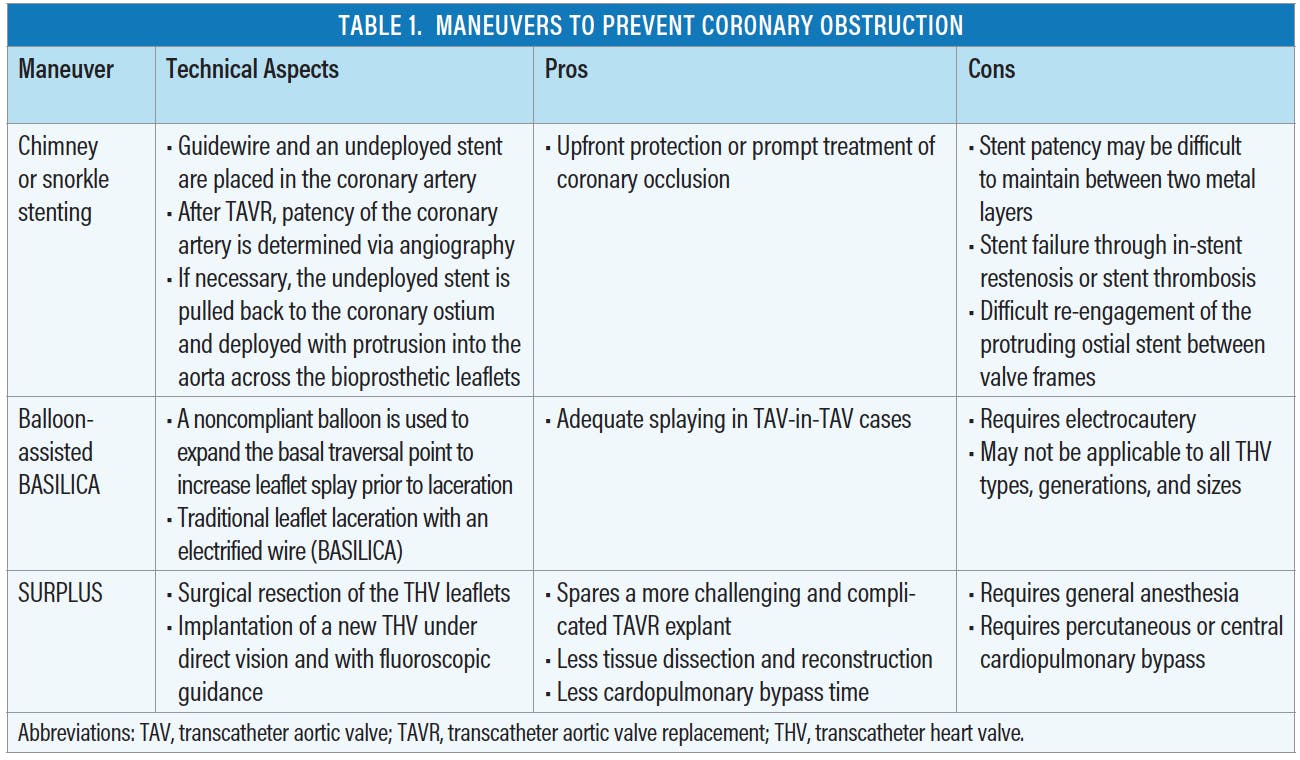
CO via displacement of a degenerated leaflet in proximity to a coronary ostium or due to sinus sequestration is one of the major concerns with ViV therapy. Thirty-day mortality after CO is > 40%.11,15 In TAV-in-TAV, host THV leaflets are less likely to cause ostial obstruction because the stent frame serves as a boundary for leaflet displacement. However, the host leaflets are pinned open during ViV implantation, forming a cylindrical neoskirt in the aortic root that can cause sinus sequestration if the top of the skirt is near the STJ.16 In cases in which the VTSTJ allows for adequate flow (> 2 mm), access to coronary ostia for angiography may still be severely impaired due to limited space, the presence of two overlapping layers of stent frame, and/or interference from a misaligned commissural post. Although early data suggest that TAV-in-TAV is a safe procedure in selected patients with rare occurrences of CO, valve embolization, or conversion to open heart surgery, CO remains a significant concern. An upfront strategy to reduce risk/protect the coronaries in high-risk TAV-in-TAV patients remains advisable. Techniques to manage at-risk patients for CO include chimney or snorkel stenting, balloon-assisted BASILICA, and SURPLUS TAVR (Table 1).
Chimney or Snorkel Stenting Technique
One technique is the chimney or snorkel stenting technique in which a guidewire and an undeployed stent, typically with the assistance of a guide extender, are placed in the coronary artery to facilitate the upfront protection or prompt treatment of CO. Once the THV is implanted, the patency of the coronary artery is determined via angiography and, if necessary, the undeployed stent is pulled back to the coronary ostium and deployed with protrusion into the aorta across the bioprosthetic leaflets. If coronary occlusion risk is high, a strategy to stent deploy upfront may be decided. However, a major concern with this technique for TAV-in-TAV is whether stent patency can be maintained between two metal layers of the THV.22 Stent failure in TAV-in-SAV, whether through in-stent restenosis or stent thrombosis, occurs at a rate of 5.3% after a median of 1.7 years.23 Furthermore, subsequent re-engagement of the protruding ostial stent between valve frames may not be possible.
BASILICA and Balloon-Assisted BASILICA
BASILICA is an alternative ViV implantation to reduce CO.24 BASILICA avoids the use of a coronary stent and its associated risks of occlusion and reaccess, in addition to reducing exposure to long-term dual antiplatelet therapy. TAV-in-TAV may pose the highest risk for CO because of narrow residual sinuses, tall leaflets, or supra-annular positioning that may vary based on THV implantation depth. Traditional BASILICA is an option, but bench testing, when compared to its use in TAV-in-SAV, suggests that there may be inadequate splaying in TAV-in-TAV.25 The inability of the THV leaflet moving beyond the THV frame would likely account for this technical limitation. Greenbaum et al recently published a case report of balloon-assisted BASILICA in which a noncompliant balloon was used to expand the basal traversal point to increase leaflet splay prior to laceration.26 Although promising, this approach still requires advanced electrocautery techniques. It remains unclear whether it is applicable to all THV types, generations, and sizes. Further validation is required.
SURPLUS TAVR
SURPLUS is a hybrid surgical-interventional technique that includes the surgical resection of the THV leaflets through an aortotomy and the implantation of a THV, under direct vision and with fluoroscopic guidance.27 This procedure spares a more challenging and complicated TAVR explant that could potentially need a more robust tissue dissection, reconstruction, and prolonged cardiopulmonary bypass (CPB) time. This hybrid procedure is conducted via a ministernotomy or minithoracotomy under general anesthesia, on central or peripheral CPB, and cardioplegic cardiac arrest. Through a standard aortotomy, the prosthetic valve leaflets are resected, leaving the frame in place. A new THV is then implanted within the original THV frame under direct vision and fluoroscopic guidance, ensuring commissural alignment prior to deployment. Despite promising advantages, SURPLUS TAVR remains a surgical hybrid procedure with its potential associated risks.
LIFETIME MANAGEMENT
In patients with longer life expectancies, the need for valve reintervention may be required. Therefore, careful planning to ensure that these patients are optimal candidates for ViV therapy is essential. Implantation of the largest valve possible during primary intervention should be pursued to maximize the effective orifice area. Due to the larger internal diameter and the potential ability to overexpand a THV, high residual gradients (> 20 mm Hg) occur less frequently when compared to TAV-in-SAV.28 Rates of paravalvular leak (PVL) may be higher in patients with TAV-in-TAV compared to TAV-in-SAV, but most residual PVL currently is no more than mild. Nonetheless, durability concerns remain regarding long-term THV function. This is due to the unknown impact of residual PVL and higher rates of leaflet thrombosis on long-term valve function.29,30 Trials have looked at initiation of novel oral anticoagulants after TAVR to prevent leaflet thrombosis without success. In fact, the use of rivaroxaban in GALILEO was associated with worse outcomes due to higher rates of bleeding and death.31 The use of apixaban in ATLANTIS was associated with lower rates of leaflet thrombosis but without a significant difference in clinical outcomes.32
In patients with underlying CAD, TAV-in-TAV adds another level of complexity to coronary access. With a double layer of frame, the ability to re-access the coronaries may also be restricted. THVs with supra-annular leaflet position or neoskirt above the coronary may especially be difficult to access.33 Imaging can be used to identity a “risk plane” level under which the passage of a coronary catheter will be impossible after a second THV is implanted. Implanting valves lower may allow the coronary ostia to be above the risk plane but at an increased risk of need for a pacemaker. Implanting valves higher in the risk plane may avoid the need for pacemakers. However, this approach requires close analysis to allow for one layer of cells to be across the coronary ostia to allow access with coronary catheters. These concerns, along with risks associated with acute CO during TAV-in-TAV, make lifetime management a complex and dynamic topic. Leveraging the multidisciplinary team along with shared decision-making is required to discuss all potential strategies prior to any intervention—initial valve implantation (TAVR vs SAVR) as well as ViV therapy. Continued research in this space with a focus on imaging is necessary to achieve an appropriate lifetime management strategy.
CONCLUSION
In general, TAV-in-TAV procedures are safe, with low rates of periprocedural complications and midterm survival comparable to recent TAVR series. The complexity of these procedures points to the fact that TAV-in-TAV is an evolving therapy that re-emphasizes the importance CTA imaging, planning, intraprocedural techniques, and involved team discussions. Until transcatheter leaflet modification tools are developed, management strategies like the ones described here will continue to mature to optimize care for patients requiring ViV.
1. Sundt TM, Jneid H. Guideline update on indications for transcatheter aortic valve implantation based on the 2020 American College of Cardiology/American Heart Association guidelines for management of valvular heart disease. JAMA Cardiol. 2021;6:1088-1089. doi: 10.1001/jamacardio.2021.2534
2. Bourguignon T, Bouquiaux-Stablo A-L, Candolfi P, et al. Very long-term outcomes of the Carpentier-Edwards Perimount valve in aortic position. Ann Thorac Surg. 2015;99:831-837. doi: 10.1016/j.athoracsur.2014.09.030
3. David TE, Armstrong S, Maganti M. Hancock II bioprosthesis for aortic valve replacement: the gold standard of bioprosthetic valves durability? Ann Thorac Surg. 2010;90:775-781. doi: 10.1016/j.athoracsur.2010.05.034
4. Forcillo J, Pellerin M, Perrault LP, et al. Carpentier-Edwards pericardial valve in the aortic position: 25-years experience. Ann Thorac Surg. 2013;96:486-449. doi: 10.1016/j.athoracsur.2013.03.032
5. Johnston DR, Soltesz EG, Vakil N, et al. Long-term durability of bioprosthetic aortic valves: implications from 12,569 implants. Ann Thorac Surg. 2015; 99:1239-1247. doi: 10.1016/j.athoracsur.2014.10.070
6. Jørgensen TH, Thyregod HGH, Ihlemann N, et al. Eight-year outcomes for patients with aortic valve stenosis at low surgical risk randomized to transcatheter vs. surgical aortic valve replacement. Eur Heart J. 2021;42:2912-2919. doi: 10.1093/eurheartj/ehab375
7. Deharo P, Bisson A, Herbert J, et al. Transcatheter valve-in-valve aortic valve replacement as an alternative to surgical re-replacement. J Am Coll Cardiol. 2020;76:489-499. doi: 10.1016/j.jacc.2020.06.010
8. Dauerman HL, Deeb GM, O’Hair DP, et al. Durability and clinical outcomes of transcatheter aortic valve replacement for failed surgical bioprostheses. Circ Cardiovasc Interv. 2019;12:e0081555. doi: 10.1161/CIRCINTERVENTIONS.119.008155
9. Kaneko T, Makkar RR, Krishnaswami A, et al. Valve-in-Surgical-Valve with SAPIEN 3 for transcatheter aortic valve replacement based on Society of Thoracic Surgeons predicted risk of mortality. Circ Cardiovasc Interv. 2021;14:e010288. Published correction appears in Circ Cardiovasc Interv. 2021;14:e000083. doi: 10.1161/CIRCINTERVENTIONS.120.010288
10. Leon MB, Smith CR, Mack MJ, et al. Transcatheter or surgical aortic-valve replacement in intermediate-risk patients. N Engl J Med. 2016;374:1609-1620. doi: 10.1056/NEJMoa1514616
11. Ribeiro HB, Rodés-Cabau J, Blanke P, et al. Incidence, predictors, and clinical outcomes of coronary obstruction following transcatheter aortic valve replacement for degenerative bioprosthetic surgical valves: insights from the VIVID registry. Eur Heart J. 2018;39:687-669. doi: 10.1093/eurheartj/ehx455
12. Bapat VN, Zaid S, Fukuhara S, et al. Surgical explantation after TAVR failure: mid-term outcomes from the EXPLANT-TAVR international registry. JACC Cardiovasc Interv. 2021;14:1978-1991. doi: 10.1016/j.jcin.2021.07.015
13. Testa L, Agnifili M, Van Mieghem NM, et al. Transcatheter aortic valve replacement for degenerated transcatheter aortic valves: the TRANSIT international project. Circ Cardiovasc Interv. 2021;14:e010440. doi: 10.1161/CIRCINTERVENTIONS.120.010440
14. Blanke P, Soon J, Dvir D, et al. Computed tomography assessment for transcatheter aortic valve in valve implantation: the Vancouver approach to predict anatomical risk for coronary obstruction and other considerations. J Cardiovasc Comput Tomogr. 2016;10:491-499. doi: 10.1016/j.jcct.2016.09.004
15. Ribeiro HB, Webb JG, Makkar RR, et al. Predictive factors, management, and clinical outcomes of coronary obstruction following transcatheter aortic valve implantation: insights from a large multicenter registry. J Am Coll Cardiol. 2013;62:1552-1562. doi: 10.1016/j.jacc.2013.07.040
16. Akodad M, Sellers S, Gulsin GS, et al. Leaflet and neoskirt height in transcatheter heart valves: implications for repeat procedures and coronary access. JACC Cardiovasc Interv. 2021;14:2298-2300. doi: 10.1016/j.jcin.2021.07.034
17. Barbanti M, Webb JG, Tamburino C, et al. Outcomes of redo transcatheter aortic valve replacement for the treatment of postprocedural and late occurrence of paravalvular regurgitation and transcatheter valve failure. Circ Cardiovasc Interv. 2016;9:003930. doi: 10.1161/CIRCINTERVENTIONS.116.003930
18. Sathananthan J, Sellers SL, Barlow A, et al. Over-expansion of the SAPIEN 3 transcatheter heart valve: an ex-vivo bench study. Catheter Cardiovasc Interv. 2018;11:1696-1705. doi: 10.1016/j.jcin.2018.06.027
19. Dvir D, Webb JG, Bleiziffer S, Valve-in-Valve International Data Registry Investigators, et al. Transcatheter aortic valve implantation in failed bioprosthetic surgical valves. JAMA. 2014;312:162-170. doi: 10.1001/jama.2014.7246
20. Nai Fovino L, Scotti A, Massussi M, et al. Coronary angiography after transcatheter aortic valve replacement (TAVR) to evaluate the risk of coronary access impairment after TAVR-in-TAVR. J Am Heart Assoc. 2020;9:e016446. doi: 10.1161/JAHA.120.016446
21. Tang GHL, Zaid S, Fuchs A, et al. Alignment of transcatheter aortic-valve Neo-commissures (ALIGN TAVR): impact on final valve orientation and coronary artery overlap. JACC Cardiovasc Interv. 2020;13:1030-1042. doi: 10.1016/j.jcin.2020.02.005
22. Pighi M, Lunardi M, Pesarini G, et al. Intravascular ultrasound assessment of coronary ostia following valve-in-valve transcatheter aortic valve implantation. EuroIntervention. 2021;16:1148-1151. doi: 10.4244/EIJ-D-20-00611
23. Mercanti F, Rosseel L, Neylon A, et al. Chimney stenting for coronary occlusion during TAVR: insights from the Chimney registry. JACC: Cardiovasc Interv. 2020;13:751-761. doi: 10.1016/j.jcin.2020.01.227
24. Khan JM, Dvir D, Greenbaum AB, et al. Transcatheter laceration of aortic leaflets to prevent coronary obstruction during transcatheter aortic valve replacement: concept to first-in-human. JACC Cardiovasc Interv. 2018;11:677-689. doi: 10.1016/j.jcin.2018.01.247
25. Khan JM, Bruce CG, Babaliaros VC, et al. TAVR roulette: caution regarding BASILICA laceration for TAVR-in-TAVR. JACC Cardiovasc Interv. 2020;13:787-789. doi: 10.1016/j.jcin.2019.10.010
26. Greenbaum AB, Kamioka N, Vavalle JP, et al. Balloon-assisted BASILICA to facilitate redo TAVR. JACC Cardiovasc Interv. 2021;14:578-580. doi: 10.1016/j.jcin.2020.10.056
27. Pirelli L, Basman CL, Brinster DR, et al. Surgical resection of prosthetic valve leaflets under direct vision (SURPLUS) for redo TAVR. JACC Cardiovasc Interv. 2021;14:1036-1037. doi: 10.1016/j.jcin.2021.02.026
28. Landes U, Sathananthan J, Witberg G, et al. Transcatheter replacement of transcatheter versus surgically implanted aortic valve bioprostheses. J Am Coll Cardiol. 2021;77:1-14. doi: 10.1016/j.jacc.2020.10.053
29. Chakravarty T, Søndergaard L, Friedman J, et al. Subclinical leaflet thrombosis in surgical and transcatheter bioprosthetic aortic valves: an observational study. Lancet. 2017;389:2383-2393. doi: 10.1016/S0140-6736(17)30757-2
30. Hatoum H, Lilly S, Maureira P, et al. The hemodynamics of transcatheter aortic valves in transcatheter aortic valves. J Thorac Cardiovasc Surg. 2021;161:565-576. doi: 10.1016/j.jtcvs.2019.09.174
31. Dangas GD, Tijssen JGP, Wöhrle J, et al. A controlled trial of rivaroxaban after transcatheter aortic-valve replacement. N Engl J Med. 2020;382:120-129. doi: 10.1056/NEJMoa1911425
32. Collet JP, Berti S, Cequier A, et al. Oral anti-Xa anticoagulation after trans-aortic valve implantation for aortic stenosis: the randomized ATLANTIS trial. Am Heart J. 2018;200:44-50. doi: 10.1016/j.ahj.2018.03.008
33. De Backer O, Landes U, Fuchs A, et al. Coronary access after TAVR-in-TAVR as evaluated by multidetector computed tomography. JACC Cardiovasc Interv. 2020;13:2528-2538. doi: 10.1016/j.jcin.2020.06.016
Advertisement
Advertisement