Advertisement
Advertisement
March/April 2022
Divergent Guidelines for the Management of Severe Aortic Stenosis
Similarities and differences between the United States and Europe.
By Harriet Hurrell, MBBS, MRCP; Christopher Allen, MBChB, BSc, MRCP; Andreas Kalogeropoulos, MD, PhD, FRCP, FESC; Tiffany Patterson, MBBS, BSc, MRCP, PhD; Simon R. Redwood, MBBS, MD, FRCP, FACC; and Bernard Prendergast, DM, FRCP, FESC
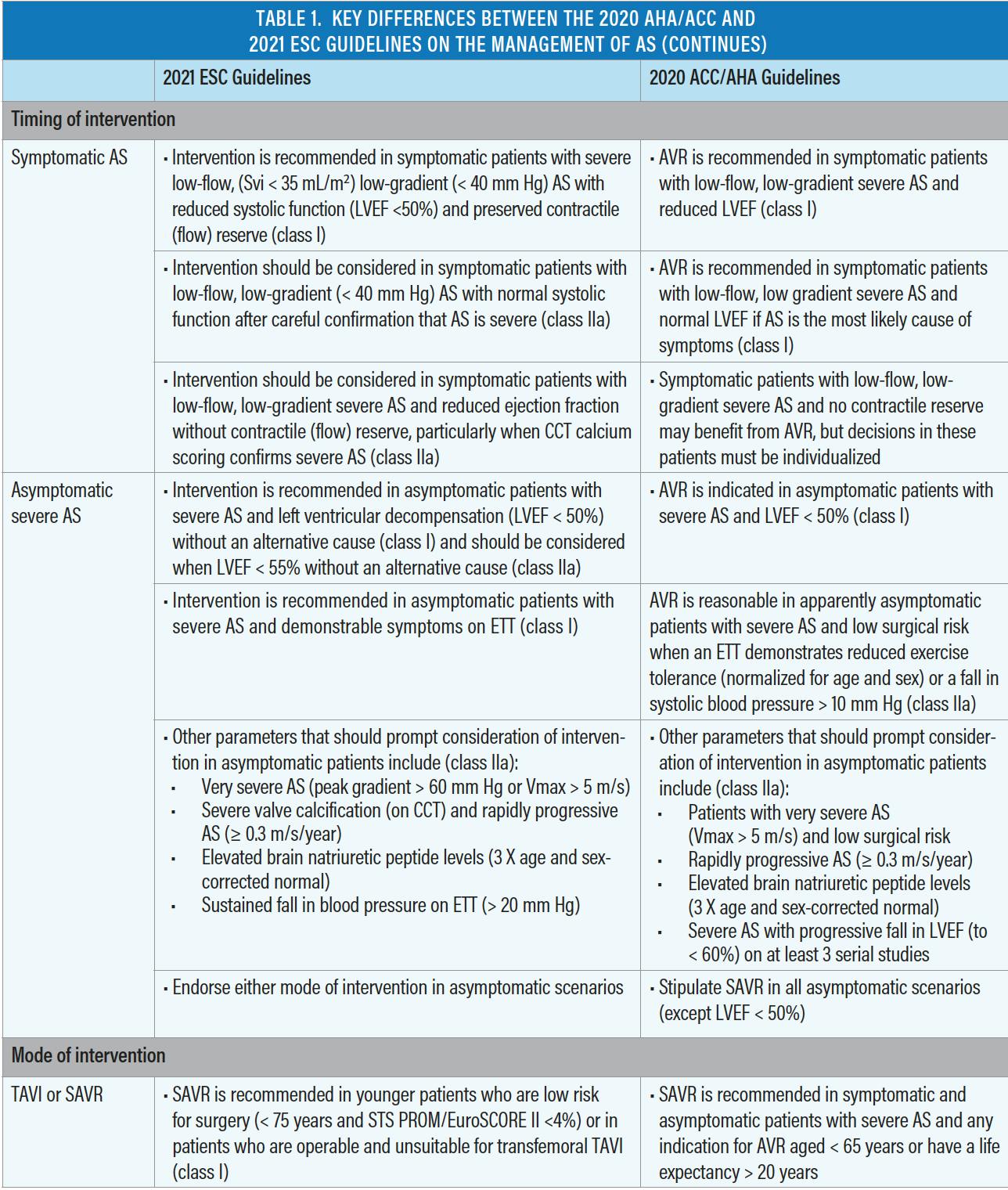
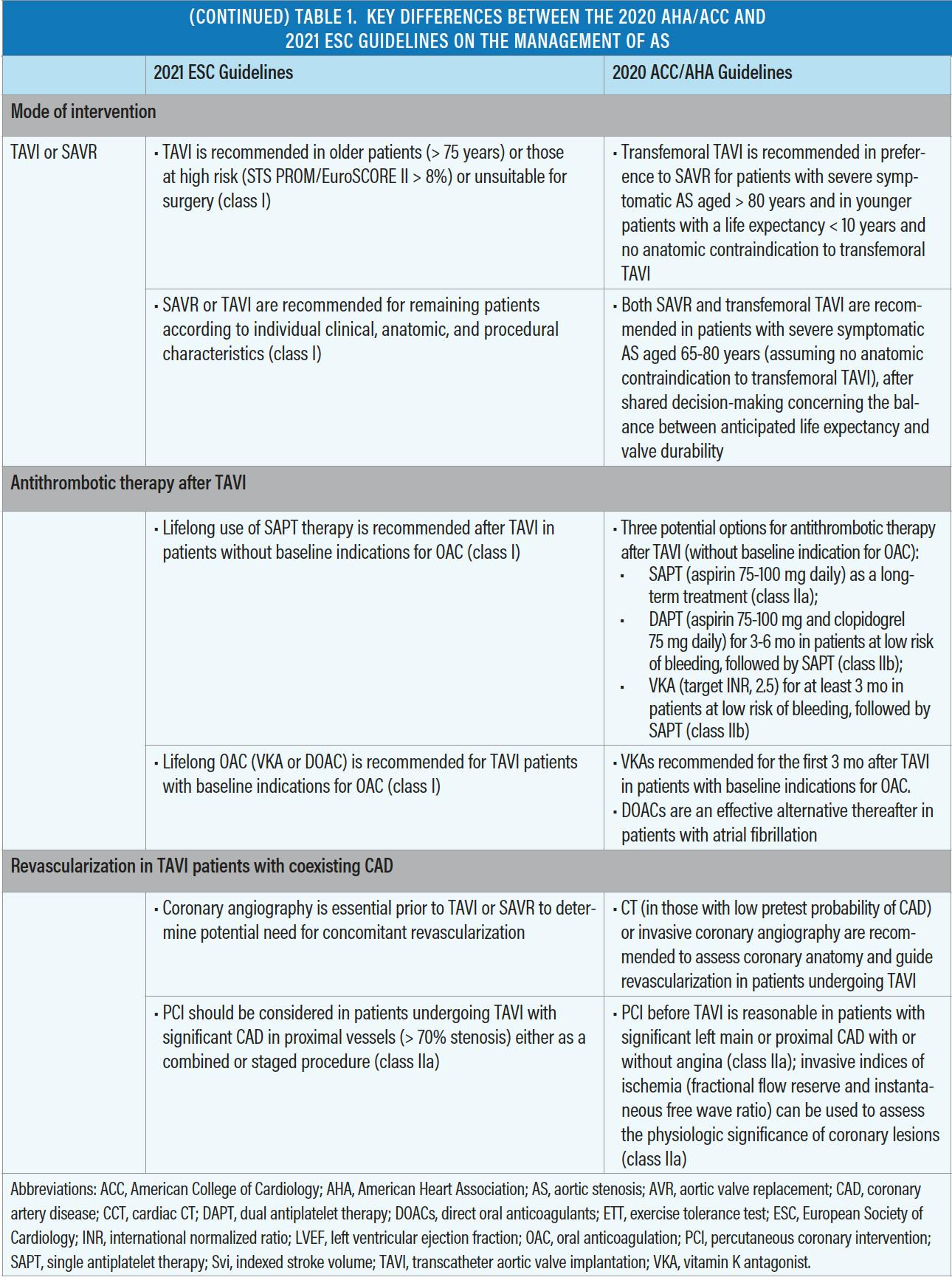
International guidelines for the management of valvular heart disease (VHD) published in 2017 emphasized the importance of early diagnosis and specialist assessment and the emerging role of transcatheter valve interventions in high-risk and inoperable patients. Several subsequent surveys at the national and international level highlighted the clinical advantages of transcatheter approaches over conventional open heart surgery and progressive trends toward earlier intervention.1 Subsequent landmark randomized controlled trials (RCTs) comparing transcatheter aortic valve replacement (TAVR) with surgical aortic valve replacement (SAVR) in patients at low surgical risk transformed the clinical management of aortic stenosis (AS)2,3 and set the stage for updated guidelines from both the United States (American College of Cardiology [ACC]/American Heart Association [AHA])4 and Europe (European Society of Cardiology [ESC]/European Association for Cardio-Thoracic Surgery [EACTS])5 in 2020 and 2021, respectively (Table 1a and Table 1b).
These new guidelines emphasize the importance of a patient-centered approach, early diagnosis, and timely referral to a specialist heart valve clinic with access to high-quality noninvasive imaging using three-dimensional echocardiography, cardiac CT, and MRI. They also stipulate that decisions regarding the need for intervention and the choice between surgery and transcatheter alternatives should be made by a multidisciplinary heart team, based upon careful evaluation of clinical, anatomic, and procedural factors (beyond conventional surgical risk scores), weighing the risks and benefits of each approach for an individual patient. Both surgical and transcatheter interventions should be undertaken in heart valve centers with active interventional cardiology and cardiac surgical programs on site that declare their local expertise and outcomes data and have sufficient procedural volume to deliver high-quality care and provide adequate training.
Access the Guidelines
2021 ESC/EACTS Valvular Heart Disease Guidelines
2020 ACC/AHA Valvular Heart Disease Guidelines
PATIENT SELECTION AND RISK STRATIFICATION
The central importance of the multidisciplinary heart team in directing high-quality clinical decision-making is emphasized in both European and United States guidelines. The heart team should include core members with an appropriate breadth of clinical experience (eg, clinical and interventional cardiologists, cardiac surgeons, imaging specialists, cardiovascular anesthetists, nurses with expertise in VHD) and have access to additional specific specialties (including care of the older physicians or intensivists) when required. Other prerequisites to inform patient selection include comprehensive diagnostics (especially advanced multimodality imaging) and a structured approach to shared decision-making where patient preference is a key consideration.
Important comorbidities (eg, lung disease and renal dysfunction) and functional statuses warrant systematic assessment, and both guidelines encourage the use of objective scientific tools for the assessment of frailty (beyond “end of the bed” evaluation). Surgical risk scores accurately predict SAVR morbidity and mortality but are not recommended for TAVR risk assessment. Currently available TAVR-specific risk tools are useful, albeit with several important limitations.
THE TIMING OF INTERVENTION
Symptomatic AS
The dismal prognosis of untreated severe symptomatic AS supports an uncontroversial and unchanged consensus for intervention (class I, both guidelines), with emphasis on prompt treatment after symptom onset to avoid the deleterious consequences of advanced disease.
Although superior to medical therapy, the comparatively poor outcomes after treatment of low-gradient AS (maximum aortic valve velocity [Vmax] < 4 m/s; mean pressure gradient < 40 mm Hg; aortic valve area < 1 cm2) inform some important nuances in both guidelines. First, measurement error should be excluded (eg, within the context of uncontrolled hypertension) and true severe AS should be confirmed through dobutamine stress echocardiography where appropriate. Intervention is recommended in the setting of reduced systolic function (left ventricular ejection fraction [LVEF] < 50%) and preserved contractile [flow] reserve [class I, both guidelines]). Increased procedural mortality in the absence of contractile reserve is recognized, although the European guidelines recommend that intervention is considered (class IIa) and the United States guidelines recommend a case-by-case approach. Intervention is also recommended in low-flow (indexed stroke volume < 35 mL/m2), low-gradient AS with preserved LVEF after careful confirmation that AS is severe (class I and class IIa in the United States and European guidelines, respectively).
Intervention is not recommended in any patient with limited life expectancy < 1 year or in whom the heart team determined that improvement of quality of life or survival is unlikely.
Asymptomatic AS
Exercise tolerance testing (ETT) is recommended in ambulant patients with asymptomatic severe AS to unmask the presence of occult symptoms that would support the need for intervention (class I, both guidelines).
Left ventricular decompensation (LVEF < 55%) without an alternative cause should prompt intervention (class I, both guidelines). There is also agreement that SAVR should be performed in patients with severe AS who are undergoing cardiac surgery for another reason (class I, both guidelines) and may be considered in the same setting in patients with moderate AS (class IIb) while balancing the competing risks of AS progression and repeat intervention.
Other adverse prognostic features that imply current or impending left ventricular decompensation and should prompt consideration of intervention in asymptomatic patients (class IIa, both guidelines) include very severe (Vmax > 5 m/s) or calcified and rapidly progressive (≥ 0.3 m/s/year) AS; elevated brain natriuretic peptide levels (elevated threefold after adjusting for age and sex); and sustained fall in blood pressure on ETT. Intervention may also be considered (class IIb) if the LVEF is < 55% without alternative cause (Europe) or falls to < 60% in serial studies (United States). Importantly, both guidelines emphasize that low procedural risk is a specific prerequisite to intervention in asymptomatic patients. Finally, in a more subtle distinction directly reflecting the underlying evidence, the United States recommendations expressly stipulate SAVR in all asymptomatic scenarios (except LVEF < 50%), whereas the European guidelines endorse either mode of intervention while acknowledging that the evidence base to support the use of TAVR in asymptomatic patients is limited.
The potential benefit of intervention in asymptomatic patients beyond these specific settings is the subject of fervent ongoing research. The marked benefit of early SAVR in recent small RCTs of younger asymptomatic patients with Vmax > 4.5 m/s is acknowledged,6,7 and the keenly anticipated findings of several ongoing trials, including EARLY TAVR (NCT 03042104), EASY-AS (NCT04204915), and EVOLVED (NCT03094143), will likely inform future guideline recommendations.
THE MODE OF INTERVENTION
Heart Team Decision-Making
Once an indication for aortic valve intervention has been established, the appropriate mode of treatment (SAVR or TAVR) should be determined. Both European and United States guidelines reflect the new evidence from large RCTs demonstrating superior or equivalent outcomes of TAVR compared with SAVR across the spectrum of surgical risk at a minimum of 2-year follow-up2,3,8 and reinforce the critical role of the heart team in reaching this decision. Thus, both guidelines recommend that all patients with VHD being considered for intervention must undergo multidisciplinary heart team evaluation (class I). This evaluation should encompass individual clinical factors as well as anatomic and procedural characteristics to allow decision-making to be tailored to the individual patient. Critically, the final heart team recommendation should be communicated to the patient (and their family, when appropriate) enabling them to make an informed treatment choice.
The Choice Between TAVR and SAVR
The key difference between the two guidelines is the age threshold governing the choice between SAVR and TAVR. The European guidelines propose a single threshold of 75 years and recommend SAVR in low-surgical-risk patients (Society of Thoracic Surgeons [STS] Predicted Risk of Mortality [PROM]/Euroscore II < 4%) aged < 75 years, and TAVR in high-surgical-risk patients (STS PROM/Euroscore II >8%) aged > 75 years. All other patients who do not match these clear characteristics should be considered for either TAVR or SAVR according to a wide range of clinical, anatomic, and procedural factors.
In contrast, the United States guidelines have adopted a three-tier system and recommend the following: (1) SAVR in patients aged < 65 years or those with a life expectancy > 20 years; (2) TAVR in patients aged > 80 years or younger patients with a life expectancy < 10 years and no anatomic contraindication to transfemoral TAVR; and (3) TAVR or SAVR in patients aged 65 to 80 years with no anatomic contraindication to transfemoral TAVR after shared decision-making.
Beyond age, the United States guidelines also recommend the use of estimated life expectancy when considering patients for either mode of intervention. Although data concerning the long-term durability of TAVR valves beyond 5 years remain limited, both guidelines recommend consideration of the balance between estimated life expectancy, valve longevity, and the potential need for reintervention. Finally, both guidelines concur that aortic valve intervention should not be undertaken in patients with reduced life expectancy < 1 year or in those with severe comorbidities whose quality of life is unlikely to improve. Treatment in these situations should focus on palliative care.
AS Affecting Bicuspid Valves
Bicuspid aortic valve (BAV) disease is common, particularly in younger low-risk patients. Although this group was excluded from most of the large RCTs, registry data have demonstrated good outcomes after TAVR in this setting.9
The United States guidelines suggest that the choice of treatment for patients with AS affecting a BAV should remain similar to that of those with trileaflet valves, but emphasize the importance of considering other anatomic and procedural factors, given that BAV patients often have complex valve anatomy and concomitant aortic root dilation that may favor surgical intervention. Similarly, the European guidelines recommend surgical intervention in younger BAV patients and reinforce the importance of considering anatomic and procedural factors when determining the appropriate mode of intervention. Both guidelines provide a class I indication for surgery in patients with AS affecting a bicuspid valve and associated aortic dilation.
ANTITHROMBOTIC THERAPY IN TAVR PATIENTS
Recommendations in patients without a baseline indication for oral anticoagulation (OAC) antithrombotic therapy after TAVR aims to reduce the risk of valve/leaflet thrombosis and the incidence of thromboembolic adverse events. The European guidelines recommend lifelong use of single antiplatelet therapy (SAPT) after TAVR in patients without baseline indications for OAC (class I), while routine use of OAC is contraindicated in patients without a baseline indication for this treatment (class III). In contrast, the United States guidelines propose three options for antithrombotic therapy after TAVR: (1) SAPT (aspirin 75-100 mg daily) as a long-term treatment (class IIa); (2) dual antiplatelet therapy (DAPT; aspirin 75-100 mg and clopidogrel 75 mg daily) for 3 to 6 months in patients at low risk of bleeding followed by SAPT (class IIb); and (3) vitamin K antagonist (VKA; target international normalized ratio, 2.5) for at least 3 months in patients at low risk of bleeding followed by SAPT (class IIb). Treatment with direct OACs (DOACs) plus aspirin (75-100 mg daily) is contraindicated in the absence of other indications for OAC due to an excess risk of bleeding.
Supporting Evidence
Previous recommendations regarding the use of DAPT for 3 to 6 months after TAVR were derived from the pivotal RCTs that demonstrated the effectiveness and safety of TAVR. Two previous RCTs, ARTE and POPular TAVI, showed that SAPT (aspirin 75 mg daily) reduced the risk of major adverse events and bleeding after TAVR compared to DAPT.10,11 Furthermore, a subsequent meta-analysis of three small RCTs showed a significant increase in major or life-threatening bleeding associated with use of DAPT compared with aspirin, and no difference in ischemic outcomes.12 These data support the class I recommendation in the European guidelines for use of SAPT after TAVR in patients with no baseline indication for OAC. Data derived from subanalysis of the PARTNER II trial demonstrating reduced incidence of increasing mean gradient (> 10 mm Hg) 1 year after TAVR in patients receiving OAC treatment (95% warfarin) support the weaker United States guideline recommendation of VKA anticoagulation for at least 3 months after TAVR in patients with low bleeding risk.13 Finally, the GALILEO trial investigating the safety and efficacy of rivaroxaban (10 mg daily) plus aspirin (75-100 mg daily) versus DAPT (low-dose aspirin plus clopidogrel 75 mg daily) was terminated prematurely owing to a higher risk of death or thromboembolic complications in the rivaroxaban group.14
Recommendations in Patients With a Baseline Indication for OAC
The European guidelines recommend the use of lifelong OAC (VKA or DOAC) for TAVR patients with baseline indications for OAC (class I). In contrast, the United States guidelines specifically recommend VKAs for the first 3 months after TAVR in patients with baseline indications for OAC and DOACs as an effective alternative thereafter in patients with atrial fibrillation (AF) (class I). VKAs are considered reasonable in patients with AF of recent onset within 3 months after TAVR (class IIa).
Supporting Evidence
The European guideline recommendations are based on findings from the POPular TAVI trial, in which rates of bleeding with OAC alone were lower at 1-month and 1-year follow-up than with OAC plus clopidogrel.15 There was no difference in the incidence of ischemic endpoints in this trial, although a further observational study suggested a higher risk of ischemic events with DOACs compared to VKAs 1 year after TAVR (after adjustment for potential cofounders).16 The United States guidelines underline the findings of large registries wherein the use of DOACs in bioprosthetic valve patients with AF was not associated with an increased risk of thromboembolic events and emphasize conflicting data concerning the safety and efficacy of DOACs in patients with AF early after TAVR.14,16-18
REVASCULARIZATION IN TAVR PATIENTS WITH COEXISTING CORONARY ARTERY DISEASE
Coexisting coronary artery disease (CAD) is frequent in AS patients, with a prevalence ranging from 15% to 80% based upon the definition of CAD and the population assessed. Both the European and United States guidelines recommend coronary angiography in patients undergoing TAVR to determine the coronary anatomy and guide decisions concerning revascularization (class I). Contrast-enhanced coronary CTA is strongly recommended as an alternative to invasive assessment in patients with a low probability of CAD in the United States guidelines (class I), whereas the European guidelines suggest that this mode of investigation should be considered in this setting (class IIa). The United States guidelines also suggest that invasive indices of ischemia (fractional flow reserve and instantaneous free wave ratio) are attractive tools to assess the physiologic significance of coronary lesions despite a relative lack of supporting evidence.
Both guidelines provide consistent recommendations supporting the use of percutaneous coronary intervention (PCI) in conjunction with TAVR in patients with significant proximal CAD (class IIa) and the use of SAVR/coronary artery bypass grafting rather than TAVR/PCI in patients with severe AS and complex CAD (left main bifurcation disease and/or complex multivessel CAD [SYNTAX score > 33]) (class IIa). However, the recently published ACTIVATION trial has demonstrated the potential risks of PCI in elderly TAVR patients with bystander CAD associated with minimal or no symptoms, principally related to the excess risks of bleeding associated with postprocedural DAPT.19 In the absence of further RCTs to evaluate the benefits and correct timing of revascularization, both guidelines advocate an individualized approach taking account of several factors, including the presence of chest pain or significant ischemia, safety of DAPT, and anatomic factors such as lesion location, complexity, and the technical feasibility of PCI.
CONCLUSION
Although transcatheter intervention for VHD is a rapidly moving field, further research is needed to refine existing risk stratification tools governing the timing and mode of intervention, establish the durability of TAVR devices, define minimum procedural volume to achieve optimal outcomes, determine the safety and efficacy of DOACs in the first 3 months after surgical or transcatheter bioprosthetic valve implantation, and provide guidance concerning the optimal management of coexisting CAD in younger low-risk patients. This research will inform future guideline recommendations on both sides of the Atlantic Ocean—meanwhile, a patient-focused heart team approach remains essential to secure optimal outcomes.
1. Iung B, Delgado V, Rosenhek R, et al. Contemporary presentation and management of valvular heart disease in Europe: the EURObservational Research Programme Valvular Heart Disease II Registry. Circulation. 2019;140:1156-1169. Doi: 10.1161/CIRCULATIONAHA.119.041080
2. Leon M, Mack M, Hahn R, et al for the PARTNER 3 investigators. Outcomes 2 years after transcatheter aortic valve replacement in patients at low surgical risk. J Am Coll Cardiol. 2021;77:1149-1161. doi: 10.1016/j.jacc.2020.12.052
3. Forrest JK, Deeb GM, Yakubov SJ, et al. Two year outcomes after transcatheter vs surgical aortic valve replacement in low risk patients. J Am Coll Cardiol. 2022;79:882-896.
4. Otto CM, Nishimura RA, Bonow RO, et al. 2020 ACC/AHA guideline for the management of patients with valvular heart disease: a report of the American College of Cardiology/ American Heart Association Joint Committee on Clinical Practice Guidelines. J Am Coll Cardiol. 2020;77:e25-e197. doi: 10.1016/j.jacc.2020.11.018
5. Vahanian A, Beyersdorf F, Praz F, et al. 2021 ESC/EACTS guidelines for the management of valvular heart disease. Eur J Cardiothorac Surg. 2021;60:727-800. doi: 10.1093/eurheartj/ehab395
6. Kang DH, Park SJ, Lee SA, et al. Early surgery or conservative care for asymptomatic aortic stenosis. N Engl J Med. 2020;382:111-119. doi: 10.1056/NEJMoa1912846
7. Banovic M, Putnik S, Penicka M, et al. Aortic valve replacement versus conservative treatment in asymptomatic severe aortic stenosis: the AVATAR trial. Circulation. 2022;145:648-658. doi: 10.1161/CIRCULATIONAHA.121.057639
8. Siontis GCM, Overtchouk P, Cahill TJ, et al. Transcatheter aortic valve implantation versus surgical aortic valve replacement for treatment of symptomatic severe aortic stenosis: an updated meta-analysis. Eur Heart J. 2019;40:3143-3153. doi: 10.1093/eurheartj/ehz275
9. Makkar R, Yoon S-H, Leon M, et al. Association between transcatheter aortic valve replacement for bicuspid versus tricuspid aortic stenosis and mortality or stroke. JAMA. 2019;321:2193-2202. doi: 10.1001/jama.2019.7108
10. Rodés-Cabau J, Masson JB, Welsh RC, et al. Aspirin versus aspirin plus clopidogrel as antithrombotic treatment following transcatheter aortic valve replacement with balloon expandable valve: the ARTE (Aspirin Versus Aspirin + Clopidogrel Following Transcatheter Aortic Valve Implantation) randomised clinical trial. JACC Cardiovasc Interv. 2017;10:1357-1365. doi: 10.1016/j.jcin.2017.04.014
11. Brower J, Nijenhuis VJ, Dlewi R, et al. Aspirin with or without clopidogrel after transcatheter aortic-valve implantation. N Engl J Med. 2020;383:1447-1457. doi: 10.1056/NEJMoa2017815
12. Maes F, Stabile E, Ussia GP, et al. Meta-analysis comparing single versus dual antiplatelet therapy following transcateter aortic valve implantation. Am J Cardiol 2018;122:310-315. doi: 10.1016/j.amjcard.2018.04.006
13. Chakravarty T, Patel A, Kapadia S, et al. Anticoagulation after surgical or transcatheter bioprosthetic aortic valve replacement. J Am Coll Cardiol. 2019;74:1190-1200. doi: 10.1016/j.jacc.2019.06.058
14. Dangas GD, Tijssen JGP, Wohrle J, et al. A controlled trial of rivaroxaban after transcatheter aortic-valve replacement. N Engl J Med. 2020;382:120-129. doi: 10.1056/NEJMoa1911425
15. Nijenhuis VJ, Brouwer J, Delewi R, et al. Anticoagulation with or without clopidogrel after transcatheter aortic-valve implantation. N Engl J Med. 2020;382:1696-1707. doi: 10.1056/NEJMoa1915152
16. Jochheim D, Barbanti M, Capretti G, et al. Oral anticoagulant type and outcomes after transcatheter aortic valve replacement. JACC Cardiovac Interv. 2019;12:1566-1576. doi: 10.1016/j.jcin.2019.03.003
17. Briasoulis A, Inampudi C, Akintoye E, et al. Safety and efficacy of novel oral anticoagulants versus warfarin in Medicare beneficiaries with atrial fibrillation and valvularherat disease. J Am Heart Assoc. 2018;7:e008773. doi: 10.1161/JAHA.118.008773
18. Mangner N, Crusius L, Haussig S, et al. Continued versus interrupted oral anticoagulation during transfemoral transcatheter aortic valve implantation and impact of post-operative anticoagulant management on outcome in patients with atrial fibrillation. Am J Cardiol. 2019;123:1134-1141. doi: 10.1016/j.amjcard.2018.12.042
19. Patterson T, Clayton T, Dodd M, et al. ACTIVATION (PercutAneous Coronary inTervention prIor to transcatheter aortic VAlve implantation): a randomized clinical trial. JACC Cardiovasc Interv. 2021;14:1965-1974. doi: 10.1016/j.jcin.2021.06.041
Advertisement
Advertisement