Advertisement
Advertisement
March/April 2022
Conduction Disturbance After TAVR
How to decide for permanent pacing and impact of new pacemakers after TAVR.
Transcatheter aortic valve replacement (TAVR) has become the standard of care for treatment of symptomatic severe aortic stenosis irrespective of surgical risk.1,2 Despite advances in the field of TAVR with respect to newer devices and techniques, conduction defects requiring permanent pacemaker (PPM) implantation remain a concern, including high-grade atrioventricular block and new-onset left bundle branch block (LBBB) due to the close proximity of the native aortic valve root to the conduction system (Figure 1).3 The rates of PPM requirement after TAVR can range between 6.7% and 39.2% in individual studies, with a pooled incidence of 19% according to a contemporary meta-analysis.4 This is a particularly important as TAVR is now being offered to a younger group of low-risk patients.5
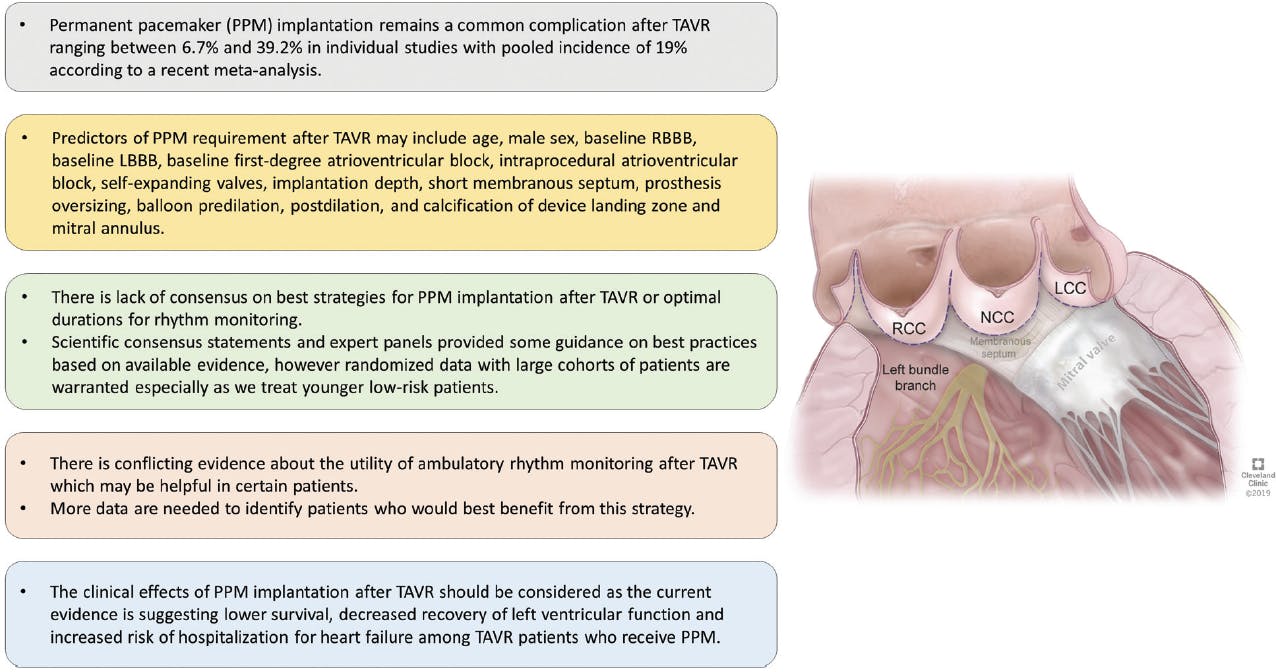
Figure 1. Summary of evidence about PPM in patients undergoing TAVR. Reprinted with permission, Cleveland Clinic Foundation ©2022. All Rights Reserved. Abbreviations: LCC, left coronary cusp; NCC, noncoronary cusp; RCC, right coronary cusp.
HOW TO DECIDE FOR PERMANENT PACING?
Predictors of New PPM Implantation
There are several risk factors that could predict the risk of developing new-onset conduction abnormalities and PPM requirement after TAVR. Baseline right bundle branch block (RBBB) is the one of the strongest predictors of PPM implantation.6 Other predictors include older age, male sex, baseline LBBB, baseline first-degree atrioventricular block, intraprocedural atrioventricular block, self-expanding valve type, valve implantation depth, short membranous septum, prosthesis oversizing, balloon predilation, postdilation, and calcification of device landing zone and the mitral annulus.4,7
Current Recommendations for Management of Conduction Disturbances Post-TAVR
There is a paucity of strong data from randomized clinical trials or guidelines regarding the indications for PPM implantation in patients undergoing TAVR. The optimal timing for PPM implantation also remains unclear. This could be challenging as some periprocedural conduction abnormalities are transient and may resolve or not evolve to high-grade atrioventricular block.3 The 2013 European Society of Cardiology guidelines recommended a period of clinical observation for patients with persistent postprocedural high-degree atrioventricular block for up to 7 days before making the decision to implant a PPM to determine whether the rhythm abnormalities are transient or not.8 However, these recommendations may not be contemporary due to recent advances in the field.
A recent scientific expert panel statement provided recommendations on management of post-TAVR conduction defects. In patients with no baseline RBBB or new electrocardiographic changes after the procedure, it may be safe to discharge patients without further monitoring. However, in patients with baseline RBBB, new-onset LBBB, or high-grade atrioventricular block, the group recommended at least 48 hours of inpatient rhythm monitoring, including at least 24 hours of temporary pacing with potential PPM implantation depending on additional inpatient monitoring.9
The American College of Cardiology published a scientific consensus statement in 2020 to give further guidance based on existing data and experience.10 Preprocedural screening for rhythm abnormalities and possible need for ambulatory rhythm monitoring should be considered based on different predictors of PPM requirement. At the conclusion of the procedure, the temporary pacer can be kept in place if the patient developed new-onset LBBB, prolongation of the PR or QRS intervals ≥ 20 milliseconds, complete transient heart block, or complete persistent heart block. Patients can be safely discharged early if they do not have a primary indication for PPM and do not exhibit new-onset LBBB or prolongation of QRS > 10% or any degree of atrioventricular block. Otherwise, they should undergo inpatient rhythm monitoring for at least 48 hours in addition to outpatient monitoring for at least 14 days.
Rapid atrial pacing may also have a role in further risk stratification of patients who may benefit from extended inpatient rhythm monitoring. In our practice, we routinely perform rapid pacing in 10-beats/min increments after withdrawing the pacing wire to the right atrium at the conclusion of the procedure. The absence of Wenckebach heart block upon rapid atrial pacing from 70 to 120 beats/min was associated with a nearly 99% negative predictive value for post-TAVR PPM requirement. This systematic approach allows a reasonable degree of safety for early same- or next-day discharge of patients after TAVR.11
Extended Outpatient Monitoring
Although most conduction disturbances usually occur in the periprocedural period, delayed life-threatening bradyarrhythmias can still occur, thus creating a need for extended ambulatory rhythm monitoring, especially among patients with early discharge.12 In a study by Ream et al, the use of 30-day event monitoring after TAVR allowed the detection of delayed high-grade atrioventricular block in 10.2% of patients who ended up requiring PPM after discharge.13 In another study by Tian et al, continuous 30-day monitoring identified patients with symptomatic delayed high-grade atrioventricular block in 7.1% and symptomatic sinus pauses in 1.6%, resulting in PPM implantation in those patients.14 The Brady-TAVR study involved the prospective blinded use of a 14-day Zio patch (iRhythm Technologies) before, immediately after, and 2 to 3 months after TAVR. We found sinus pauses of 3 seconds or more in 5.2% before TAVR, 12.7% immediately after TAVR, and 7% at 2 to 3 months after the procedure. Despite being a frequent finding, bradyarrhythmias were not associated with PPM requirement after TAVR, raising concerns about potential overtreatment of ambulatory rhythm monitoring findings when providers are not blinded.15
Further randomized studies with larger cohorts and strictly identified protocols are needed to identify patients who would benefit from extended ambulatory rhythm monitoring and define the real impact and cost-effectiveness of this strategy among patients undergoing TAVR.12
WHAT IS THE IMPACT OF NEW PACEMAKERS AFTER TAVR?
The morbidity associated with PPM requirement should be taken into consideration when making the decision to implant these devices. The need for PPM after TAVR has been linked with worse left ventricular function. A meta-analysis showed that patients who did not require PPM had significantly greater recovery of left ventricular function after TAVR as compared with those who received a PPM.16 Furthermore, PPM requirement was associated with increased risk of hospitalizations for heart failure after TAVR (relative risk, 1.18; 95% CI, 1.03-1.36; P = .02).17 The effects of PPM requirement on left ventricular function recovery and heart failure hospitalizations may be secondary to chronic right ventricular pacing, which has been previously linked with adverse effects.18
There is a great deal of contradiction in the existing data from individual studies regarding the effects of post-TAVR PPM on mortality, with more recent evidence suggesting a negative impact of PPM on survival.3 A contemporary meta-analysis of 42,927 TAVR recipients by Faroux et al was the first to demonstrate that a new PPM requirement after TAVR was associated with increased risk of all-cause mortality at 1 year after TAVR (relative risk, 1.17; 95% CI, 1.11-1.25; P < .001).17 However, the meta-analysis failed to show differences in cardiovascular death, which could be related to failure or lack of reporting the accurate causes of death, according to the authors. In another study with the longest follow-up duration, PPM was associated with increased all-cause death after 6 years of follow-up.19 Due to the deleterious effects of pacing among patients undergoing TAVR, it is important to strive toward finding novel approaches for reducing the risk of PPM related to the procedure, particularly through modifiable risk factors such as higher valve implantation techniques implantation depth.5 Future randomized data are needed to shed more light on the long-term effects of PPM among the younger low-risk TAVR patients.
CONCLUSION
Conduction disturbances and PPM requirement continue to be common after TAVR, resulting in increased morbidity and mortality. Randomized data and guidelines are necessary to identify best practices for PPM implantation and optimal durations for both inpatient and ambulatory rhythm monitoring as we expand the indications of TAVR to include low-risk patients.
1. Mack MJ, Leon MB, Thourani VH, et al. Transcatheter aortic-valve replacement with a balloon-expandable valve in low-risk patients. N Engl J Med. 2019;380:1695-1705. doi: 10.1056/NEJMoa1814052
2. Popma JJ, Deeb GM, Yakubov SJ, et al. Transcatheter aortic-valve replacement with a self-expanding valve in low-risk patients. N Engl J Med. 2019;380:1706-1715. doi: 10.1056/NEJMoa1816885
3. Sammour Y, Krishnaswamy A, Kumar A, et al. Incidence, predictors, and implications of permanent pacemaker requirement after transcatheter aortic valve replacement. JACC Cardiovasc Interv. 2021;14:115-134. doi: 10.1016/j.jcin.2020.09.063
4. Bruno F, D’Ascenzo F, Vaira MP, et al. Predictors of pacemaker implantation after transcatheter aortic valve implantation according to kind of prosthesis and risk profile: a systematic review and contemporary meta-analysis. Eur Heart J Qual Care Clin Outcomes. 2020;7:143-153. doi: 10.1093/ehjqcco/qcaa089
5. Sammour Y, Banerjee K, Kumar A, et al. Systematic approach to high implantation of SAPIEN-3 valve achieves a lower rate of conduction abnormalities including pacemaker implantation. Circ Cardiovasc Interv. 2021;14:e009407. doi: 10.1161/CIRCINTERVENTIONS.120.009407
6. Sammour Y, Sato K, Kumar A, et al. Impact of baseline conduction abnormalities on outcomes after transcatheter aortic valve replacement with SAPIEN-3. Catheter Cardiovasc Interv. 2021;96:E127-E138. doi: 10.1002/ccd.29309
7. Ullah W, Zahid S, Zaidi SR, et al. Predictors of permanent pacemaker implantation in patients undergoing transcatheter aortic valve replacement - a systematic review and meta-analysis. J Am Heart Assoc. 2021;10:e020906. doi: 10.1161/JAHA.121.020906
8. Brignole M, Auricchio A, Baron-Esquivias G, et al. 2013 ESC Guidelines on cardiac pacing and cardiac resynchronization therapy: the Task Force on cardiac pacing and resynchronization therapy of the European Society of Cardiology (ESC). Developed in collaboration with the European Heart Rhythm Association (EHRA). Eur Heart J. 2013;34:2281-2329. doi: 10.1093/eurheartj/eht150
9. Rodés-Cabau J, Ellenbogen KA, Krahn AD, et al. Management of conduction disturbances associated with transcatheter aortic valve replacement: JACC scientific expert panel. J Am Coll Cardiol. 2019;74:1086-1106. doi: 10.1016/j.jacc.2019.07.014
10. Lilly SM, Deshmukh AJ, Epstein AE, et al. 2020 ACC expert consensus decision pathway on management of conduction disturbances in patients undergoing transcatheter aortic valve replacement. J Am Coll Cardiol. 2020;76:2391-2411. doi: 10.1016/j.jacc.2020.08.050
11. Krishnaswamy A, Sammour Y, Mangieri A, et al. The utility of rapid atrial pacing immediately post-TAVR to predict the need for pacemaker implantation. JACC Cardiovasc Interv. 2020;13:1046-1054. doi: 10.1016/j.jcin.2020.01.215
12. Muntané-Carol G, Philippon F, Rodés-Cabau J. Role of continuous ECG monitoring to improve management of conduction disturbances post-transcatheter aortic valve replacement. Circ Cardiovasc Interv. 2019;12:e008674. doi: 10.1161/CIRCINTERVENTIONS.119.008674
13. Ream K, Sandhu A, Valle J, et al. Ambulatory rhythm monitoring to detect late high-grade atrioventricular block following transcatheter aortic valve replacement. J Am Coll Cardiol. 2019;73:2538-2547. doi: 10.1016/j.jacc.2019.02.068
14. Tian Y, Padmanabhan D, McLeod CJ, et al. Utility of 30-day continuous ambulatory monitoring to identify patients with delayed occurrence of atrioventricular block after transcatheter aortic valve replacement. Circ Cardiovasc Interv. 2019;12:e007635. doi: 10.1161/CIRCINTERVENTIONS.118.007635
15. Tarakji KG, Patel D, Krishnaswamy A, et al. Bradyarrhythmias detected by extended rhythm recording in patients undergoing transcatheter aortic valve replacement (Brady-TAVR study). Heart Rhythm. 2022;19:381-388. doi: 10.1016/j.hrthm.2021.11.020
16. Mohananey D, Jobanputra Y, Kumar A, et al. Clinical and echocardiographic outcomes following permanent pacemaker implantation after transcatheter aortic valve replacement: meta-analysis and meta-regression. Circ Cardiovasc Interv. 2017;10:e005046. doi: 10.1161/CIRCINTERVENTIONS.117.005046
17. Faroux L, Chen S, Muntane-Carol G, et al. Clinical impact of conduction disturbances in transcatheter aortic valve replacement recipients: a systematic review and meta-analysis. Eur Heart J. 2020;41:2771-2781. doi: 10.1093/eurheartj/ehz924
18. Nadeem F, Tsushima T, Ladas TP, et al. Impact of right ventricular pacing in patients who underwent implantation of permanent pacemaker after transcatheter aortic valve implantation. Am J Cardiol. 2018;122:1712-1717. doi: 10.1016/j.amjcard.2018.07.046
19. Costa G, Zappulla P, Barbanti M, et al. Pacemaker dependency after transcatheter aortic valve implantation: incidence, predictors and long-term outcomes. EuroIntervention. 2019;15:875-883. doi: 10.4244/EIJ-D-18-01060
Advertisement
Advertisement