Advertisement
Advertisement
July/August 2021
Sponsored by ACIST
Making the Case for CI-AKI Prevention With the ACIST CVi™ Contrast Delivery System
How can this technology benefit my practice and my cath lab?
As a busy interventional and structural cardiologist who has trained in a variety of cath lab settings and performed a range of procedures, I have noted how much variation there is from cath lab to cath lab in the types of technology and equipment that are available. All cath labs seem to have a variety of setups and use different equipment, but the defining difference seems to be the presence or absence of an automated contrast delivery system as the predominant method of injecting contrast.
Below are some common questions that interventional cardiologists and cath lab managers have asked about the automatic CVi Contrast Delivery System (ACIST) and my thoughts given my experience with this technology.
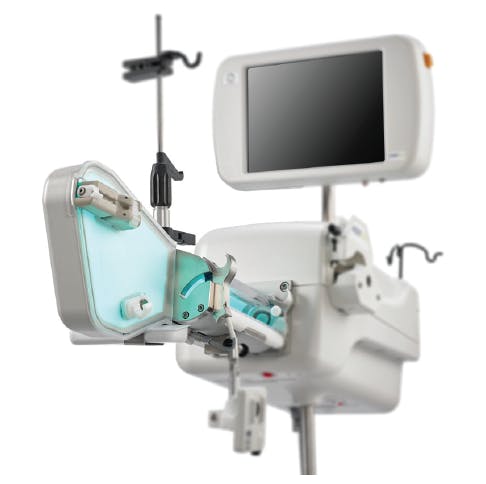
What are the safety features of ACIST’s CVi Contrast Delivery System?
Dr. Krishnan: CVi has many safety features that can help reduce the risk of air injection. The tilt of the syringe and the autorefill/purge chambers reduce the chance that air can inadvertently be introduced into the contrast tubing. The most important feature is the air column detector. This is instrumental in catching air columns in the contrast tubing that could contribute to patient harm in coronary procedures if not visually identified. Combined with the standard cath lab team’s vigilance, the CVi Contrast Delivery System provides an additional layer of oversight during my busy lab days to guard against air embolism. It allows me to feel comfortable with having anyone who scrubs do the injection regardless of their experience level. Finally, I am also able to put more distance between myself and the fluoroscopic equipment during cine runs as I can step back as we inject contrast.
How long does the CVi Contrast Delivery System take to set up? Will cath lab turnaround time be longer?
Dr. Krishnan: Turnaround time is actually faster. Setup is simpler than the traditional hand manifold and can be done prior to the patient getting on the table, which means there is less prep time once the patient is draped. Furthermore, there are no more “spaghetti strings” of the contrast, saline, transducer, and waste lines coming off of the hand manifold. The CVi has just one hand controller, a stopcock with high-pressure tubing, and that’s it.
How do I control how much contrast is injected during the procedure? Does the CVi system use more contrast?
Dr. Krishnan: This is a great point. I have found that I actually use less contrast because I can precisely select the exact amount of contrast I want to inject in each artery. Furthermore, at the end of the case, I don’t have to guess how much contrast I actually used because the CVi Contrast Delivery System keeps track of it during the case. You still have to subtract waste from the contrast total, but the CVi system gives you more control and knowledge of how much contrast is injected during the procedure compared to the hand manifold, which means less guessing! One concern that I always have if someone else is injecting is whether they are injecting too much or too little contrast. With CVi, I can set the exact amount I would like to be injected each time.
What about large-volume injections?
Dr. Krishnan: You can do both large-volume injections and smaller coronary injections without having to disconnect and reconnect. Although I rarely perform left ventriculography or aortography, when I do there is no other bulky power injector required. This saves time and money because we waste less contrast as a lab. This also frees up the circulator or nurse (depending on how your lab works) to focus on the patient and ensure their safety and comfort during the procedure. This also saves time as we do not have to air out the line during big injections as it is already done as part of the set up for the CVi.
We do a lot of peripheral/structural cases. Does the CVi Contrast Delivery System work for that?
Dr. Krishnan: The three main settings that can be adjusted on the CVi are flow rate, amount of contrast delivered, and rise time. You get all of these options for each injection, and you can inject 5 or 50 mL easily depending on your preferred settings. You just input the settings for each injection on the touch screen, and when you hit the button, that’s how much contrast will be delivered. There are no separate settings or setup for peripheral or structural versus coronary cases. In fact, the syringe containing the contrast does not need to be swapped out between these case types either, making time between cases more efficient.
Is there support for doing a peripheral runoff? Can we sync the CVi Contrast Delivery System with our fluoroscopy system?
Dr. Krishnan: Yes, there is a cable that can be connected with most standard x-ray systems. I really love this feature because it allows me to step out of the room for higher-radiation dose images, further enhancing workplace safety for myself and the cath lab team.
How often does the contrast need to be filled?
Dr. Krishnan: There is one syringe in the CVi that holds 100 mL of contrast, and there is a hook to hang another contrast bottle up to 500 mL at the same time, which can be used to autofill the syringe inside the CVi. It does need to be refilled once the 100 mL of contrast is depleted, but it refills at 3 mL/s, and this happens automatically. Moreover, the operator or assistant can manually refill it when the main syringe is getting low to not interrupt the physician in the middle of the case.
How do I convince my hospital administration it is worth the investment?
Dr. Krishnan: This is a question I am often asked by my colleagues. The CVi system is worth the investment due to savings on multiple levels.
- The lab saves on the amount of contrast used during each case because the syringe is multiuse.
- The lab saves time due to faster room turnover and set up, as well as saving time during big injections.
- The physicians and staff are exposed to less radiation because the operators can step back from the table before they inject.
- The CVi Contrast Delivery System combines the power injector and manifold into one so it saves on disposables and repair costs.
- It decreases contrast-induced acute kidney injury (CI-AKI) up to 30% versus manual injection1,2; therefore, it can be a key tool to manage patients at risk for CI-AKI.
Another set of questions that I am asked often is how to build a low-contrast percutaneous coronary intervention (PCI) center of excellence. As the population of patients going to the cath lab gets progressively sicker and more complex, chronic kidney disease (CKD) is a comorbidity that we are seeing increasingly in our patients. Unfortunately, many patients are not referred for coronary angiography due to pre-existing CKD
Building a low-contrast PCI center of excellence in your community is one way to deal with this growing problem. This is yet another business argument for bringing in new technology like a contrast delivery system because it should also help grow the cath lab volume.
What are some of the backbones of a low-contrast PCI center of excellence?
Dr. Krishnan: This is a great question. The backbone starts with preoperative workup of a potential cath patient. Factors outside of cardiology must be considered. Many patients with chest pain or shortness of breath often get CT scans in the emergency room. These CT scans are often ordered with contrast that can easily amount to 90 to 120 mL delivered intravenously. As is well recognized, this often takes 48 to 72 hours to manifest as CI-AKI and in that time frame, patients are often referred to the cardiac cath lab. Being more mindful of the contrast the patient received prior to coming to the cardiac cath lab is very important, especially in patients who are transferred in from other hospitals.
Furthermore, staged procedures are often underused in patients with CKD. Staging stable lesions a few days later as an outpatient can help decrease the immediate contrast burden and allow patients’ kidneys at least a few days to recover between contrast loads.
How does a contrast delivery system like CVi reduce contrast use?
Dr. Krishnan: When performing diagnostic catheterization, I have found that 2 to 3 mL is all that is needed to fill most right coronary arteries. In fact, with my low-contrast protocol that uses limited angiography for clearly normal vessels and dialing down the standard dosing for left and right coronary injections on the CVi display console, I have obtained a complete diagnostic coronary angiogram with 10 mL or less of contrast. CVi gives you, the operator, total control of how much contrast is injected and how quickly it is injected. Regardless of who is injecting contrast using a hand manifold, everyone is watching the screen during the injection. With CVi, you can watch the screen while knowing exactly how much contrast is being injected with each push of a button.
Besides using a contrast delivery system, how else can I reduce contrast use?
Dr. Krishnan: Performing more imaging with intravascular ultrasound (IVUS) and less with angiography will inherently save on contrast usage—not to mention more IVUS will also help improve outcomes.3 This is something that many operators still struggle with. Personally, I am a 100% IVUS user. I pull an IVUS catheter for every single PCI I perform. This helps me be more precise in placing stents and choosing stent length and diameter. It also helps me avoid geographic miss, stent underexpansion, and stent malapposition.
Additionally, I use the diagnostic angiogram reference images to wire culprit lesions instead of having my assistant give me puffs of contrast. I look at the curve of the artery and try to use the patient’s bony landmarks to judge my wire position.
If you are also interested in reducing contrast usage, there is a growing body of literature supporting the use of fractional flow reserve (FFR) post-PCI as well.4
The ACIST Navvus® II Rapid Exchange microcatheter is a great tool to use in these settings as you can do a quick FFR over your coronary wire before you take a final image. This will indicate if you have an acceptable result or if you need to do more work prior to taking a final angiogram. These techniques can help you successfully and safely reduce your contrast usage.
See Figures 1A and 1B as an example of a patient before and after low-contrast PCI. This patient had advanced stage 4 CKD and was referred for low-contrast PCI due to ongoing anginal symptoms refractory to optimal medical therapy, and we were able to complete the staged PCI with 5 mL of contrast.
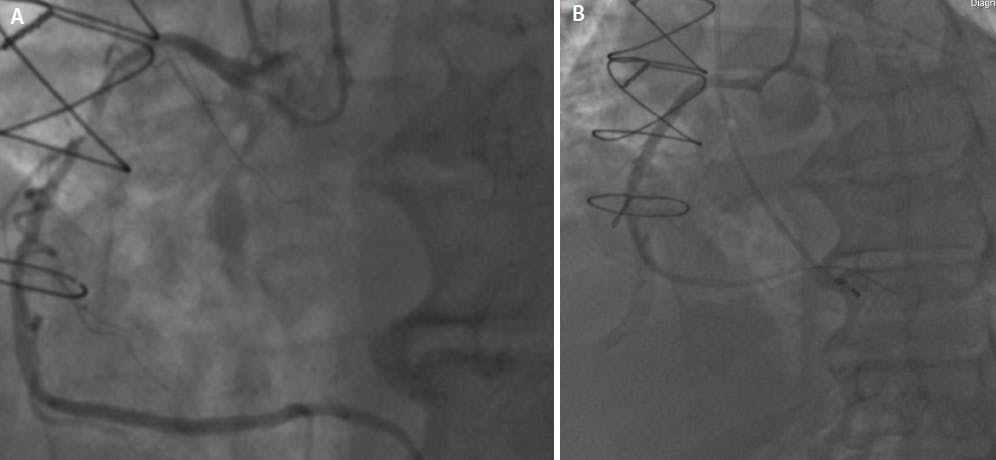
Figure 1. Diagnostic imaging of the right coronary artery showing 85% to 90% tubular proximal/mid RCA lesion. Subsequent staged PCI given the patient’s advanced stage 4 CKD (A). Post-PCI image of the right coronary artery after one 3.5 X 38-mm drug-eluting stent was placed using IVUS and fractional flow reserve guidance. The entire PCI was completed with 5 mL of contrast (B).
If you have any questions about automated contrast injectors, performing low-contrast PCI, or using IVUS in your everyday practice please feel free to contact me at xsandeepx@gmail.com. I am happy to discuss best practices for starting a low-contrast PCI Center of Excellence at your institution.
1. Minsinger KD, Kassis HM, Block CA, et al. Meta-analysis of the effect of automated contrast injection devices versus manual injection and contrast volume on risk of contrast-induced nephropathy. Am J Cardiol. 2014;113:49-53. doi: 10.1016/j.amjcard.2013.08.040
2. Call J, Sacrinty M, Applegate R, et al. Automated contrast injection in contemporary practice during cardiac catheterization and PCI: effects on contrast-induced nephropathy. J Invasive Cardiol. 2006;18:469-474.
3. Zhang J, Gao X, Kan J, et al. Intravascular ultrasound versus angiography-guided drug-eluting stent implantation: the ULTIMATE trial. J Am Coll Cardiol. 2018;72:3126-3137. doi: 10.1016/j.jacc.2018.09.013
4. Thakur U, Khav N, Comella A, et al. Fractional flow reserve following percutaneous coronary intervention. J Interv Cardiol. 2020. doi: 10.1155/2020/7467943

Advertisement
Advertisement