Advertisement
Advertisement
July/August 2021
Total Cost of Care: Understanding the Economics of Your Program
A discussion on cost comparisons, expert reviews of value-based reimbursement models, and a deep dive into defining total cost of care components for developing transformational cost strategies.
Hospitals face continuous obstacles centered around reimbursement and variable costs associated with care, especially for cath lab procedures. The Centers for Medicare & Medicaid Services support the need to tackle the challenge of containing health care costs, which are expected to reach $6.2 trillion by 2028.1
As the share of the gross domestic product spent on health consumption continues to climb, it’s important to define the drivers of the total cost of care, explore their significance, and motivate health care systems to proactively manage inpatient and outpatient care in a financially responsible manner.
Over the last decade, cardiovascular provider organizations have integrated with health care systems to align the economic interests and organize more efficient delivery models. Risk is shifting from payers to providers in emerging models, requiring health care leaders to develop new strategies to optimize care delivery in terms of quality, patient outcomes, and the cost to deliver care.
By providing a comparison between the cost to an organization for care delivery and the cost to the payer and patient for receiving care, we can uncover each unique perspective and see the bigger picture of the total cost of care through a lens most of us haven’t historically done.
KEY DEFINITIONS
Operational efficiency is a concept that has gained ground relative to cath labs. Identifying inadequacies and wastefulness in cath lab care delivery can optimize production, save time, and reduce costs. At the root of operational efficiency is taking a closer look at the total cost of care, which includes the cost to deliver care and the cost to reimburse care.
Cost to Deliver Care
The principal owners are the provider or organization that is delivering the care, including:
- Hospital organization
- Provider organization
- Ancillary services
When calculating costs to deliver care, you’ll need to consider direct costs and indirect costs. These costs exclude charges and center on how much profit and loss are falling on your expense side. In other words, what are the costs you’re paying to care for patients, today?
Optimizing care delivery in the cath lab is a significant area of focus for health care systems to optimize care delivery and succeed today and in the future. Direct costs are directly attributable to the cath lab costs to deliver care. There are a number of elective and routine procedures we can predict, but we also have to be available for urgent procedures, which can affect our direct costs.
It is also important to consider how much it costs to keep your cath lab open, such as the salaries and payroll of cath lab administration. The following are examples of those direct fixed costs:
- Salary of cath lab staff (unless you are able to staff to volume)
- Cost of maintenance of the cath lab
- Capital and depreciation of cath lab equipment
- Environmental services
Direct variable costs are the other components of direct costs and vary depending on the number of procedures done. These costs include:
- Devices such as stents, implants, and closure devices
- Disposable equipment used during procedures, as well as supplies
- Drugs, such as periprocedural medications (eg, bivalirudin)
- Room utilities, including electricity for C-arm, etc.
- Salary of cath lab staff if you’re able to staff to volume, with consideration to overtime and weekend hours
Indirect costs are the third factor to consider for the total cost to deliver care. These are not directly attributable to the cath lab but are more focused on the system-level infrastructure costs to keep the hospital system open and running. They are not necessarily managed by the cath lab but must be considered when evaluating the total cost of care. Indirect costs include:
- Salary of the hospital C-suite leaders
- System administration, marketing, infrastructure support
- Maintenance of facilities
- Interest on institutional debt
Influences on Cost of Care
In this ever-changing environment, it is important to continue to look for opportunities to decrease internal patient care costs. This can be a challenge when the reality is that 60% to 70% of our cath lab patients are Medicare patients and, in many cases, providers are not breaking even based on their episodes. Table 1 shows some of the fixed and variable direct costs that organizations should look at first when working to decrease internal costs. These are costs that can fluctuate based on patient needs, costs of goods, and staff requirements.
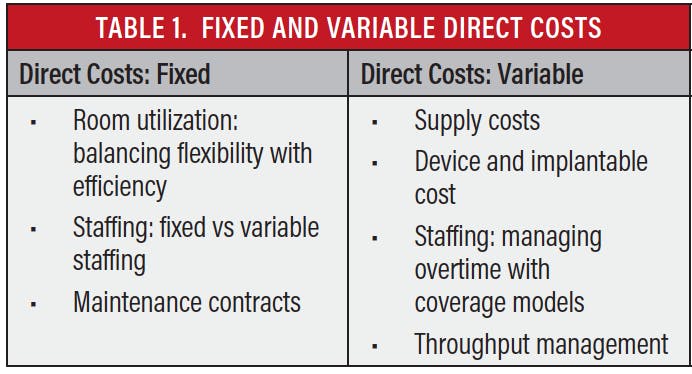
Working with the rest of the hospital team to think about the overall patient care cost is also important as the patient throughput and length of stay could be affected by what is done in the cath lab. Another factor to think about is place of service. If a patient is qualified for inpatient care when he or she really should be outpatient, caring for him or her as an inpatient will add unnecessary internal costs, such as staff and care facility costs. This can also be said for the ambulatory setting, which has its own cost structure. It is important to consider what your patient is qualified for when it comes to reimbursement and ensure that is how we are supporting them. Managing patient care needs will also help with staffing decisions to match resources with the place of service. Finally, it’s important to consider complications, delays, and anticipated care needs.
Costs to Reimburse Care
Providers are being measured based on traditional reimbursement models and alternative payment models. This makes it even more important for us to work with the full cardiovascular care team to ensure that we are managing patient care costs to the best of our abilities. Table 2 shows the different payment models.
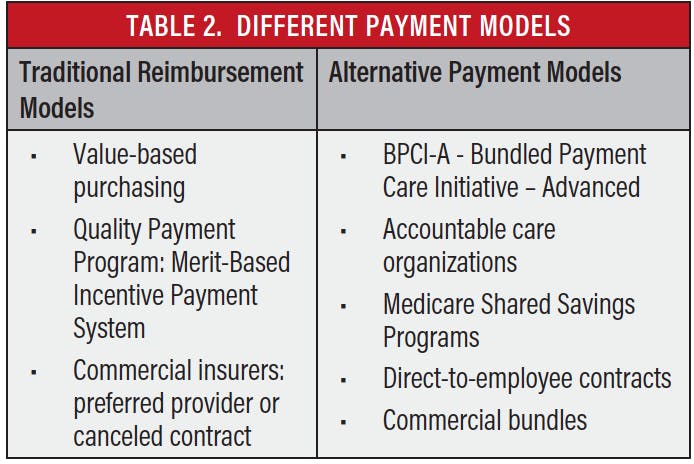
The following list details areas to consider when thinking about cost management and utilization of service management, which contributes to the costs to the payer:
- Managing complications: How are vascular complications, hospital-acquired complications and infections, and any respiratory complications managed?
- Readmission reduction: How are transitional care, postdischarge, and follow-up handled? How are high-risk patients identified? How are urgent needs handled, and do patients know who to contact after they are released? Is your care pathway mapped out?
- Appropriate utilization strategies: Are the right procedures being provided to the right patient? Are guidelines and appropriate use criteria used for making decisions, working with the heart teams?
- Appropriate coding: Do your coding levels reflect the acuity of your patients?
Risk Adjustment
The term “risk” has taken on a new meaning for health care leaders in today’s environment, and there continue to be new ways in which stakeholders are working together to align risk. Payers and providers, providers and hospitals, and hospitals and employers are working together to achieve shared goals and success continues to expand across the market.
CONCLUSION
Cath lab optimization impacts a large patient population, improves quality of care, improves patient outcomes, and reduces the total cost of patient care, while reducing the cost to deliver care. Solutions are emerging that focus on standardizing the clinical delivery of care, which will improve patient outcomes and quality and bring program profitability within reasonable reach. These efforts are targeting large patient populations and sharing best practices among peers throughout the health care community.
1. The Centers for Medicare & Medicaid. NHE Fact Sheet. Accessed July 12, 2021. https://www.cms.gov/Research-Statistics-Data-and-Systems/Statistics-Trends-and-Reports/NationalHealthExpendData/NHE-Fact-Sheet
Advertisement
Advertisement