Advertisement
Advertisement
January/February 2025
Sponsored by Pi-Cardia
ShortCut™: Simplifying Complex TAVR With Leaflet Modification
With commentary from Hemal Gada, MD; Philippe Généreux, MD; and Thomas E. Waggoner, DO, FACC
The management of heart valve disease is becoming increasingly challenging as structural heart interventions advance, particularly with the growing adoption of transcatheter aortic valve replacement (TAVR). As patients experience longer lifespans following TAVR, the need for subsequent procedures to address valve degeneration or complications from earlier treatments continues to rise.
Challenges with Valve-in-Valve Procedures
TAVR has become the preferred treatment for aortic stenosis, even surpassing surgery in patients aged < 65 years.1 As bioprosthetic valves degenerate over time, it is likely that these patients will need a valve-in-valve (ViV) procedure. A primary concern with ViV is the risk of coronary obstruction or impaired coronary access.
“When conducting a ViV procedure, the leaflets of a previously implanted bioprosthetic valve—either via surgical aortic valve replacement (SAVR) or TAVR—are often displaced and can interfere with normal blood flow in the aortic sinuses and hinder access to the coronary arteries," said Dr. Waggoner. “As a result, coronary obstruction may occur, potentially leading to severe, life-threatening complications, whether acute or progressive, and can carry a mortality rate of up to 50%.”
Recent prediction models indicate that the ViV market is currently dominated by TAVR-in-SAVR procedures. However, with the rising use of TAVR, a surge in TAVR-in-TAVR procedures is anticipated. By 2028, the annual volume of TAVR-in-TAVR procedures is expected to equal that of TAVR-in-SAVR and subsequently become the predominant segment of the ViV market. By 2035, the total ViV market in the United States is projected to reach 42,000 procedures annually.2
“We are seeing a growing number of patients with failed valves returning for treatment, particularly among patients who initially underwent TAVR 10 to 15 years ago,” said Dr. Généreux. “In the next decade, we anticipate that approximately 15% of all TAVR procedures will require ViV interventions, representing a significant proportion of our patients.”
ShortCut™—A Dedicated Leaflet Modification solution
ShortCut™ (Pi-Cardia) is a groundbreaking device specifically designed to mechanically split preexisting valve leaflets prior to TAVR. By splitting the leaflets in front of the coronary arteries, this innovative approach helps minimize the risk of coronary obstruction and preserves coronary access, ensuring a safer ViV TAVR procedure (Figure 1).
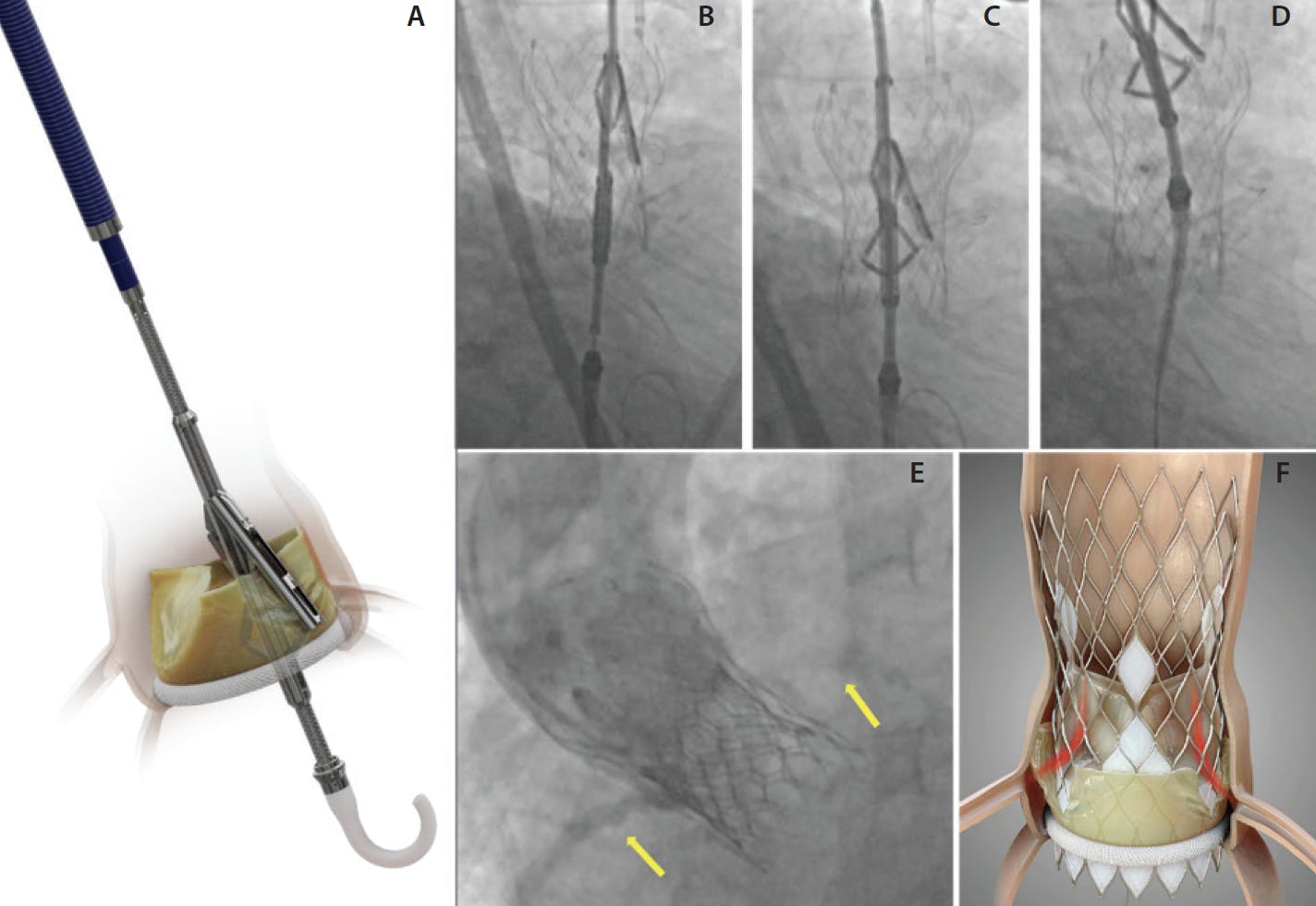
Figure 1. (A) Illustration of the ShortCut device. (B) ShortCut device aligned at the annular level with the positioning arm rotated toward the targeted leaflet. (C) Activation of the splitting element, penetrating the base of the leaflet. (D) Right coronary cusp leaflet splitting. (E) SAPIEN 3 (23 mm) TAVR implanted post–dual split with good flow to both the right coronary cusp and left coronary cusp. (F) Illustration post-ShortCut and ViV TAVR procedure. Fluoroscopic images taken from ShortCut procedure in a failed Evolut 29-mm TAVR, performed by Dr. Danny Dvir at Shaare Zedek Medical Center, Jerusalem, Israel.
In September 2024, ShortCut received de novo clearance from the FDA, representing the first-ever medical device cleared by the FDA for leaflet modification for patients at risk of coronary obstruction.3
“The ShortCut device is a game changer. It has potential to fill a critical gap in care and will be essential for the lifetime management of aortic stenosis patients who need multiple valve interventions throughout their lifetime,” said Dr. Gada. “Given its FDA clearance, it may become a vital tool in TAVR procedures, especially for patients at risk of coronary obstruction.”
ShortCut offers a safe, simple, and effective approach for splitting both single and dual leaflets. Given its intuitive design, operators have full control throughout the procedure and can position the device at the base of the leaflet. The procedure is quick, easy to learn, and seamlessly integrates into the standard TAVR workflow, making it highly adoptable across TAVR centers.
“The biggest impact for me is having a dedicated tool like the ShortCut device in our workflow,” said Dr. Waggoner. “I believe it will be a critical enabler for TAVR and an essential device for every structural heart program when performing ViV procedures. It’s so easy to use, safe, and efficient, making it a time-saving option that helps optimize outcomes.”
ShortCut Pivotal Study Results
The ShortCut pivotal study assessed the safety and efficacy of the ShortCut device for splitting bioprosthetic aortic valve leaflets in patients at risk for TAVR-induced coronary obstruction.4 Sixty patients with either a failed surgical or transcatheter valve were enrolled, with 63% of patients undergoing single leaflet splitting and 37% of patients undergoing dual leaflet splitting.4 The ShortCut device met the primary safety endpoint, with 0% procedural mortality and only one stroke (1.7%).4 The primary efficacy endpoint of successful leaflet splitting was achieved in 100% of patients.4 The procedure was completed efficiently on the first attempt in all cases, including by first-time users, with an average procedure time of 30 minutes.4 The results demonstrate that the ShortCut device is easy to adopt and can be a useful tool for safely treating patients at risk of coronary obstruction without disrupting TAVR procedures.
“In the ShortCut pivotal trial, dual leaflet splits accounted for over 35% of cases, which is significant. In our practice, performing dual leaflet split only added a few minutes to the procedure. It was remarkable to be able to safely and effectively address a second leaflet so quickly—something that would be much more challenging with BASILICA,” said Dr. Gada.
Other Leaflet Modification Techniques
Although ShortCut is the only FDA-cleared device for leaflet modification, other techniques are available but pose various challenges.
The BASILICA procedure offers an alternative approach involving leaflet modification with electrocautery.5 Although the BASILICA procedure has been available for several years, its adoption has been slow, primarily due to the complexity of the procedure and the significant time it demands. It is especially challenging when modifying two leaflets and adds substantial difficulty and time to the procedure.
“BASILICA is a highly complex technique that faces significant challenges in terms of reproducibility, particularly when splitting two leaflets. Additionally, the procedure is associated with nontrivial failure and complication rates. It is also highly resource-intensive, requiring a substantial number of materials to perform it effectively,” said Dr. Généreux.
Other advances in TAVR platforms, such as commissural alignment, larger cells, and implantation methods do not replace the need for leaflet modification.
ShortCut: Paving the Way for Future Valve Treatments
Pi-Cardia is a global leader in developing a unique portfolio of non-implant, catheter-based leaflet modification solutions for treating heart valves. Beyond ShortCut, the company is developing additional technologies to address challenging anatomies, including native valve leaflets at risk of obstruction and bicuspid aortic valves, where tricuspidization techniques may improve the transcatheter valve opening and function.
The company has also performed a first-in-human procedure on the mitral valve, successfully splitting the anterior mitral leaflet transapically prior to transcatheter mitral valve replacement in patients at risk of left ventricular outflow tract obstruction. The company is developing a transeptal delivery system for better ease of use.
These innovative techniques are currently under investigation and underscore Pi-Cardia’s commitment to advancing treatment options for valve therapies.
1. TCTMD. National data point to soaring TAVI rates in patients under 65. June 14, 2024. Accessed November 25, 2024. https://www.tctmd.com/news/national-data-point-soaring-tavi-rates-patients-under-65
2. Généreux P, Leon MB, Dar RD, et al. Predicting treatment of bioprosthetic aortic valve failure in the United States: a proposed model. Struct Heart. Published online July 9, 2024. doi: 10.1016/j.shj.2024.100339
3. Business Wire. Pi-Cardia receives FDA market clearance for ShortCut™. September 30, 2024. Accessed November 25, 2024. https://www.businesswire.com/news/home/20240928442730/en/Pi-Cardia-Receives-FDA-Market-Clearance-for-ShortCut%E2%84%A2
4. Dvir D, Tchetche D, Leon MB, et al. Leaflet modification before transcatheter aortic valve implantation in patients at risk for coronary obstruction: the ShortCut study. Euro Heart J. 2024;45:3031-3041. doi: 10.1093/eurheartj/ehae303
5. Medranda GA, Khan JM, Bruce C, et al. BASILICA for coronary obstruction prevention during TAVR: procedural technique, data, and future challenges. Cardiac Interv Today. 2022;16:49-54. https://citoday.com/articles/2022-jan-feb/basilica-for-coronary-obstruction-prevention-during-tavr-procedural-technique-data-and-future-challenges



Advertisement
Advertisement