Advertisement
Advertisement
March/April 2024
Considerations When Treating Patients With Multivalvular Heart Disease
Diagnosis and management of the most common subtypes of mixed and multivalvular heart disease.
Mixed valvular heart disease (VHD) is the combination of stenosis and regurgitation of a single valve, whereas multi-VHD refers to more than moderate stenosis or regurgitation of two separate valves.1 Mixed and multi-VHD represent 20% of patients with native VHD and 17% of patients undergoing any type of valvular intervention.2 Although echocardiography remains the initial test of choice, incorporation of other diagnostic modalities such as invasive hemodynamic assessment and crosssectional imaging with either cardiac CTA or cardiac MRI may be necessary to accurately classify the severity of each valvular lesion.3 The treatment of multi-VHD is challenging due to the limited data available to guide decision-making on the timing of multiple interventions and modality of treatment. In general, priority should be given to treatment of the dominant lesion. This article provides a broad overview of the diagnosis and management of the main subtypes of mixed and multi-VHD.
COMMON PRESENTATIONS OF MIXED AND MULTIVALVULAR LESIONS
Aortic Stenosis and Mitral Regurgitation
The combination of aortic stenosis (AS) and mitral regurgitation (MR) represents the most common variant of multi-VHD. At least 20% to 30% of those with severe AS also have MR at the time of diagnosis. Of this subgroup, 15% have at least moderate MR at the time of aortic valve replacement.4,5 In an analysis of the SWEDEHEART registry of all transcatheter aortic valve replacements (TAVRs) performed in Sweden, patients with more than moderate MR undergoing TAVR were found to have higher mortality, and this risk was attenuated in those whose MR was reduced to mild or less after intervention.6
The most common pathophysiology resulting in this presentation is AS due to calcific degeneration, which then results in left ventricular (LV) remodeling, tethering of the mitral valve apparatus, and secondary MR.5 The presence of moderate-to-severe MR, in turn, can make it difficult to accurately assess the severity of AS due to decrease in stroke volume and lower gradients. Dobutamine stress echocardiography or aortic valve calcium scoring can be used to confirm the severity of AS in such cases.3 Additionally, the severity of MR can be overestimated due to elevated LV filling pressures and increased afterload in patients with severe AS.7 Quantitative measures of MR severity on transthoracic or transesophageal echocardiography should be used,7 but where there is discrepancy, cardiac MRI may provide more reliable measures of regurgitant volumes and fractions.8
After treatment with aortic valve replacement, there is decrease in LV systolic pressures, which lowers the transaortic gradient and often results in a reduction of MR severity that is more likely to occur in secondary rather than primary MR.5,9 Data from the PARTNER trial demonstrated that approximately 60% to 70% of patients experienced improvement in secondary MR after aortic valve replacement. Approximately 3% to 5% went on to have worsening MR, but only 14% of patients with significant persistent MR after aortic valve replacement remained symptomatic.10 In patients with severe AS and severe primary MR, the ideal treatment is surgical aortic valve replacement (SAVR) and mitral valve repair.11,12 When surgical risk is elevated, this population can be treated with TAVR and, if symptoms persist, staged transcatheter edge-to-edge repair (TEER)—provided the anatomy of the mitral valve is suitable for this therapy. In the COAPT trial, mitral TEER was shown to improve MR severity, heart failure symptoms, and mortality in patients with symptomatic severe secondary MR, with findings sustained at 5 years of follow-up.13,14
In patients proceeding to surgery, concomitant mitral valve repair or replacement is reasonable if the risk of persistent significant MR is deemed high.12 However, combined surgical procedures are associated with increased surgical risk, and mortality rates of aortic and mitral valve surgery are around 10%, as compared to 3% for isolated aortic valve replacement.2,15 Thus, in patients with increased surgical risk, a reasonable approach is to perform TAVR, then reassess MR severity to determine whether there may be an additional benefit to staged mitral TEER (Figure 1).1,14,16,17
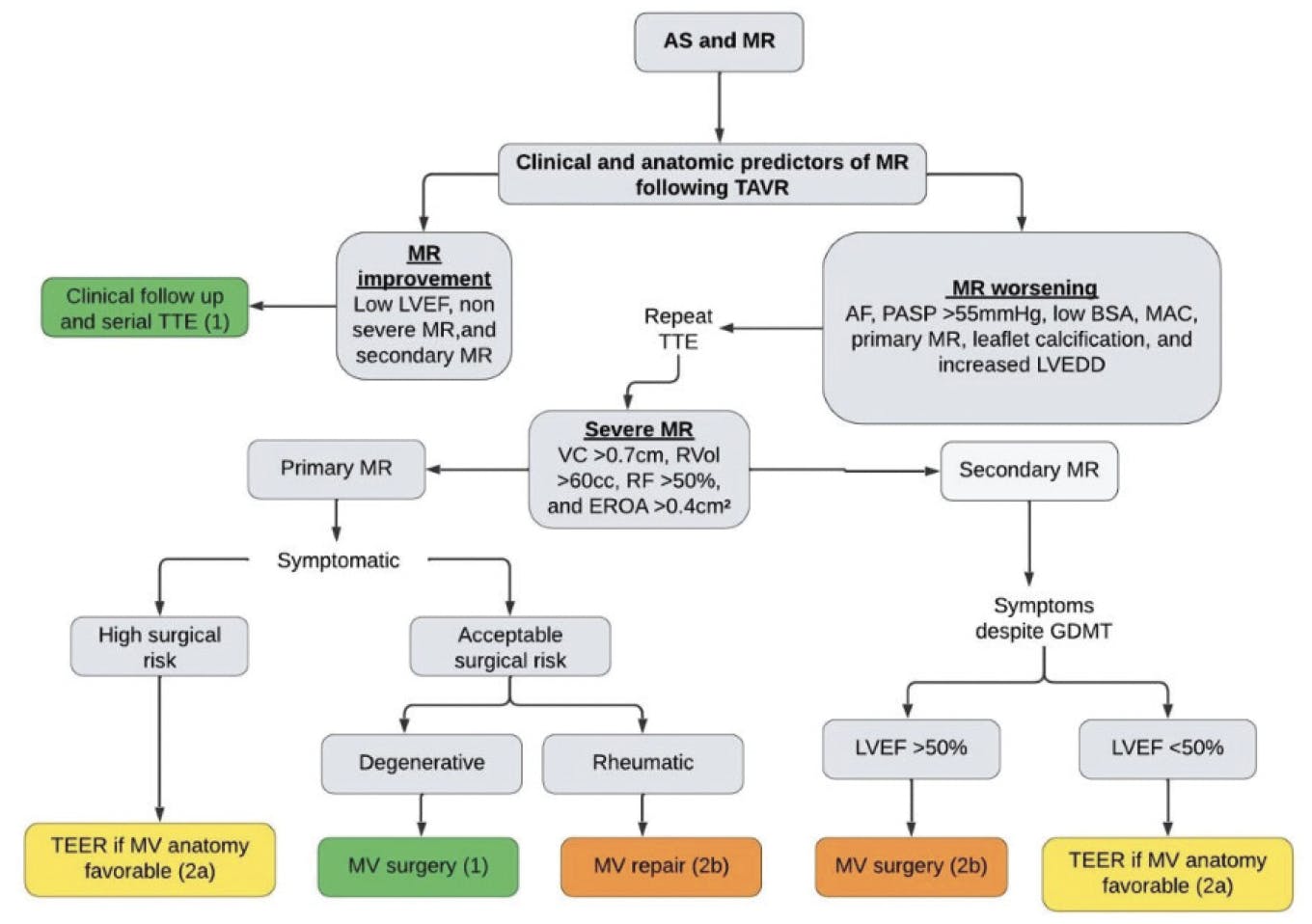
Figure 1. Predictors of MR trajectory after TAVR. Adapted from the 2020 ACC/AHA guideline for the management of patients with valvular heart disease. Circulation. 2021;143:e35-e71. AF, atrial fibrillation; BSA, body surface area; EROA, effective regurgitant orifice area; LVEDD, LV end-diastolic diameter; LVEF, LV ejection fraction; MV, mitral valve; PASP, pulmonary artery systolic pressure; RF, regurgitant fraction; RVol, regurgitant volume; TTE, transthoracic echocardiogram; VC, vena contracta.
AS and Aortic Regurgitation
The majority of patients with AS have some degree of aortic regurgitation (AR). Conversely, nearly 20% of patients with AR have AS.2 Stenosis leads to increased LV afterload with resultant hypertrophy and diastolic dysfunction, whereas regurgitation results in LV dilation and volume overload.18 Transaortic pressure gradients measured with echocardiography can be falsely elevated due to LV dilation and higher stroke volume. In cases where the severity of clinical symptoms appears disproportionate to the severity of either AS or AR, confirmation with cardiac CTA and MRI should be considered.19,20 Recent data demonstrate that moderate, mixed AS/AR is associated with similar morbidity and mortality to that of severe AS alone.21,22
Current guidelines give a class Ib indication for aortic valve replacement in symptomatic patients with combined AS/AR with peak transvalvular velocity of 4 m per second or mean gradient of 40 mm Hg and a class Ic indication in asymptomatic patients with peak jet velocity > 4 m per second and LV ejection fraction < 50%.1 These represent the only class I recommendations for mixed VHD, highlighting the paucity of high-quality data for this population of patients. Despite the limited data regarding optimal timing of intervention for mixed aortic valve disease, aortic valve replacement should be considered in those who are symptomatic, even if transaortic hemodynamics do not meet the criteria of a level I guideline recommendation.22,23 Most patients presenting with mixed aortic valve disease will have some degree of calcification involving the leaflets or annulus to provide anchoring for current commercially available TAVR platforms. This subgroup has demonstrated higher survival after TAVR compared to their counterparts with isolated AS, with higher risk of paravalvular leak (PVL).23,24
The multidisciplinary heart team should consider the patient’s surgical risk, anatomic features impacting likelihood of valve embolization and PVL, local expertise, and patient preferences when determining treatment with either TAVR or SAVR.
AS and Mitral Stenosis
Data from the TVT registry demonstrate that 11.6% of patients with AS undergoing TAVR have mitral stenosis (MS), with 2.7% having severe MS, a combination associated with increased morbidity and mortality.25 Both AS and MS can limit stroke volume and cardiac output, reducing transvalvular flow and gradients and rendering assessment of the relative severity of each lesion challenging. In these cases, three-dimensional planimetry of the mitral valve orifice area via echocardiography may be helpful.3 In patients with rheumatic heart disease, the mechanism of MS is commissural fusion for which percutaneous mitral commissurotomy can yield excellent long-term results26 and be combined with TAVR for a fully percutaneous approach.27,28 However, the most common etiology of combined significant AS and MS in the United States is calcific aortic valve disease with mitral annular calcification (MAC),29 for which both transcatheter and surgical interventions to address the mitral valve carry significant risks and ongoing limitations. Given the challenges and risks involved, teams should seek a heart team approach with multidisciplinary deliberation and patient-centered decision-making.30,31
Data from the TMVR in MAC global registry of patients at extreme surgical risk have shown that implantation of a balloon-expandable Sapien valve (Edwards Lifesciences) in MAC is a feasible but highly challenging procedure. The rate of technical success was 76.7%, with 11.2% experiencing LV outflow tract (LVOT) obstruction resulting in hemodynamic compromise. Mortality was 25% during the first 30 days and > 50% at 1 year.32 Given the risks associated with transcatheter mitral valve replacement (TMVR), the approach in patients suitable for percutaneous treatment of both lesions should be to perform TAVR first, then reassess residual symptoms and measures of MS severity to guide careful selection of those most likely to benefit from staged TMVR.
MS and MR
The combination of MS and MR is primarily due to severe MAC or rheumatic heart disease. MS can be protective of MR as it will prevent LV dilation due to chronic volume overload.1 Assessing the severity of MS using transvalvular gradients may not be reliable in the presence of concomitant significant MR. Three-dimensional planimetry of the mitral orifice via echocardiography or direct left atrial (LA)/pulmonary capillary wedge pressure measurement can confirm the severity of stenosis, and MR severity can be confirmed using cardiac MRI.3 In patients with discrepancy between symptoms and echocardiographic findings, further testing with exercise echocardiography or right heart catheterization can be considered to assess rise of LA filling pressures and flow patterns in the pulmonary veins. This combination should be treated based on current guideline recommendations applicable to the more severe lesion.1 In the setting of severe MAC, surgery is technically challenging due to the need to perform calcium debridement, which can become extensive, and diminished tissue integrity of the mitral annulus, which results in increased risk of PVL. Also of concern is disruption of the atrioventricular groove, which is a fatal complication.1,31,32 In patients with severe MAC at increased surgical risk, TMVR using the balloon-expandable Sapien platform can be considered in patients with suitable anatomy, which is primarily driven by CTA analysis of risk of LVOT obstruction and valve embolization.32
Tricuspid Regurgitation in the Presence of Aortic or Mitral Valve Disease
Secondary tricuspid regurgitation (TR) is very common in patients with left-sided VHD. This is due to chronically elevated LV/LA filling pressures resulting in postcapillary pulmonary hypertension, right ventricular dilation, and eventual dysfunction. Atrial fibrillation is highly prevalent in patients with left-sided VHD and can result in right atrial remodeling and dilation of the tricuspid annulus, further contributing to development of TR in this population. Moderate (at least) TR is present in 33% of patients with mitral valve disease and 40% of patients with severe AS; it is also associated with higher mortality after correction of mitral and aortic valve pathologies.4,33 Current guidelines recommend tricuspid valve (TV) surgery at the time of left-sided surgery in the setting of severe TR or in moderate TR if the annulus is > 4 cm or there is right heart failure. This is based on the rationale that TR severity may not improve after correction of left-sided VHD and reoperation for TR after the initial surgery is associated with 25% perioperative mortality. If left uncorrected, TR progresses in up to 25% of patients and is associated with poor survival.1 Data suggest that TR repair does not add significant surgical risk and is preferred over replacement.1,34 Newer data from the TRILUMINATE trial using the dedicated percutaneous tricuspid TriClip TEER system (Abbott) and the TRISCEND trial of the Evoque transcatheter tricuspid replacement platform (Edwards Lifesciences) have demonstrated improvement in TR severity and quality of life in patients with more than moderate functional TR. Nearly 40% of these patients had prior valvular interventions.35,36 In patients undergoing surgery, TV repair should be performed as per guidelines. In patients at high surgical risk who complete treatment of their left-sided valvular lesions, staging transcatheter TV repair or replacement is appropriate.
MULTIDISCIPLINARY HEART TEAM APPROACH
Due to the complexity of diagnosis and management of the patient with mixed and multi-VHD, evaluation should be undertaken in a comprehensive valve center that can leverage advanced multimodality cardiac imaging, as well as the clinical expertise of cardiothoracic surgery, structural cardiology, cardiac anesthesia, heart failure, and critical care. The most severe lesion should be treated first, and in most cases, monitoring of nonsevere lesions should be pursued as an up-front strategy. To guide decisions on timing and approach of interventions when two or more severe lesions are present, the multidisciplinary heart team will need to consider the patient’s overall clinical presentation, surgical risk, and anatomic suitability of each lesion for surgical versus transcatheter treatment. In a patient at low to intermediate surgical risk presenting with multi-VHD, surgery will usually be preferred to address all lesions simultaneously. When a patient has increased (but not excessive) surgical risk, a hybrid approach can be pursued, with surgical treatment of the valvular lesion most likely to yield durable success with lower risk and staged transcatheter intervention for the remaining lesion.
CONCLUSION
Mixed and multi-VHD are highly prevalent and often present a challenging clinical scenario. Multimodality cardiac imaging is useful and frequently necessary for accurate assessment of the severity of each valvular lesion, which then guides decisions regarding timing and modality of intervention. Evaluation and treatment should be undertaken in a comprehensive valve center that leverages the expertise of a multidisciplinary heart team to provide patient-centered care in scenarios where little high-quality data exist to inform evidence-based decision-making.
1. Otto CM, Nishimura RA, Bonow RO, et al. 2020 ACC/AHA guideline for the management of patients with valvular heart disease: executive summary: a report of the American College of Cardiology/American Heart Association joint committee on clinical practice guidelines. Circulation. 2021;143:e35-e71. doi: 10.1161/cir.0000000000000932
2. Iung B, Baron G, Butchart EG, et al. A prospective survey of patients with valvular heart disease in Europe: The Euro Heart Survey on Valvular Heart Disease. Eur Heart J. 2003;24:1231-1243. doi: 10.1016/s0195-668x(03)00201-x
3. Unger P, Pibarot P, Tribouilloy C, et al. Multiple and mixed valvular heart diseases. Circ Cardiovasc Imaging. 2018;11:e007862. doi: 10.1161/circimaging.118.007862
4. Berti S, Bonanni M, D’Agostino A, et al. Treatment of multiple valve disease: surgery, structural intervention, or both? Eur Heart J Suppl. 2023;25(suppl B):B21-b24. doi: 10.1093/eurheartjsupp/suad061
5. Mantovani F, Barbieri A, Albini A, et al. The common combination of aortic stenosis with mitral regurgitation: diagnostic insight and therapeutic implications in the modern era of advanced echocardiography and percutaneous intervention. J Clin Med. 2021;10:4364. doi: 10.3390/jcm10194364
6. Feldt K, De Palma R, Bjursten H, et al. Change in mitral regurgitation severity impacts survival after transcatheter aortic valve replacement. Int J Cardiol. 2019;294:32-36. doi: 10.1016/j.ijcard.2019.07.075
7. Zoghbi WA, Adams D, Bonow RO, et al. Recommendations for noninvasive evaluation of native valvular regurgitation: a report from the American Society of Echocardiography developed in collaboration with the Society for Cardiovascular Magnetic Resonance. J Am Soc Echocardiogr. 2017;30:303-371. doi: 10.1016/j.echo.2017.01.007
8. Hundley WG. The use of cardiovascular magnetic resonance to identify adverse cardiac prognosis: an important step in reducing image-related health care expenditures. J Am Coll Cardiol. 2010:1244-1246. doi: 10.1016/j.jacc.2010.07.011
9. Katte F, Franz M, Jung C, et al. Impact of concomitant mitral regurgitation on transvalvular gradient and flow in severe aortic stenosis: a systematic ex vivo analysis of a subentity of low-flow low-gradient aortic stenosis. EuroIntervention. 2018;13:1635-1644. doi: 10.4244/eij-d-17-00476
10. Barbanti M, Webb JG, Hahn RT, et al. Impact of preoperative moderate/severe mitral regurgitation on 2-year outcome after transcatheter and surgical aortic valve replacement: insight from the Placement of Aortic Transcatheter Valve (PARTNER) Trial Cohort A. Circulation. 2013;128:2776-2784. doi: 10.1161/circulationaha.113.003885
11. Kiramijyan S, Koifman E, Asch FM, et al. Impact of functional versus organic baseline mitral regurgitation on short- and long-term outcomes after transcatheter aortic valve replacement. Am J Cardiol. 2016;117:839-846. doi: 10.1016/j.amjcard.2015.11.064
12. Gillinov AM, Blackstone EH, Cosgrove DM 3rd, et al. Mitral valve repair with aortic valve replacement is superior to double valve replacement. J Thorac Cardiovasc Surg. 2003;125:1372-1387. doi: 10.1016/s0022-5223(02)73225-x
13. Stone GW, Lindenfeld J, Abraham WT, et al. Transcatheter mitral-valve repair in patients with heart failure. N Engl J Med. 2018;379:2307-2318. doi: 10.1056/NEJMoa1806640
14. Feldman T, Kar S, Elmariah S, et al. Randomized comparison of percutaneous repair and surgery for mitral regurgitation: 5-year results of EVEREST II. J Am Coll Cardiol. 2015;66:2844-2854. doi: 10.1016/j.jacc.2015.10.018
15. Galloway AC, Grossi EA, Baumann FG, et al. Multiple valve operation for advanced valvular heart disease: results and risk factors in 513 patients. J Am Coll Cardiol. 1992;19:725-732. doi: 10.1016/0735-1097(92)90509-l
16. Rudolph V, Schirmer J, Franzen O, et al. Bivalvular transcatheter treatment of high-surgical-risk patients with coexisting severe aortic stenosis and significant mitral regurgitation. Int J Cardiol. 2013;167:716-720. doi: 10.1016/j.ijcard.2012.03.060
17. D’Ancona G, Paranskaya L, Öner A, et al. Mitro-aortic pathology: a point of view for a fully transcatheter staged approach. Neth Heart J. 2017;25:605-608. doi: 10.1007/s12471-017-1028-6
18. Ngiam JN, Chew NWS, Pramotedham T, et al. Implications of coexisting aortic regurgitation in patients with aortic stenosis. JACC Asia. 2021;1:105-111. doi: 10.1016/j.jacasi.2021.05.004
19. Pawade T, Clavel MA, Tribouilloy C, et al. Computed tomography aortic valve calcium scoring in patients with aortic stenosis. Circ Cardiovasc Imaging. 2018;11:e007146. doi: 10.1161/circimaging.117.007146
20. Hendel RC, Patel MR, Kramer CM, et al. ACCF/ACR/SCCT/SCMR/ASNC/NASCI/SCAI/SIR 2006 appropriateness criteria for cardiac computed tomography and cardiac magnetic resonance imaging: a report of the American College of Cardiology Foundation Quality Strategic Directions Committee Appropriateness Criteria Working Group, American College of Radiology, Society of Cardiovascular Computed Tomography, Society for Cardiovascular Magnetic Resonance, American Society of Nuclear Cardiology, North American Society for Cardiac Imaging, Society for Cardiovascular Angiography and Interventions, and Society of Interventional Radiology. J Am Coll Cardiol. 2006;48:1475-1497. doi: 10.1016/j.jacc.2006.07.003
21. Zilberszac R, Gabriel H, Schemper M, et al. Outcome of combined stenotic and regurgitant aortic valve disease. J Am Coll Cardiol. Apr 9 2013;61:1489-1495. doi: 10.1016/j.jacc.2012.11.070
22. Egbe AC, Luis SA, Padang R, Warnes CA. Outcomes in moderate mixed aortic valve disease: is it time for a paradigm shift? J Am Coll Cardiol. May 24 2016;67:2321-2329. doi: 10.1016/j.jacc.2016.03.509
23. Ugwu JK, Kandah DR, Ndulue JK, et al. Comparative outcomes of TAVR in mixed aortic valve disease and aortic stenosis: a meta-analysis. Cardiol Ther. 2023;12:143-157. doi: 10.1007/s40119-022-00293-3
24. Guddeti RR, Gill GS, Garcia-Garcia HM, Alla VM. Transcatheter aortic valve replacement in mixed aortic valve disease: a systematic review and meta-analysis. Eur Heart J Qual Care Clin Outcomes. 2022;8:169-176. doi: 10.1093/ehjqcco/qcab080
25. Joseph L, Bashir M, Xiang Q, et al. Prevalence and outcomes of mitral stenosis in patients undergoing transcatheter aortic valve replacement: findings from the Society of Thoracic Surgeons/American College of Cardiology Transcatheter Valve Therapies registry. JACC Cardiovasc Interv. 2018;11:693-702. doi: 10.1016/j.jcin.2018.01.245
26. Reichart DT, Sodian R, Zenker R, et al. Long-term (≤ 50 years) results of patients after mitral valve commissurotomy--a single-center experience. J Thorac Cardiovasc Surg. 2012;143(4 Suppl):S96-S98. doi: 10.1016/j.jtcvs.2011.09.064
27. Tarantini G, Gasparetto V, Napodano M, et al. A case of combined percutaneous transfemoral mitral valvuloplasty and aortic valve implantation. J Invasive Cardiol. 2011;23:E200-E201.
28. Mrevlje B, Aboukura M, Nienaber CA. Percutaneous dual-valve intervention in a high-risk patient with severe aortic and mitral stenosis. Heart Views. 2016:109-113. doi: 10.4103/1995-705X.192563
29. Unger P, Lancellotti P, de Cannière D. The clinical challenge of concomitant aortic and mitral valve stenosis. Acta Cardiol. 2016;71:3-6. doi: 10.2143/ac.71.1.3132091
30. Palacios IF. Percutaneous mitral balloon valvuloplasty: worldwide trends. J Am Heart Assoc. 2019:e012898. doi: 10.1161/JAHA.119.012898
31. Feindel CM, Tufail Z, David TE, et al. Mitral valve surgery in patients with extensive calcification of the mitral annulus. J Thorac Cardiovasc Surg. 2003;126:777-782. doi: 10.1016/s0022-5223(03)00081-3
32. Guerrero M, Urena M, Himbert D, et al. 1-Year outcomes of transcatheter mitral valve replacement in patients with severe mitral annular calcification. J Am Coll Cardiol. 2018;71:1841-1853. doi: 10.1016/j.jacc.2018.02.054
33. Shiran A, Sagie A. Tricuspid regurgitation in mitral valve disease incidence, prognostic implications, mechanism, and management. J Am Coll Cardiol. 2009;53:401-408. doi: 10.1016/j.jacc.2008.09.048
34. Mahesh B, Wells F, Nashef S, Nair S. Role of concomitant tricuspid surgery in moderate functional tricuspid regurgitation in patients undergoing left heart valve surgery. Eur J Cardiothorac Surg. 2013;43:2-8. doi: 10.1093/ejcts/ezs441
35. Sorajja P, Whisenant B, Hamid N, et al. Transcatheter repair for patients with tricuspid regurgitation. N Engl J Med. 2023;388:1833-1842. doi: 10.1056/NEJMoa2300525
36. Kodali S, Hahn RT, Makkar R, et al. Transfemoral tricuspid valve replacement and one-year outcomes: the TRISCEND study. Eur Heart J. 2023;44:4862-4873. doi: 10.1093/eurheartj/ehad667
Advertisement
Advertisement