Advertisement
Advertisement
March/April 2024
An Interview With Shrilla Banerjee, MD, FRCP, FESC
Dr. Banerjee discusses her interest in disparities in cardiovascular care, involvement in organizations seeking to address equity concerns within the interventional cardiology field, best practices for calcium modification and MINOCA, and more.

Can you break down your top clinical and research priorities among the diverse range of clinical responsibilities, societal appointments, and initiatives you regularly undertake? Where does your passion lie in interventional cardiology (IC)?
I think my passion lies in disparities in care related to sex and ethnicity—both have always been very important to me. That interest has grown and become more of a focus in my career and also enabled me to meet some inspiring personalities.
As a trainee, I published data showing that ethnic minority patients were less likely to receive revascularization than similar White patients in an East London population registry,1 and that kindled my interest. Our responsibility as cardiologists is to advocate for all of our patients because it is the less vocal, less fluent, and less visible who are most often overlooked. I have had the honor of working with Drs. Quinn Capers, Martha Gulati, and Clyde Yancy, along with my mentee Dr. Aaysha Cader, on publications looking at the impact of race or ethnicity on optimal cardiovascular care.2 This has been a real eye-opener because the impact of implicit or unconscious bias can be devastating, including to the physician whose patient care is impacted by their own bias. It taught me to be aware of my own bias and ensure that my decision-making is fair and balanced (yes, I do have some mild bias, which I checked via the Harvard Implicit Association Test). I hope to continue to work on this in the future.
Clinically, I enjoy the challenge of complex intervention, with careful procedure planning, use of intravascular imaging, and calcium modification if necessary. Bifurcations are a multistep procedure I particularly enjoy. I love the concentration that is required. The culotte is my favorite technique, supported by imaging, where possible.
One particular focus of yours is coronary artery disease (CAD). When it comes to the prevention and complex intervention of CAD, what progress do you hope to see in the next decade?
In my area of the United Kingdom (UK), we can see the impact of optimal primary and secondary prevention, but there is still a huge gradient in cardiovascular disease (CVD) detection and care delivery across the UK. We talk about the North-South divide, and it is real. I hope to see these disparities lessen over the next decade. Going forward, I hope we can reduce disparities nationally and globally by addressing causative factors such as poverty, its contribution to obesity, and the metabolic syndrome.
In the next decade, I think we will continue to see more diffuse and calcific CAD as a consequence of diabetes and obesity. I hope we will become better at identifying risk, particularly in women. Women are often forgotten in many of the risk scores. There are unassessed contributions of hormone imbalance/loss and pregnancy-related conditions. CVD is the number one cause of death in women, albeit sometimes manifesting 10 to 15 years after men.
You’re also involved in aviation cardiology and worked with the Civil Aviation Authority (CAA). What does this work entail, and how does it inform your day-to-day life in the cath lab?
Working with the CAA was a new challenge. We all need to evolve and develop, and the opportunity to work with aviation came at just the right time for me. The focus as a consultant advisor is on aviation safety rather than on the patient or pilot. Initially, it was difficult learning how to balance care for the patient with the regulator’s concern for aviation safety. As a physician, while recommending if a pilot was safe to fly or not, I also tried to advise the pilot on how to make themselves fit to fly in the long term, a practice that I have held onto firmly.
Aviation medicine is very algorithmic, and this is an approach I was not particularly used to when I started but is happening across medicine now.
What do you consider best practice when it comes to calcium modification in percutaneous coronary intervention (PCI)? Do you have an algorithm for determining which technique to use in which scenarios?
I am inspired to see how much the use of intravascular imaging and physiology is improving outcomes for our PCI patients. The key to any calcium modification algorithm is the need to understand (with imaging) the disease we hope to modify. Optical coherence tomography and intravascular ultrasound (IVUS) provide such insights, and we should use these tools more and more. The ongoing management varies by what is seen on intravascular imaging and found with intracoronary physiology.
It has been a real journey for me personally, coming from a training time and environment where IVUS was rarely used and the IVUS machine stood collecting dust in the corner. I really enjoy having the knowledge and tools on hand and the discussion that ensues with our cath lab team when we plan the best strategy and review our results to ensure that we get the best result for our patients. I always say PCI is a team activity!
This algorithm from Professor James Spratt and the Optima team is one that I enjoy using because it is comprehensive and easy to use (Figure 1).
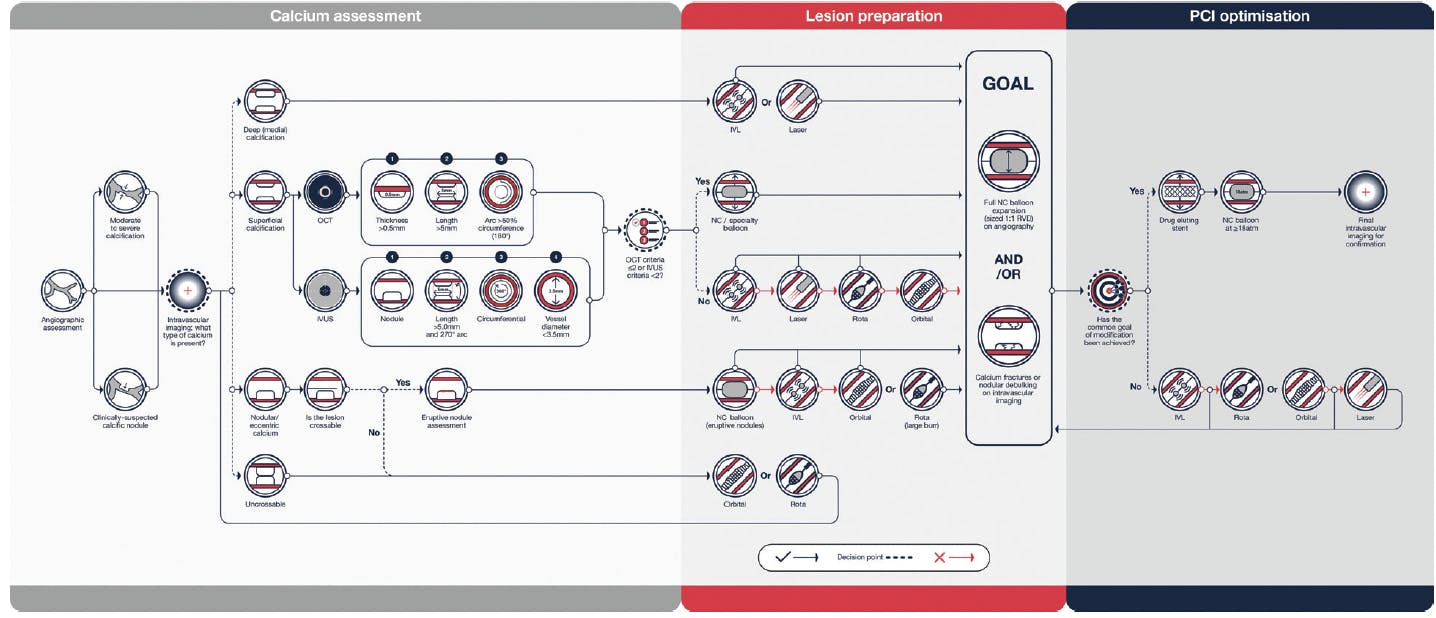
Figure 1. An algorithm for calcium modification in PCI. Reprinted with permission from Optima medical education.
What are the knowns and unknowns about myocardial infarction with nonobstructive coronary arteries (MINOCA) in 2024?
The MINOCA algorithm is an evolving process, as more evidence is being found about the multiple components that come under the umbrella term of MINOCA. There is still much to learn. MINOCA is an important diagnosis, occurring in 5% to 15% of acute coronary syndrome patients and with a 1-year all-cause mortality of 3.5%.3,4 When dealing with MINOCA presentations, we need to be thorough and perform a comprehensive review of all possible causations. I particularly favor a MINOCA algorithm that considers the patient journey and how to incorporate all the necessary tests in the timeline.5
At the heart of much of your published work in recent years is disparities in cardiovascular care. What equity-related concerns in the field are top of mind for you currently, and do you have any in-progress projects on these topics that you can share?
I enjoyed coauthoring an editorial based on Professor Mamas Mamas’ study considering how the pandemic highlighted ethnic disparities in non–ST-segment elevation myocardial infarction care.6,7 I am still working on ethnic disparities, but the main focus of my work is women’s heart health. We need a better understanding of CVD risk in women throughout their lives, and research needs to be focused on the areas needing more evidence.
Transcatheter aortic valve replacement (TAVR) is also very topical here. Women are less likely to enter the TAVR pathway by undergoing echocardiography, and while the periprocedural complication rates are higher in women, the outcomes in appropriate patients are equivalent in men and women.8 This is a familiar story for patients from ethnic minorities, where we see ongoing evidence of the impact of implicit bias. We need to be better!
Women’s heart health is so important. That women fear breast cancer more than CVD shows that our cardiovascular education is lacking. I am working with colleagues including Professors Angela Maas and Maryam Kavousi to clearly identify evidence-poor areas (eg, pregnancy-related complications) and their impact on later CVD outcomes. We are also examining the exponential rise in CVD risk that occurs in women after menopause. We need to identify our targets and then act to reduce CVD risk aggressively and as early as possible.
The Lancet Women and Cardiovascular Disease Commission chaired by Dr. Roxana Mehran is bringing these issues to the forefront of our attention—specifically, the underrepresentation of women in clinical trials.9 As women interventionalists, we need to enroll our patients in clinical trials and get involved as local and national principal investigators because once more women are involved, trial inclusivity improves.
How does your work as Chair of the British Cardiovascular Intervention Society (BCIS) Women in Cardiology Focus Group and involvement in Women as One allow you to focus on these equity concerns, particularly for women in the field? What are your goals with these organizations?
The BCIS role has allowed me to look at gender- or sex-based variation in our workforce. I frequently say, “You can’t be what you can’t see.” As a senior woman in IC in the UK, I believe it is my responsibility to stand up and advocate for the female trainees coming through our systems and hopefully be an example for them! It is also important to show that women interventionalists can have a family and a fulfilling career if they wish.
It has been my absolute pleasure to work on this focus group with my inspirational male and female colleagues to ensure the fair representation of women in our training courses and meetings, as well as to develop ways to support male and female trainees with mentorship, sponsorship, and preceptorship opportunities. None of this would have been possible without the allyship of Professor Nick Curzen, Past President of BCIS, and the support of Dr. Fiona MacDonald from BCIS and the Millbrook Conferences team. With the impressive pipeline of talented female trainees, the future of IC looks bright.
Organizations such as BCIS and the European Society of Cardiology have been leaders in the field by actively considering women when choosing faculty for meetings. We now have a wealth of excellent, experienced, highly skilled women who can be invited to chair panels, make strong contributions as discussants, and present great cases as presenters. It won’t be long before the sex of a faculty member will not matter, and we will have achieved a gender-blind meritocracy.
Women as One (established by my heroes, Dr. Roxana Mehran, Dr. Marie-Claude Morice, and Rebecca Ortega) is an organization that all women in medicine should support, both financially and emotionally. The empowerment that comes from their backing is second to none and has helped my career and my confidence enormously. I applied for and was fortunate to win a Women as One Mentor Match Award that facilitated a mentorship project and a mentoring relationship with Dr. Aaysha Cader, who is probably the easiest person to mentor as she is hardworking, dedicated, and loves cardiology. We enjoyed publishing many articles together, and she is a name to look out for in the future! I then applied to the CLIMB educational program, chaired by Drs. Manos Brilakis and Margaret McEntegart, where I learned new skills in a safe and supportive space. I attended the inaugural Women as One RISE meeting in New York in 2023 and then co-directed the CLIMB 2023 calcium modification program with Dr. Evan Shlofmitz. Now, it’s time to pay it back. Aaysha and I have produced a template for mentorship that can be downloaded from the Women as One site that will support men and women looking to set up a mentoring relationship (www.mentor.womenasone.org).
I hope that the support we provide women coming through interventional training from BCIS, Women as One, and other organizations is not viewed with suspicion. It is more about helping women to navigate childbearing years and beyond and encouraging them to do what they need or want to, when they wish to.
With your interest in education, can you share one area that you wish interventional cardiologists received more training on?
I know many trainees wish they received more structured training in intravascular imaging. If we all feel more comfortable using imaging, we will use it more often and obtain better PCI outcomes for our patients. It really is as simple as that! I sometimes hear that imaging “adds time” to an already complex procedure, but another way of looking at it is that it makes every procedure better and provides long-lasting results.
What has been the impact of mentorship, either as a mentor or mentee, in your life?
As a trainee, I was mentored by some impressive cardiologists: Dr. Howard Swanton, Dr. Diana Holdright, Professor Charles Knight, and Dr. Andrew Deaner. They encouraged me and kept me going whenever I hit obstacles. They probably have no idea how much I valued them. The mentorship then was informal but taught me so much about how to be a mentor.
As part of the Women as One Mentor Match award, I mentored Dr. Aaysha Cader. Mentorship is supposed to be an altruistic relationship, so I feel I have cheated because I received so much reward personally from this initial mentorship and now friendship with Aaysha.
1. Feder G, Crook AM, Magee P, et al. Ethnic differences in invasive management of coronary disease: prospective cohort study of patients undergoing angiography. BMJ. 2002;323:511. doi: 10.1136/bmj.324.7336.511
2. Banerjee S, Cader FA, Gulati M, Capers Q 4th. Racism and cardiology: a global call to action. CJC Open. 2021;3(12 suppl):S165-S173. doi: 10.1016/j.cjco.2021.09.014
3. Tamis-Holland JE, Jneid H, Reynolds HR, et al. Contemporary diagnosis and management of patients with myocardial infarction in the absence of obstructive coronary artery disease: a scientific statement from the American Heart Association. Circulation. 2019;139:e891-e908. doi: 10.1161/CIR.0000000000000670
4. Pasupathy S, Lindahl B, Litwi P, et al. Survival in patients with suspected myocardial infarction with nonobstructive coronary arteries: a comprehensive systematic review and meta-analysis from the MINOCA Global Collaboration. Circ Cardiovasc Qual Outcomes. 2021;14:e007880. doi: 10.1161/CIRCOUTCOMES.121.007880
5. Parwani P, Kang N, Safaeipour M, et al. Contemporary diagnosis and management of patients with MINOCA. Curr Cardiol Reports. 2023;25:561-570. doi: 10.1007/s11886-023-01874-x
6. Rashid M, Timmis A, Kinaird T, et al. Racial differences in management and outcomes of acute myocardial infarction during COVID-19 pandemic. 2021;107:734-740. doi: 10.1136/heartjnl-2020-318356
7. Cader FA, Yancy CW, Banerjee S. To be, or not to be BAME, in the time of COVID-19: does it matter? Heart. 2021;107:692-693. doi: 10.1136/heartjnl-2020-318884
8. Palacios-Fernandez S, Salcedo M, Belinchon-Romero I, et al. Epidemiological and clinical features in very old men and women (≥ 80 years) hospitalized with aortic stenosis in Spain, 2016–2019: results from the Spanish Hospital Discharge Database. J Clin Med. 2022;11:5588. doi: 10.3390/jcm11195588
9. Vogel B, Acevedo M, Appelman Y, et al. The Lancet women and cardiovascular disease commission: reducing the global burden by 2030. Lancet. 2021;397:2385-2438. doi: 10.1016/S0140-6736(21)00684-X
Advertisement
Advertisement
Interested in reading more interviews?
To read more interviews with thought leaders in the interventional cardiology field, check out our Profiles & Perspectives hub.
Read More