Advertisement
Advertisement
July/August 2024
Access and Closure of Calcified Vessels in Patients Undergoing PCI
An analysis of access decision points and closure technologies in the setting of arterial calcification.
By Jacob C. Ricci, MS; Prashant Kaul, MD; and Andrew J. Klein, MD, FACC, FSVM, FSCAI
Percutaneous coronary procedures are a main strategy for both the diagnosis and management of coronary artery disease. As of 2020, there were > 950,000 percutaneous coronary intervention (PCI) procedures completed each year in the United States according to National Cardiovascular Data Registries.1 Arterial calcification presents a significant challenge in these procedures and increases the risk of adverse events, including atheroembolization, perforation, and dissection. Given that the prevalence of arterial calcification increases with age and the life expectancy in the United States continues to rise, it is likely that calcified arteries will be encountered more often in the setting of percutaneous interventions. Therefore, a discussion of access and closure procedures in the setting of calcified arteries is warranted, with an emphasis on reduction of potential adverse events.
ACCESS
Site Choice
Undoubtedly, the best way to prevent complications from calcifications is to avoid access in areas with high disease burden. Although transfemoral access is a common practice, transradial access has become an increasingly popular choice and has recently been supported as a first access site for emergent PCI.2 It has been shown that compared with transfemoral access, transradial access is similar in terms of clinical outcomes and is associated with a lower risk of major bleeding events.3,4 However, radial access is not always an option secondary to a variety of factors, including smaller vessel size, spasm, and subclavian tortuosity. Given the paucity of dedicated radial guides and decades of transfemoral use in the United States, many operators continue to choose femoral access as their default strategy, especially in the setting of complex PCI where large-bore guides providing more support may be preferred. The common femoral artery is well known to harbor more calcification than the radial, although radial artery calcification clearly exists in certain patient subsets (eg, end-stage renal disease [ESRD]).5,6
The radial artery can also be calcified, precluding proper advancement of the sheath. This is most common in patients with ESRD and/or diabetes and can limit access. Dialysis duration (> 5 years) and presence of diabetes has been shown to be a predictor of radial artery calcification.7 Often, the 0.018-inch access, stainless steel wire may meet resistance, requiring a change to a more hydrophilic access wire, as is available in the sheath kits from Terumo Interventional Systems. We have experienced cases where the sheath is only able to be partially inserted because of the calcification, prompting a change to a smaller size catheter (4 or 5 F) to complete the case from the radial approach when this occurs.
Calcification can lead to plaque disturbance and dissection during access and limit closure techniques. In a recent review of 8,500 patients who underwent transcatheter aortic valve replacement (TAVR), the presence of significant iliofemoral calcification or tortuosity increased the risk of vascular complications two- to fivefold.8 Careful access of noncalcified portions of the vessel under ultrasound may be a way to preclude these complications, but even ultrasound may miss calcification.
Ultrasound Guidance
Ultrasound-guided access in PCI has become more prevalent in recent years. Regardless of access site, being able to visualize sites with ultrasound carries multiple benefits and reduces complications. In the FAUST trial, it was shown that ultrasound guidance resulted in faster access, fewer access attempts, and reduced complication rates compared with fluoroscopy-guided access.9
However, even under ultrasound guidance, the presence of arterial calcification presents a significant risk for adverse events.10 A recent study analyzing > 500 successful femoral accesses under ultrasound guidance found that the largest independent predictors for site failure are common femoral artery calcification and arterial diameter.11 Although ultrasound-guided access is rapidly becoming the standard of care, operators should be aware that it also has limitations. In a study comparing detection of calcium by ultrasound to that of cone-beam CT, lesions < 8 mm were not consistently identified, and this may increase access site complications.6 Regardless, ultrasound should be utilized in guiding access in the cath lab and may have a valuable role in preprocedure planning.
With the continuing innovation of handheld point-of-care ultrasound devices such as the Butterfly IQ3 (Butterfly Network), nonemergent patients who need a procedure could undergo a quick access site evaluation, either in the clinic or in the preprocedural area to determine not only which site is best (ie, vessel calcification, vessel size) but also provide better information to the patient in an informed consent process. Beyond this, if an access site is determined a priori, this may allow for increased efficiency in the procedure itself with respect to setup and equipment choice.
Preprocedural Planning
Preprocedural planning is a crucial time to not only to create a plan for the procedure itself but also ensure that contingency plans are in place in the event of problems that may arise. Although CT to evaluate vessel size and calcification is now standard for TAVR, it is not a standard practice in PCI.12 In elective PCI cases, especially those requiring mechanical circulatory support (MCS) involving large-bore access, a preprocedural CT may be helpful in selection of the best access point. TAVR centers have standard CT protocols for such an evaluation. CT is currently utilized to evaluate coronary artery structure as well as potential lesions and degree of calcification.13 The use of CT in evaluation of access sites prior to elective PCI has not been evaluated but may be of particular use in the event that patients require MCS as large-bore sheaths/catheter. These standard CTs can provide critical information regarding common femoral arterial size, aortoiliac tortuosity and calcification, and presence of any significant peripheral artery disease, which may induce acute limb ischemia if MCS is placed. However, the information gleaned from a preprocedural CTA must be weighed against the risk (contrast and radiation dose along with cost) associated with the procedure.
CLOSURE
Vascular Closure Devices
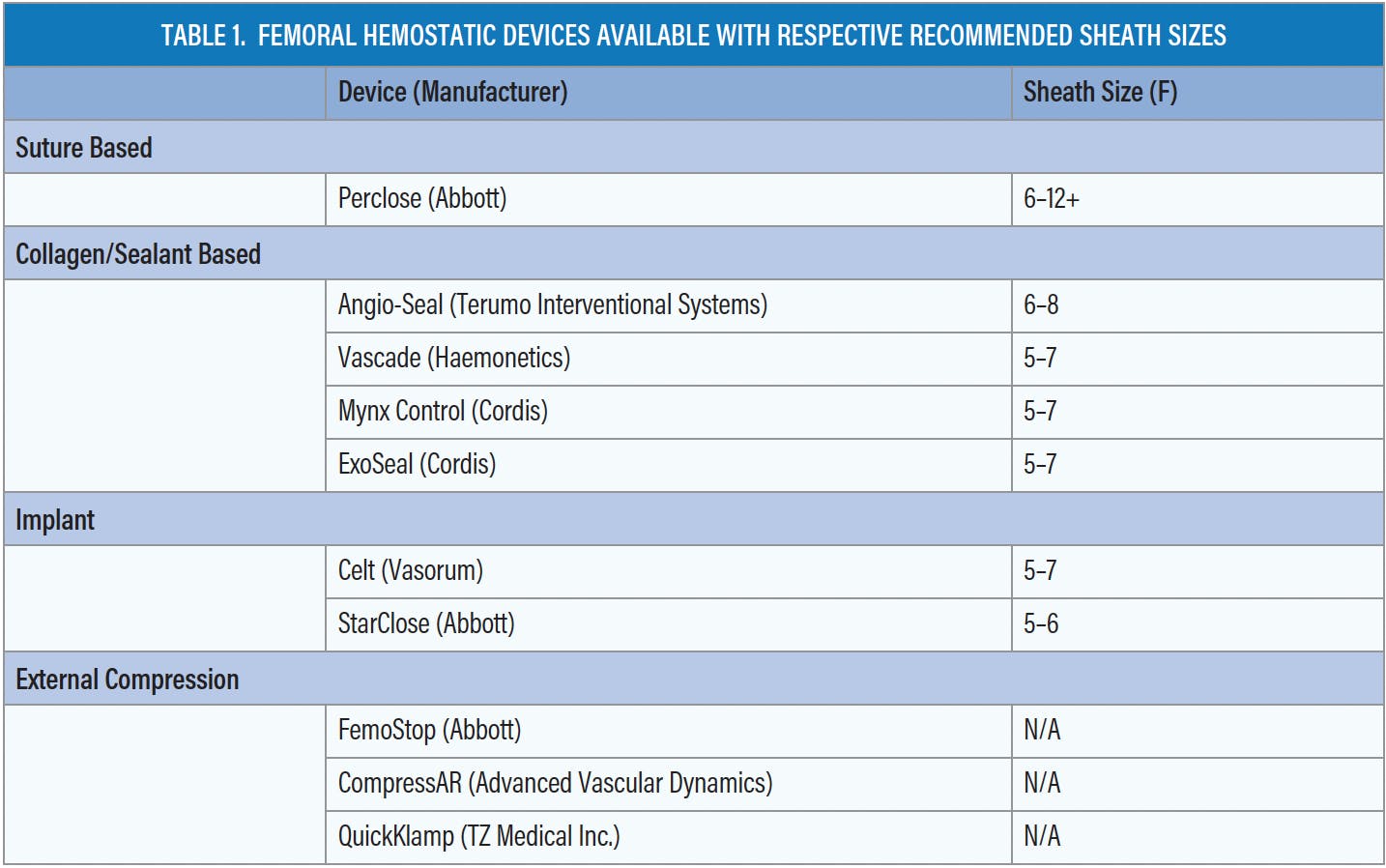
Although manual compression remains the gold standard in achieving hemostatic control, vascular closure devices (VCDs) have become an increasingly popular choice for operators because they drastically reduce the time to hemostasis compared to manual compression and permit early patient ambulation. A recent systematic review compiled the current devices available and associated trials of efficacy of each.14 A list of femoral hemostatic devices can be seen in Table 1. Generally, VCDs are separated into two categories: active approximators and passive approximators. Active approximators use a clip or suture to physically close the access site while passive approximators rely on a collagen or sealant plug. There is also an additional third category of devices that aid in providing mechanical compression and work by external compression. In calcified vessels, external compression to attain hemostasis may be limited if the target vessel is noncompressible. If bleeding is uncontrollable in this case, covered stenting and/or open surgical repair will likely be required.
Closure of the radial arteriotomy is classically performed with manual compression given its size, proclivity to spasm, and superficial location. Access to the radial artery also can be performed at the wrist or in the distal radial at the anatomic snuffbox, pending operator choice. Manual compression remains the standard, and the most common type of compression is administered with the TR band (Terumo Interventional Systems), but other devices are available. Recently, a small randomized control trial showed reduced time to hemostasis, fewer device manipulations, and increased patient comfort.15 Similar compression devices are available from different manufacturers. Although it has not been evaluated in a formal study, radial artery calcification may increase time to hemostasis given the challenge in compressing calcified arteries. Fortunately, prolonged external compression using the available devices is possible, and patients with these conditions may need to be observed longer after their procedure to ensure late bleeding and/or hematoma formation does not occur.
With any VCD, target vessel composition in the area of deployment should be an important consideration. Particular attention should be paid to the extent of calcification and/or presence of significant plaque. A recent analysis of data from the CHOICE-CLOSURE trial (NCT04459208) showed more vascular complications occurred when there was anterior or severe arterial calcification in the common femoral artery accessed for TAVR.16 There is no clear ideal VCD for calcified vessels. No head-to-head trials exist in this realm either to aid operators in VCD selection. Clearly, maintenance of vessel access during closure plays a factor for many operators. This can be performed using suture-based devices such as Perclose (Abbott), and if the device fails, reinsertion of the sheath over a wire can be performed with maintenance of hemostasis. At this point, another attempt using a VCD of choice or a change to manual compression can be decided. For this reason, many operators choose this type of closure device over a collagen plug–based device in calcified vessels. Other operators prefer sealant- or collagen plug–based VCDs. However, foot plate trauma from any of these devices can occur, leading to plaque disruption, dissection, and embolization and necessitating meticulous technique. In all patients, closure technique is critical to preclude complications.
CONCLUSION
Overall, calcification of arteries should be a consideration when planning a percutaneous procedure. In doing so, operators can increase procedure efficiency and reduce potential negative outcomes associated with the access or closure of these vessels. When planning access, ultrasound can be used to visualize sites and determine the optimal access location, but options may be limited based on required catheter sizes. In closing calcified vessels, there does not seem to be clear superiority in suture versus plug devices as both have similar complications when used in calcified arteries. Thus, closure-associated adverse events can be minimized when access site choice is optimized.
1. Research iData. Over 965,000 angioplasties (PCIs) are performed each year in the United States. iData Research. Accessed July 10, 2024. https://idataresearch.com/over-965000-angioplasties-are-performed-each-year-in-the-united-states
2. Mason PJ, Shah B, Tamis-Holland JE, et al. An update on radial artery access and best practices for transradial coronary angiography and intervention in acute coronary syndrome: a scientific statement from the American Heart Association. Circ Cardiovasc Interv. 2018;11:e000035. doi: 10.1161/HCV.0000000000000035
3. Manunga JM, Gloviczki P, Oderich GS, et al. Femoral artery calcification as a determinant of success for percutaneous access for endovascular abdominal aortic aneurysm repair. J Vasc Surg. 2013;58:1208-1212. doi: 10.1016/j.jvs.2013.05.028
4. Kopin D, Seth M, Sukul D, et al. Primary and secondary vascular access site complications associated with percutaneous coronary intervention: insights from the BMC2 registry. JACC Cardiovasc Interv. 2019;12:2247-2256. doi: 10.1016/j.jcin.2019.05.051
5. Gui Z, Shao C, Zhan Y, Wang Z, Li L. Vascular calcification: high incidence sites, distribution and detection. Cardiovasc Pathol. 2024;72:107667. doi: 10.1016/j.carpath.2024.107667
6. Yang Y, Lin N, Xu Y, et al. Calcification detection on upper extremity arteries: a comparison of ultrasonic and x-ray methods. PeerJ. 2023;11:e15855. doi: 10.7717/peerj.15855
7. Chen Z, Zhou Y, Yang T. Histopathological assessment of radial artery calcification in patients with end-stage kidney disease. Ren Fail. 2021;43:362-370. doi: 10.1080/0886022X.2021.1889600
8. Androshchuk V, Chehab O, Prendergast B, et al. Computed tomography derived anatomical predictors of vascular access complications following transfemoral transcatheter aortic valve implantation: a systematic review. Catheter Cardiovasc Interv. 2024;103:169-185. doi: 10.1002/ccd.30918
9. Seto AH, Abu-Fadel MS, Sparling JM, et al. Real-time ultrasound guidance facilitates femoral arterial access and reduces vascular complications: FAUST (Femoral Arterial Access With Ultrasound Trial). JACC Cardiovasc Interv. 2010;3:751-758. doi: 10.1016/j.jcin.2010.04.015
10. Rocha-Singh KJ, Zeller T, Jaff MR. Peripheral arterial calcification: prevalence, mechanism, detection, and clinical implications. Catheter Cardiovasc Interv. 2014;83:E212-220. doi: 10.1002/ccd.25387
11. Mezzetto L, Mastrorilli D, Gennai S, et al. Preoperative risk factors for access site failure in ultrasound-guided percutaneous treatment of TASC C and D aorto-iliac occlusive disease. Ann Vasc Surg. 2022;79:130-138. doi: 10.1016/j.avsg.2021.06.048
12. Blanke P, Weir-McCall JR, Achenbach S, et al. Computed tomography imaging in the context of transcatheter aortic valve implantation (TAVI)/transcatheter aortic valve replacement (TAVR): an expert consensus document of the Society of Cardiovascular Computed Tomography. JACC Cardiovasc Imaging. 2019;12:1-24. doi: 10.1016/j.jcmg.2018.12.003
13. Andreini D, Collet C, Leipsic J, et al. Pre-procedural planning of coronary revascularization by cardiac computed tomography: an expert consensus document of the Society of Cardiovascular Computed Tomography. EuroIntervention. 2022;18:E872-E887. doi: 10.4244/EIJ-E-22-00036
14. Noori VJ, Eldrup-Jørgensen J. A systematic review of vascular closure devices for femoral artery puncture sites. J Vasc Surg. 2018;68:887-899. doi: 10.1016/j.jvs.2018.05.019
15. Minor RL, Maley T, Jenkins D, Li YH. Randomized trial of VasoStat versus TR Band following radial artery access for catheterization procedures. J Invasive Cardiol. 2021;33:E84-E90.
16. Fitzgerald S, Dumpies O, Shibata M, et al. Femoral arterial calcification and plug- vs. suture-based closure device strategies post-transcatheter aortic valve implantation: insights from CHOICE-CLOSURE. Struct Heart. 2024;8:100236. doi: 10.1016/j.shj.2023.100236
Advertisement
Advertisement
