Advertisement
Advertisement
July/August 2024
Valvular Calcium: Calcium in Mitral Valves
Understanding how mitral annular calcification is assessed and how it may influence the outcomes of treatment options.
There have been remarkable advances in transcatheter therapies for structural heart disease during the last 20 years, resulting in an assortment of treatment options for patients with severe valvular heart disease. For mitral valve disease, there are a range of transcatheter, surgical, or hybrid options, with the former including balloon valvuloplasty; edge-to-edge repair; annuloplasty; valve-in-ring, valve-in–mitral annular calcification (MAC), or valve-in-valve; and more recently, standalone transcatheter mitral valve replacement (TMVR).
In this setting, it has become of increased importance to understand the role of MAC in mitral valve disease and how this might influence the success of various mitral treatment strategies. This article reviews the etiology, progression, and outcomes of MAC, and identifies important considerations for clinicians and heart teams when planning the optimal approach to management.
EPIDEMIOLOGY AND OUTCOMES
MAC is a common condition with an estimated prevalence of 8% to 23%, which increases with age, and it has substantial overlap with the development of aortic calcification and coronary atherosclerosis.1,2 MAC refers to chronic degeneration of the fibrous saddle-shaped mitral annulus, usually sparing the anterior aspect nearest the aortic valve. Progression can be driven by inflammatory conditions or altered calcium homeostasis and MAC is especially common among patients with chronic kidney disease. In 1% to 3% of cases, soft periannular calcification may form (termed caseous MAC), which can act as a nidus for infective endocarditis and is associated with a risk of embolic stroke.3
For the most part, MAC is an asymptomatic disease process and the majority of patients remain unaffected by the condition. In the minority of patients, MAC may result in impairment of valvular function, including impingement on leaflet or subvalvular structures, resulting in mitral regurgitation, mitral stenosis, or both. Similarly, MAC is associated with a greater risk of arrhythmias and conduction system disease, including atrioventricular or bundle branch blocks. MAC is strongly associated with atherosclerosis and aortic calcification, with shared pathophysiological pathways, and the presence of MAC on imaging should prompt clinicians to aggressively modify cardiovascular risk factors to reduce the risk of coronary events, especially with cholesterol-lowering treatments. Currently, no therapies or medications are available to prevent progression of MAC.
IMAGING CONSIDERATIONS
MAC can be diagnosed with several imaging modalities, including chest x-ray, fluoroscopy, transthoracic or transesophageal echocardiography (TTE or TEE), CT, and MRI (Figure 1). TTE/TEE and CT are most commonly used to assess MAC, appearing echogenic (often with acoustic shadowing) on echocardiography and hyperdense on CT. Caseous MAC has the typical appearance of an echogenic soft tissue mass with central lucency with TTE/TEE, and an appearance of a variably hyperdense mass without contrast enhancement on contrast CT.3
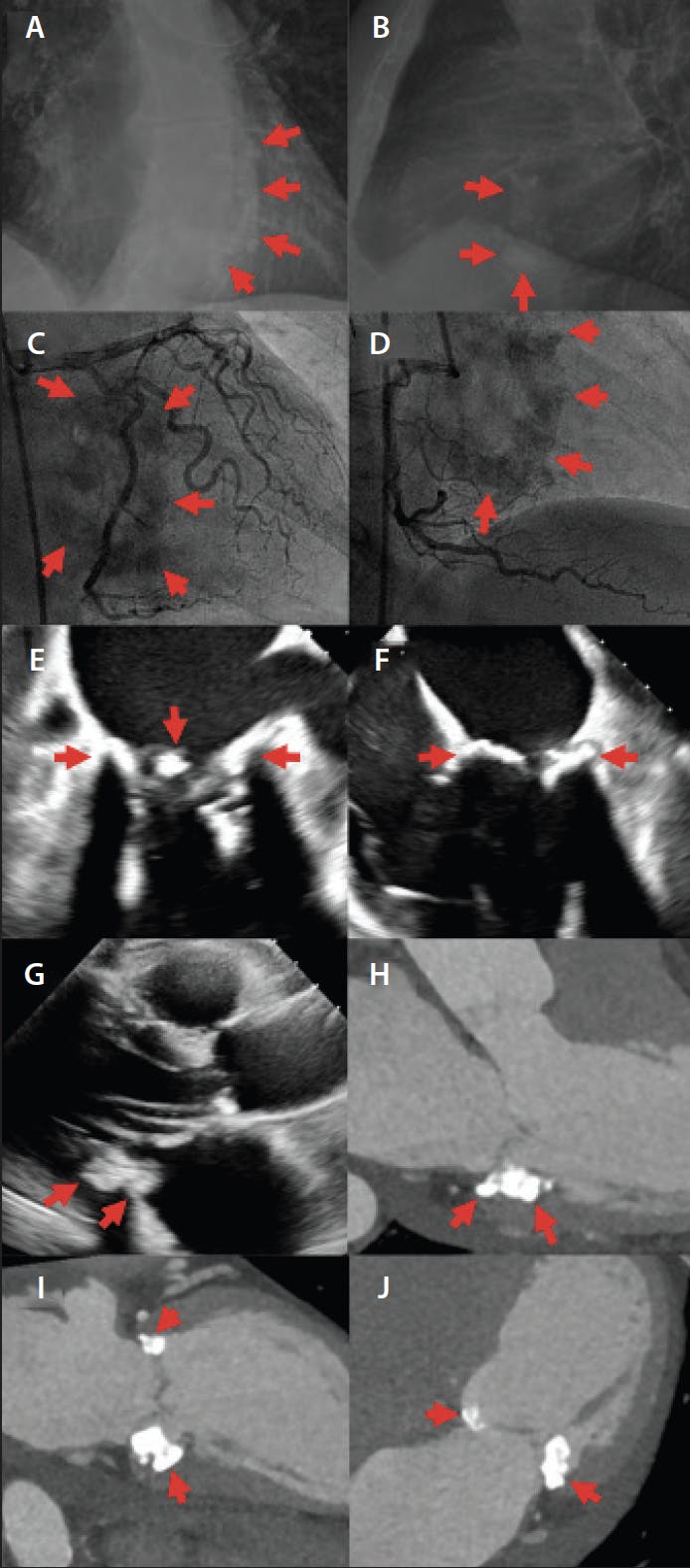
Figure 1. Severe MAC with different imaging modalities. Severe MAC on chest x-ray in the anteroposterior (A) and lateral (B) views. Severe MAC on fluoroscopy during coronary angiography of the left coronary system in the right anterior oblique caudal view (C) and the right coronary artery in the right anterior oblique view (D). TEE demonstrating severe MAC in the commissural (E) and four-chamber (F) views. Severe MAC on TTE in the parasternal long-axis view (G). Gated cardiac CT three-dimensional reconstructions demonstrating severe MAC in a reconstructed three-chamber view (H), commissural view (I), and two-chamber view (J). Red arrows indicate MAC.
Several scoring systems have been proposed to grade MAC severity, with the most common being the CT-MAC Score System, which grades four parameters from 1 to 3: calcium thickness, calcium distribution, trigone involvement, and leaflet involvement.4 Other features have also been proposed to assist in severity grading, specifically extra-annular calcification such as ventricular calcification.1 A MAC calcium score can be derived from CT, but this does not have the same utility as aortic calcium scoring in being associated with the severity of valvular stenosis.5
TREATMENT CONSIDERATIONS
Regardless of whether MAC is a cause of mitral valve dysfunction or a bystander, its presence can have significant implications on the feasibility and success rates of mitral valve interventions. Multiple studies have demonstrated that MAC increases the complexity and worsens outcomes for mitral valve surgeries, including increasing risk of conduction issues, ventricular rupture, paravalvular leak, injury to the left circumflex artery, and conversion of mitral repair to replacement. Surgical approaches generally require debridement and decalcification of the mitral annulus and annular reconstruction. Hybrid approaches resecting the anterior leaflet and anchoring a balloon-expandable TAVR to the mitral annulus with pledgeted sutures via a transatrial approach may overcome some of these limitations and have become an accepted alternative treatment approach at some centers.5
Transcatheter mitral valve-in-valve replacement using balloon-expandable TAVR has become widely accepted as the preferred option for higher-risk patients requiring replacement of a mitral bioprosthesis via the transseptal approach. Valve-in-MAC is a similar, but substantially more complex, procedure requiring detailed assessment of the calcification for anchoring the valve, with a CT MAC score ≥ 7 recommended.1 In one study, device migration or embolization occurred in 60% of patients with a CT MAC score ≤ 6 versus 9.7% with a score ≥ 7.4 Estimating the neo-left ventricular outflow tract is also required based on CT imaging, with an area of > 200 mm2 preferred. LAMPOON (laceration of the anterior mitral leaflet to prevent outflow obstruction) can be considered for patients without other options.
More recent dedicated TMVR devices remain in trials but show promise so far. Early experiences suggest that these devices are feasible with some MAC being present but are currently not recommended among patients with significant calcification or with spiculations that may interfere with device expansion.
In selected patients with MAC, mitral transcatheter edge-to-edge repair (mTEER) has comparable outcomes to patients without MAC. However, patients with severe MAC were excluded from mTEER randomized trials, and in observational studies, outcomes with mTEER in moderate/severe MAC were poor, with high 1-year mortality and less symptomatic improvement.6,7
CONCLUSION
Mitral calcification is common and increases the complexity of treating mitral valvular disease with either surgical, transcatheter, or hybrid approaches. As an ever-broadening range of dedicated transcatheter mitral valve devices become available, it becomes of great importance to understand how MAC is assessed and how it may influence the outcomes of treatment options.
1. Guerrero ME, Grayburn P, Smith RL 2nd, et al. Diagnosis, classification, and management strategies for mitral annular calcification: a heart valve collaboratory position statement. JACC Cardiovasc Interv. 2023;16:2195-2210. doi: 10.1016/j.jcin.2023.06.044
2. Abramowitz Y, Jilaihawi H, Chakravarty T, et al. Mitral annulus calcification. J Am Coll Cardiol. 2015;66:1934-1941. doi: 10.1016/j.jacc.2015.08.872
3. Elgendy IY, Conti CR. Caseous calcification of the mitral annulus: a review. Clin Cardiol. 2013;36:E27-31. doi: 10.1002/clc.22199
4. Guerrero M, Wang DD, Pursnani A, et al. A cardiac computed tomography-based score to categorize mitral annular calcification severity and predict valve embolization. JACC Cardiovasc Imaging. 2020;13:1945-1957. doi: 10.1016/j.jcmg.2020.03.013
5. El Sabbagh A, Parikh P, Ray J, et al. Mitral annulus calcium score in patients with calcific mitral stenosis undergoing invasive hemodynamic assessment. J Am Heart Assoc. 2024;13:e030540. doi: 10.1161/JAHA.123.030540
6. Fernández-Peregrina E, Pascual I, Freixa X, et al. Transcatheter edge-to-edge mitral valve repair in patients with mitral annulus calcification. EuroIntervention. 2022;17:1300-1309. doi: 10.4244/EIJ-D-21-00205
7. Hatab T, Bou Chaaya RG, Zaid S, et al. Feasibility and outcomes of mitral transcatheter edge-to-edge repair in patients with variable degrees of mitral annular calcification. J Am Heart Assoc. 2023;12:e031118. doi: 10.1161/JAHA.123.031118
Advertisement
Advertisement
